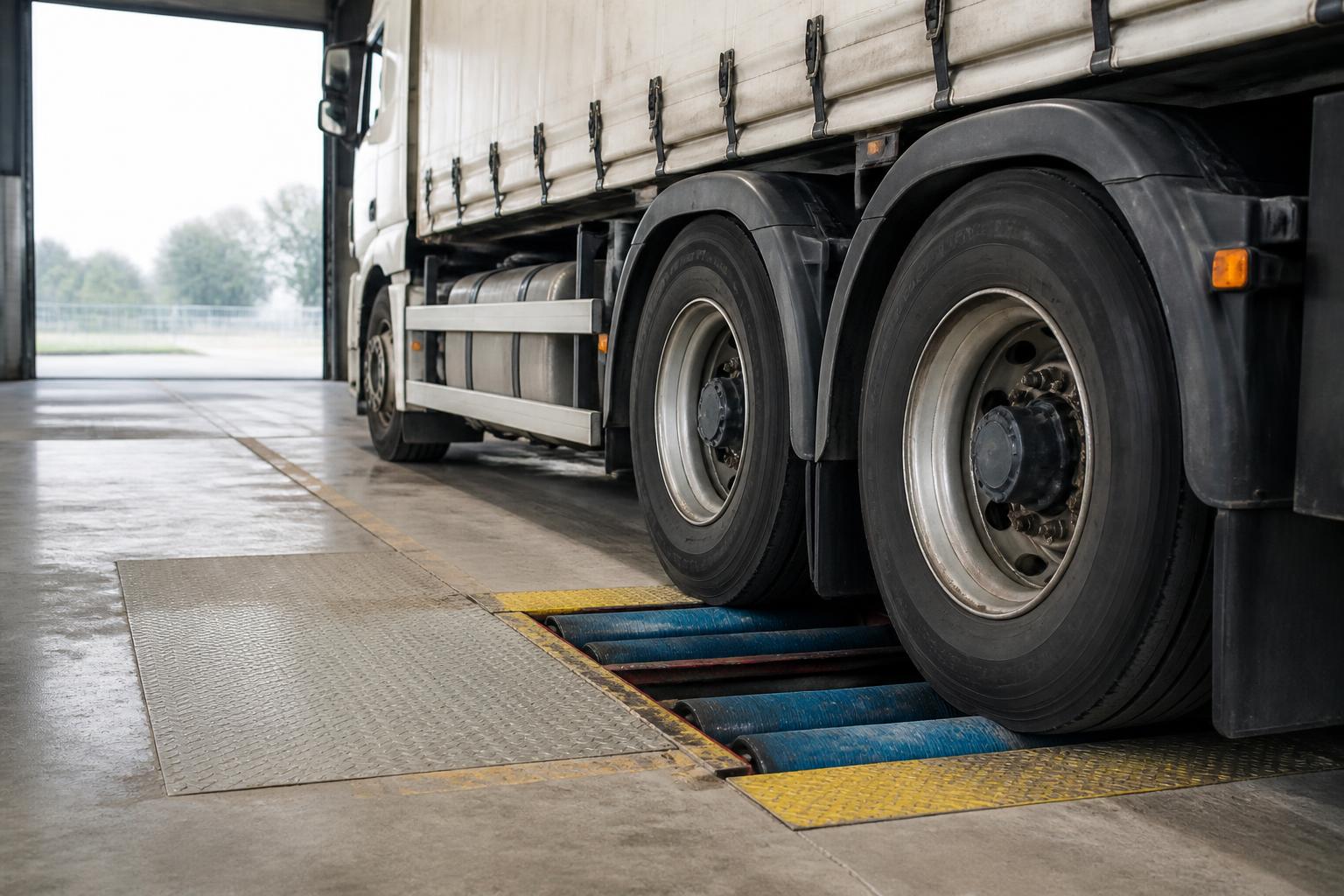
If you are asking what an HGV roller brake test checks, the short answer is this. It measures how much braking force each wheel and axle can produce on a set of rollers, how evenly that force is applied, and whether the service brake and parking brake are working to a safe standard. It also helps us spot signs of drag, delayed application, imbalance, and axle or trailer brake performance that is likely to cause trouble at MOT or out on the road.
That matters because a brake problem is not always obvious from the driver’s seat. A vehicle can still stop, yet have one wheel doing too little, one side coming on late, a trailer axle underperforming, or a parking brake that looks acceptable on level ground but is weak on test. At Woolpit Truck Repairs, we use roller brake testing as a practical workshop tool for fleets and owner-drivers in Woolpit, Suffolk and along the A14, not just as a box to tick before MOT.
What a roller brake test is for
A roller brake test is there to give a measured view of braking performance, wheel by wheel and axle by axle. For an HGV or trailer operator, that means replacing guesswork with figures and patterns we can inspect properly.
Operators usually book the test for one of three reasons.
First, before MOT. This is the most common. A pre-MOT brake test shows whether the vehicle is likely to pass on brake performance, and it gives time to correct weak or uneven readings before the test slot is lost. If you want to reduce the risk of avoidable MOT delays, a pre-MOT roller brake check is usually cheaper than a failed presentation and the downtime that follows.
Second, after a brake complaint. That might be poor braking feel, a vehicle pulling under braking, a trailer that feels as if it is holding back, a parking brake concern, or a driver report that the pedal or hand control does not feel right. A roller brake test gives us a controlled way to see whether the complaint shows up in actual brake effort and balance.
Third, during routine maintenance and safety inspections. Fleets that want fewer surprises use brake testing as part of planned maintenance, especially on hard-worked units, tippers, tractor units doing regular trailer changes, and trailers that spend time standing between jobs. A trailer can develop seized or contaminated brake components without an obvious road report until the defect is advanced.
The purpose is not just pass or fail. It is to identify where the braking system is strong, where it is weak, and what needs workshop attention next. That is why we treat the test as part of diagnosis, not as an isolated machine printout.
What the test actually measures
The main thing the machine measures is brake force. Each wheel is driven by the rollers, and when the brake is applied, the machine records the resistance created by braking at that wheel. From there, we can assess several important points.
Service brake effort is the first one. This is the braking force produced when the normal braking system is applied. On an HGV, that means the footbrake operation through the service brake circuit. We are looking at whether each axle is producing sensible effort and whether the total result is in line with what the vehicle should be capable of.
Parking brake performance is another core check. The parking brake, whether acting on the drive axle or through the trailer parking system, must hold properly. On test, we can see whether the parking brake is generating enough force and whether it is acting evenly. Weak parking brake readings often show up before a driver fully trusts the hand control less on a slope or loaded site.
Left to right balance is critical. A good brake system does not just stop the vehicle, it does so evenly. If one side of an axle is producing much less effort than the other, that is brake imbalance. On the road, that can mean pulling, instability, tyre scrub, and a likely MOT issue. If you are already seeing signs such as steering pull or uneven brake feel, our article on brake imbalance checks before an HGV fails MOT covers the warning signs in practical terms.
Axle performance matters as well. One axle may be strong while another is clearly weak. On a tractor unit or rigid, we compare steer, drive, and where relevant tag or lift axle performance. On a trailer, we look at each trailer axle in turn. A single weak axle can point to a local defect rather than a whole-system problem, which helps narrow down the inspection.
The test can also show signs of drag. If a brake is not releasing properly, the roller readings and wheel behaviour can suggest binding or residual braking force. That is especially useful where a trailer has been standing, or where a driver reports heat, smell, or sluggish running. If that sounds familiar, our guide on what to check first when trailer brakes are binding on the A14 goes into the usual starting points.
Delayed application is another clue. Sometimes the issue is not that the brake never works, but that one wheel, one side, or one axle comes in late. On the printout and in the way the readings build, we can often see that one brake is lagging behind the rest. That may indicate an air delivery issue, adjustment problem, or seized mechanical movement in part of the brake assembly.
Depending on the vehicle and test setup, the results can also help us judge overall brake efficiency and whether the braking system is behaving consistently across the vehicle combination. On articulated combinations, trailer results are just as important as unit results. A strong tractor unit does not compensate for a poor trailer.
What a poor result can point to
A poor roller brake test result is a symptom, not the final diagnosis. The value of the test is that it points us towards the most likely faults.
Brake wear is an obvious one. Linings, pads, drums, and discs all wear, and once they are out of serviceable condition, brake effort drops. Wear can also become uneven across an axle, which then appears as imbalance.
Contamination is common. Oil, grease, water ingress, or road contamination on friction surfaces reduces braking force and can make readings erratic. A leaking hub seal can contaminate brake components without the problem being obvious until the wheel end is stripped.
Adjustment issues are another frequent cause. On drum brake setups, poor adjustment can leave one brake doing less work or applying later than the opposite side. Automatic slack adjusters can also seize or stop operating as they should. A reading that looks weak or delayed often leads us to inspect adjustment and actuator stroke.
Seized components are high on the list. Caliper slides, camshafts, rollers, linkage points, and other moving parts can stiffen or seize. When that happens, the brake may drag, underperform, or apply unevenly. A wheel end that has spent time standing can show this clearly on test.
Air faults can sit behind poor readings too. Low delivered pressure, leaks, sticking valves, damaged lines, or slow air response can all affect brake application. If one axle is slow to build effort, or one side is inconsistent, we will be looking closely at the air side of the system as well as the foundation brakes.
Trailer-related defects deserve special mention because they are often missed until a test is done. A trailer can have weak brake chambers, poor adjustment, seized components, load sensing valve issues where fitted, air leaks, or electrical faults affecting brake control systems. Where warning lamps or system messages are involved, the trailer’s ABS or EBS system may need proper diagnostics alongside the brake test. If that is the concern, our article on trailer ABS faults in Suffolk, roadside check or workshop test explains why a scan and a workshop inspection often need to go together.
We also see poor results after incomplete repairs. New parts on one side only, reused worn hardware, a caliper changed without addressing the opposite side, or a chamber replaced while the underlying seizure remains, can all produce readings that still fail or remain uneven.
What the test does not tell you on its own
A roller brake test is useful, but it is not the whole diagnosis.
It tells us what the braking performance looks like on the machine. It does not, on its own, tell us exactly which component has failed without inspection. A weak near-side drive axle reading might be caused by worn friction material, contamination, poor adjustment, a seized actuator path, a chamber issue, or an air delivery fault. The machine points us in the right direction, but the workshop confirms the cause.
It also does not replace a proper visual and mechanical inspection. We still need to check friction material condition, disc or drum condition, wheel end contamination, chamber operation, caliper or camshaft movement, air leaks, valve performance, and the rest of the system.
That matters even more where ABS or EBS warnings are present. A brake test can show poor performance, but it will not decode fault memories, identify damaged wheel speed sensor circuits, confirm modulator faults, or explain network communication issues. Electronic braking systems need diagnostics as well as mechanical checks. If a warning lamp is on, the next step is rarely just another brake test. It is usually a combination of machine results, fault code reading, inspection, and system checks. We cover that in more detail in what to do next after brake warning lights on HGVs.
There are practical limits too. A roller test is controlled and repeatable, which is its strength, but it is not the same as every real road condition. Load state, operating temperature, intermittent faults, and driver-reported behaviour under certain conditions may need further fault-finding.
Where rules differ, the UK MOT process and brake assessment are the relevant framework for operators here, not a general EU assumption. Vehicles working in Suffolk, around Ipswich, Felixstowe, Stowmarket, Bury St Edmunds, Newmarket and Elmswell need to be judged against the standards that apply to UK test presentation and roadworthiness expectations.
When operators should book a test
The obvious time is before MOT. If a vehicle or trailer is close to test date, a roller brake test gives you a chance to deal with imbalance, weak effort, or parking brake defects before they become a test failure.
You should also book after brake repairs. If chambers, calipers, discs, drums, pads, shoes, slack adjusters, valves, or trailer brake components have been changed, testing confirms the repair has produced the result you expected. That is especially important where the original complaint was uneven braking or poor performance.
Book a test after a warning light or braking system fault report, particularly if ABS or EBS issues are involved. The brake test may not solve the electronics, but it quickly tells us whether there is also a mechanical or performance problem to deal with.
If the vehicle feels wrong, book it. That includes poor braking feel, a pull to one side, dragging, overheating, a trailer that seems to hold back, or a parking brake that does not inspire confidence. Operators often wait because the vehicle is still moving and stopping, but that is how defects become downtime.
A trailer that has been standing is another good candidate. Standing time is hard on brake components, especially if the trailer is then expected to go straight back into work. Corrosion, seized movement, and air leaks are common findings.
Routine fleet maintenance is the final category. If you are running regular work on the A14 corridor, with units and trailers moving between Felixstowe, Ipswich, Stowmarket, Bury St Edmunds, Newmarket and beyond, planned testing helps avoid brake issues becoming roadside issues. If convenient access matters, our page on HGV roller brake testing near the A14 without losing road time explains how operators usually fit it around traffic and workshop schedules.
How Woolpit Truck Repairs approaches brake test results
At Woolpit Truck Repairs, we do not stop at handing over a printout. The machine result is the start of the workshop conversation.
If the readings are good, we tell you that clearly and note any points worth watching before MOT or the next inspection. If the readings are poor, we explain where the weakness is, which axle or side is affected, and what the likely causes are in plain terms. Operators do not need a vague comment that the brakes are down. They need to know whether the issue looks like wear, seizure, adjustment, air delivery, or a trailer-specific problem.
From there, we triage. Some defects need immediate repair before the vehicle goes back out. Others can be planned in if the readings are marginal rather than critical and the vehicle’s operating schedule allows. We are practical about that because fleets and owner-drivers need realistic next steps, not broad claims.
Being based at Bridge Farm, close to A14 J47 in Woolpit, means we are well placed for operators working through Suffolk and the surrounding routes. We regularly deal with HGVs, rigids, artics and trailers moving between local depots, customer sites and trunk roads. That HGV-and-trailer-only focus matters because brake defects on commercial vehicles are not the same as car workshop work. The test results have to be read in the context of axle layouts, trailer systems, air braking, and how the vehicle is actually used.
Where needed, we move from test to inspection, from inspection to diagnostics, and from diagnostics to repair planning. That can include brake strip and assessment, air system checks, warning light diagnosis, trailer fault-finding, and MOT preparation. If you need the test itself, our roller brake testing service for HGVs and trailers sets out the practical side.
Woolpit Truck Repairs operates under FLEETA LIMITED, and the way we handle brake issues is straightforward. We check what the machine is telling us, inspect what is causing it, and explain what needs doing so you can make the right decision for the vehicle, the trailer, and the job in front of you.
Does a roller brake test check ABS or EBS?
Not directly. It shows braking performance and can highlight symptoms that suggest ABS or EBS issues, but warning lights, fault codes and system checks still need separate diagnostics.
Can a vehicle pass a roller brake test and still have a brake fault?
Yes. A decent reading does not rule out every issue. Intermittent faults, warning light problems, heat-related defects or component wear may still need inspection.
Will the test show if a trailer brake is binding?
It can. Drag or imbalance on the rollers may suggest a binding brake, but the cause still needs checking at component level, such as chambers, adjusters or seized running gear.
Should I book a brake test before MOT?
Usually yes. A pre-MOT roller brake test can flag weak performance, imbalance or parking brake issues early, giving time to fix defects before the test date.
What if the brake readings are uneven across an axle?
Uneven readings often point to adjustment, wear, contamination, seizure or air delivery issues. The next step is inspection to find the exact cause rather than guessing from the printout.