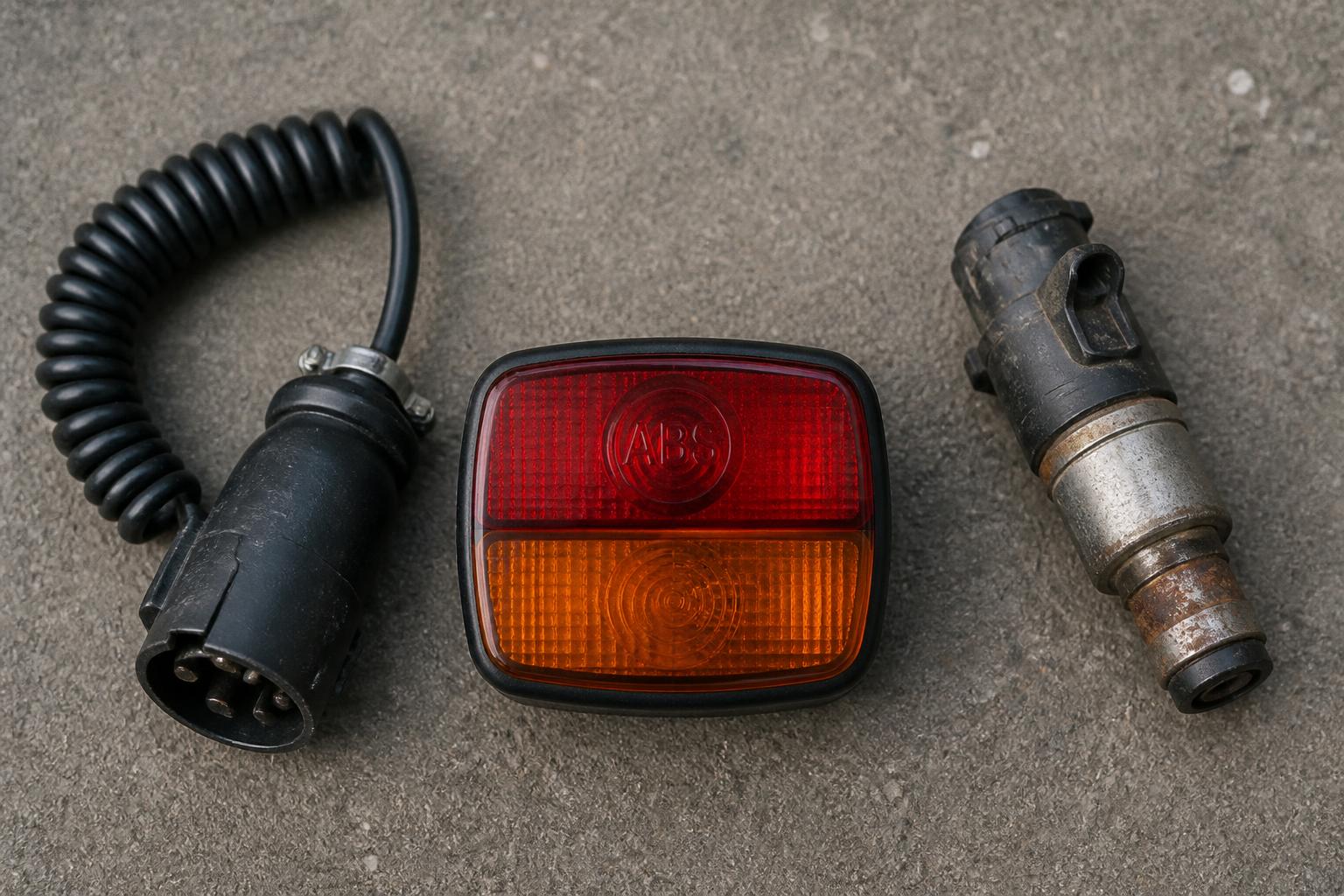
An ABS or EBS warning on a trailer does not automatically mean the trailer is unsafe to move, but it does mean something in the braking control system needs checking properly. In practice, the right answer depends on what warning is showing, whether the fault is constant or intermittent, whether braking performance has changed, and what you can confirm safely at the roadside before deciding whether to continue, swap trailers, or bring it in for testing.
For operators looking for trailer ABS fault diagnosis in Suffolk, the quickest route is usually to separate simple connection and power issues from faults that need diagnostic equipment, brake testing, or workshop access under the trailer. That is exactly where clear triage helps. At Woolpit Truck Repairs, near A14 J47 at Bridge Farm, Woolpit, we deal with these faults as working defects, not theory. The priority is always the same, keep the vehicle legal, protect braking performance, and avoid losing more time than the fault already has.
What a trailer ABS fault usually means in practice
Most operators first notice an ABS or EBS issue in one of three ways. The warning lamp stays on after coupling. The warning appears intermittently during a run. Or the driver reports a trailer brake fault message through the unit, sometimes with no obvious change in how the trailer is pulling up.
Those three situations can all point to very different causes.
A warning that appears immediately after coupling often starts with basics, electrical supply through the suzie, poor pin contact, damage at the plug, or a trailer that is not receiving stable power from the tractor unit. An intermittent warning that comes and goes over bumps or during turns often suggests a connection issue, wiring movement, or a sensor problem that only shows when the axle or cable position changes. A constant warning with a stored fault code may point further into the trailer system itself, such as a wheel speed sensor, tone ring condition, modulator issue, or an internal EBS fault.
This is why a dashboard warning alone does not tell you enough. ABS and EBS systems monitor several inputs and components. The same lamp can come on because the trailer has lost its electrical feed, because one wheel speed signal has dropped out, or because the ECU has logged an internal defect. The driver sees one warning. The workshop sees several possible fault paths.
It also matters whether the trailer is fitted with ABS only or a fuller EBS system. On a conventional ABS setup, the issue may be limited to anti lock intervention and fault monitoring. On EBS-equipped trailers, the system is doing more, so faults can involve braking control, pressure management, sensor inputs and communication. The practical effect on operation can be wider, even if the warning presented to the driver looks similar.
From an operator’s point of view, the key point is simple. Treat the warning as a brake system defect until proven otherwise, but do not assume the cause is automatically major. Good trailer ABS fault diagnosis in Suffolk starts with identifying what the driver is actually seeing, when it started, whether it clears after recoupling, and whether there are any other symptoms such as brake imbalance, dragging, low power supply, or repeated lamp faults on different trailers.
Roadside checks versus workshop diagnosis
There are sensible checks a driver or fitter can make at the roadside, and there are checks that should wait for a safe yard or workshop. Knowing the difference saves time and avoids turning one defect into two.
At the roadside, the realistic checks are the obvious external ones. Confirm the electrical suzie is fully connected and locked in place. Check for damaged plugs, bent pins, corrosion, stretched cable, chafing, crushed sections, or signs the cable has been dragging. Look at the trailer sockets and the tractor unit socket for dirt, green corrosion, moisture, or loose fit. If the warning appeared after a trailer swap, compare whether the same unit throws the same warning on a different trailer or whether a different unit clears the issue on the same trailer.
You can also do basic observation around the trailer. Is there visible wiring damage near an axle? Has a sensor lead come loose from its clips? Is there obvious air system damage or a modulator area that has taken impact? Is a hub area contaminated or damaged? If the trailer has just come out of a yard with heavy mud, debris around sensor areas can be relevant.
What you should not do at the roadside is start dismantling wheel end components, crawling under an unsupported trailer in a live area, or making assumptions about brake safety from a quick visual check. A lamp that clears after unplugging and reconnecting still needs treating carefully if the fault returns. A trailer that appears to brake normally can still have a stored defect affecting ABS or EBS function.
Proper diagnosis usually needs three things that the roadside does not give you. First, stable access and safe working conditions. Second, trailer specific diagnostic equipment to read fault codes and live data. Third, a way to confirm the actual braking result, not just the warning lamp status.
That is where workshop time matters. In the workshop we can interrogate the trailer ECU, identify whether the fault is current or historic, see which wheel or circuit is involved, inspect the related components, and then verify the repair. If there is any question over brake performance or balance, a roller brake test is often the point where suspicion turns into evidence. For a broader view of who should handle which defects, our guide to truck and trailer fault diagnosis in Suffolk sets out where driver checks end and workshop checks begin.
The most common fault sources and how they differ
The most common causes are not all equal, and they do not usually present in the same way.
Suzie and plug issues are high on the list because they are exposed, handled daily, and easily damaged. A poor electrical connection can trigger an ABS or EBS warning straight after coupling, especially if the plug is not seating properly or the pins are worn or contaminated. These faults can be intermittent, particularly when the cable moves during steering or over rough road surfaces. If the same tractor unit throws faults across more than one trailer, the unit side socket and wiring need checking as well.
Power supply faults often sit close to suzie issues but are not quite the same. The trailer ECU needs the correct supply and earth. Low voltage, unstable feed, or poor earth can create warning lamps and erratic behaviour without there being anything wrong at the wheel ends. These faults often show up after coupling, during lighting load changes, or on trailers that have been standing. They can also be confused with unit side electrical faults, which is why swapping combinations carefully can be useful as a first triage step.
Wheel speed sensors are one of the most common true ABS component faults. When a sensor is damaged, out of position, contaminated, or has a wiring defect, the ECU loses or mistrusts the wheel speed signal. Operators may report an intermittent lamp at first, then a permanent warning later. Sometimes the fault appears after recent axle or brake work, because sensor position or wiring routing has changed. Sensors also suffer from corrosion and cable damage over time.
Tone rings differ slightly in how they fail. If the exciter ring is cracked, heavily corroded, damaged, or contaminated, the sensor may read inconsistently. That can produce repeated wheel speed faults even after a sensor has been replaced. This is one reason replacing the sensor alone does not always cure the warning. On diagnosis, we are looking at the wheel end as a system, not one part in isolation.
Modulator faults tend to be less common than suzie or sensor issues, but they matter because they sit at the heart of trailer brake control. A modulator problem may show as a persistent EBS warning, a valve related fault code, or a braking complaint that is more than just a lamp on the dash. Depending on the defect, you may also see air leaks, poor brake response, or faults linked to a specific axle group.
Internal EBS faults are the ones operators often fear because they can mean ECU or electronic control issues rather than a damaged external item. Sometimes the fault is genuinely internal. Sometimes it is logged that way because the system has been affected by power instability, water ingress, or repeated unresolved peripheral faults. That is why reading codes without checking the surrounding wiring and supply is not enough.
It is also worth remembering that multiple defects can exist together. A trailer may have a damaged suzie plug and a weak wheel speed sensor circuit. If the obvious connection issue is repaired first, the trailer may still have a warning afterwards. That does not mean the first repair was wrong. It means the initial fault was masking the next one.
If you are seeing a wider pattern of trailer defects causing delays, our article on trailer faults that cost operators time on the A14 covers the practical reasons some issues keep reappearing in day-to-day operation.
When the trailer can move and when it should not
This is the part operators need answered plainly. A trailer with an ABS or EBS warning is not automatically immobilised, but neither should it be waved on without thought.
If the trailer has a warning lamp only, with no obvious change in braking, no air loss, no dragging brake, no hub heat concern, and no other brake defect reported, there may be a case for moving it carefully for diagnosis or returning it to base, depending on the circumstances. That is a transport decision, but it should be based on actual symptoms, route risk, load, distance, and whether the defect has been assessed sensibly.
If there is any sign of reduced braking performance, imbalance, wheel lock tendency, dragging, overheating, air system abnormality, repeated brake fault messages, or uncertainty about whether the service brakes are applying correctly, the trailer should not simply continue as normal. At that point the issue is no longer just a warning lamp problem. It is a potential braking safety problem.
There is also the legal side. In the UK, trailer braking defects can lead to immediate prohibition if the condition affects roadworthiness. Even where the trailer still has service braking, an illuminated ABS warning can have MOT implications and may point to a defect that fails test standards. A warning lamp that is ignored because the trailer still “feels all right” is exactly the sort of issue that causes trouble later at inspection, roadside enforcement, or after an incident.
Where UK practice differs from broad EU expectations, the main point is not the technology but enforcement and test process. UK roadworthiness decisions are made against UK standards and inspection practice, including MOT requirements and DVSA enforcement expectations. So if you are running in Suffolk, the question is not whether a fault might be tolerated somewhere else. It is whether the trailer is safe and compliant here, on this job, with this defect.
In practical terms, we usually advise operators to think in three levels. First, warning only, no change in braking, likely connection or electrical issue, trailer may be moved cautiously to a place of repair if the rest of the condition supports that decision. Second, warning plus repeated recurrence or unclear cause, swap the trailer if you can and get the faulty one booked for diagnosis. Third, warning plus any braking concern, air issue, heat, noise, or poor brake behaviour, stop and treat it as a brake defect needing direct attention.
If the fault has already stopped you on route, our guide on what to do when a trailer fault stops you in Suffolk sets out the safest order of decisions.
Choosing the quickest next step in Suffolk
For operators around Woolpit, Ipswich, Felixstowe, Stowmarket, Bury St Edmunds, Newmarket and along the A14, speed matters, but so does choosing the right kind of speed.
If the warning has just appeared and there is a realistic chance it is a coupling or supply issue, start with triage. Confirm what the driver is seeing. Ask whether the fault came up on coupling, during the journey, or after a trailer change. Check whether another unit or trailer changes the symptom. Note any other issues, lights, air warnings, or braking complaints. That information often tells us whether you are likely dealing with a quick electrical check or a workshop job involving diagnostics and brake testing.
If the trailer is near Woolpit, Elmswell, Stowmarket or moving along A14 J47, booking it straight into our workshop at Bridge Farm is often the quickest route to a proper answer. We can inspect the trailer, connect diagnostics, and if needed carry out brake testing and repair in one place. That is usually more efficient than repeated roadside resets and recoupling attempts that still leave you unsure whether the trailer is fit for the next load.
If you are running from Felixstowe or Ipswich and the trailer needs to keep earning, the commercial decision may be to swap it out first, then send the defective trailer in for diagnosis. That avoids tying up a unit and driver while a fault is still being guessed at. The same applies for fleets around Bury St Edmunds and Newmarket when the warning is present but the trailer can be brought in under control rather than dealt with in a lay-by.
Callout enquiries make sense when the trailer cannot sensibly be moved, when there is uncertainty over braking safety, or when the combination is already off the road and needs a practical recovery plan. Not every ABS or EBS fault is a roadside repair. Sometimes the most efficient callout is the one that confirms the trailer should come into the workshop rather than burning hours trying to prove a wheel end or ECU fault on the verge.
At Woolpit Truck Repairs, we focus on HGV and trailer work only, so the conversation is usually short and practical. What is the warning. Has the trailer been swapped. Is there any change in braking. Can it move safely. Does it need diagnostics, brake test, repair, or recovery support. That is how we help operators across Suffolk make the next decision without turning a warning lamp into half a day of lost transport time.
Woolpit Truck Repairs is operated by FLEETA LIMITED, and our workshop location near A14 J47 gives straightforward access for operators moving between Ipswich, Felixstowe, Stowmarket, Bury St Edmunds and Newmarket. If you need trailer ABS fault diagnosis in Suffolk, we would rather tell you clearly whether it looks like a roadside check, a workshop booking, or a stop-now brake issue than have you guessing from the cab.
Can a trailer ABS warning be caused by the tractor unit?
Yes. A poor electrical connection, damaged suzie, power supply issue or communication fault between unit and trailer can trigger an ABS or EBS warning even when the trailer hardware is not the root cause.
Is a wheel speed sensor the most likely cause?
It is common, but not automatic. Sensor gap, damaged wiring, corrosion, a tone ring problem or a modulator fault can produce similar symptoms. Reading faults and checking live data is usually the quickest way to separate them.
Can I clear the fault by reconnecting the lines?
Sometimes a poor connection or temporary voltage issue will clear after reconnecting, but that does not prove the defect is fixed. If the warning returns, the trailer needs proper diagnosis before it becomes repeat downtime.
Will a trailer ABS fault affect braking?
It can. Some faults leave basic braking available but disable anti-lock or affect EBS functions. Operators should not assume braking performance is normal just because the trailer still rolls and stops.
Is this likely to cause an MOT problem?
Yes, it can. ABS and EBS warning issues, stored faults, damaged wiring or braking defects may all create MOT preparation problems, especially if the warning is active or the underlying brake system fault remains unresolved.
What information should I have ready before calling?
Have the trailer registration or fleet number, warning lamp behaviour, recent repairs, whether the fault is constant or intermittent, and where the vehicle is parked or running near Woolpit, A14 J47 or elsewhere in Suffolk.