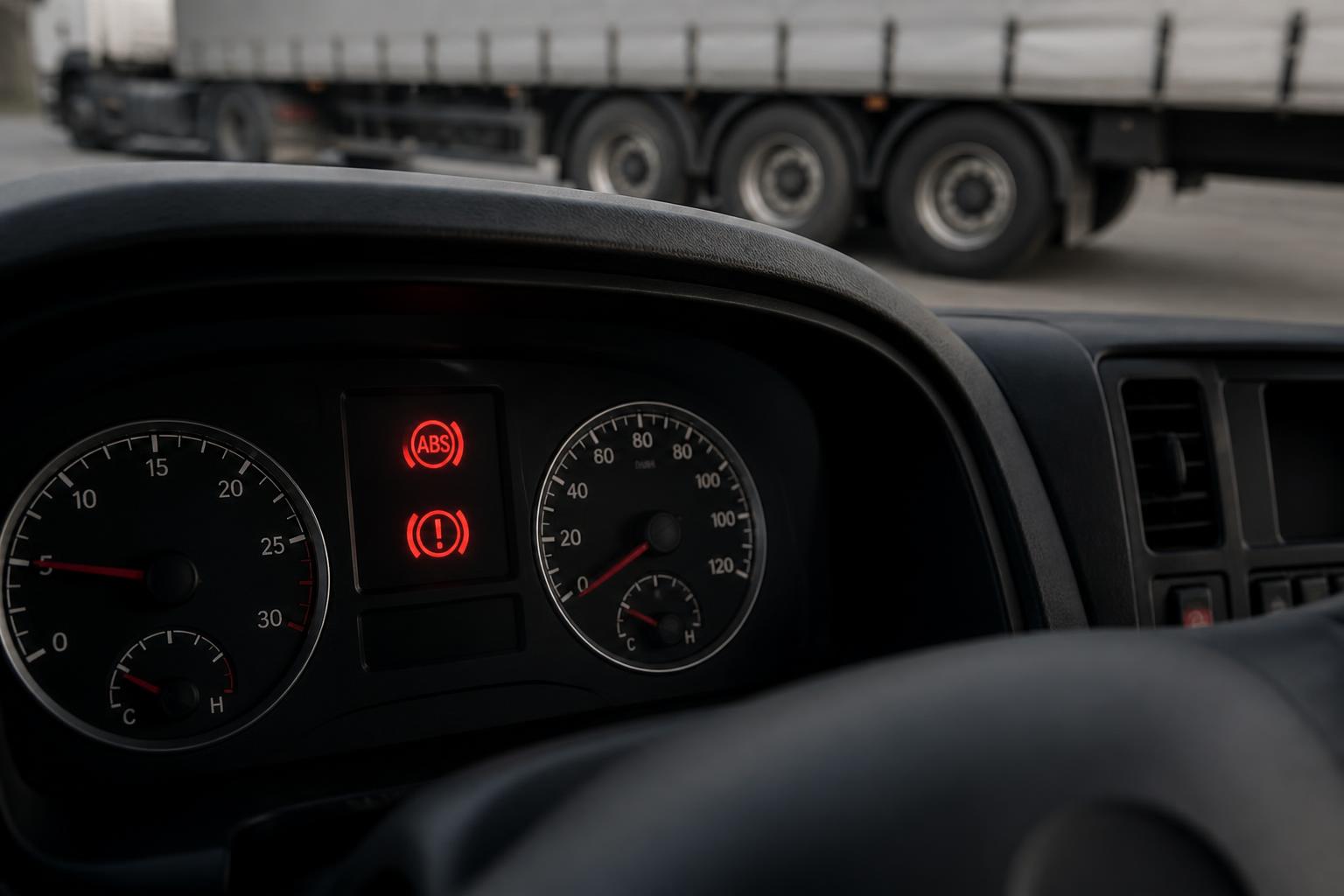
A brake warning light on an HGV is not something to ignore and hope clears on the next key cycle. Sometimes it is a sensor or communication fault with normal service braking still available. Sometimes it is the first sign of a real brake defect, low air issue, trailer supply problem or an electronic braking fault that can affect roadworthiness straight away. The right next step depends on which light is on, whether braking performance has changed, and whether the fault is on the unit, the trailer or the connection between them.
For operators in Suffolk, the practical question is usually simple. Can the vehicle continue safely, can it return to base, or does it need to stop and be checked now? At Woolpit Truck Repairs, near A14 J47 at Bridge Farm, Woolpit, we deal with that decision every week for fleets, owner-drivers and route-based vehicles running between Ipswich, Felixstowe, Stowmarket, Bury St Edmunds, Newmarket and Elmswell. If you are looking for HGV brake warning light repair in Suffolk, the fastest route to the right answer is proper triage, not guessing from the dashboard alone.
What different HGV brake warning lights usually mean
Not all brake-related warning lights point to the same type of defect. On modern HGVs and trailers, the main difference is between a conventional brake system warning, an ABS warning and an EBS warning.
A red brake warning generally needs the most caution. In workshop terms, that can point to low air pressure, a parking brake issue, a serious imbalance in the air system, or a fault that the manufacturer treats as safety-critical. If the vehicle is slow to build air, if the buzzer is active, or if the park brake will not release or re-applies unexpectedly, that is not just an electrical nuisance. It needs attention before the vehicle keeps working. If your issue starts with air build-up rather than a warning lamp alone, our guide on when an HGV will not build air in Suffolk covers the first practical checks.
An ABS light usually means the anti-lock function has a fault, not necessarily that the foundation brakes have stopped working. Common causes include wheel speed sensor gaps, damaged sensor leads, corroded tone rings, poor trailer electrical supply, or a failed modulator. On a trailer, ABS faults are often triggered by cable and suzie issues, water ingress in connectors, broken wiring near axles, or faults inside the ECU or modulator assembly. Service braking may still feel normal in a steady stop, but the anti-lock protection may not operate correctly under harsh braking or low grip conditions.
An EBS light can mean more than an ABS light. EBS manages braking electronically and can affect brake balance, response and communication between unit and trailer. An EBS fault might be caused by sensor faults, pressure control issues, modulator defects, CAN communication problems, trailer ECU faults, or supply voltage issues. Some EBS faults leave the vehicle with fallback braking, but not full electronic control. In practice, that means the vehicle may still stop, but not necessarily with the response, balance or system support it should have.
Operators sometimes see both unit and trailer warnings together. That often points us first toward the 24N or ISO 7638 electrical connection, air supply to the trailer, or a communication issue between tractor and trailer. It is one reason we do not treat every warning light as a dealer-only electronic mystery. Many faults are found in the basics first, then confirmed properly with diagnostics and inspection.
If you want a useful first read before booking in, our article on warning light checks that cut HGV downtime explains the kind of simple checks that help narrow the fault before parts are changed.
Can you keep running or does the vehicle need to stop?
This is where operators need a practical answer, not theory. The decision comes down to three things. What warning is showing, how the vehicle is behaving, and whether there is an actual braking defect as well as a dashboard fault.
If the warning is red, the vehicle has poor braking, air pressure is not normal, the pedal feel has changed, the trailer brakes feel delayed, or the vehicle is pulling under braking, stop and assess it straight away. If air is not building correctly, if the warning buzzer stays on, if there is a major leak, or if the park brake system is not behaving normally, we would treat that as urgent. Continuing risks both safety and a roadworthiness issue.
If the warning is an ABS light only, with normal air pressure and no change in braking performance, the immediate risk may be lower, but that does not mean the defect can be ignored. In Great Britain, roadworthiness is about the actual condition and operation of the vehicle, not just whether it still moves. A warning light can indicate a defect serious enough to affect annual test outcome, roadside enforcement attention, or the operator’s own maintenance compliance. If the anti-lock function is inoperative, the vehicle may still be drivable to base or workshop depending on conditions, load, route and company policy, but it still needs prompt diagnosis.
With EBS warnings, more caution is sensible because the system’s fallback mode is not always obvious from the driver’s seat. If the unit or trailer has reduced functionality, the safest approach is to limit movement until the fault has been assessed, especially if the combination is loaded or running trunk routes.
For UK operators, the practical standard is not “can I get away with it until tonight?” but “is this vehicle roadworthy now?” That matters at roadside checks and at MOT preparation stage. A warning light with no braking symptoms may justify a controlled return to base or direct run to workshop. A warning light with any braking symptom should be treated as a stop-and-check situation.
When drivers ring us from the road, we normally work through a triage sequence. Which lamp is on. Unit, trailer or both. Is air pressure normal. Any recent trailer change. Any damaged suzies or electrical leads. Has the fault appeared only with one trailer. Has braking feel changed. That usually tells us whether the next step is roadside checks, workshop diagnosis, or recovery support enquiries.
Truck fault or trailer fault?
This is one of the most common reasons time gets wasted. A driver sees a brake warning on the dash and assumes the unit needs repair, when the fault is actually on the trailer or in the connection between them.
If the warning appears only when a specific trailer is connected, the trailer is the first suspect. That could be trailer ABS or EBS wiring, a wheel speed sensor fault, a damaged modulator, poor earth, a failed ECU, or low voltage reaching the trailer system. The ISO 7638 lead is a regular culprit. Bent pins, corrosion, broken conductors and poor plug retention can all trigger trailer brake system warnings.
If the same warning stays with multiple trailers, the unit becomes more likely. We then look at the tractor’s electrical supply to the trailer, ABS or EBS faults on the unit itself, air supply performance, and communication faults in the unit loom or control system.
Air and electrical issues often overlap. A trailer can show an electronic brake fault because it is not getting proper supply or signal from the unit. Equally, a driver may report poor trailer braking when the actual fault is a trailer air leak, sticky relay emergency valve, seized brake component, or maladjusted brakes underneath.
This is why a proper comparison test matters. Swap trailers if possible. Connect a known good trailer to the unit. Connect the suspect trailer to another tractor if available. Check whether the fault follows the trailer, follows the unit, or appears only on one pairing. That is often the quickest way to cut through guesswork.
We see this regularly on vehicles working in and out of Felixstowe, Ipswich and the wider Suffolk route network, where trailers are swapped frequently and faults are blamed on the wrong asset. For trailer-specific issues, our guide to ABS warning light checks on a trailer is a useful place to start before booking the combination in.
Warning light only or braking defect underneath?
A dashboard warning tells you there is a fault condition. It does not tell you whether the problem is electronic only, mechanical only, or both.
An electronic warning on its own might be a sensor out of range, a broken wire, a poor connection, a voltage problem, or a communication fault. The brakes can still feel normal in a basic road test, particularly at low speed and light load. But that does not prove the whole system is healthy.
A mechanical brake defect underneath may exist with or without a warning light. We regularly find worn pads or linings, cracked discs, binding calipers, seized sliders, contaminated friction material, weak chambers, air leaks, maladjustment, damaged hoses, or imbalance across an axle. On trailers, poor brake performance can come from foundation brake wear and adjustment issues with no obvious dashboard clue until stopping distances worsen or an MOT brake test shows imbalance.
That is where inspection and roller brake testing matter. Diagnostics can tell us what the ECU has seen. A brake tester tells us what the brakes are actually doing. The two are not interchangeable.
If the warning light points to ABS or EBS, we usually want both strands covered. Electronic diagnosis identifies stored and active faults, sensor readings, pressure information and communication errors. Physical inspection checks the obvious failure points on wiring, sensors, modulators, air lines and brake components. Roller brake testing then confirms service brake effort, parking brake performance and imbalance in real terms.
For operators trying to stay ahead of downtime, this is often the difference between clearing a warning and actually fixing the cause. A sensor fault can be repaired, but if one wheel end is also underperforming, the job is not finished. The same applies before test. Clearing a lamp is not MOT preparation if the brakes still fail on performance.
That is why we offer roller brake testing for HGVs and trailers as part of fault finding and pre-test checks, not just as a tick-box exercise. It gives a clearer answer on whether you are dealing with a warning light only, or a braking defect underneath that needs repair before the vehicle goes back into normal work.
Dealer visit or independent HGV workshop?
There is a place for dealer support, especially where a fault involves manufacturer-specific software functions, warranty work, control unit programming or technical campaigns. If the repair requires coding, parameter changes or parts restricted to the dealer network, that can decide the route quickly.
But many brake warning light jobs do not start there. They start with finding out whether the defect is on the unit, the trailer, the air system, the electrical connection, or the brakes themselves. For that, an independent HGV-and-trailer workshop can often move faster and more practically, especially when downtime is already costing you.
At Woolpit Truck Repairs, our focus is HGVs and trailers, not general cars and vans alongside them. That matters when a warning light could be a tractor issue, a trailer issue, or a combination issue. We can inspect both sides of the coupling, test the brakes properly, check electrical and air connections, and look at the defect in the context of MOT preparation, fleet maintenance and day-to-day uptime.
Location matters too. Being at Bridge Farm in Woolpit, close to A14 J47, gives straightforward access for operators running the A14 corridor between Felixstowe, Ipswich, Stowmarket, Bury St Edmunds and Newmarket, as well as local traffic around Elmswell. If a unit can return safely to workshop, that route access can make the difference between a quick diagnosis and losing another day.
The other practical advantage is triage. Dealer booking systems are not always built around mixed unit-and-trailer fault finding or same-day brake assessment. A local independent workshop can often make a quicker call on whether the vehicle needs immediate repair, further testing, trailer separation, or MOT-related brake work. That helps fleets plan around loads, trailer swaps and workshop time instead of simply joining a queue.
There are limits, and we are straightforward about them. If a fault proves to be manufacturer-specific programming or a dealer-only campaign issue, we will say so. But in a large number of cases, the real need is not software first. It is competent diagnosis, brake testing, defect confirmation and sensible next-step advice. That is exactly where independent support earns its place.
For operators searching for HGV brake warning light repair in Suffolk, the best result is not a dramatic promise. It is getting the vehicle assessed properly, understanding whether the fault is electronic, pneumatic or mechanical, and knowing whether it can return to work, needs repair now, or should not move again until fixed.
Woolpit Truck Repairs supports fleets, owner-drivers and commercial operators across Suffolk with inspections, diagnostics, roller brake testing, repairs, MOT preparation and practical fault triage for HGVs and trailers. If a brake warning light has come on and you need a clear next step, we will help you work out whether it is the truck, the trailer, the connection, or the brakes themselves, then deal with the fault accordingly.
FLEETA LIMITED is the registered company behind Woolpit Truck Repairs.
What is the first thing to do when an HGV brake warning light comes on?
Record what light appeared, whether it was on the unit or trailer, and whether braking feel changed. Then get the vehicle assessed before guessing at parts or clearing codes.
Does an ABS light always mean the brakes are unsafe?
Not always. An ABS fault may leave foundation brakes working but remove anti-lock control. It still needs prompt diagnosis because the cause may affect roadworthiness, tyre wear or MOT outcome.
Can a trailer cause a brake warning light on the unit?
Yes. Trailer ABS or EBS faults, damaged suzies, poor electrical connections or air supply issues can trigger warnings seen by the driver in the unit.
Will a diagnostic scan alone fix the problem?
No. Diagnostics point to the affected circuit or component, but the fault still needs confirming with inspection, wiring checks, sensor checks and sometimes roller brake testing.
Why do brake warning lights matter before MOT?
Because a warning light can indicate a defect that leads to failure, delayed test preparation or extra repair time. Finding the cause early gives more control over booking and downtime.