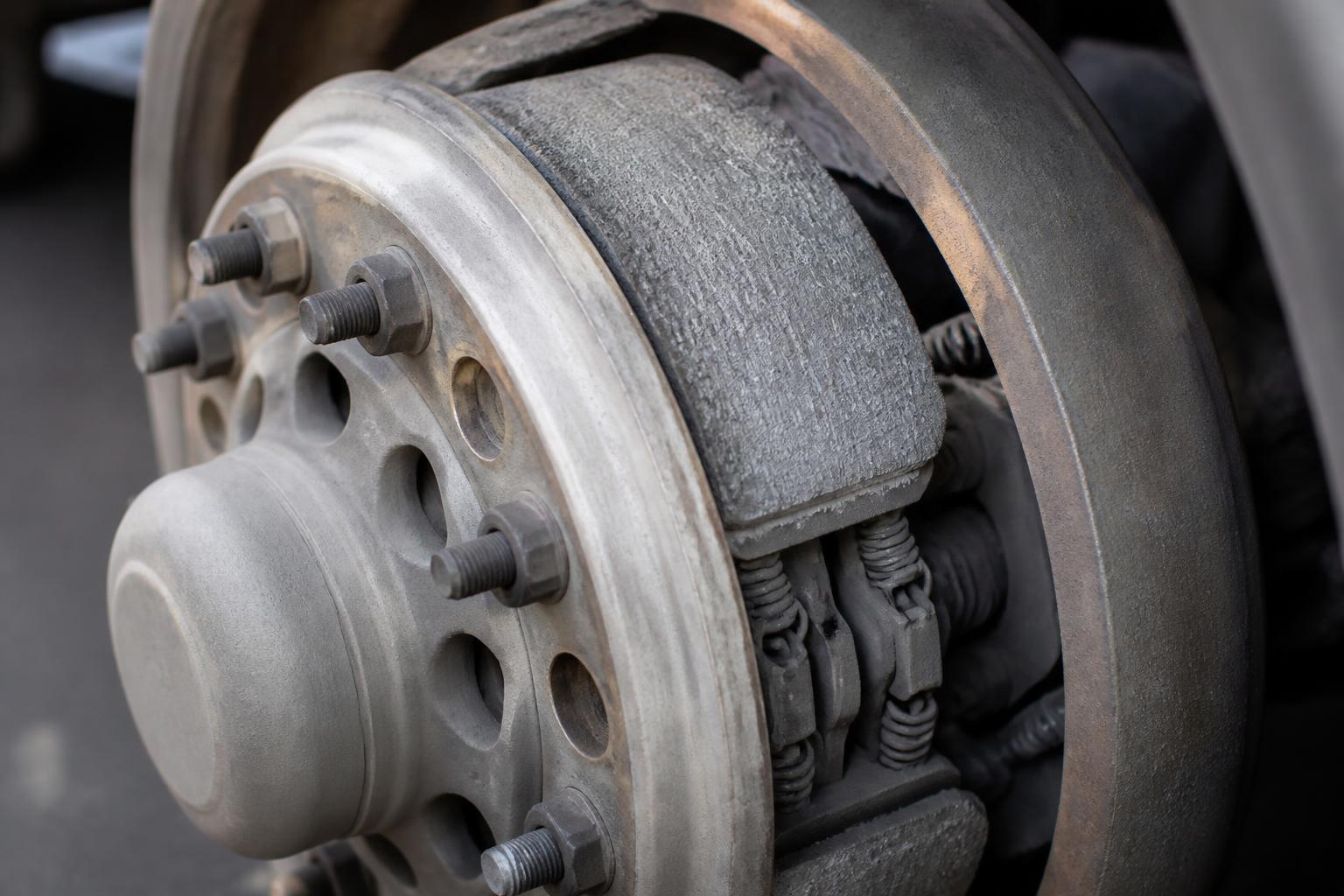
If a trailer brake starts binding on the A14, the first checks are not complicated. Look for heat, smell, drag, poor roll, an axle that is doing more work than the rest, and any warning signs from the trailer’s ABS or EBS system. Then stop the problem getting worse. A dragging brake can turn a manageable defect into a roadside immobilisation, tyre damage, hub damage, disc cracking, or a failed delivery plan very quickly.
From our workshop at Bridge Farm in Woolpit, near A14 J47, we see the same pattern regularly. Drivers often notice the symptoms before anyone knows the exact fault. The right first step is to treat binding as a safety and downtime issue, not just a nuisance. If you need HGV trailer brake binding repair in Suffolk, the useful question is not only “what part has failed?” but “what can still be moved safely, what needs testing, and what should be ruled out before more damage is done?”
What brake binding usually looks like on a trailer
Trailer brake binding rarely starts with a dramatic failure. More often, it begins with one or two early signs that are easy to dismiss when the vehicle is loaded, working to time, or joining the A14 in traffic.
A driver may notice the trailer does not roll away cleanly after releasing the brakes. It may feel held back on a gentle pull off. Fuel use can creep up. The unit may feel as though it is working harder than normal. On some combinations, there is a slight tugging sensation or a reluctance to coast. If the fault is isolated to one wheel end or one axle, the symptoms can be subtle at first.
Heat is one of the clearest clues. After a short run, a binding brake can leave one wheel end, one drum, or one disc much hotter than the others. Sometimes the first sign is smell, hot lining, hot metal, or the distinct odour of an overheated brake. In worse cases, smoke appears, or a tyre near the affected brake starts to suffer from sustained heat.
You may also see uneven wheel contamination, accelerated brake dust on one side, or signs that a hub area has been running hotter than it should. If the trailer has ABS or EBS warnings, those matter too. A warning lamp does not automatically mean the brake is mechanically stuck on, but it can point to a control issue, sensor problem, or modulator fault that affects brake release.
For operators, the reason these early signs matter is simple. A brake that is dragging does not usually repair itself on the next leg. It tends to get hotter, tighter, and more expensive. What begins as a call about poor rolling resistance can end with discs, pads, calipers, bearings, tyres, or air system parts all needing attention.
Why trailer brakes bind
There is no single cause of trailer brake binding. On HGV trailers, the fault can be mechanical, pneumatic, or electronic, and the symptom of “brake staying on” does not always point to the true source straight away.
A common mechanical cause is a seized or partially seized caliper. If the caliper does not slide or return properly, the pads can continue dragging on the disc after the brake should have released. Sticking pad movement, corrosion around pad guides, or wear in the caliper mechanism can all contribute. On drum brake trailers, the issue may be with return springs, camshaft movement, or internal component wear and contamination.
Brake chambers and slack adjuster related faults can also hold a brake on, depending on the trailer brake type and layout. If movement is restricted or adjustment has gone out of range, release can be incomplete. Seized linkages and lack of free movement are basic faults, but they still turn up.
Air faults are another major cause. A trailer that is not exhausting air correctly can keep brake force applied longer than it should. That can happen because of a sticking relay emergency valve, a modulator issue, contamination in the air system, damaged lines, internal valve faults, or poor air supply behaviour between tractor and trailer. Kinked suzies, damaged couplings, leaks, or restrictions can all create misleading symptoms.
ABS and EBS control faults matter because modern trailer braking is not just mechanical. A sensor fault, wiring defect, modulator problem, or control issue can affect how the trailer applies and releases braking. Not every ABS or EBS defect causes binding, but some do, and some mechanical binding complaints turn out to be control related once tested properly.
We also see cases where the original defect is one thing, but the secondary damage creates the binding complaint. For example, a wheel bearing issue or severe heat event can distort related components. A brake that has overheated badly may then continue to drag because the friction materials, disc condition, or caliper function have been altered by that heat.
That is why guessing from one symptom alone often wastes time. A hot wheel end does not automatically mean “needs pads”. A trailer with an EBS warning does not automatically mean “electrical only”. Proper HGV trailer brake binding repair in Suffolk starts with separating the symptom from the actual failed part or system.
What to do before the fault gets worse
If binding is suspected on the road, the first priority is safety. Do not keep driving in the hope that the brake will free off by itself. If there is smoke, strong heat, obvious drag, or concern about tyre or hub temperature, stop in a safe place as soon as it is practical and legal to do so.
Carry out a sensible walk round. Look for smoke, smell, abnormal heat, tyre distress, and any visible air or brake component issue. Do not put hands straight onto a wheel, disc, drum, or hub that may be overheated. If one wheel end is much hotter than the others, that is useful information, but it needs to be checked safely.
Check the dash indications on the tractor unit and note any trailer ABS or EBS warnings. If the fault appears after coupling a particular trailer, that matters. If the issue changes when the red and yellow lines are connected, or after a brake application and release, tell the workshop exactly that. Good fault reporting saves time.
If you are in a yard, do not keep shunting the trailer repeatedly to “see if it clears”. Repeated movement with a dragging brake can do more damage than one careful stop and inspection. If the trailer must be moved for safety, keep that movement minimal and controlled.
For operators, this is the stage to decide whether the trailer is safe to continue, safe only for controlled movement, or needs callout, recovery support enquiry, or workshop attention before another road leg. If you are unsure, err on the side of stopping the damage. A brake defect that becomes a wheel end fire risk or a roadside prohibition costs more than the delay you were trying to avoid.
We cover the same decision making in more detail in our guide to trailer brake faults near the A14 and the safest next step and in our article on what to do when a trailer fault stops you in Suffolk.
How a workshop confirms the cause
The workshop job is to prove the cause, not just confirm the complaint. A trailer can arrive with “brake binding on rear axle” written on the defect report, but that is only the starting point.
We begin with a practical inspection. That includes checking wheel end temperatures if the trailer has arrived recently enough for the heat pattern to tell us something, inspecting pads or shoes, disc or drum condition, caliper operation, chamber movement, adjuster function where relevant, air lines, couplings, and visible wiring or sensor issues. We also look for signs of heat damage beyond the brake itself.
Air system checks are a key part of the process. We need to know whether the brake is failing to release because the mechanical parts are stuck, or because air pressure is being held where it should be exhausting. That can involve checking valve behaviour, line condition, modulator response, and the trailer’s reaction through applied and released brake cycles.
If the trailer is fitted with EBS, diagnostics may be needed to read stored faults and identify whether the electronic control side is involved. ABS and EBS information is useful, but it is not a substitute for physical inspection. A clean fault memory does not rule out a seized caliper, and a recorded fault code does not prove that the code is the root cause of the binding.
Roller brake testing is often what turns suspicion into a clear answer. With a proper roller brake test for trailers and HGVs, we can compare brake effort, imbalance, release behaviour, and whether a wheel is dragging when it should be free. That helps distinguish between low efficiency, imbalance, delayed release, and true binding. It also gives a more reliable basis for deciding whether the issue is isolated or part of a wider axle or system defect.
For operators preparing for MOT, this matters even more. A trailer that “seems alright now it has cooled down” may still show poor release, imbalance, or other defects under test conditions. In the UK, MOT expectations are based on the actual brake performance and condition presented at test, not on whether the fault was intermittent in the yard earlier in the week.
If you want a clearer idea of how we approach fault finding before parts are ordered, our pages on HGV and trailer inspections and related brake testing explain the process.
What repairs may be needed and what affects downtime
The repair depends on what the inspection and testing actually show. In some cases, the answer is straightforward, such as replacing seized caliper components, worn pads, damaged discs, a faulty chamber, or a failed valve. In other cases, the brake binding is the end result of several linked defects, and repairing only one part would send the trailer back out with the same risk still present.
Typical repair routes include caliper replacement or overhaul where appropriate, pad and disc replacement, brake chamber replacement, line or coupling repairs, relay or modulator replacement, ABS or EBS wiring and sensor repairs, and rectification of seized or worn mechanical linkage parts. If overheating has been severe, we may also need to inspect bearings, seals, hub condition, tyre condition, and nearby components affected by heat.
Downtime varies because access and parts condition vary. A visibly seized caliper with stock available is one job. A trailer with multiple heat damaged components, contaminated air issues, or an EBS related release fault is another. The age of the trailer, axle type, brake manufacturer, previous repair history, and whether damage has spread beyond the original fault all affect how quickly the job can be completed.
Parts availability also matters. Some trailer brake components are easy to source the same day, others are not. If the trailer has already been driven while binding, that can add work. By the time it reaches us, what began as a release problem may have become a disc and pad job, plus tyre checks and hub inspection.
This is why we give practical next step advice rather than pretending every binding brake is a quick fix. Sometimes the right answer is “do not move it again until tested”. Sometimes it is “bring it in carefully for inspection”. Sometimes it is “the brake fault is real, but the bigger risk now is the heat damage around it”.
When local route access matters in Suffolk
Route access matters because trailer brake problems rarely happen at a convenient time or place. Operators running through Suffolk often need a workshop that understands not just the defect, but the practical geography around it.
From Bridge Farm in Woolpit, near A14 J47, we are well placed for traffic moving along the A14 corridor and the surrounding commercial routes. That includes operators working through Ipswich, Felixstowe, Stowmarket, Bury St Edmunds, Newmarket, and Elmswell, as well as fleets and owner-drivers crossing the county between delivery points, ports, depots, and RDCs.
When a driver reports suspected trailer brake binding near Woolpit or along the A14, the first useful question is often whether the trailer can safely reach a workshop, or whether it needs support where it stands. A workshop that knows the route network can give more realistic triage. If you are loaded near Felixstowe, delayed near Ipswich, or trying to decide what to do after a warning near Stowmarket, the next step is not theoretical. It affects driver hours, delivery commitments, and whether the trailer avoids secondary damage.
That is one reason we keep our advice direct. We work on HGVs and trailers, and we know that operators do not need broad claims when a brake is dragging. They need to know what to check first, what not to risk, and what testing will confirm the cause. If the issue needs inspection, diagnostics, roller brake testing, repair, MOT preparation, tyre support, or a callout or recovery support enquiry, we deal with it in the context of the route the vehicle is actually running.
Woolpit Truck Repairs is part of FLEETA LIMITED, and our workshop focus stays where operators need it, on commercial vehicles, trailer defects, and practical decisions that reduce unnecessary downtime. If you are dealing with suspected HGV trailer brake binding repair in Suffolk, especially around A14 J47 and the wider A14 route, the right first move is to stop the damage spreading and get the trailer properly assessed.
Can a trailer brake bind without an ABS or EBS warning?
Yes. A trailer brake can drag because of seized components, air issues or adjustment faults without showing an ABS or EBS warning straight away.
Is it safe to keep driving with a binding trailer brake?
Not usually. Heat and drag can quickly damage tyres, hubs, drums, discs and brake parts, and can turn a manageable repair into a roadside problem.
What will a workshop need to inspect first?
Usually the brake assembly, air system condition, actuator movement, wheel-end heat signs, fault codes and brake performance under test.
Can brake binding affect MOT preparation?
Yes. Uneven braking, overheating, worn components or warning system faults can all create issues that need sorting before MOT presentation.
Do all binding faults need major trailer brake repairs?
No. Some faults are straightforward, but others involve multiple worn or heat-damaged parts. The right repair depends on what inspection and testing show.