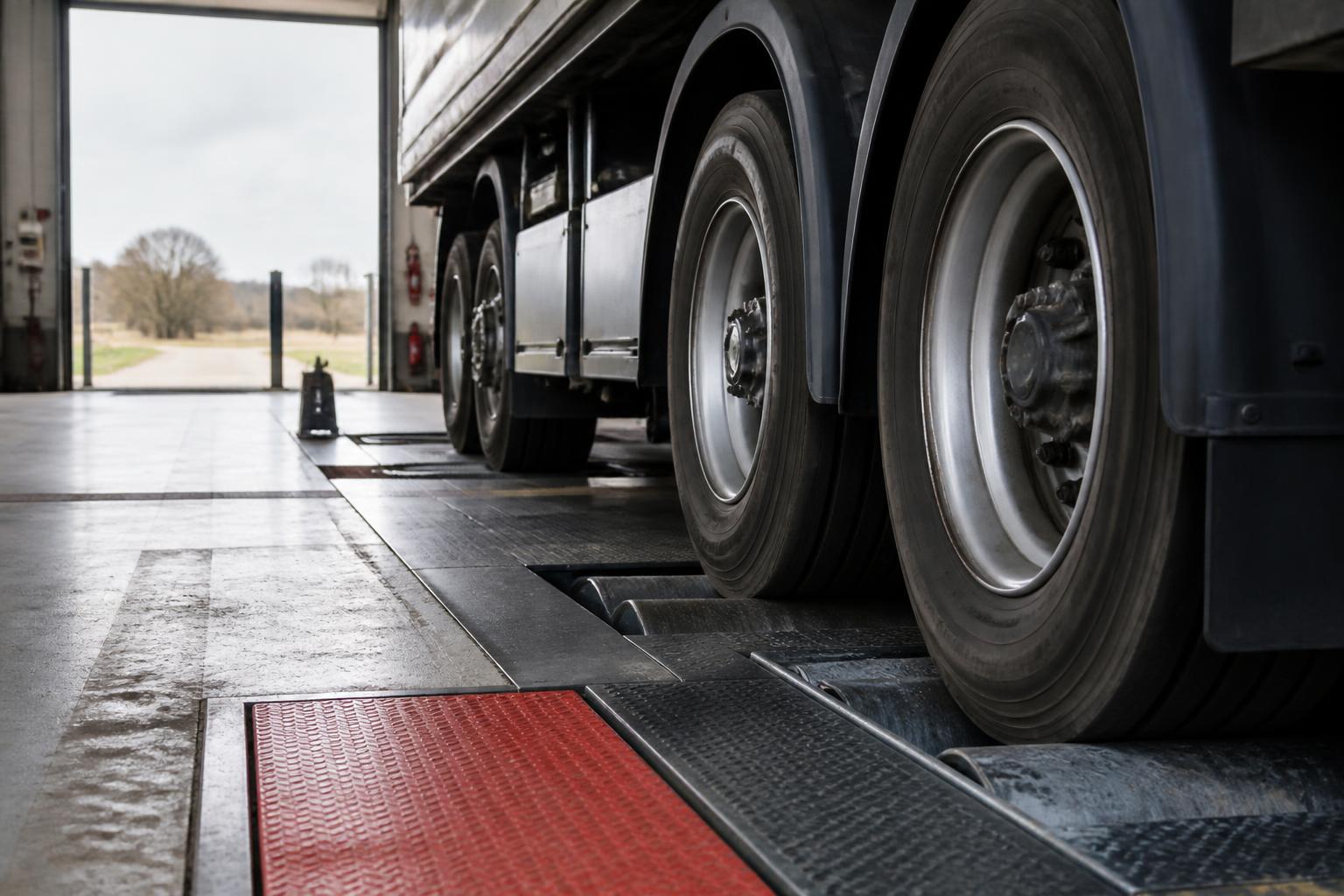
A brake roller check is one of the quickest ways to find out whether an HGV or trailer is likely to present a brake issue at MOT, or sooner on the road. It gives us measured brake performance at each axle, not just a driver’s impression or a visual check under the vehicle. That matters when a unit feels “not quite right”, when a trailer has been standing, or when you want to avoid turning up for test with a defect that could have been dealt with in the workshop first.
At Woolpit Truck Repairs, we carry out brake testing for operators running through Woolpit, Suffolk and the wider A14 corridor, including traffic moving between Ipswich, Felixstowe, Stowmarket, Bury St Edmunds, Newmarket and Elmswell. For fleets and owner-drivers alike, the value is practical, you get a clear reading of braking effort, balance and likely next steps, so you can decide whether the vehicle is ready for MOT, needs repair, or needs further diagnosis before it goes back into service.
What a brake roller test actually shows
A roller brake test measures braking force at the wheels while the axle is driven on a set of rollers in controlled workshop conditions. For HGVs and trailers, that gives us objective readings axle by axle, instead of relying on road feel alone.
The main things it shows are:
- brake force produced by each wheel
- side-to-side balance on the same axle
- overall axle performance
- whether the service brake is applying evenly and strongly enough
- whether the parking brake is producing a suitable holding force
- whether there are signs of drag, delay, binding or imbalance
On a typical test, we are looking for whether one side is doing noticeably more work than the other, whether a whole axle is weak, and whether the vehicle is producing a consistent response as pressure is applied. A vehicle can still stop on the road and yet show poor balance or low output on the rollers. That is often the difference between “it feels usable” and “it is likely to cause trouble at MOT or in operation”.
For trailers, the test is especially useful because brake defects are often missed until loading, reversing, or a formal inspection highlights them. A trailer may have sat in the yard, had intermittent use, or developed air or brake component issues that do not become obvious until measured properly. A roller test helps show whether each axle is contributing as it should.
Operators use brake roller testing for three main reasons. First, for MOT preparation, to reduce the chance of a surprise fail on brake performance or imbalance. Second, for fault finding, when a driver reports poor braking, pulling, a warning light or an odd feel through the pedal. Third, for decision making after standing time, repairs, or defect reports, where the question is whether the vehicle can return to work or needs more attention.
If you want a fuller breakdown of what is checked and why it matters, we have covered that in more detail in what an HGV roller brake test actually checks.
When operators usually need one
Most bookings happen because there is a reason to stop guessing.
The most common one is MOT preparation. If a test date is approaching, a brake check on the rollers gives a much clearer picture than a basic road run. It lets us spot imbalance, low effort, weak parking brake performance or axle-specific issues before the vehicle reaches the test lane. That is often the difference between a planned repair and unplanned downtime.
Another common trigger is a change in braking feel. Drivers usually describe this as weak braking, a delayed response, pulling to one side, grabbing, or a trailer that does not seem to come in cleanly behind the unit. Sometimes the complaint is less precise, just “it doesn’t feel right”. That is enough reason to test. A measured result is more useful than trying to interpret a vague symptom in isolation.
Standing time is another big one. A trailer that has been parked up can develop seized or partially seized brake components, corroded moving parts, sticking adjusters or contamination issues. Units that have been off the road for repair or low utilisation can show similar problems. The first loaded run is not the place to find that out.
Defect reports from inspections also lead to testing. If a safety inspection picks up brake wear, uneven adjustment, air leaks, damaged components, warning lights or signs of heat on one wheel end, a roller check helps confirm the effect on actual braking performance. It gives us a better basis for deciding whether the issue is minor, whether repair is needed straight away, or whether more diagnosis is required.
Warning lights are another obvious reason to book in. ABS and EBS faults do not always mean the foundation brakes have failed, but they do mean the system needs proper attention. On some vehicles the issue is on the tractor, on others it is on the trailer, and the symptom on the road is not always enough to tell which. We often combine a brake performance check with diagnostics so we can see both the measured output and the electronic fault picture. If that is the issue you are dealing with, these guides on brake warning lights on HGVs and what to do next and Trailer ABS faults in Suffolk: roadside check or workshop test? are useful starting points.
Operators also book a test after brake repairs. If chambers, discs, pads, drums, shoes, valves, slack adjusters or trailer brake components have been changed, a post-repair check confirms the system is performing as expected before the vehicle goes back onto route.
How the test is carried out in the workshop
On the day, the process is straightforward, but it is structured. We want a safe test and a result that means something.
We start with a basic check of the vehicle or trailer condition relevant to the test. That can include tyre condition, wheel security concerns, obvious brake defects, air build-up and whether there are any warning lights or reported faults that need to be taken into account. If the issue is trailer-related, we also check the air and electrical connections being used for the test.
The vehicle is then positioned on the brake rollers axle by axle. Each axle is tested in turn. As the rollers turn the wheels, braking is applied progressively so that the machine can measure the force generated at each side. We monitor how quickly the brakes come in, how balanced they are left to right, and whether the readings are stable or erratic.
For a unit, we usually assess service brake performance across the relevant axles and then the parking brake. For a trailer, we do the same in trailer terms, looking at each axle’s contribution and the parking brake function where applicable. If a problem is obvious on one axle, we may stop and inspect before continuing, depending on the fault and safety considerations.
What the driver or operator should expect is not a long theory exercise. It is a workshop test with a printout or recorded result, followed by a practical explanation. If the readings are healthy and balanced, that is useful confirmation. If one axle is weak or one side is low, we explain where the issue sits and what is likely to be behind it.
Where needed, we follow the roller check with further inspection or diagnostics. For example:
- checking brake adjustment or wear
- inspecting chambers, calipers, drums, discs or shoes
- checking for seized or restricted movement
- tracing air leaks or pressure delivery issues
- reading ABS or EBS faults
- inspecting trailer control and relay valves
That matters because the roller test tells us what the braking performance is doing, but not always why. The “why” comes from the workshop inspection that follows.
For operators planning around route time, access matters as much as the test itself. Being at Bridge Farm, close to A14 J47, means many vehicles can come off route, be checked, and get a clear answer without losing a full day to travel. If timing is the main concern, our page on where to get an HGV brake test near the A14 before MOT explains how operators typically plan that in practice.
What can cause a poor result?
Poor roller readings usually come back to a handful of common faults. Some are simple adjustment or wear issues. Others point to a deeper defect in the brake or air system.
One frequent cause is uneven brake adjustment. If one side is applying sooner or harder than the other, the balance reading will show it. On drum brake setups, worn or sticking adjusters can have a big effect. On disc systems, restricted caliper movement can do the same.
Seized or partially seized components are another regular cause. That can include sticking calipers, seized slide pins, camshaft issues, binding linkages or components that have corroded after standing. Sometimes the result is weak braking. Sometimes it is imbalance. Sometimes it is drag that shows up before a force problem does.
Contamination also matters. Oil or grease on friction material, water ingress, or general brake contamination can reduce output and make readings inconsistent. A wheel end issue such as a leaking seal can end up appearing first as a brake performance problem.
Air faults are common on both units and trailers. Low delivered pressure, leaks, sticking valves, restricted lines or delayed application can all affect the result. On a trailer, a relay emergency valve or load sensing arrangement can be part of the issue. If the air system is not delivering and controlling pressure properly, the brake force on the rollers will reflect that.
Trailer defects often show up as axle-specific weakness or poor balance. We regularly see issues such as:
- seized trailer brake calipers
- worn pads or shoes on one axle
- inoperative brake chambers
- poor adjustment
- air leaks at chambers or valves
- defects after long standing periods
- faults following partial or uneven previous repairs
ABS and EBS faults can also affect braking behaviour, though it is important to separate electronic control issues from foundation brake defects. An ABS warning does not automatically mean the vehicle will show poor basic brake force, but it can indicate sensor, modulator or wiring issues that need correcting. EBS faults can have a wider effect on brake control and response, particularly on trailers. In workshop terms, we do not treat an electronic warning and a mechanical brake issue as the same thing, but we do look at both together when needed.
Tyres and loading condition can also influence how the test behaves. That does not create brake force out of nowhere, but it can affect consistency and interpretation. That is why workshop context matters. A printout on its own is only part of the answer. The useful part is knowing whether the poor result points to wear, seizure, air delivery, control fault, or something else entirely.
What to do after the results
The next step depends on what the readings actually show.
If the results are good, balanced and consistent, that usually gives you the confidence to proceed with MOT preparation or return the vehicle to service, assuming there are no other defects. A clean brake result does not replace the rest of the inspection regime, but it does remove one major unknown.
If the readings are borderline, the decision is more operational. A vehicle close to MOT may still need adjustment or repair before test, even if the brakes are not obviously unsafe in day-to-day driving. This is where practical advice matters. We would rather tell you to deal with a known issue now than send you away with a likely MOT problem a few days later.
If the result is clearly poor, the right next step is usually immediate workshop inspection and repair. Weak braking, serious imbalance, a failed parking brake, or signs of seizure or air system defect should not be treated as a paperwork issue. They are serviceability and safety issues. Depending on the fault, the vehicle may need to stay off the road until repaired and rechecked.
Where the roller result points to a symptom but not a confirmed cause, we move into diagnosis. That may mean stripping and inspecting a wheel end, checking chamber stroke, tracing an air leak, or running ABS or EBS diagnostics. The point is to use the test result as a starting point for the right repair, not to guess and fit parts blindly.
For MOT preparation, the best use of a roller brake test is not just to get a pass or fail indication in advance. It is to identify what needs doing while there is still time to plan it properly. That is especially important for fleets juggling bookings and for owner-drivers who cannot afford a failed test tying up the vehicle unexpectedly.
If you are deciding whether a vehicle can return to work after a complaint, repair or defect report, the result needs to be read in plain operational terms:
- Is braking force strong enough?
- Is it balanced side to side?
- Is every axle contributing properly?
- Is the parking brake performing as it should?
- Is there evidence of a fault that needs stripping, repair or diagnosis?
That is how we approach it at Woolpit Truck Repairs. We are not trying to turn a workshop test into a theory lesson. We are trying to give operators in Woolpit, Suffolk and along the A14 a clear answer on whether the vehicle is ready, risky, or in need of repair before it causes downtime at MOT or on the road.
If you need the test itself, our HGV and trailer roller brake testing service sets out how we handle it. We operate from Bridge Farm near A14 J47, which is practical for traffic moving between Ipswich, Felixstowe, Stowmarket, Bury St Edmunds, Newmarket and Elmswell.
One final point on rules and standards. In Great Britain, MOT and roadworthiness enforcement for HGVs and trailers follows the UK system, not EU procedures as such, even where vehicle technology and some technical principles overlap. For operators, the practical point is simple. What matters is whether the vehicle meets the braking standard expected here, and whether you have dealt with defects before they become a test failure, a prohibition risk or roadside downtime.
Woolpit Truck Repairs is part of FLEETA LIMITED, and our job is to make the next step clear. If the brakes are fine, we will say so. If they are not, we will tell you what the readings mean, what is likely causing them, and what needs doing next.
Is a roller brake test the same as an MOT brake test?
It uses the same basic principle of measuring brake performance on rollers, but a workshop test before MOT is mainly for diagnosis, preparation and deciding what needs attention first.
Can you test both HGV units and trailers?
Yes, roller brake testing can be used on HGV and trailers, which helps identify whether the issue sits with the unit, the trailer or both together in operation.
Will a brake roller test tell me exactly which part has failed?
Not always. It shows braking performance and imbalance clearly, but the cause may still need inspection, adjustment checks, air system diagnosis or strip-down work.
Should I book a test if the brakes feel normal?
Yes, especially before MOT or after a vehicle has stood for a period. Some imbalance, binding or low performance issues are not obvious from normal driving alone.
Do ABS or EBS faults affect the result?
They can. ABS or EBS issues may change how braking behaves or point to wider system faults, so the roller result is best read alongside warning lights, fault codes and inspection findings.