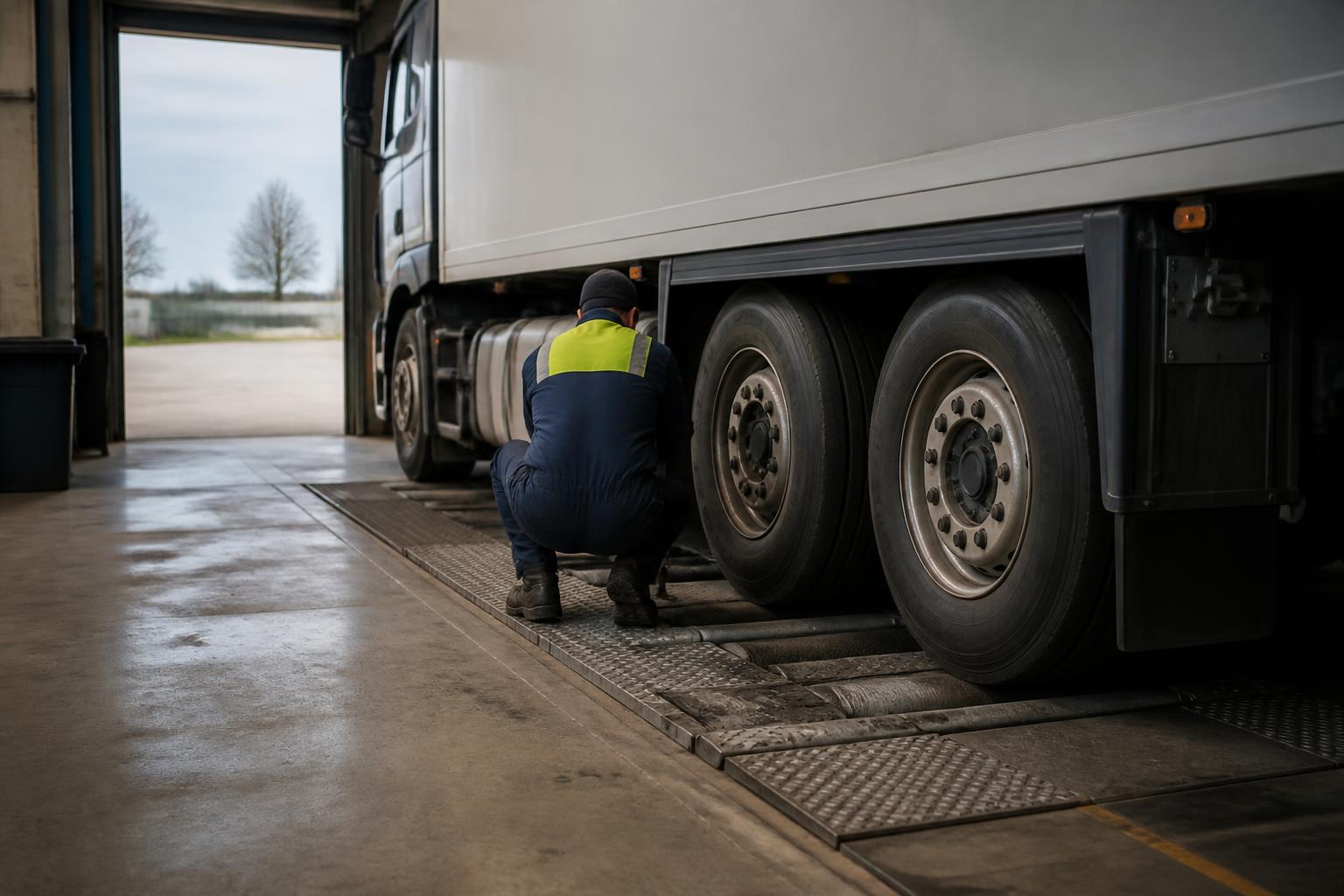
If you need an HGV brake test before MOT near the A14, the practical answer is to book somewhere that can test the vehicle properly, explain any defects clearly, and deal with the next step without sending you elsewhere. For most operators, the real need is not just a pass or fail style result. It is knowing, before the MOT appointment, whether the truck or trailer is likely to present well on brake performance and what needs doing if it does not.
At Woolpit Truck Repairs, we handle that from Bridge Farm in Woolpit, close to A14 J47. That matters for operators running through Suffolk, between Ipswich and Bury St Edmunds, or moving to and from Felixstowe, Stowmarket, Newmarket and Elmswell. If the concern is brake efficiency, imbalance, warning lights, trailer performance or an MOT date getting too close, a proper pre-MOT brake check can save a wasted test slot and a longer spell off the road.
What operators usually mean by a brake test before MOT
When an operator searches for an HGV brake test before MOT near the A14, they are usually not looking for a generic inspection. They want to know one of three things.
First, is the vehicle or trailer likely to meet brake performance expectations at MOT?
Second, if there is a problem, is it a brake issue only, or is it tied to something else such as ABS or EBS faults, poor adjustment, air leaks, seized components, tyre condition, hub heat, or trailer defects?
Third, can any defect be diagnosed and repaired quickly enough to protect the booking, the load plan and the rest of the week?
That is why a simple yes or no answer is not enough. A useful pre-MOT brake test should show actual brake performance, identify imbalance across an axle where possible, and point towards the likely cause if results are not right. For HGV operators, the value is in reducing uncertainty. If the vehicle goes to MOT with known brake concerns, you risk losing the slot, adding another journey, and creating avoidable downtime.
In the UK, unlike some broader EU assumptions operators may hear, the practical process is shaped by DVSA testing expectations and by how commercial workshops actually prepare vehicles for MOT. What matters on the ground is not a theoretical compliance discussion. It is whether the truck or trailer can be tested properly, whether the readings make sense against the complaint, and whether somebody can act on the result there and then.
Comparing your main options near the A14
Around the A14, operators usually have four realistic options.
The first is a dedicated HGV workshop. This is normally the strongest option if you want brake testing with a clear route into diagnosis and repair. A workshop that deals with HGVs and trailers every day is more likely to understand whether poor readings point to adjustment, chambers, slack adjusters, discs, pads, drums, shoes, valves, air supply issues, sensor faults or trailer-specific defects. It also means the conversation is practical. You can tell us what the driver has felt, what warning lights are on, whether the issue is on unit or trailer, and how soon the MOT is due.
The second is a general commercial garage. This can work for some operators, but capability varies. Some garages cover vans, light commercials, plant and trucks together. The risk is not that they cannot help at all, but that HGV and trailer brake issues are only one part of what they do. If your problem is straightforward, that may be enough. If it is tied to EBS communication, trailer imbalance or a fault that needs proper triage before parts are ordered, a more HGV-focused workshop is usually the better fit.
The third is an MOT lane only option. That may suit you if you simply need the statutory test and are confident the vehicle is fully prepared. It is less useful if you suspect a brake issue already. A test lane can confirm a problem, but confirmation is not the same as a repair plan. If the vehicle then needs to leave for diagnosis and parts, you have added time and another movement without solving the main issue.
The fourth is waiting until the MOT itself. Operators do this when they are busy, the vehicle feels mostly fine, or the booking is already in place. Sometimes that works. Often it is what causes the disruption. If the brake performance is poor, if there is a significant imbalance, or if an ABS or EBS issue is present, you have discovered it at the worst point in the schedule.
If you are weighing those options up, our roller brake testing for HGVs and trailers is designed around the workshop route, not just the test result. We also covered the practical differences in more detail in our guide to choosing a brake test site near Woolpit without losing time.
What matters more than distance alone
Operators often start with postcode distance, but distance on its own is not what protects uptime. The closer site is not always the quicker or safer option if access is awkward, bookings are slow, trailers cannot be handled, or the workshop cannot take the next step.
Route access matters first. A workshop near A14 J47 is easier to work into the day if you are running east-west through Suffolk, coming off at Woolpit, or trying to avoid a long diversion off a loaded route. For vehicles moving between Felixstowe, Ipswich, Stowmarket and Bury St Edmunds, that practical access usually matters more than a workshop that looks close on a map but adds town traffic, restricted approach roads or awkward turning.
Booking speed matters just as much. If your MOT is imminent, the best workshop is the one that can assess the vehicle in time to do something useful with the result. A brake test next week is no help if the MOT is tomorrow and the warning light came on today.
Trailer capability is another point operators sometimes miss. A unit may feel acceptable on the road, but the trailer is where the defect sits. If the workshop only deals comfortably with the truck, you still have half the problem. We work on both HGVs and trailers, which matters when the complaint is not yet fully pinned down.
Defect triage is where downtime is often won or lost. A workshop should be able to say, with reasonable confidence, whether the issue looks like adjustment, wear, an electronic fault, a binding brake, a load sensing issue, an air system problem, or something more involved. That lets you decide whether to hold the vehicle, swap trailers, move the MOT booking, or approve repair work.
Repair follow-up is the final point. A brake test is useful only if it leads to a workable next step. If the result shows a problem but the workshop cannot repair it, source parts quickly, or help you decide whether the vehicle is safe to move, you are still in the same commercial bind.
That is why operators searching for an HGV brake test before MOT near the A14 are usually better served by a workshop that can test, diagnose and repair in one place. If the issue has already started affecting reliability, our article on how to handle HGV faults before they turn into downtime sets out the same principle more broadly.
What a useful pre-MOT brake check should uncover
A proper pre-MOT brake check should do more than produce numbers. It should help uncover the likely reason those numbers are right or wrong.
One common issue is brake imbalance. That may show across an axle or between tractor and trailer performance. The cause can vary. Worn friction material, contamination, uneven adjustment, sticking components or chamber issues can all sit behind the same complaint. The important thing is not just spotting the imbalance, but tracing it.
Binding brakes are another regular cause of concern. Drivers may report heat, drag, poor fuel economy, a smell after a run, or a wheel that does not feel right after stopping. Binding can come from seized calipers, sticking slides, poor return, mechanical wear or air side issues. Left alone, it can turn into a bigger brake repair and can affect tyre life and hub condition as well.
ABS faults should also be taken seriously in a pre-MOT context. A warning light is not something to leave until test day. Sensor faults, wiring damage, reluctor ring issues or modulator problems can all sit behind an ABS issue. On trailers, these faults can be intermittent, which is one reason operators sometimes delay action until the defect becomes impossible to ignore.
EBS adds another layer. With EBS systems, the complaint may involve communication faults, warning lamps, poor response, inconsistent trailer braking or defects that need proper diagnostics rather than guesswork. If a driver says the trailer is not braking as expected, or the fault appears only with a particular trailer coupled, that matters. The brake test result and the electronic fault picture need to be read together.
Air leaks and supply issues are another linked area. Brake performance can be affected by leaks, poor pressure build-up, valve faults or damaged lines. Sometimes the reported problem is "bad brakes" when the underlying issue is in the air system.
Trailer defects deserve separate attention because many pre-MOT surprises sit there, not on the unit. We regularly see cases where the tractor is blamed first, but the trailer has the actual brake fault, ABS issue, worn components or imbalance. That is why a workshop used to trailer work can save time. If trailer concerns are part of the picture, our piece on trailer brake faults near the A14 and the safest next step is worth reading.
A useful check may also bring up related defects that are not the headline complaint but still matter for MOT preparation, such as tyre condition, wheel end concerns, visible wear, damaged lines or obvious air leaks. Catching those at the same visit is often what stops a brake concern turning into a wider test failure.
Why operators around Woolpit often choose a workshop near A14 J47
For operators based in Woolpit or moving regularly through this part of Suffolk, location near A14 J47 is not just a convenience point. It changes how quickly a brake concern can be turned into a decision.
We operate from Bridge Farm, with access that suits working trucks and trailers rather than car-based retail traffic. For fleets running between Ipswich and Bury St Edmunds, for owner-drivers based around Stowmarket or Elmswell, and for vehicles routing inland from Felixstowe, that makes us a practical stop rather than a detour that consumes the rest of the day.
The second reason is focus. Woolpit Truck Repairs is HGV and trailer work. That matters when the vehicle in front of us is an artic with a trailer complaint, a rigid with an MOT date closing in, or a unit showing ABS or EBS issues that need proper triage. We are not trying to fit truck brake problems around a mixed diary of unrelated vehicle types.
The third reason is how we handle the conversation. Operators do not need broad claims. They need to know what the defect appears to be, whether it is likely to affect the MOT outcome, what can be done next, and how urgently. That practical explanation is often the difference between a manageable repair and a wasted day.
We also understand the route pressure in this area. If a vehicle is due back on the road, you need realistic next-step advice. If it is not sensible to push on to test day, we will say so. If the issue looks trailer-led, we will treat it that way. If the complaint points to something wider than brake performance alone, we will explain that too.
Woolpit Truck Repairs is operated by FLEETA LIMITED, and our day-to-day work is built around what local and passing operators actually need, which is a clear assessment and a workable plan.
How to choose the right booking for your vehicle and deadline
When you book, the best results usually come from giving the workshop the right information up front.
Start with the MOT date. If the test is close, say exactly when it is booked. "Due soon" is not enough if there are only a few days left. The workshop needs to judge whether you need a brake test only, a pre-MOT inspection, diagnostics, or a slot that allows for likely repair work.
Next, say whether the concern is on the unit, the trailer, or uncertain. If the driver reports poor braking only with one trailer, mention that. If the warning light stays with the tractor unit regardless of trailer, mention that too. It changes the likely first step.
Be specific about warning lights. ABS and EBS are not the same problem, and an intermittent light is still useful information. Tell us when it appears, whether it clears, and whether the driver has noticed any change in braking feel.
Describe the symptom in plain terms. Pulling, dragging, poor response, a hot wheel, uneven trailer braking, noise, air loss or a recent roadside defect are all more useful than saying the brakes are "not right". If another workshop has already commented on imbalance, low readings or binding, say so.
If the vehicle is an artic, confirm whether the trailer needs to be included in the booking. A lot of lost time comes from the vehicle arriving without the part of the combination that is actually causing the complaint.
Finally, be clear about urgency. If you need triage before authorising repair, say that. If you want the workshop to test and repair where possible because the MOT booking must be protected, say that instead.
For operators trying to avoid a failed appointment, our article on HGV roller brake testing before MOT delays you explains why timing and workshop choice matter so much.
If you need an HGV brake test before MOT near the A14, the right booking is the one that matches the actual risk. Sometimes that is a straightforward roller brake test. Sometimes it is a brake test plus diagnostics. Sometimes it is a truck and trailer booking because the defect could sit on either side. The clearer the starting information, the quicker we can get to the useful answer.
At Woolpit Truck Repairs, we keep that process practical. Test the vehicle properly, identify what the result means, and move straight to the next sensible step from our workshop at Bridge Farm near A14 J47.
How close to MOT should an HGV brake test be done?
Close enough that the result still reflects the vehicle on test day, but with enough time to fix defects. If there is a brake concern, warning light or known issue, do it earlier rather than waiting.
Is a roller brake test the same as the MOT brake check?
Not exactly. A roller brake test before MOT is a workshop check used to assess braking performance and spot likely defects. It helps you prepare, but it is not the MOT itself.
Can trailer brake faults be found at the same time?
Yes, if the workshop is set up for trailer work as well as HGV units. That matters if the issue could sit with the trailer, connections, braking balance or EBS-related faults.
What if the vehicle passes the brake test but still fails MOT?
A pre-MOT brake test reduces risk but does not guarantee an MOT pass. Other defects outside braking can still fail the vehicle, and conditions can change between the workshop visit and the test.
Why does location near the A14 matter so much?
For working vehicles, easy access can save time, fuel and disruption. A workshop near the A14 is often more practical for route-based operators than one that is only closer on paper.