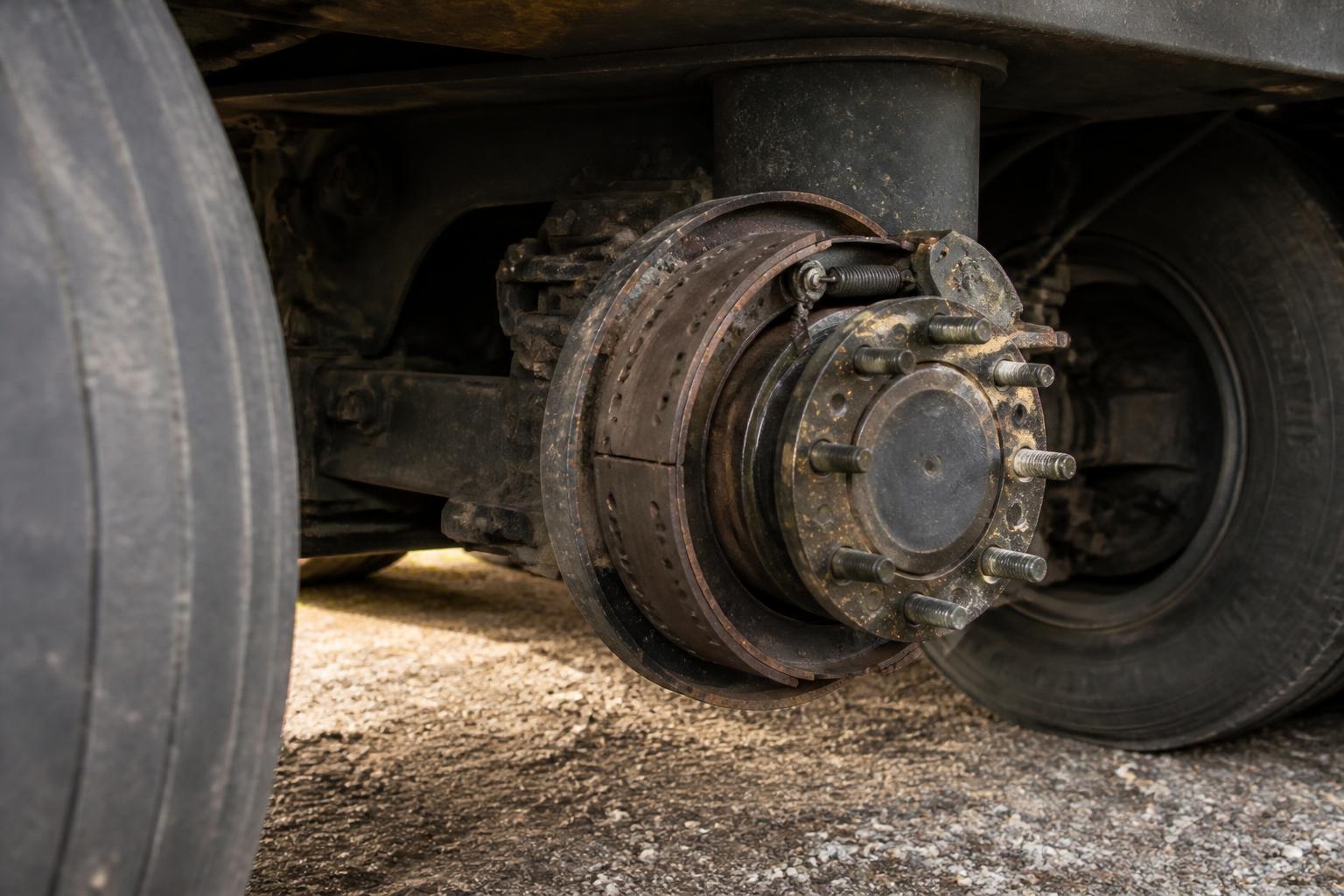
A trailer MOT rarely fails on one dramatic defect that appeared overnight. Most failures come from items that were visible, audible or measurable beforehand, a weak brake reading, an ABS warning, a cut tyre sidewall, a lamp out, excess play, a cracked mounting, a missing spray suppression flap. A proper pre-check is there to catch those points while there is still time to repair them without losing a test slot or parking the trailer up longer than planned.
For operators, the value of an HGV trailer MOT checklist is not the paper itself. It is the routine behind it. If the same items are checked in the same order, with defects recorded clearly and repairs booked before presentation, avoidable MOT failures drop. At Woolpit Truck Repairs, at Bridge Farm in Woolpit, just off the A14 at A14 J47, that is how we approach trailer inspections for fleets, owner-drivers and route-based operators moving through Suffolk, Ipswich, Felixstowe, Stowmarket, Bury St Edmunds, Newmarket and Elmswell.
What a trailer MOT pre-check should cover
A trailer MOT pre-check should cover the same systems that are likely to be assessed at test, starting with identity, roadworthiness and brake performance. That means more than a quick walk-round with a torch.
We start with the basics. Registration plate condition and legibility. VIN or chassis identification where applicable. Number plate lamps. General presentation. If a trailer arrives plastered in mud, with damage hiding around axle lines and lamp units, it is already harder to inspect properly and easier to miss defects that matter.
From there, the pre-check should cover:
- Service brake condition and operation
- Parking brake operation where fitted
- Brake chambers, slack adjusters, linkages and air lines
- ABS and EBS warning status and stored faults
- Tyres, wheels and wheel security
- Suspension, axle fixings and signs of movement or damage
- Chassis, cross members, body mounts and landing legs
- Kingpin wear, skid plate area and coupling condition
- Lights, reflectors, conspicuity markings and electrical connections
- Mudwings, spray suppression, sideguards and rear under run protection
- Doors, hinges, catches, curtains or body security where relevant
A proper check also needs the trailer connected and supplied correctly. That sounds obvious, but intermittent electrical faults and air leaks can disappear or change depending on the unit, suzies, socket condition and line pressure. If a warning lamp has been reported by the driver, we want to see it in the same operating conditions that produced the complaint.
Brake checks should never be limited to looking for worn linings. We look for obvious contamination, damaged drums or discs where visible, cracked or perished hoses, leaking chambers, seized or over-stroking components, and signs that one side is not working evenly against the other. If there is any doubt about brake performance, roller brake testing is the right next step, not guesswork.
On structure, the key point is that a trailer can look usable and still be wrong for MOT. Cracks around suspension hangers, loose body mountings, damaged sideguard brackets, weakened rear frame sections and poor previous repairs are all defects that can stop a pass. The same goes for landing legs that are bent, insecure or not operating correctly.
For many operators, the most efficient way to cover all of this is a workshop inspection before the test booking. Our trailer inspection service for HGV and trailer operators is built around that practical approach, identify what will matter at test, explain the defect plainly, then agree the next step.
Brake, ABS and EBS faults that commonly cause failures
Brake defects are among the most common reasons trailers fail MOT, and they are often linked. A low brake efficiency result may not be just about friction material. It can point to adjustment issues, seized components, poor balance across an axle, air loss, ABS or EBS related control problems, or defects in the foundation brakes themselves.
The faults we see most often include:
- Brake imbalance across the same axle
- Poor overall service brake performance
- Excessive brake lag or uneven application
- Worn, contaminated or damaged brake linings or pads
- Seized calipers, camshafts or slack adjusters
- Air leaks from chambers, valves or pipework
- Damaged or insecure brake hoses
- ABS warning lamp or system malfunction
- EBS communication or modulator faults
- Wheel speed sensor faults or damaged sensor rings
In practice, brake imbalance usually means one side is not doing the same work as the other. That may be due to seizure, poor adjustment, contamination, a chamber issue or a problem in the control side of the system. If the trailer has been dragging a brake, running hot on one wheel end, or showing uneven wear, that needs investigating before test day.
ABS faults are another common trap. Operators sometimes assume that because the brakes still apply, the trailer is close enough to present. It is not that simple. If the ABS warning sequence is wrong, if there is a persistent fault, or if the system is not functioning as required, the trailer can fail. EBS-equipped trailers add another layer, because the fault may sit in the electronic brake control side rather than in a clearly visible mechanical part.
A warning light should never be treated as an MOT-day surprise. We would rather diagnose it in the workshop, check the power supply, socket, suzies, ECU communication, wheel speed sensor readings and modulator response, then confirm the fix. If you are dealing with that type of issue already, our guide to roadside checks or workshop testing for trailer ABS faults explains the practical difference.
Roller brake testing is often the point where uncertainty becomes clear evidence. You can suspect an imbalance from tyre marks, heat or driver report, but a roller brake test shows what each wheel line is actually doing. That matters when deciding whether a trailer is fit to present or whether it needs repair first.
There is also a UK-specific point worth keeping clear. MOT presentation and pass criteria are governed here by UK testing standards, not by a general EU rule of thumb. Operators moving between UK and international work sometimes assume a trailer that is serviceable for use elsewhere will automatically satisfy the UK MOT. It still needs to meet the UK test requirements on the day.
Where brakes are concerned, the expensive mistake is pressing on in the hope that a warning lamp will stay off or a weak reading will scrape through. If there is already a known issue, preparation costs less than a wasted booking, a fail record and extra downtime.
Tyres, lights and structure checks before test day
Many trailer MOT failures come from routine roadworthiness items because they are easier to postpone. The trailer is loading fine, the curtains run, the customer is waiting, so the defect gets carried another week. Then MOT arrives and the small issue becomes the reason the trailer is off the road.
Tyres should be checked for tread depth, exposed cords, sidewall damage, cuts, bulges, uneven wear and signs of underinflation or overload stress. We also look at whether tyres on the same axle are appropriately matched in size and type, and whether there is evidence of contact damage from suspension or body issues. A tyre that is legal enough to finish a shift is not the same thing as a tyre you should confidently present for MOT.
Wheel and hub checks matter too. Missing wheel nuts, movement indicators showing possible loosening, cracked rims, oil contamination around the hub, or signs of bearing trouble all need attention first.
Lighting defects are another avoidable cause of failure. Marker lamps, rear lamps, indicators, stop lamps, fog lamps, number plate lamps and reflectors all need to be present, secure and working properly. On trailers, the fault is not always the lamp unit itself. It may be corrosion in the plug, damage in the loom, poor earth, water ingress, a broken connection at a junction box or a fault that only appears when the cable is moved. If a lamp has been intermittent on the road, do not assume it will behave for the test. Our article on likely causes when trailer marker lights are out on an HGV covers the usual pattern.
Structure and external fittings deserve just as much attention. Test failures can come from:
- Cracked or weakened chassis members
- Insecure sideguards
- Damaged rear under run protection
- Defective spray suppression
- Loose mudwings or brackets
- Bent or insecure landing legs
- Body or floor insecurity affecting safe use
- Door retention faults on box or fridge trailers
- Curtain security issues where body retention is affected
Previous repairs are worth checking carefully. A trailer may have had a roadside patch or a quick fabrication job that got it back to work, but poor welding, thin plating in the wrong place, or repairs that do not restore proper strength can all become MOT issues. This is one of the reasons trailer-only workshop experience matters. We spend our time on HGV and trailer defects, so the likely fail points are familiar rather than theoretical.
How to use a checklist across a fleet or owner-driver operation
A checklist works when it becomes part of planning, not when it is pulled out the day before MOT because someone needs a form to tick. The aim is to create a repeatable process that turns defects into scheduled work before they become test failures.
For a fleet, that usually means setting inspection points at fixed intervals before the MOT due date. A practical pattern is:
- Review MOT due dates in advance
- Book a workshop pre-inspection with enough time for parts and repairs
- Record all defects by trailer number
- Separate immediate safety defects from advisory repair items
- Authorise repairs in order of test impact and downtime risk
- Recheck brake performance and warning systems after repair
- Present only when the trailer is genuinely ready
That process is just as useful for an owner-driver with one or two trailers. The scale changes, but the logic does not. If your trailer is due next month and you already know there is an ABS issue, a tyre close to limit and one marker lamp that comes and goes, you already have enough information to justify a proper pre-check.
The checklist itself should be simple enough that it gets used consistently. We recommend dividing it into sections:
- Identification and paperwork
- Brakes and air system
- ABS and EBS
- Tyres and wheels
- Lights and electrics
- Chassis and structure
- Coupling and landing legs
- Body, guards and safety fittings
Each defect entry should answer three things. What is wrong. How serious it is. What happens next. That sounds basic, but it prevents the common problem where a driver reports "brakes not right" and nobody knows whether that meant a warning lamp, pulling to one side, poor response or air loss.
For larger operations, defect trends across the fleet are useful. If several trailers of the same type are showing loom faults near the rear lamp clusters, recurring wheel speed sensor damage, or repeated tyre shoulder wear on a particular axle position, that points to a maintenance pattern rather than isolated bad luck. The checklist then becomes a planning tool, not just an MOT tool.
At Woolpit Truck Repairs, we keep the process practical. Operators do not need a lecture, they need triage, findings they can act on, and realistic timing. If a trailer can be repaired and presented sensibly, we will say so. If it needs more time off road, we will say that too. That is particularly useful for operators running through Suffolk corridors between Felixstowe, Ipswich, Stowmarket, Bury St Edmunds and Newmarket, where workshop timing affects route planning as much as the repair itself.
When to book MOT preparation instead of risking a test
If a trailer has a known brake defect, warning lamp, structural concern or repeated roadworthiness issue, book MOT preparation before the test. That is the short answer.
In practical terms, preparation is the right call when:
- The trailer has failed recently on related items
- A driver has reported poor braking, grabbing or imbalance
- ABS or EBS warnings are active or intermittent
- There are visible air leaks or damaged brake components
- Tyres are near limit or show damage
- Lights are intermittent rather than simply blown
- Structural damage, cracking or poor previous repairs are visible
- The trailer has been standing and has not been checked under load or air
- You cannot confidently say the trailer would pass if presented tomorrow
Preparation is also sensible when the trailer is route-critical. If that trailer is booked for work out of Felixstowe, through Ipswich, or along the A14 corridor and a fail will disrupt deliveries or cover plans, the cost of a workshop inspection is usually easier to justify than the cost of unplanned downtime.
What preparation should include depends on the symptoms. It may mean a full inspection, diagnostics, roller brake testing, electrical fault tracing, tyre replacement, structural repair, or a combination of those. The point is to test the trailer in workshop conditions before the MOT station does it in test conditions.
If repairs are needed, we can carry them through in one place. Our truck and trailer repair work covers the defects that commonly hold trailers back from test, and because we are based at Bridge Farm in Woolpit, near A14 J47, it is a practical stop for operators working across Suffolk and nearby routes, including Elmswell, Stowmarket and Bury St Edmunds.
One final point on responsibility. The operator should always know who is managing the process and where the defect record sits. If your maintenance is handled through a third party, fleet company or contract structure such as FLEETA LIMITED, make sure there is no gap between the reported defect, the repair approval and the MOT booking. Good trailers still fail when communication fails first.
If your trailer is close to test and there is any doubt about brakes, warning systems, tyres, lights or structure, do not leave that doubt to the MOT lane. Bring it in for inspection, diagnostics or brake testing first. That is how avoidable failures are cut, and how test bookings are used for passing, not finding out what should have been repaired last week.
What is usually included in a trailer MOT checklist?
It normally covers brakes, tyres, wheels, lights, reflectors, ABS, EBS, suspension, air leaks, body condition, coupling security and general roadworthiness items visible at test.
What are the most common trailer MOT failure points?
Brake performance, brake imbalance, worn tyres, lighting faults, ABS warnings, air leaks and structural defects are among the most common reasons a trailer fails.
Should I get roller brake testing before MOT?
If there is any doubt about brake balance or performance, yes. Roller brake testing can show issues before test day and helps avoid an avoidable failure.
Can a warning light cause a trailer MOT failure?
Yes. ABS or EBS faults can lead to failure, especially where the system shows a clear defect or does not operate as it should during inspection.
How early should a trailer be checked before MOT?
Ideally early enough to allow parts, workshop time and any retest planning. Leaving checks to the day before can turn a small defect into lost trailer availability.