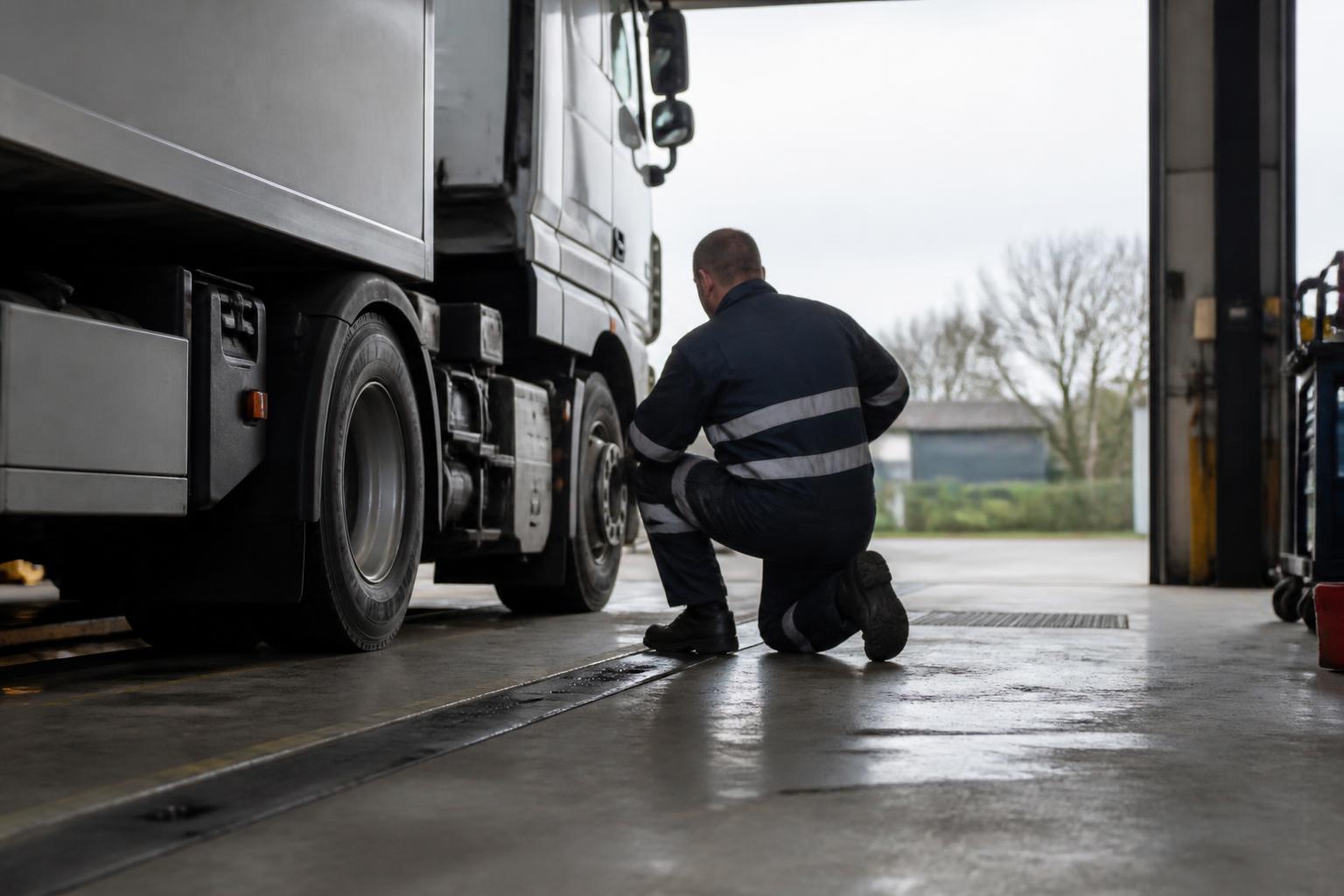
If your vehicle has failed its annual test, the first job is not to guess, order parts, or send the driver straight back out. It is to confirm exactly what the tester recorded, whether the vehicle can legally be moved, and what defects actually caused the fail. On HGVs and trailers, a short defect line on the test sheet can point to anything from a simple adjustment to a deeper brake, electrical or running gear fault.
At Woolpit Truck Repairs, we deal with HGV MOT fail repairs in Suffolk by starting with the fail sheet, the vehicle’s current condition, and the quickest safe route to a retest. For fleets and owner-drivers alike, the aim is the same, get the vehicle compliant again with the least wasted labour, the right parts, and no avoidable downtime.
What an HGV MOT fail means for the vehicle and operator
An MOT fail means the vehicle or trailer did not meet the required standard at test on that day. What happens next depends on the defects listed and the actual condition of the unit. Some vehicles can be moved for repair by prior arrangement. Others should not be driven except in tightly limited circumstances, or should be recovered. That distinction matters for your operator licence responsibilities as much as for road safety.
The first thing to confirm is the exact wording on the VTG documentation and any additional notes from the test. The defect wording matters because it tells you what the examiner actually found, not what the workshop or driver assumes has gone wrong. “Brake performance below requirement” is not the same as “brake binding”, and “lamp malfunction indicator” is not the same as a failed sensor or ECU. If you repair the symptom you guessed at, rather than the defect that was recorded, you risk paying for work that does not clear the fail.
You also need to confirm whether the fail sits on the truck, the trailer, or both. With artics, operators sometimes lose time by focusing on the tractor unit when the recorded issue is on the trailer axle, trailer ABS warning, or trailer brake imbalance. The fail sheet needs reading against the combination that was actually presented.
For operators in the UK, annual testing for HGVs and trailers follows the DVSA system, not the general passenger car MOT process people are more familiar with. That matters because the defect categories, brake performance evidence, and vehicle test procedures are specific to commercial vehicles. If you run internationally, do not assume a practice common elsewhere in the EU applies in exactly the same way here. The UK process is its own system and your next step should be based on the UK test result in front of you.
From an operator’s side, we usually advise confirming five things immediately:
- The exact fail items and any advisory items.
- Whether the vehicle is safe and lawful to move.
- Whether the issue is likely truck-side, trailer-side, or both.
- Whether parts are obviously needed before strip-down.
- Whether a retest slot can be planned around repair time.
That is where practical workshop triage saves time. A good workshop should explain the fail in plain English, tell you what needs checking first, and separate urgent safety work from secondary jobs that can wait.
Which defects usually lead to HGV MOT fail repairs
Most HGV and trailer fails come back to a familiar group of systems. The exact fault varies, but the same areas come up repeatedly in workshop bookings after test.
Brakes are one of the biggest. That includes low brake efficiency, imbalance across an axle, excessive fluctuations, binding brakes, poor park brake performance, worn friction material, seized components, air leaks, contaminated linings, maladjustment, and faults in valves or actuators. On trailers, we also see issues linked to load sensing, slackness in foundation brake components, and faults that only show properly under brake test conditions.
Warning lights and electronic brake systems are another common cause. ABS and EBS faults can trigger a fail even where the vehicle feels normal enough to the driver on the road. A warning lamp may be caused by a damaged wheel speed sensor, corroded wiring, a tone ring issue, a modulator fault, low voltage history, or a trailer electrical connection problem. The important point is that the light is not the diagnosis. It is the starting point.
Tyres regularly cause failures, especially where there is exposed cord, sidewall damage, cuts, bulges, mismatched fitment issues, or tread depth below the legal minimum. On commercial vehicles, tyre condition also ties into inflation, shoulder wear, axle geometry, and running gear condition. If a tyre has failed because something else is wearing it abnormally, replacing the tyre alone may not solve the real problem. We cover that in more detail in our guide to truck tyre failures in Suffolk and the safest next step.
Running gear defects are another regular fail area. Wheel bearings, hub play, suspension wear, broken or shifted leaves, damaged air bags, worn bushes, shock absorber issues, axle alignment concerns, and steering linkage wear can all lead to a fail. Some of these are obvious during inspection. Others show up as vibration, uneven tyre wear, brake variation, or noise before they are confirmed on the workshop floor. If the reported issue involves hub noise or play, our article on wheel bearing noise on an HGV and the safest next step is a useful reference.
Roadworthiness items also matter, even when operators are focused on a bigger mechanical concern. Lamps, reflectors, registration plate condition, body security, spray suppression, mirrors, wipers, washers, steps, guards, and visible air leaks can all turn a planned pass into a fail. So can insecure battery mountings, chafed brake pipes, fuel leaks, or damaged electrical looms.
On trailers, we commonly see fail items around:
- brake performance and imbalance
- ABS or EBS warning faults
- tyres and wheel security
- air leaks and suzie connection issues
- worn bushes, suspension components, or axle-related wear
- lighting and marker lamp faults
- structural or body security concerns
This is why hgv mot fail repairs suffolk operators need are rarely just “fix the one item and send it back”. The recorded fail may be one line, but the cause can sit elsewhere in the system.
How a workshop should assess the fail before starting repairs
A proper assessment starts with triage, not parts fitting. We want the fail sheet, the driver’s report if there is one, any warning lights currently showing, and a quick picture of whether the defect appeared suddenly or has been building over time. That context often points us in the right direction before tools come out.
The first stage is visual and practical inspection. If the fail is tyre-related, roadworthiness-related, or clearly visible running gear wear, we can often confirm the issue quickly. If it is brake performance, electronic braking, or an intermittent warning fault, visual checks alone are not enough.
For brake-related fails, roller brake testing is one of the key steps. It helps confirm whether the problem is low effort, imbalance, drag, delayed application, or something less obvious. A vehicle can feel acceptable to a driver and still fail on measured brake output. Equally, replacing chambers, discs or pads without testing can lead to wasted work if the root cause is elsewhere in the air system or control side.
Diagnostics matter where warning lights or electronically controlled systems are involved. On modern HGVs and trailers, ABS and EBS faults need proper fault code reading and live assessment where relevant. That means checking sensor readings, wiring integrity, connector condition, power and earth supply, and whether the issue is current or historic. On trailers especially, the workshop needs to identify whether the fault sits in the trailer system itself or is being triggered by the tractor connection.
This is also where experience with truck and trailer combinations matters. A workshop used to cars or light vans may not approach the fault path correctly on heavy commercial systems. We focus only on HGV and trailer work, so our starting point is always how the defect behaves in a working commercial setup, not a generic repair process. If you are weighing up who should handle the diagnosis, our article on truck and trailer faults in Suffolk, who should diagnose what explains the split.
A good assessment should also identify knock-on issues before repair starts. For example:
- A brake imbalance may trace back to contamination from a leaking hub seal.
- Repeated tyre edge wear may point to worn suspension or alignment issues.
- An ABS lamp may be caused by wiring damage from movement in a worn mounting.
- A trailer brake fail may involve both service work and electrical fault tracing.
That is why we explain the defect in plain terms before proceeding. Operators need to know what failed, why it failed, what is definitely required, and what should be checked while the vehicle is already in. That is the difference between efficient repair and a string of repeat bookings.
How to plan repairs and retest with the least downtime
The fastest route back on the road is usually the one that avoids doing the job twice. That starts with deciding what must be repaired for the retest, what should be dealt with at the same time because access is already there, and what can wait for a planned maintenance slot.
For fleets, the key is coordination. If a tractor unit fails with a trailer-related issue, the trailer should be isolated and assessed without tying up the prime mover any longer than needed. If the truck has failed on brakes and tyres, it often makes sense to complete both together rather than return it to service only to stop it again days later. The same goes for defects that affect test readiness, such as warning lights, air leaks, and obvious roadworthiness items.
For owner-drivers, parts timing is often the biggest factor. Before committing to labour, it helps to know whether the likely repair needs stocked service items, specialist brake components, sensors, hubs, or trailer-specific parts. A proper assessment allows labour and parts to be sequenced in the right order, rather than stripping the vehicle down and then waiting.
Retest planning matters too. In many cases, downtime is reduced by booking repair and MOT preparation together, rather than treating them as separate jobs with a gap in between. Once the fail items are repaired, the vehicle should be checked as a whole, not just at the failed component. There is little value clearing one brake issue if a lamp fault, tyre defect, or air leak sends it back to fail again.
That is why we often recommend combining the immediate repair with a sensible pre-test check. Our guide to Pre-MOT HGV checks that cut the risk of a fail sets out the sort of issues worth catching before the vehicle goes back in.
Where a vehicle is off-road away from base, recovery or callout decisions should be made early. If the defect makes roadside repair unrealistic, losing hours on phone calls and assumptions helps nobody. A workshop should be able to tell you whether the likely next step is mobile attendance, recovery, or direct workshop booking.
The practical sequence we use is straightforward:
- Read the fail sheet and confirm legal movement position.
- Triage the defect and identify truck, trailer, or combination issue.
- Inspect and test before ordering major parts.
- Confirm the repair scope clearly.
- Complete repair work and recheck related systems.
- Prepare properly for retest, not just the original fail line.
That is the approach that keeps HGV MOT fail repairs in Suffolk commercially sensible, especially when the vehicle is part of a working fleet and every day off-road affects deliveries, driver time, and customer commitments.
Why location and route access matter when a vehicle has failed
When a vehicle has failed, workshop location is not just a convenience issue. It affects recovery mileage, driver time, route disruption, and how quickly the unit can get from test result to inspection, repair, and retest.
We are based at Bridge Farm in Woolpit, close to A14 J47. For operators running through Suffolk, that matters because it gives practical access from the main east-west route without dragging a failed truck or trailer deep into side roads or across a long diversion. If you are covering Ipswich, Felixstowe, Stowmarket, Bury St Edmunds, Newmarket or Elmswell, being near the A14 usually makes the next step simpler.
That is particularly useful for:
- fleet vehicles moving between depots and customer sites
- port-related traffic to and from Felixstowe
- owner-drivers working the A14 corridor
- trailers that need workshop attention without unnecessary dead mileage
- vehicles that have failed locally but need a workshop that understands truck and trailer test defects
Location also helps when the fail is not the whole story. A truck may arrive for one recorded issue and turn out to need brake testing, diagnostics, tyre support, or a broader roadworthiness check before it is ready to go back. Having those services in one HGV-focused workshop reduces handoffs and guesswork.
At Woolpit Truck Repairs, we keep the advice practical. If the fail wording points to a likely brake issue, we say so. If the warning light needs diagnostics before parts are ordered, we say that too. If the vehicle should not be driven and recovery is the sensible option, we will tell you plainly. That matters more than broad promises when a truck or trailer is already losing time.
Woolpit Truck Repairs is operated by FLEETA LIMITED, and our job is to help operators make the next sound decision after a fail. If your HGV or trailer has failed in Suffolk, the best starting point is the actual defect wording, a proper assessment, and a repair plan built around the fastest safe return to test and service.
Can an HGV be driven after an MOT fail?
That depends on the defect and the vehicle’s condition. If it is not roadworthy, it should not be driven in service. The fail details need checking first so the next step is safe and compliant.
What repairs are most common after an HGV MOT fail?
Common repair areas include brake imbalance, worn components, ABS or EBS faults, tyre defects, lighting issues, trailer defects and other roadworthiness items found during inspection or brake testing.
Do trailer defects need separate assessment after a fail?
Yes. Trailer faults often need their own inspection, especially where braking, tyres, lights or running gear are involved. Treating the unit and trailer as one problem can miss the actual cause.
How can a workshop confirm the real cause of a brake fail?
A proper assessment usually combines inspection, diagnostics and roller brake testing. That helps show whether the issue is adjustment, wear, air system performance, ABS or EBS faults, or a wider axle problem.
Why use a workshop near the A14 for MOT fail repairs?
For Suffolk operators, route access matters when a vehicle is already losing time. A workshop at Bridge Farm in Woolpit near A14 J47 can be more practical for vehicles working around Ipswich, Felixstowe and nearby routes.