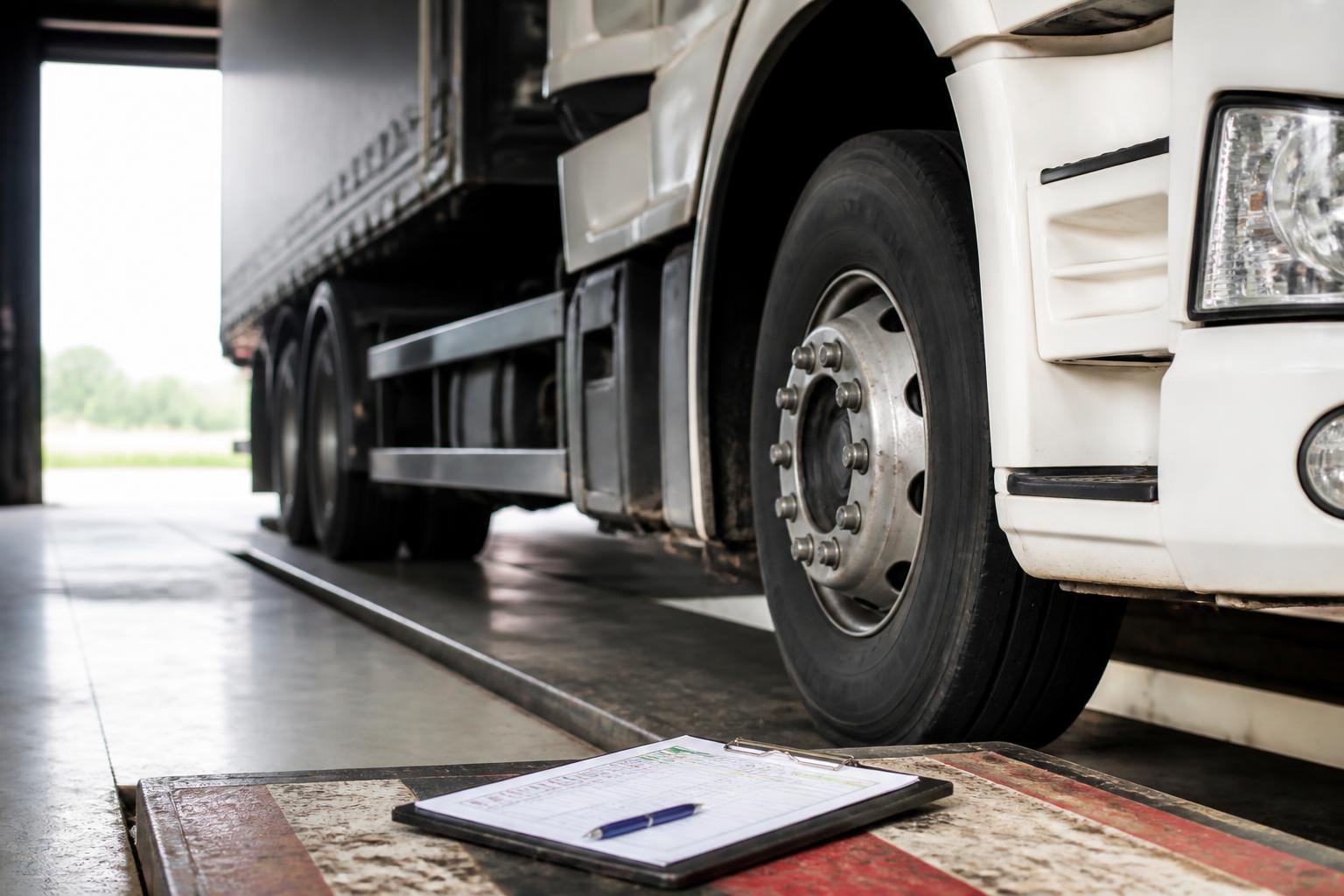
If you want to cut the risk of an MOT fail, the best step is not simply booking the test and hoping for the best. A proper HGV inspection before MOT gives you time to find defects, decide what matters now, and deal with repairs before the vehicle or trailer is committed to a test slot. That matters whether you run a fleet, a single unit, or a mixed operation with trailers moving between sites and routes.
At Woolpit Truck Repairs, we see the difference every week between planned preparation and test-day surprises. The operators who manage MOTs best are usually not the ones doing the most paperwork. They are the ones who know what kind of inspection they need, when a brake concern needs measuring rather than looking at, and when a warning light or repeat advisory means the check needs to go deeper.
What a pre-MOT inspection does and does not do
A pre-MOT inspection is preparation. The MOT is the official annual test.
That sounds obvious, but it matters because operators sometimes expect a workshop pre-check to guarantee a pass. It cannot do that. Only the MOT result issued through the official test process decides whether the vehicle or trailer has passed, failed, or received advisories.
What we can do in an HGV inspection before MOT is assess roadworthiness, identify defects that are likely to cause a fail, and put right what needs attention before the test. That includes items such as brakes, tyres, steering, suspension, lights, chassis condition, air leaks, warning lights, load security related defects on trailers where relevant, and general condition issues that tend to appear at annual test.
What it does not do is replace the MOT lane, the DVSA test procedure, or the tester’s judgement on the day. A vehicle can still present a defect between inspection and test. A trailer can develop a lighting fault on the way in. A brake imbalance can appear under test conditions even if the vehicle felt acceptable on the road. That is why timing matters. A pre-MOT check carried out too far in advance is less useful than one planned close enough to the test to reflect the vehicle’s current condition, while still leaving time for parts and repairs.
In the UK, operators also need to remember that annual testing practice is tied to DVSA requirements, not a general EU approach. If you run across borders, that does not change what your UK-based HGV or trailer needs to meet for its MOT here.
A good pre-MOT process should leave you with three things. First, a clearer view of likely fail points. Second, a realistic repair plan. Third, a decision on whether the vehicle or trailer is ready to test now, or should be repaired first.
Light check or full workshop inspection
Not every vehicle needs the same level of inspection.
A basic roadworthiness look-over is useful when you need a quick sense of whether a unit or trailer is broadly fit to present, especially if the MOT date is close and there are no known issues. This type of check usually covers obvious defects such as tyre condition, wheel security indicators, lamp operation, visible air leaks, damaged lines, worn components with visible play, body damage affecting safety, registration plate condition, mirrors, and obvious trailer defects.
That level of check suits some low-risk situations. For example, a fleet vehicle with a strong maintenance record, no warning lights, no recent advisories, and no driver-reported defect may only need a sensible pre-test look-over.
A full workshop inspection goes further. It is the better option where there is any doubt about brakes, suspension, steering, warning lights, repeated defects, trailer running gear, or the quality of recent repairs. It is also usually the right choice for owner-drivers, because one failed test can disrupt the whole week’s work rather than just one slot in a larger fleet.
For trailers, the deeper inspection is often more valuable than operators expect. Trailers can be the source of repeat MOT problems because they are shared, parked, loaded by different people, and not always reported consistently. Lamp faults, brake performance issues, tyre wear, damaged suzies, worn couplings, cracked mudwings, and ABS or EBS faults can all sit unnoticed until the wrong day.
For fleets, the right answer is often mixed. Some assets only need a light pre-test check. Others need workshop time. The point is not to buy the biggest inspection every time. It is to match the inspection to the risk in front of you.
If you need a workshop-led assessment rather than a cursory glance, our HGV and trailer inspection support is built around that practical difference.
Brake testing versus visual brake checks
Brakes are where many operators lose time by relying on what can be seen, rather than what can be measured.
A visual brake check can identify obvious faults. You may spot worn linings if accessible, damaged chambers, air leaks, broken or insecure components, contaminated parts, heat damage, or signs that something is not operating correctly. That is useful, but it is not the same as knowing how the brake system is actually performing under load.
Roller brake testing gives different information. It measures braking effort, balance across an axle, and can help show whether a unit or trailer is likely to meet the required performance standard. It can also bring out problems that are not obvious during a walk-round or workshop visual check, such as imbalance, underperformance, dragging, or inconsistent operation.
That is why a vehicle can look acceptable and still fail on brakes.
If there is a known brake concern, recent brake work, a pull under braking, poor feel, uneven wear, or a previous brake advisory, a visual inspection alone is often not enough. The same applies where ABS or EBS faults are involved. A warning lamp that has been intermittent, a trailer with an electronic braking fault history, or a unit showing system errors needs more than someone saying the hardware looks fine.
ABS and EBS issues can sit in the background without producing an obvious mechanical symptom until they affect test results, fault memory, or warning lamp status. In those cases, proper diagnostics and brake testing are usually the sensible route. A quick look may tell you there is no broken wire hanging loose. It will not tell you enough about sensor readings, stored faults, modulator behaviour, or actual brake performance.
We regularly advise operators to separate two questions. Is anything visibly wrong with the brake system? And, does the braking performance prove out properly? Those are not the same question.
If brake performance is the concern, read more about roller brake testing before an MOT delay starts. If the issue sits with trailer braking in particular, our guide to trailer brake testing in Suffolk before downtime spreads covers the practical warning signs.
Using defect history to decide how much to inspect
The quickest way to waste workshop time is to inspect every vehicle as if it had no history. The quickest way to miss a fail risk is to ignore the history it does have.
Previous MOT advisories should change the scope of the pre-MOT inspection. If a vehicle was advised on brake imbalance last year, we want to know whether that was fully resolved, partially improved, or has started to return. If a trailer has had repeated tyre edge wear, that points us toward axle, suspension, or usage issues rather than treating the next worn tyre as a one-off.
Repeat defects matter more than isolated ones. One lamp fault before an MOT can be bad luck. Three lamp faults across the year on the same trailer may point to wiring damage, poor connections, water ingress, or a handling problem on site. One ABS warning event may need checking. Repeated ABS or EBS faults should push the inspection beyond a visual check and into diagnostics.
Warning lights are another place where scope should change immediately. If the dash shows ABS, EBS, or another active fault, that is not the moment for the lightest possible pre-MOT check. The same applies if the driver reports intermittent warnings that have recently cleared. Faults that come and go are still faults worth chasing before test day.
Recent repairs also need to be considered properly. New parts do not automatically mean lower risk. If brake components, wheel bearings, suspension parts, steering items, or electrical components were fitted recently, it is worth checking that the repair has bedded in correctly, that no related issue remains, and that no secondary defect has appeared. We often find that the problem is not the new part itself, but an associated issue nearby.
For fleet operators, this is where good defect reporting pays back. For owner-drivers, it is where memory and paperwork both matter. Bring the previous test sheet, any maintenance notes, and a clear description of what has happened since. That helps us decide whether the vehicle needs a fast pre-test inspection or a fuller workshop assessment with diagnostics or brake testing.
Workshop preparation or test-day gamble
Turning up for MOT and hoping it passes can work. It can also create avoidable downtime at the worst possible moment.
The problem is not just the fail itself. It is what follows. If the defect is simple and parts are on hand, you may recover quickly. If the defect involves brake components, warning light diagnosis, trailer parts, tyre availability, or a fault that needs proper investigation, the vehicle can be off the road longer than the original inspection would have taken.
Parts timing matters. Even common service items are not the whole story. Some HGV and trailer parts are straightforward to source, others are less so, and some faults are only properly identified once the vehicle is in the workshop. If you only discover the issue at test time, you have compressed diagnosis, parts sourcing, repair, retest planning, and job commitments into the same narrow window.
Trailer issues are especially disruptive because they are often treated as easier to swap out than units. That works until the spare trailer has its own defects, the booked load needs a specific trailer type, or multiple trailers are already committed. A preventable trailer MOT fail can spread into loading, route planning, and customer delivery problems very quickly.
Planned MOT preparation gives you options. You can decide what must be repaired now, what can be scheduled, whether the test booking should move, and whether another asset should cover the work. You also reduce the chance of paying for urgency that could have been avoided with a sensible workshop slot a few days earlier.
That is the commercial case for preparation. Not perfection, just fewer surprises.
Choosing a workshop near your route
A workshop can be technically capable and still be impractical for pre-MOT work if getting in and out costs too much time.
For operators in Suffolk and on nearby trunk routes, location matters in a very ordinary way. Can you reach the workshop without dragging a unit and trailer through roads that do not suit the job? Can you get in, explain the issue clearly, and get a realistic answer about next steps? Can the workshop handle HGVs and trailers as routine work, rather than as occasional larger vehicles mixed into a car-based setup?
That is why many operators around Ipswich, Felixstowe, Stowmarket, Bury St Edmunds, Newmarket, Elmswell, and Woolpit look for support close to the A14. Access near A14 J47 makes a practical difference if the vehicle is already on route, if you are trying to minimise dead mileage, or if a trailer issue needs checking before it becomes a wider downtime problem.
At Woolpit Truck Repairs, we operate from Bridge Farm in Woolpit, Suffolk, close to A14 J47. For many operators, that means a workshop stop can fit into the day without turning into a detour that causes another problem elsewhere.
The other point to judge is workshop focus. We work on HGV and trailer jobs, not general retail vehicle work with the occasional truck in the corner. That affects how quickly faults are triaged, how defects are explained, and whether the advice you get is actually useful. Sometimes the right answer is, yes, this needs brake testing and diagnostics before MOT. Sometimes it is, no, this can be dealt with as a straightforward repair and recheck. Sometimes it is, this trailer is not the one to send for test this week.
That kind of practical triage matters more than broad promises.
It also helps to ask how the workshop explains defects. You should come away knowing what has been found, whether it is likely to affect MOT, what needs doing now, and what the next sensible step is. If there is an ABS or EBS fault, you should be told whether that points toward diagnostics, wiring checks, sensor issues, or a deeper brake system investigation. If tyres are part of the risk, the advice should be specific about condition and timing, not vague.
For operators who need support beyond a simple inspection, we also provide commercial vehicle diagnostics when warning lights or fault codes need proper answers.
Woolpit Truck Repairs is part of FLEETA LIMITED, and our day-to-day work is built around the practical needs of HGV operators moving through Suffolk and along the A14 corridor. If you are deciding where to book an HGV inspection before MOT, the useful test is simple. Choose a workshop that understands HGVs and trailers, is practical for your route, and will tell you plainly whether you need a light check, a full inspection, brake testing, diagnostics, or repairs before the test date arrives.
Is an HGV inspection before MOT the same as an MOT pre-test?
In practice, operators often mean the same thing: a check before the MOT to find likely fail points. It is still separate from the official MOT test.
How early should I book a pre-MOT inspection?
Early enough to leave time for repairs, parts and a retest if needed. If the vehicle has known faults or trailer defects, leave more time than you think you need.
Do trailers need a separate pre-MOT inspection?
Yes. A trailer can have its own brake, tyre, lighting, ABS or structural defects. It should be inspected on its own merits, not assumed ready because the unit is.
Will a roller brake test guarantee an MOT pass?
No. It is a useful indicator of brake performance, but the MOT covers more than brake figures alone. Other defects can still cause a fail.
What if the vehicle has an ABS or EBS warning light?
Treat it as a fault to investigate, not something to leave until test day. Warning lights can point to defects that need diagnostics and repair before the MOT.