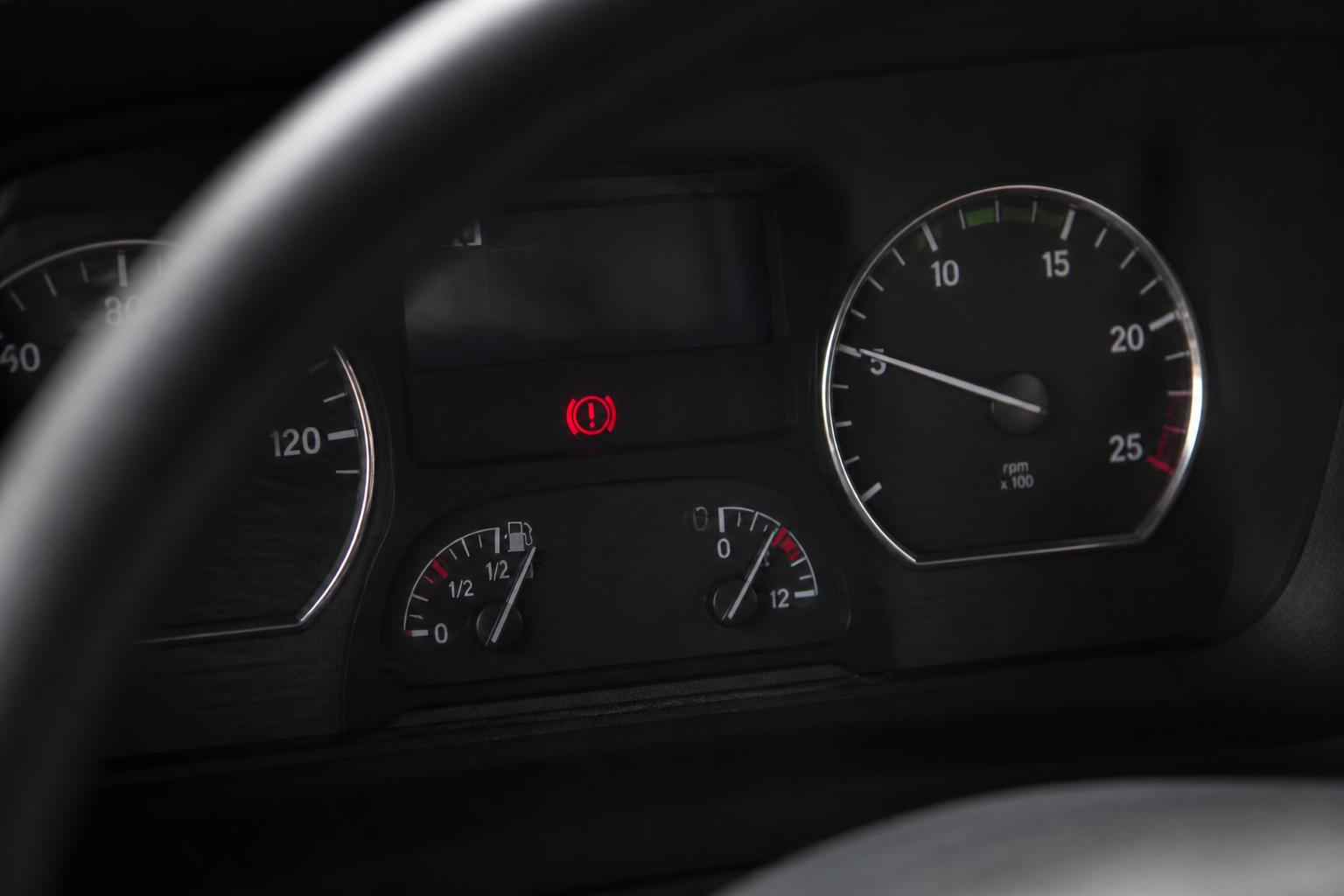
If you are asking, can I drive an HGV with a brake warning light, the safe answer is usually no until you know exactly what the warning is for. A brake warning light can mean anything from low air pressure during start-up to an active fault affecting braking performance, ABS, EBS, or a trailer brake circuit. On a commercial vehicle, that is not something to guess at or drive around for convenience.
The practical rule is simple. If the warning stays on, comes on while driving, or is accompanied by low air pressure, a buzzer, poor brake feel, pulling, or trailer brake concerns, treat the vehicle as potentially unroadworthy until checked. Finishing the delivery does not come before roadworthiness. Around Woolpit, Suffolk, and along the A14, the right next step is to stop, assess the defect properly, and decide whether the vehicle needs workshop attention, a brake test, or recovery support.
What does a brake warning light on an HGV usually mean?
On an HGV, a brake warning light is not one single fault. It is a warning that one part of the braking system is outside normal operating condition. The cause can be simple, but it can also be serious enough to put the vehicle off the road immediately.
A common cause is low air pressure. On air-braked vehicles, the warning may appear during start-up before the system has fully charged. That can be normal for a short period. It is not normal if the pressure fails to build correctly, drops away, or the warning remains on after the system should be ready to move. If an air leak, compressor issue, dryer fault, valve problem, or reservoir issue is stopping pressure from reaching the proper operating range, the vehicle should not go back on route.
Another frequent cause is an ABS or EBS fault. Modern HGVs and trailers rely on electronic brake control, wheel speed information, and modulator response. A failed wheel speed sensor, damaged tone ring, wiring defect, corroded plug, poor earth, or modulator issue can trigger a warning. Sometimes the service brakes still apply, but the system may lose anti-lock function, stability-related intervention, brake force optimisation, or proper communication between unit and trailer.
Worn brake components can also trigger warnings, either directly through pad wear sensing or indirectly through poor brake performance and imbalance. We regularly see faults linked to worn pads, seized calipers, sticking sliders, damaged discs, contaminated linings, weak return action, and trailer brake defects. A warning light may be the first sign the driver sees, but the underlying issue may already be affecting stopping performance.
Sensor and electrical issues are also common. A brake warning does not always mean the foundation brakes themselves have failed. It may be a pressure sensor, brake switch, wiring break, damaged connector, or intermittent fault logged in the ECU. That still needs proper diagnosis, because an electrical fault can either mask a real brake problem or reduce system function in a way that is not obvious from pedal feel alone.
Trailer-related defects are another major source of brake warnings. Suzie line issues, ISO socket faults, damaged plugs, trailer EBS faults, poor electrical continuity, air leaks at the coupling, or a fault within the trailer brake system can all bring a warning onto the unit dash. In an artic combination, you need to know whether the defect is on the tractor, the trailer, or the connection between them. If you need a broader overview of first actions, our guide to brake warning lights on HGVs and what to do next covers the early triage clearly.
Can you legally and safely keep driving?
The legal and practical answer is that you can only continue if the vehicle remains roadworthy, and if you know the fault does not compromise braking performance or required brake system function. In many cases, you will not know that from the cab alone.
If the brake warning appears with low air pressure, an audible alarm, poor retardation, increased stopping distance, pulling to one side, a trailer that feels as if it is pushing, or any sign that the brakes are not behaving normally, stop immediately in a safe place. Do not try to nurse it to the next drop. Do not assume it is just a sensor. At that point you are dealing with a possible safety-critical defect.
If the warning appears at start-up and then clears once full air pressure is reached, you may simply have been watching the normal self-check sequence. If it clears and stays clear, that is very different from a warning that remains active or returns as soon as you move. Likewise, an intermittent warning that comes and goes over bumps or on lock may point to wiring or sensor damage, but it is still a defect that needs attention before the vehicle resumes normal work.
There are limited cases where very short movement may still involve judgement. For example, moving within a yard, shunting to a safe inspection area, or repositioning off a live carriageway can be necessary. That is not the same as deciding the vehicle is fit to continue on the public highway. A short controlled move to reach safety may be justified. Continuing a loaded road journey is a separate decision and needs a proper defect assessment.
In Great Britain, the key point is roadworthiness. A warning light on its own is not the legal test. The legal test is whether the braking system is in efficient working order and whether the vehicle is safe to use on the road. In practice, if you have an unexplained active brake warning, you are on weak ground if you choose to continue and the vehicle is later found to have a braking defect. EU operators may see similar principles applied, but local enforcement and defect categorisation can differ by country. For operators in Suffolk running between Ipswich, Felixstowe, Stowmarket, Bury St Edmunds, Newmarket, and Elmswell, the sensible approach is to make the roadworthiness decision before the route decision.
What should the driver check before moving again?
Before moving again, the driver should carry out basic checks that can be done safely at the roadside or in the yard. The aim is not to repair the vehicle from the hard shoulder. It is to establish whether the warning was a temporary start-up condition, an obvious connection issue, or a defect that means the vehicle needs workshop support.
Start with air build-up. Watch the gauges and confirm the system reaches normal operating pressure. If pressure is slow to rise, will not fully build, or drops noticeably with the engine running or brakes applied, stop there. Listen for obvious air leaks around the unit, trailer front end, suzies, and couplings.
Check the dash properly, not just the lamp. Many vehicles display text warnings or identify whether the issue relates to the unit, trailer, ABS, EBS, park brake circuit, service brake circuit, or low pressure. That extra information matters. A generic red or amber brake symbol means far less than the actual message behind it.
If you are coupled to a trailer, inspect the red and yellow air lines and the electrical line. Make sure the suzies are fully connected, not crossed, not damaged, and not under tension. Check the electrical plug for poor seating, corrosion, bent pins, or obvious damage. If you can safely swap to another trailer and the warning clears, that can help isolate whether the fault is on the trailer or the unit. We cover the trailer side in more detail in our guide to what to check first on a trailer ABS warning light.
Walk round the vehicle and trailer. Look for anything obviously wrong, air leaks, damaged brake chambers, hanging cables, hot hubs, signs of a binding brake, broken sensor wiring, or a wheel area that suggests contact damage. If a brake has been dragging, you may smell heat or see evidence of overheating.
Check brake feel carefully in a safe area. Does the foot brake feel normal? Is the response delayed? Does the vehicle pull? Does the trailer feel balanced? Does the park brake release and apply normally? If there is any doubt about actual braking performance, do not continue.
Then see whether the fault clears or returns. A warning that clears after reconnecting a trailer line or allowing air to build may still need reporting and inspection. A warning that returns as soon as you move, brake, or couple the trailer again is telling you the defect is still present.
From an operator’s point of view, this is where a good defect report matters. Record what the warning showed, whether it was red or amber, whether it affected the unit or trailer, air pressure readings if relevant, and what happened when the vehicle moved. That gives the workshop something useful to work from and cuts diagnostic time. We see avoidable downtime when the report just says “brake light on” and nothing more. Our article on warning light checks that cut HGV downtime explains the kind of information that helps.
How serious are ABS and EBS warning lights?
ABS and EBS warnings need taking seriously, but they do not all mean the same thing.
A general brake warning often points the driver toward a broad braking system issue such as low pressure, a service brake fault, or another condition the vehicle considers safety critical. An ABS warning is more specific. It usually means the anti-lock function is unavailable on one axle, one wheel station, or part of the vehicle combination. The foundation brakes may still work in normal service braking, but wheel lock protection under heavy braking may be reduced or lost.
An EBS warning can be more significant because EBS is the control layer for many modern HGV braking functions. Depending on the vehicle and trailer specification, an EBS fault can affect brake balance, electronic control of brake application, communication between tractor and trailer, stability support, and how the system manages emergency or uneven braking situations. Some systems revert to a fallback mode. That does not automatically mean the vehicle is fit for normal operation. It means the system has degraded and now needs diagnosis.
This is why diagnosis matters before the vehicle goes back on route. A wheel speed sensor fault may sound minor, but if it is repeated, intermittent, or linked to damaged wiring, the system may not behave properly under load or in poor grip conditions. A trailer EBS fault may leave the driver with service braking that feels acceptable on light application but is unbalanced in a hard stop. You cannot confirm brake efficiency from a dash light alone.
In workshop terms, we normally want fault code interrogation, a physical inspection of the braking components and wiring, and where needed a proper brake performance check. If the warning follows a trailer, the trailer has to be part of the diagnosis. If it stays with the unit regardless of trailer, that points the other way. If there is any question over actual brake output or imbalance, a roller brake test is the right next step. Our roller brake testing service is there for exactly that kind of decision point.
When should you call a workshop or recovery support?
Call a workshop as soon as the warning does not clearly resolve as a normal start-up condition, or if you have any sign that braking performance may be affected. Waiting to see if it goes away on the next run often turns a manageable defect into a roadside stop, a missed slot, or a failed MOT preparation check.
You need workshop input if the warning remains on, returns repeatedly, follows a particular trailer, appears with an ABS or EBS message, or is linked to an air loss concern. You also need support if the driver reports poor brake feel, pulling, overheating, or unusual trailer behaviour under braking. Those are not defects to leave until the weekend.
You need recovery support, or at least a firm do-not-drive decision, if air pressure will not build correctly, the warning is red and active, the alarm continues, the vehicle is clearly not braking normally, or the defect location is unsafe for roadside inspection. The same applies if the trailer brakes are in doubt and the vehicle is loaded or route critical. A short move to safety is one thing. Continuing on the A14 with an unresolved brake fault is another.
For operators near Woolpit Truck Repairs, the practical advantage is access. We are at Bridge Farm, close to A14 J47 in Woolpit, Suffolk, which makes us a workable option for vehicles moving between Ipswich, Felixstowe, Stowmarket, Bury St Edmunds, Newmarket, and Elmswell. If the safest next step is workshop diagnosis, brake testing, repair, or MOT-related brake preparation, we can help you decide whether the vehicle should come in under its own steam, be attended to by callout, or be recovered.
Our approach is straightforward. We triage the symptom first, separate unit faults from trailer faults, explain what the warning is likely to mean, and then confirm it with diagnostics and inspection rather than guesswork. Where brake output or balance is in question, we test it properly. Where the defect is clearly unsafe, we say so plainly.
Woolpit Truck Repairs is operated by FLEETA LIMITED, and our work is focused on HGVs and trailers rather than mixed vehicle traffic. That matters when the issue is not just “a warning light” but a brake system defect that affects earning time, compliance, and risk.
If your driver is asking whether they can keep driving with a brake warning light on, the best answer is to stop treating it as a yes or no question. First identify whether it is low air, ABS, EBS, trailer-related, or a genuine brake performance problem. Then decide the next step based on roadworthiness, not schedule pressure. That is the point where a clear workshop assessment saves time and usually saves a bigger problem later.
Can I drive an HGV with a red brake warning light?
Treat a red brake warning light as serious. If braking, air pressure or warning messages suggest a live defect, stop and assess before moving. Driving on without checks can be unsafe and may leave the vehicle unroadworthy.
Is an ABS warning light less serious than a brake warning light?
Not always. The vehicle may still brake, but ABS performance may be reduced or unavailable. On an HGV or trailer, that still needs proper diagnosis before normal work continues.
Can a trailer fault bring on a brake warning light on the unit?
Yes. Trailer electrical or braking faults, poor suzie connections, sensor issues or EBS communication problems can trigger warnings on the unit and should be checked as part of the fault.
Will a brake warning light fail an MOT?
A brake-related warning light can point to a defect that affects MOT outcome, especially if it reflects a braking system fault or warning system issue. The vehicle should be inspected before test.
What checks should a driver do first?
Check air pressure build-up, listen for leaks, confirm trailer connections, note any dash messages, test brake feel carefully and see whether the warning clears or returns. Do not guess if the fault remains.