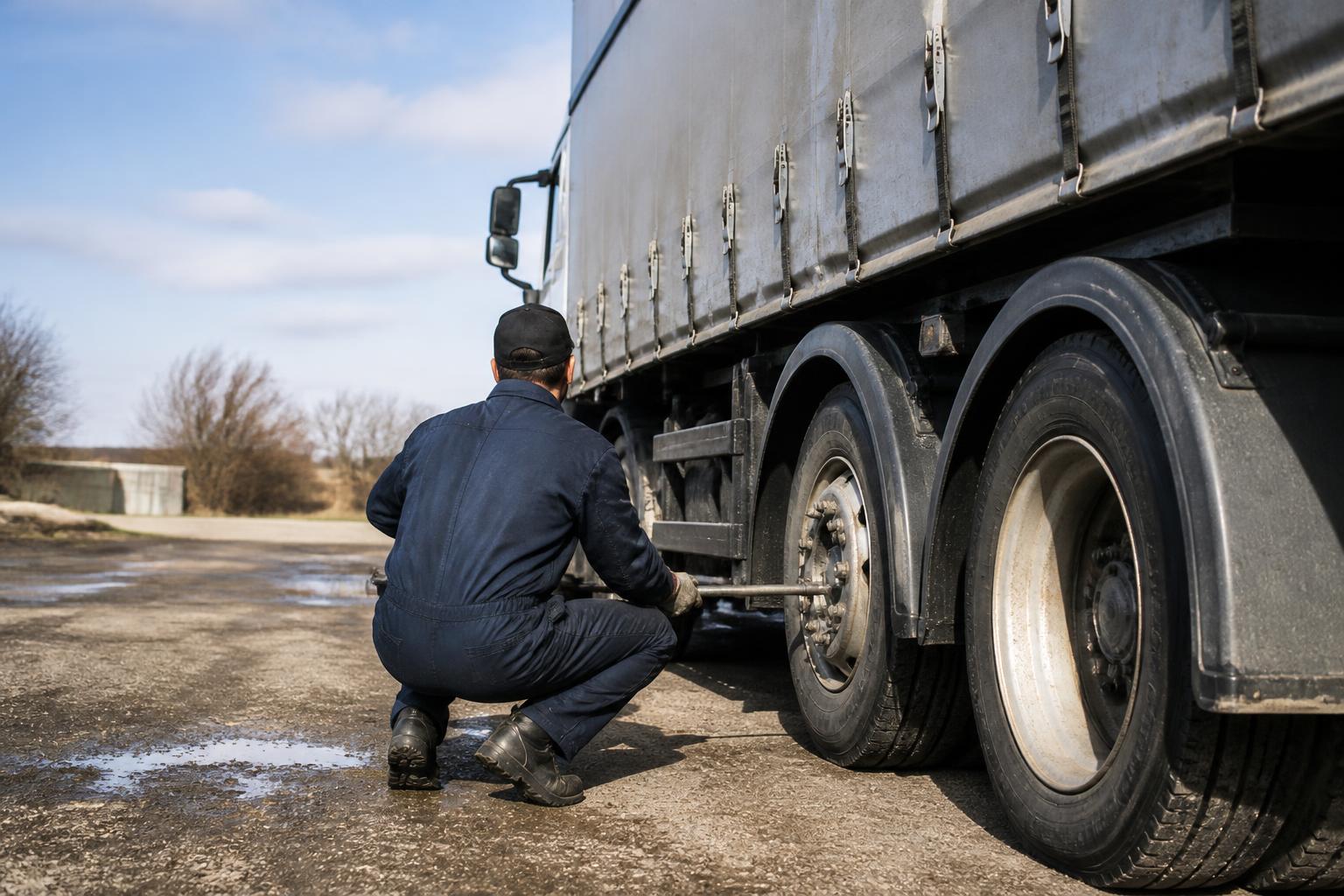
If a truck starts drifting left or right only when the brakes are applied, that is not a quirk to monitor and carry on with. It usually means braking effort is uneven somewhere across the axle group, or that another fault is only showing itself when weight transfers forward under braking. In plain terms, one side is slowing harder than the other, or the chassis and running gear are reacting differently side to side.
For an HGV or trailer operator, the first job is not to guess which component has failed. It is to decide whether the vehicle is still safe to move, then narrow the fault down properly. At Woolpit Truck Repairs, near A14 J47 at Bridge Farm, Woolpit, we see this on rigids, artics and trailers running through Suffolk, Ipswich, Felixstowe, Stowmarket, Bury St Edmunds, Newmarket and Elmswell. The cause can be as simple as a tyre issue or as serious as a brake imbalance that will fail an MOT and put the vehicle off the road.
What a pull under braking usually means
When operators describe a vehicle pulling on the brakes, they usually mean this. The truck runs straight enough while driving normally, but as soon as the service brake is applied, the steering needs correction because the vehicle drifts or tugs to one side. Sometimes it is a steady pull. Sometimes it is a sudden snatch on first brake application. On a unit and trailer combination, the driver may feel it through the unit even though the fault is on the trailer.
The main fault groups are fairly consistent.
First, there are brake output faults. One wheel end, one side of an axle, or one axle in the combination is applying more or less braking force than it should. That can come from worn linings, contamination, seized components, poor adjustment, a faulty chamber, an air supply issue, or a problem in the foundation brake itself.
Second, there are tyre and wheel faults. A badly mismatched tyre, underinflation, a shifted belt, uneven tread depth, a damaged sidewall, or a wheel bearing issue can make the vehicle react differently under load transfer. Braking then exposes the imbalance.
Third, there are axle, steering and suspension faults. Worn bushes, spring issues, ride height problems, axle misalignment, steering play, or a damaged suspension component can allow the vehicle to steer itself slightly when brake force comes on.
Fourth, there are control system faults, especially on newer vehicles and trailers with ABS or EBS. These systems do not create every pull complaint, but they can contribute if a sensor, modulator, valve or wiring fault is affecting brake control on one side or one axle.
That is why a report of a truck pulling to one side under braking should never be treated as just a brake pad question. It is a symptom, not a diagnosis.
The faults most likely to cause it on an HGV or trailer
On an HGV, the most common causes sit at wheel end level.
A brake on one side may be underperforming because the caliper is sticking, the slide pins are seized, the pads are tapered, the disc is badly worn, or the linings are contaminated. On drum brake setups, a seized camshaft, worn rollers, weak return springs, poor shoe condition or incorrect adjustment can do the same. If one side bites and the other side lags, the vehicle pulls toward the stronger side.
The opposite can happen too. A brake can bind on one side, heat up, glaze, and then behave inconsistently. The driver may report a pull only after a few applications, or once the vehicle has been running for some distance. If that sounds familiar, our guide on what to check first when trailer brakes are binding on the A14 covers the early signs.
Air faults are another regular cause. A damaged hose, restricted line, leaking chamber, sticking relay valve, or poor response from a load sensing or modulating component can delay or reduce brake application on one side or one axle. On trailers, if the service line issue is not equal across the system, the trailer can steer the combination under braking. With ABS or EBS equipped trailers, a fault in a modulator or wheel speed signal may alter brake behaviour, even where the mechanical brake itself is serviceable.
Tyres matter more than many drivers expect. Different rolling radius side to side on the same axle, major pressure differences, uneven shoulder wear, casing damage, or mixed tread patterns can all change how the vehicle behaves under braking. A steer axle tyre defect is especially noticeable because the driver feels it immediately through the wheel. On trailers, tyre issues can still produce a brake pull complaint because the trailer starts to steer or scrub under load.
Wheel bearings and hub condition also belong on the list. Excessive play, overheating or partial seizure can upset braking and tracking together. A bearing defect may first show up as heat, noise, or abnormal tyre wear before the operator links it to the pull.
Suspension and axle alignment faults are often missed at first report. Broken leaves, worn spring eye bushes, air suspension leaks, ride height valve faults, worn torque rod bushes, cracked hangers, or a shifted axle position can all create side to side differences in how brake force acts on the chassis. Under braking, that becomes a drift or steer effect.
On trailers, we also pay close attention to axle set up and brake balance across axle groups. A tri-axle trailer with one weak brake station may not feel the same as a rigid with a single front axle issue. The complaint is similar, but the test route to confirm it is different.
What the driver should notice before the vehicle goes off the road
Most serious brake pull faults do not appear with no warning at all. Drivers often notice smaller signs first.
During driving, the vehicle may feel normal on a light pedal but pull on a firmer application. It may pull more when laden than empty, or more at motorway speeds than in low speed traffic. A steering wheel that kicks slightly on brake application is useful information. So is a complaint that the vehicle only pulls after a long run, after repeated braking, or only in the wet.
Brake feel matters. If the pedal response seems uneven, delayed or harsher than usual, that points us toward an air or foundation brake issue. If there is vibration, shudder or grabbing, we start thinking about disc condition, contamination, out of round drums, hub issues or tyre defects.
Drivers should also notice what happens after stopping. A hot wheel, a brake smell, smoke, or one hub clearly hotter than the others is a strong warning sign. So is a trailer wheel that seems to have done more work than the rest. If the vehicle has an ABS or EBS warning light, that should be reported with the pull complaint, not as a separate issue. On trailers, a warning lamp history can save time when tracing an intermittent fault. We cover that in more detail in our guide to trailer ABS faults in Suffolk, roadside check or workshop test.
Walk-round clues are often enough to decide whether the vehicle should move at all. Look for one tyre with fresh scrub marks, one wheel covered in more brake dust than the others, evidence of overheating, an obvious inflation problem, a slack or damaged airline, or suspension sitting unevenly. Uneven pad wear visible through the inspection opening is another clue on some setups.
A driver does not need to identify the failed part. What matters is recognising that a vehicle which pulls under braking can worsen very quickly, especially on wet roads, on roundabouts, under heavy load, or in emergency braking.
What to check safely at the roadside or in the yard
The safe first checks are visual, basic and comparative. They are not strip-down work.
Start with the driver report. Which way does it pull. Is it constant or intermittent. Does it happen light, laden, hot, cold, straight away, or only after distance. Is there an ABS or EBS warning. Has any brake, tyre or suspension work been done recently. Good fault triage starts there.
Then carry out a walk-round on level ground. Compare tyres side to side on the same axle. Check inflation by appearance if no gauge is available, tread condition, shoulder wear, cuts, bulges, objects in the tread, and any obvious mismatch in size or wear pattern. If you suspect a tyre fault, do not ignore it just because the complaint mentions brakes.
Look at ride height and stance. Does one corner sit low. Is an air bag deflated. Is a spring broken. Are mudwings, lift axle parts or suspension components sitting oddly. On a trailer, check whether one axle appears to be carrying differently from the others.
Check for heat carefully. A wheel end that is much hotter than its opposite side after normal running can indicate a binding brake or bearing problem. Do not touch a suspect wheel or brake component directly. Use caution and compare from a safe distance first.
Listen for air leaks with the system charged. A significant leak around a chamber, hose or valve can affect brake response. Check visible airlines and electrical lines to the trailer for damage, poor connection or strain. If there is a trailer warning lamp issue, note it.
If the vehicle can be moved safely in the yard, a very low speed brake application in a straight line may help confirm whether the pull is obvious and repeatable. This is not a road test substitute, and it should not be done if the vehicle already feels unsafe.
What not to do is just as important. Do not back off adjusters, clamp lines, swap tyres around, or keep driving in the hope it clears. Do not assume a pull to the left means the left brake is faulty. The vehicle often pulls toward the side with more braking force, but not every case is that simple once tyre and chassis faults are in the mix.
If the vehicle needs a more structured inspection plan, our approach to planned HGV maintenance that cuts roadside downtime is built around finding these defects before they become recovery jobs.
When to stop using the vehicle and book brake testing
If the pull is strong enough that the driver has to correct steering noticeably, stop using the vehicle until it has been checked. The same applies if there is wheel end heat, smoke, brake smell, an ABS or EBS warning combined with poor braking behaviour, obvious tyre damage, air loss affecting brake performance, or any sign that one brake is binding or not contributing.
From a legal and MOT point of view, uneven braking is not something to leave until convenient. In the UK, brake performance and imbalance are central test items for HGV and trailer MOT. A vehicle can fail for brake force imbalance, insufficient efficiency, warning lamp issues, and visible defects in the braking system. Trailer standards and test outcomes are particularly unforgiving where brake condition is poor, as we explain in can a trailer fail MOT on brakes.
There is also the downtime question. A minor pull complaint can become a seized brake, damaged disc or drum, tyre destruction, hub damage, or roadside prohibition if it is ignored. For operators running between Felixstowe, Ipswich, Stowmarket and Bury St Edmunds, that usually means a simple workshop booking would have been cheaper than a loaded breakdown.
If the fault appears on a trailer, remember the trailer can still be the reason the unit feels unstable under braking. Swapping trailers may isolate the issue, but it is not a repair. The suspect trailer still needs proper brake testing and inspection before going back into service.
Where rules differ between Great Britain and the EU generally, braking principles are much the same, but test regimes, enforcement detail and documentation can vary by country. For operators based in Suffolk and running mainly in Great Britain, the practical point is simple. If braking is uneven, the vehicle is a safety risk first and a compliance problem second.
How a workshop confirms the cause and plans the next step
A proper diagnosis starts by separating brake imbalance from tyre, steering or suspension faults. We do that with inspection, fault history, and controlled testing rather than replacing parts on guesswork.
First, we confirm the complaint. Was the pull under light or heavy braking. Unit only, or unit with trailer attached. Laden or unladen. Any warning lamps, recent defects, tyre changes or brake work. If a fleet runs multiple trailers, that history helps identify whether the issue follows the unit or follows one trailer.
Next comes a visual and mechanical inspection. We check tyre condition and pressures, wheel end play, brake component wear, caliper or camshaft movement, chamber condition, slack adjuster operation where fitted, air leaks, line condition, suspension wear, axle location and obvious ride height issues. On vehicles with ABS or EBS, we also check for stored faults, sensor issues and modulator related problems.
Then we use roller brake testing. This is where a lot of uncertainty disappears. A roller brake test shows actual brake effort at each wheel position and highlights imbalance across an axle or through the vehicle combination. It helps confirm whether the braking system is genuinely uneven, whether one side is delayed, or whether the complaint may be coming more from tyre or chassis behaviour than raw brake force.
On trailers, roller testing is particularly useful because driver feel on the road can be misleading. A trailer with one weak axle or one dragging wheel station may present as a unit steering issue. The test figures tell us where the braking difference really sits.
If brake output looks acceptable but the vehicle still pulls, we go back to tyres, wheel bearings, alignment and suspension geometry. If brake figures are poor, we can plan repair by cause, not by assumption. That may mean freeing or replacing seized components, correcting wear issues, repairing air faults, resolving ABS or EBS defects, replacing damaged tyres, or dealing with suspension wear before retesting.
Our aim at Woolpit Truck Repairs is practical triage and a clear next step. We are at Bridge Farm in Woolpit, close to A14 J47, which makes us straightforward to reach from Ipswich, Felixstowe, Stowmarket, Bury St Edmunds, Newmarket and Elmswell. Whether the answer is a brake repair, tyre support, diagnostics, roller brake testing, MOT preparation or a wider fleet maintenance issue, we would rather identify the real cause once than have you lose another day chasing the wrong fault.
Woolpit Truck Repairs is operated by FLEETA LIMITED, and our workshop focus is HGV and trailer work. If your vehicle is pulling under braking, treat it as a defect to prove and fix, not a symptom to drive around.
Why does my truck pull left or right only when I brake?
Usually because braking force is uneven across an axle, or because tyres, steering or suspension let the vehicle react unevenly once weight transfers forward under braking.
Can a sticking brake caliper cause a pull?
Yes. A sticking caliper or seized brake component can make one wheel brake harder or later than the other, causing drift, heat build-up and uneven wear.
Could tyres cause a braking pull even if the brakes are working?
Yes. Mismatched pressures, uneven wear, damaged casings or grip differences across an axle can make an HGV pull under braking, especially in the wet.
Is it safe to keep driving if the pull is slight?
Not without checking it properly. A slight pull can still point to a brake imbalance, tyre defect or worn suspension part that may worsen quickly under load.
Will ABS or EBS warning lights always appear with this fault?
No. Some braking pull faults trigger ABS or EBS warnings, but many mechanical, tyre or wear-related defects do not show a dash warning at all.
What is the best test for confirming brake imbalance?
A roller brake test is one of the clearest ways to measure braking force side to side and axle to axle before deciding what repair is actually needed.