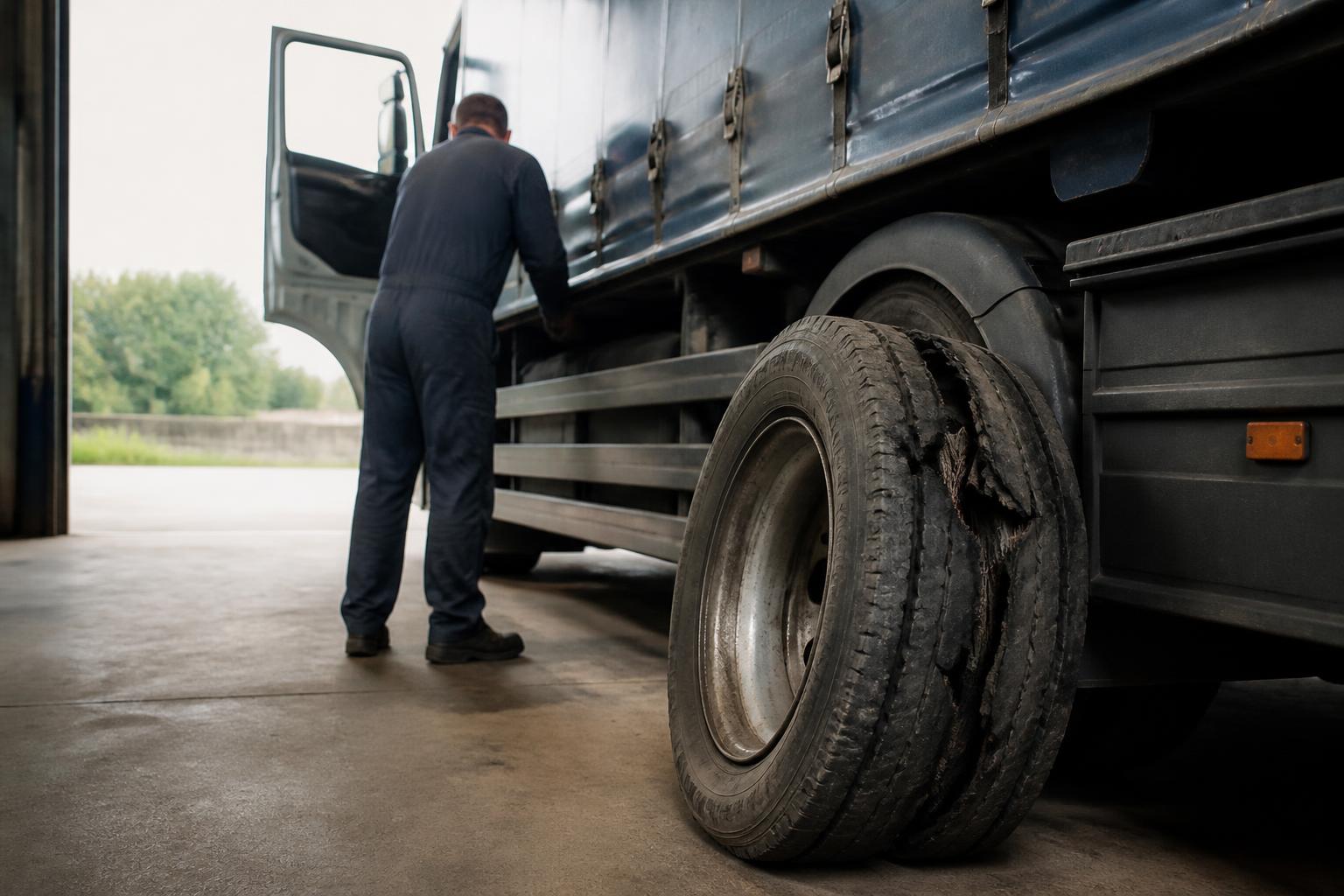
A fast replacement is needed when a tubeless truck tyre is no longer safe to repair, cannot hold pressure reliably, or has suffered damage that risks a sudden failure under load. On an HGV or trailer, that decision is not just about getting moving again. It is about whether the casing, bead, sidewall, tread area and wheel assembly can still do their job safely at working pressure and temperature.
At Woolpit Truck Repairs, we see this regularly with vehicles running through Woolpit, Suffolk and along the A14 corridor between Ipswich, Felixstowe, Stowmarket, Bury St Edmunds and Newmarket. The right next step is usually clear once the tyre is inspected properly. Some tyres can be repaired within accepted limits. Others need replacing without delay, because the risk sits in the structure of the tyre, not just in the hole that started the problem.
What tubeless tyre replacement means on an HGV or trailer
Most modern commercial vehicles on UK roads run tubeless tyres. Instead of using an inner tube, the tyre seals directly against the wheel rim and holds air within the tyre and valve assembly. On an HGV or trailer, that matters because the tyre is carrying high loads, running for long periods, and generating heat as it flexes. The air seal has to remain sound, but so does the tyre casing itself.
A tubeless tyre can lose pressure through a puncture, a valve problem, bead damage, a cracked wheel, corrosion around the rim seat, or damage to the tyre structure. If the issue is limited and the casing remains sound, a repair may be possible after a full internal inspection. If the structural integrity is compromised, replacement is the only safe option.
That is what tubeless tyre replacement means in practice. We are not simply swapping rubber because it has gone flat. We are deciding that the tyre can no longer be trusted in service, even if it might still look usable from a few feet away. On a loaded drive axle, steer axle or trailer axle, that distinction matters.
The position of the tyre on the vehicle also matters. A defect on a steer tyre is treated more cautiously because a failure there has obvious control implications. Damage on a trailer tyre may seem less urgent to some operators, but a trailer blowout can still lead to roadside damage, mudguard and airline damage, wheel arch damage, delays, and enforcement attention if the condition should have been picked up earlier.
For UK operators, the legal test is not whether a tyre might manage one more run. It is whether the vehicle is roadworthy. Tyres must meet Construction and Use requirements and be free from defects that make the vehicle unsafe. MOT standards are another checkpoint, but they are not the only one. A tyre that would fail at annual test can still stop a vehicle in service long before its MOT date.
Signs the tyre should be replaced rather than repaired
The first sign is sidewall damage. Cuts, bulges, exposed cords, impact breaks and deep abrasions in the sidewall usually mean replacement, not repair. The sidewall flexes constantly and cannot be safely repaired in the way a limited crown puncture can. If a driver has clipped a kerb, struck debris, or run a tyre flat even for a short distance, the visible mark on the outside may be only part of the damage.
The second is damage outside the repairable tread area. A puncture in the central crown area may be repairable if the injury size, angle and internal condition are within accepted limits. Damage in the shoulder or sidewall is a different matter. Once the injury is too close to the shoulder, or the casing has been weakened, replacement is usually the correct decision.
The third sign is evidence of running underinflated. When a tubeless tyre has been driven while seriously low on pressure, the inner liner can show circumferential wear, heat damage, dusting, wrinkling or separation. The sidewalls may have been over-flexed and the structure overheated. Even if the original puncture looks small, the tyre may already be beyond safe repair.
Tread depth and wear pattern also matter. If the tyre is at or near the legal minimum, repair often makes no commercial sense. For goods vehicles over 3,500kg gross vehicle weight, the UK minimum tread depth is generally 1mm throughout a continuous band covering at least three quarters of the breadth of the tread and around the entire outer circumference. In practice, most operators replace well before that point because wet grip, casing life and inspection outcomes all worsen as the tyre wears down. Irregular wear, such as one-sided wear, feathering, centre wear or shoulder scrub, may also point to alignment, inflation or suspension issues that need dealing with alongside the tyre.
Repeated pressure loss is another strong sign. If a tyre has already been topped up more than once, or keeps dropping despite no obvious nail or screw, we look at the whole assembly. A leaking valve core, damaged valve stem, poor bead seat, rim corrosion or a hairline wheel crack can all mimic a simple puncture. If the tyre has been compromised as well, replacement becomes the safe answer.
We also replace tyres where the bead has been damaged during operation or after a deflation event. If a tyre has spun on the rim, unseated violently, or been run flat until the bead area overheated, it may not reseal safely. On commercial work, that is not a risk worth taking.
If you want a clearer idea of how we approach urgent tyre decisions, our guide to truck tyre failures in Suffolk and the safest next step sets out the practical route from defect to safe movement.
What causes tubeless tyre failure in day-to-day operation
The obvious cause is puncture damage from road debris. Screws, bolts, metal fragments and sharp stone can all penetrate the tread. Vehicles working in yards, construction access roads, farm entrances and industrial estates often pick up damage away from the main carriageway, then lose pressure later on the A14 or local routes around Elmswell, Stowmarket or Bury St Edmunds.
Kerb strikes are another common cause, especially on urban deliveries and tight trailer manoeuvres. A hard contact can bruise the casing, break cords, cut the sidewall or damage the bead area without causing an immediate flat. Days later, the tyre may begin to bulge, crack or lose air.
Underinflation is one of the most damaging conditions for any tubeless commercial tyre. A tyre that is even moderately low runs hotter. The casing flexes more, the shoulders work harder, and internal temperature rises. That leads to rapid wear and, in worse cases, structural breakdown. On trailers, underinflation can go unnoticed for longer because the handling change is less obvious to the driver than on a steer axle.
Overload and poor load distribution also shorten tyre life. A tyre may be technically inflated, but if the axle is overloaded or the load is unevenly placed, one tyre can be carrying more than its share. That extra stress shows up as heat, shoulder wear, casing fatigue and eventual failure.
Wheel and hub issues are another day-to-day cause. Corroded rims can prevent proper bead sealing. Distorted wheels can create sealing problems or uneven loading. Bearing play, alignment faults and worn suspension components can all create abnormal tyre wear that ends in replacement earlier than expected.
Heat is the common thread through many failures. Heat comes from speed, load, inflation error, brake drag and ambient conditions. A binding brake, for example, can overheat the wheel end and tyre. If a driver reports a hot wheel, burning smell or recent brake issue, we do not treat the tyre as an isolated problem. We inspect the wider assembly, including signs that ABS or EBS faults may have contributed to uneven brake application or wheel-end stress.
Age and previous damage also play a part. A tyre that has had earlier repairs, repeated impacts or long periods of low-pressure running is more likely to fail again. Not every failure starts on the day the driver notices it.
What happens during inspection and replacement
When a vehicle arrives with a suspected tyre failure, we start with the basics. Which axle is affected, what the driver felt, whether there was a warning from the tyre pressure monitoring system if fitted, how quickly the pressure dropped, and whether the vehicle was driven while low. That short defect history often tells us where to look first.
We then inspect the tyre in situ. We check inflation state, visible tread and sidewall damage, foreign objects, bead seating, valve condition, wheel condition and any signs of contact damage around the arch or mudguard. If there has been a rapid deflation, we also look for collateral damage to airlines, lift axle components, ABS leads, EBS sensor wiring and nearby bodywork, especially on trailers.
If the tyre may be repairable, it has to come off for an internal inspection. A proper decision cannot be made from the outside alone. We demount the tyre and inspect the inner liner, casing, shoulders, bead area and injury path. If there is evidence of run-flat damage, liner cracking, exposed cords, separation or bead trauma, the tyre is rejected for repair.
If replacement is needed, we confirm the correct size, load index, speed rating and application for the axle position. Steer, drive and trailer positions do not all want the same tread pattern or casing characteristics. We also check the condition of the wheel itself. There is no point fitting a sound tyre to a rim with sealing corrosion, cracks or damage around the bead seat.
Before fitting, the rim is cleaned and checked, the valve or valve components are inspected and replaced if needed, and the bead seats are prepared correctly. The new tyre is then mounted using the right equipment and lubrication, so the beads seat without damage. Inflation is carried out safely and to the correct operating pressure for the application, not guessed at.
After inflation, we check for leaks at the valve, bead and wheel assembly. We confirm that the tyre is seated evenly and that the pressure holds. On a drive or trailer axle, we also look at the paired tyre if there is one, because mismatched condition or pressure can create another problem straight away. If the failed tyre has worn oddly, we do not ignore that. We explain whether the vehicle needs alignment checks, suspension inspection, brake inspection or wheel-end attention before it goes back into normal work.
That workshop process is why fast does not mean rushed. A quick tubeless tyre replacement only helps if the replacement is the right one, fitted to a sound wheel, at the correct pressure, with the underlying defect understood.
If you need the practical service side, our HGV and trailer tyre replacement support covers the workshop route we provide from Bridge Farm near A14 J47.
How to reduce downtime after a tyre problem
The best way to reduce downtime is to catch the issue before it becomes a roadside failure. That starts with daily walkaround checks. We advise drivers to look for obvious cuts, bulges, exposed cords, objects in the tread, irregular wear, low-looking tyres and damage to valves or wheel rims. A quick visual check at the start of shift is cheaper than a shredded tyre and damaged trailer arch later in the day.
Pressure control matters just as much as tread depth. If your operation has regular routes, loaded axle patterns and known working conditions, set pressure checks into the maintenance routine rather than relying on appearance alone. A tyre can be well below its correct pressure without looking flat enough to alarm a tired driver in poor light.
When a problem happens on the road, the key is not to turn a repairable issue into a non-repairable one. If a driver notices a pressure warning, unusual drag, vibration, steering pull, or the sound of a tyre breaking up, stopping promptly in a safe place can preserve the casing and prevent further damage. Continuing to the next drop on a deflating tyre often turns a simple puncture into a full replacement, plus possible wheel damage.
Good defect reporting also saves time. We need clear information from the driver or transport office, axle position, tyre size if visible, whether the tyre is holding any pressure, whether the vehicle can move, and whether there is related damage. That helps us plan the safest next step, whether that is workshop attendance, triage, or support with onward movement and repair.
After replacement, use the event to check the wider cause. If a trailer tyre has scrubbed out on one edge, look at axle alignment or suspension wear. If a steer tyre shows repeated shoulder wear, review pressures and steering geometry. If one wheel end runs hot, inspect brakes and bearings. Downtime is reduced most effectively when the second failure is prevented, not just the first one dealt with.
Operators running between Felixstowe, Ipswich, Woolpit, Newmarket and the wider Suffolk network often benefit from having a clear plan before there is a failure. Know who will inspect the vehicle, where it can be brought safely, and how quickly a workshop can triage the defect. That matters for fleets and for owner-drivers alike.
At Woolpit Truck Repairs, we keep that process practical. From Bridge Farm at A14 J47, we are set up for HGV and trailer work only, which means the conversation stays focused on axle position, roadworthiness, likely cause and the next safe movement decision. If the tyre issue is part of a bigger defect picture, we will say so plainly. If it is a straightforward replacement, we will deal with it as such.
For operators planning ahead, our advice on HGV tyre help by the A14 that cuts roadside downtime and fast trailer tyre help that cuts roadside downtime is worth keeping to hand.
Woolpit Truck Repairs is part of FLEETA LIMITED, supporting commercial operators in Woolpit, Suffolk from our workshop at Bridge Farm, close to A14 J47. If a tubeless tyre replacement is the right answer, we will tell you directly, explain why, and set out the safest next step for the vehicle.
Can a tubeless truck tyre always be repaired?
No. Some punctures may be repairable, but sidewall damage, run-flat damage, exposed cords, bead damage or severe wear usually mean replacement is the safer option.
What happens if an HGV keeps running on a deflating tubeless tyre?
It can damage the casing, overheat the tyre, affect handling and braking, and turn a simple puncture into a full replacement with more downtime.
Does the wheel need checking during tyre replacement?
Yes. The rim, bead seat, valve and related components should be checked for damage, corrosion or leaks before a replacement tyre is put back into service.
Can uneven wear mean more than a tyre problem?
Yes. Uneven wear can point to inflation issues, axle or suspension faults, brake drag, alignment problems or loading patterns that need attention.
When should an operator stop and ask for help?
Stop as soon as it is safe if there is rapid pressure loss, visible sidewall damage, vibration, heat, a bulge, exposed cords or any concern about roadworthiness.