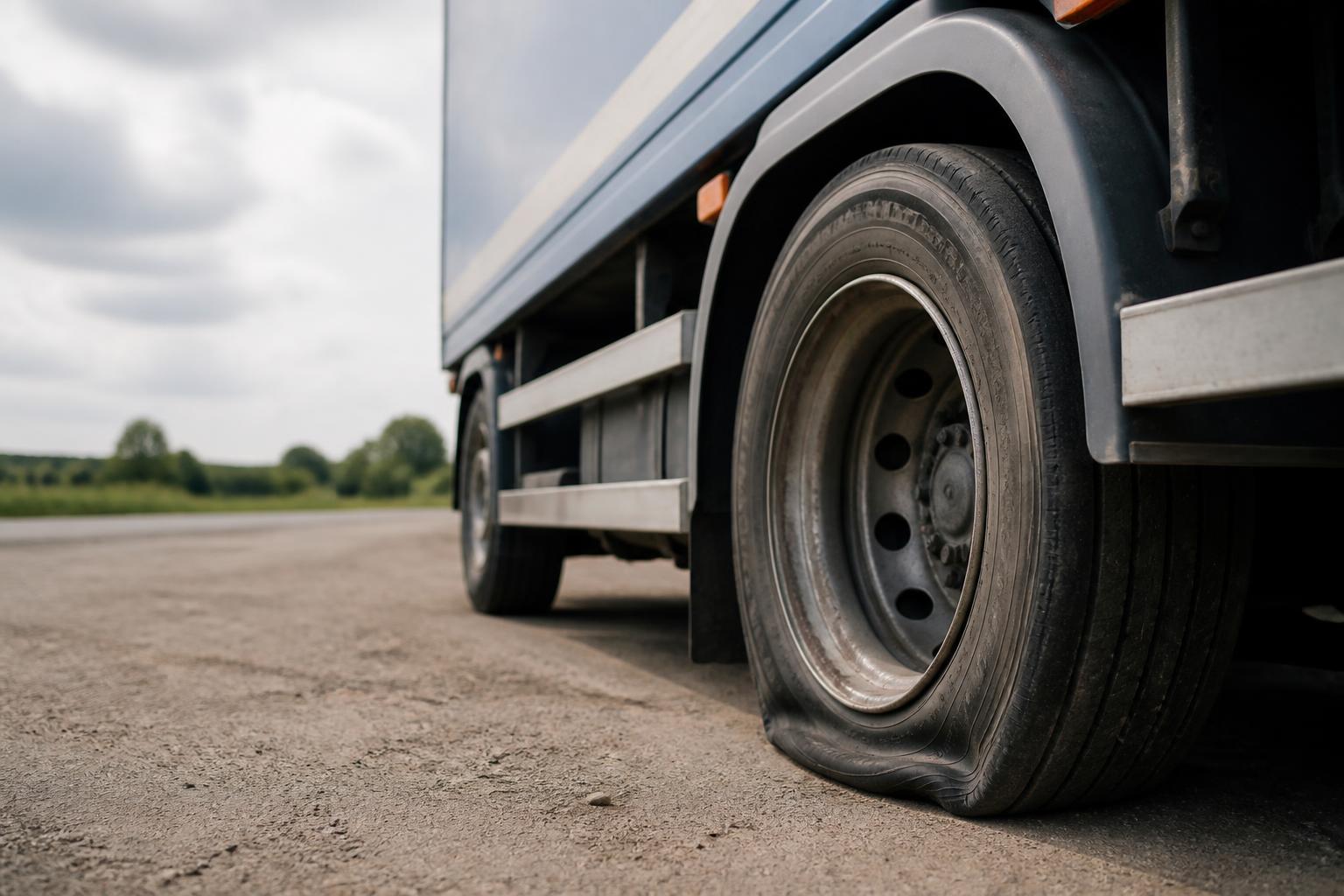
A tyre problem on an HGV or trailer can move from nuisance to downtime risk very quickly. If the vehicle is pulling, losing pressure, showing exposed cords, scrubbing a shoulder off a tyre, or running with heat in one wheel position, the right next step is not guesswork. It is a safe stop, a basic defect check, and a practical decision on whether the vehicle needs roadside help, workshop attendance, recovery support enquiry, or a fuller inspection.
From our base at Bridge Farm in Woolpit, close to A14 J47, we help operators make that decision without wasting time. For fleets running between Felixstowe, Ipswich, Stowmarket, Bury St Edmunds and Newmarket, and for owner-drivers working local Suffolk routes, the value is usually in getting the fault triaged properly first. Tyres fail for obvious reasons, but they also fail because something else on the vehicle is wrong.
When an HGV tyre problem needs action straight away
Some tyre defects can wait until the vehicle is back in the yard. Others should trigger immediate action because they create a direct safety risk, a risk of roadside prohibition, or a strong chance of turning a repairable issue into a wheel-end, brake, or suspension problem.
The signs that need immediate attention include:
- Rapid or ongoing air loss
- A blowout, partial tread separation, or visible sidewall rupture
- Exposed cords, deep cuts, bulges, or impact damage
- Tyre contact with bodywork, mudguard, air line, or suspension component
- Severe irregular wear on one edge or one patch of the tread
- A wheel position running noticeably hot after a short journey
- A trailer axle with one tyre overloaded because the paired tyre has failed or gone soft
- Vibration through the cab or trailer that appears suddenly and gets worse with speed
- Steering pull on a unit or rigid that was not present before
- Any tyre defect appearing alongside ABS or EBS warnings, brake drag, or hub concern
A flat tyre is not the only urgent tyre issue. A tyre that still holds some pressure can be more misleading, because the vehicle may remain mobile while the casing is being destroyed. We often see cases where an operator has tried to nurse a vehicle off route, only for the tyre to break up and damage the wing, lamp, airline, or mudguard on the way.
On a steer axle, the threshold for stopping is lower. If there is visible sidewall damage, major shoulder wear, impact damage, or sudden change in handling, the safest assumption is that the vehicle needs immediate assessment. On a trailer, operators sometimes focus on whether the load can still move. The better question is whether that axle line, brake position, and wheel-end are still safe and legal to run.
If the fault follows a pothole strike, kerbing impact, brake overheating event, or wheel change done elsewhere, that matters too. Tyre damage after impact can point to rim damage, tracking issues, hub stress, or suspension movement that is not obvious at first glance.
What operators should check before calling for tyre support
A good call saves time if the right details are ready. Before calling for tyre support near the A14, we need enough information to judge urgency, likely cause, and whether roadside attendance is sensible or whether the vehicle should come into the workshop.
The most useful details are:
- Vehicle type, unit, rigid, trailer, tanker, curtainsider, fridge, tipper
- Registration number and fleet reference if you use one
- Exact wheel position affected
- Whether it is a steer, drive, lift, tag, or trailer axle position
- Current location, including carriageway, layby, depot, industrial estate, or farm access
- Whether the vehicle is loaded, and if so, with what type of load
- Whether the tyre is flat, damaged, worn, running hot, or has already failed
- Any warning lights, especially ABS or EBS
- Any brake smell, smoke, pulling, vibration, or noise
- Whether the vehicle can move safely at all
- Tyre size if visible
- Photos of the tyre, wheel, and surrounding area if safe to take
The wheel position matters because the likely causes are different. A near-side front steer tyre worn heavily on one shoulder points us in a different direction from an outer drive axle tyre with a cut, or a trailer tyre with diagonal scrub across the tread.
The driver should also note whether the wheel nut indicators have moved, whether there is grease contamination around the hub, whether an airbag looks low, and whether a brake chamber, slack arrangement, or mudguard bracket appears out of place. We do not need a roadside diagnosis from the driver, but those details help us judge whether the problem is likely to be tyre-only or part of a wider defect.
If the vehicle is in a dangerous position, the first priority is scene safety. If it is on the live carriageway or in a position where roadside work would be unsafe, that changes the plan immediately. In those cases, a recovery support enquiry may be the right route before any tyre work is attempted.
Why location near A14 J47 changes the response
Location affects downtime more than many operators expect. A vehicle near A14 J47 is not just a pin on a map. The route it is on, the direction of travel, the load, and whether it can leave the A14 safely all affect the next step.
Our workshop at Bridge Farm, Woolpit gives us practical access to the A14 corridor and nearby Suffolk routes. That matters for vehicles moving between Felixstowe and the Midlands, local distribution work around Stowmarket and Elmswell, and operators covering Ipswich, Bury St Edmunds and Newmarket. A vehicle that can come off safely and reach us may be back in service faster than one waiting roadside for a tyre-only response that later turns into a brake or hub defect.
A14 J47 also matters because not every fault is best handled where the vehicle stops. For example:
- If a tyre has failed because a brake is binding, changing the tyre roadside does not solve the brake issue
- If a trailer tyre has scrubbed out because of axle alignment or suspension wear, fitting another tyre without inspection risks a repeat failure
- If there is wheel-end heat, workshop checks are safer than trying to push on
- If the vehicle is close enough to Woolpit to reach us safely, workshop triage can reduce total downtime
Access around Bridge Farm and Woolpit can also help with practical workshop handling. A loaded trailer, a time-sensitive delivery, or a combination vehicle with multiple defects may need a decision that balances legal compliance, route timing, and whether the defect can be contained to one visit.
This is where local route knowledge helps. A truck coming westbound from Ipswich is a different planning job from a trailer issue found near Bury St Edmunds or a local operator working around Elmswell. The shortest distance is not always the quickest or safest option. We look at whether the vehicle can move, what the defect suggests, and whether workshop access will save a second stoppage later. That is often the difference between a simple tyre job and a day lost to avoidable downtime.
How tyre faults are triaged on HGVs and trailers
When we assess a tyre fault, we do not start with the assumption that the tyre is the whole problem. We start with the wheel position, the wear pattern, the failure type, and any linked vehicle symptoms.
The practical triage process usually works like this.
First, we confirm the immediate condition. Is the tyre punctured, cut, shredded, underinflated, overheated, or worn out? Is the casing likely to have been run soft? Is the rim damaged? Has the tyre contacted another component?
Second, we check whether the defect looks like simple damage or something vehicle-related. A clean penetration is different from one-sided shoulder wear. Feathering, diagonal scrub, flat spotting, localised heat damage, and paired axle overload all tell different stories.
Third, we look for wheel-end and running gear clues. That can include:
- Hub heat
- Brake drag
- Uneven pad or lining behaviour
- Bearing play concern
- Suspension bush or air suspension issue
- Ride height irregularity
- Shock absorber condition where relevant
- Axle alignment concern
- Mudguard or body contact
- Signs of ABS or EBS related braking imbalance
Fourth, we decide the safest next step. That may be tyre replacement, further inspection, brake testing, diagnostics, or a broader trailer check.
On trailers especially, repeated tyre failures are often symptoms. A trailer that keeps wearing the same edge, or keeps losing one position on the same axle line, usually needs more than another casing. If the trailer has ABS or EBS warnings, or if one brake is working harder than the others, tyre life will not recover until the root cause is dealt with.
Where diagnostics are needed, we can follow the tyre issue into a wider fault-finding process through commercial vehicle diagnostics and fault tracing. Where the immediate need is tyre replacement and condition assessment, we handle that through HGV and trailer tyre replacement support.
When tyre damage points to a bigger vehicle defect
Tyres record what the rest of the vehicle is doing. That is why unusual wear matters. A tyre can tell you about inflation, alignment, brake performance, suspension movement, hub condition, and trailer running gear long before a more obvious failure happens.
Examples we take seriously include:
One-sided steer axle wear. This can point to tracking error, worn steering or suspension components, or a ride height issue affecting geometry.
Cupping or scalloping. This may suggest damping or suspension control issues, wheel imbalance, or wheel-end movement.
Diagonal trailer scrub. This often raises alignment or axle position concerns, particularly if it repeats on the same axle or side.
Flat spots. These can be linked to harsh braking events, seized or imbalanced brake performance, or ABS and EBS issues.
Heat damage or rapid shoulder wear on one wheel position. This can indicate brake drag, bearing trouble, or a tyre that has been overloaded because its paired tyre was underinflated.
Inner edge wear that is not obvious on a quick walk-round. This is common on trailers and can be missed until the casing is close to failure.
In the UK, tyre condition is part of roadworthiness expectations and MOT standards for commercial vehicles, but operators should not wait for MOT preparation to act on abnormal wear. If a wear pattern suggests a brake or suspension problem, the tyre is the symptom. Replacing it without inspection may get the vehicle moving, but it does not protect uptime.
That is why tyre support often leads into a wider check. On the workshop side, that may include brake performance assessment, axle and suspension inspection, wheel-end checks, and where needed, a full HGV and trailer inspection before defects multiply.
Choosing the next step with the least disruption
The least disruptive option is not always the quickest-looking one. The right choice depends on risk, location, load, time pressure, and whether the tyre issue is isolated or part of a broader defect.
A roadside support enquiry usually makes sense when:
- The vehicle cannot move safely
- The tyre has failed but there is no sign yet of brake or hub involvement
- The location allows safe attendance
- The operator needs an urgent assessment before deciding on workshop movement
A workshop visit is often the better option when:
- The vehicle is close to A14 J47 and can reach us safely
- The tyre issue may be linked to brake drag, alignment, suspension, or warning lights
- More than one wheel position is affected
- The trailer has repeated wear patterns
- The operator wants the defect explained properly and resolved in one stop where possible
A broader inspection should be chosen when:
- The same vehicle or trailer has repeated tyre failures
- There is visible irregular wear across multiple positions
- ABS or EBS faults are active
- The driver reports pulling, vibration, or uneven braking
- The issue appears just before MOT and there may be related defects to address
MOT preparation becomes relevant where tyre condition is only one part of what needs attention. If the vehicle is approaching test date and the tyre fault has exposed brake, suspension, or warning light concerns, it is usually more efficient to treat it as part of a pre-test defect plan rather than a standalone tyre event.
For fleets, the bigger question is whether this is a one-off or a pattern. If several vehicles are showing similar wear, or one trailer keeps consuming tyres, that points to maintenance control rather than bad luck. In those cases, tying the issue into planned inspections or wider fleet maintenance is usually the commercially sensible route.
At Woolpit Truck Repairs, that is how we approach HGV tyre support near the A14. We look at the actual wheel position, the actual route, and the actual defect. If it needs a tyre, we say so. If it points to brakes, suspension, wheel-end trouble, or trailer running gear, we say that too. And if the safest first step is a callout or recovery support enquiry rather than trying to force the vehicle onward, we will say that plainly.
For operators running through Suffolk, especially around Woolpit, A14 J47, Bridge Farm, Stowmarket, Elmswell, Ipswich, Bury St Edmunds, Newmarket and the Felixstowe corridor, clear triage saves time. It also prevents the common mistake of treating a tyre as the whole problem when the real cause is still on the vehicle.
If you need the next step rather than a guess, start with the defect, the wheel position, and the location. We will take it from there. FLEETA LIMITED trades as Woolpit Truck Repairs, and we keep the focus where operators need it, on practical decisions that get the vehicle safe, legal, and back to work with the least avoidable downtime.
What counts as an urgent HGV tyre issue?
Rapid pressure loss, exposed cords, sidewall damage, a bulge, severe vibration, heat, or damage on a steer axle should be treated as urgent. If the vehicle feels unstable, stop and assess the safest next step.
Can trailer tyre wear mean something other than the tyre itself?
Yes. Uneven or repeated wear can point to axle alignment, suspension wear, brake drag, hub issues or running gear defects. A tyre replacement alone may not solve the underlying cause.
Why does being near A14 J47 matter?
Access near A14 J47 can reduce wasted time when a vehicle needs workshop attention or support planning. For operators moving through Suffolk, route position affects downtime, scheduling and recovery decisions.
What information should a driver give when reporting a tyre problem?
Give the vehicle type, axle position, whether it is tractor or trailer, the visible damage, any warning lights, load status, exact location and whether the vehicle can move safely.
Should an HGV with tyre damage also be checked for brake faults?
Often yes. Heat, drag, uneven wear or repeated failures can be linked to brake issues. On some vehicles, related checks may also involve ABS or EBS depending on the symptoms.