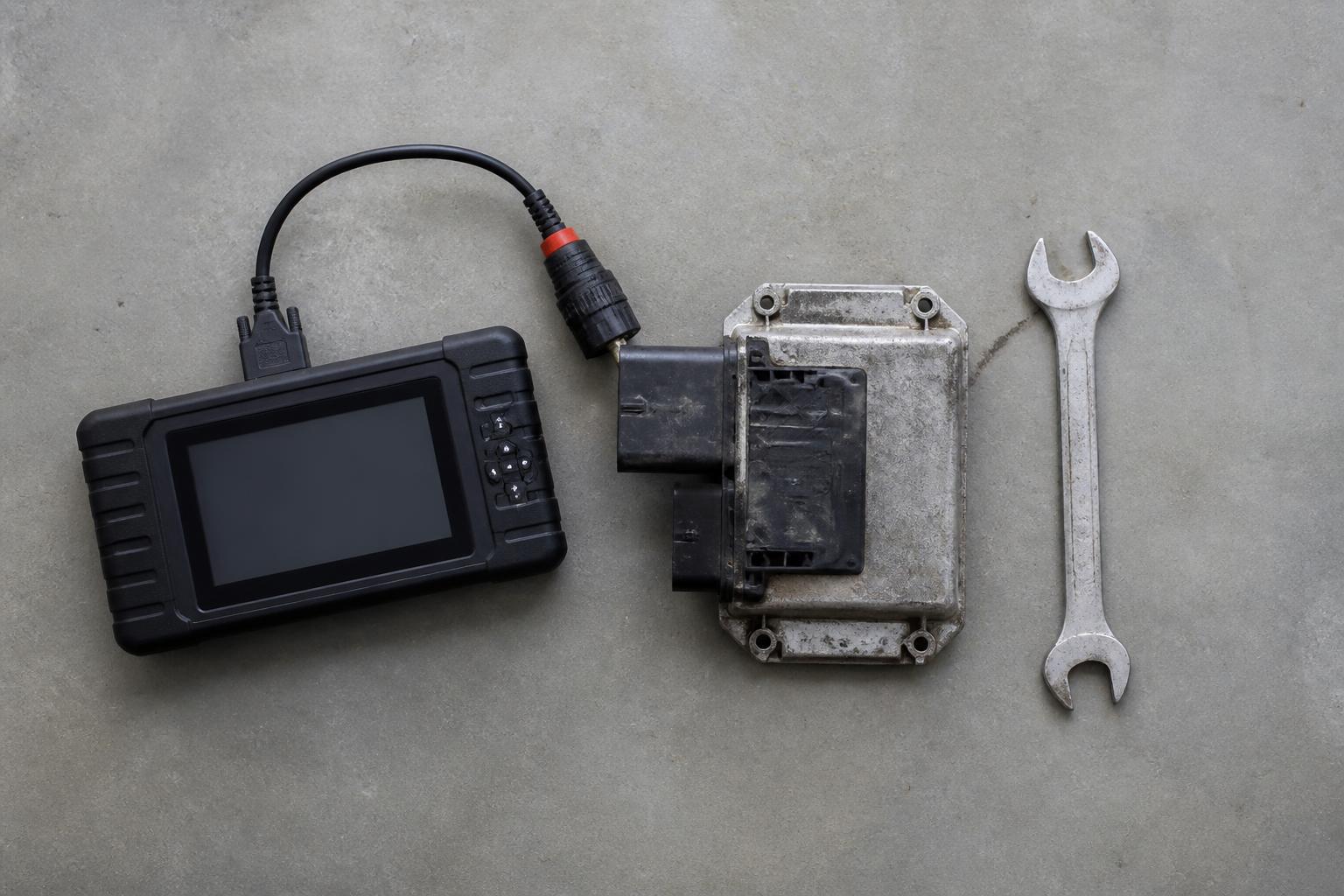
When a warning light comes on, the brakes feel wrong, or a trailer defect starts costing hours, the right first step is not always a full strip-down. Sometimes a quick, disciplined check is enough to confirm whether the vehicle is safe to move, whether the fault is likely electrical, pneumatic or mechanical, and whether you can plan the repair without turning one defect into a full day off the road. Other times, a basic inspection only tells you that there is a problem, not why it is there.
That is where proper truck diagnostics in Suffolk make the difference. At Woolpit Truck Repairs, we deal with HGV and trailer faults from Bridge Farm near A14 J47, supporting operators running through Woolpit, Stowmarket, Ipswich, Felixstowe, Bury St Edmunds, Newmarket and Elmswell. Our job is to give a practical answer quickly, explain the defect clearly, and set out the next safe step with the least avoidable downtime.
When a quick check is enough and when full diagnostics matter
A quick fault check has a clear purpose. It is there to answer immediate operational questions.
Is the vehicle safe to continue? Is the defect likely to worsen if moved? Is the issue simple enough to confirm by inspection? Do we need parts, workshop time, or a trailer bay? Is the problem on the unit, the trailer, or the connection between them?
For many day to day defects, a structured visual and functional inspection gets you a long way. That might include checking warning lamps, air build-up, visible wiring damage, suzie connections, wheel end condition, tyre condition, brake stroke, lamp operation, battery voltage, fault memory on a first scan, and whether the issue is constant or intermittent. If a driver reports a trailer ABS lamp, for example, we may quickly establish whether the problem appears only with one trailer, which already points the investigation in a very different direction from a unit fault.
A quick check is often enough when the defect is obvious and the remedy is straightforward. Common examples include damaged electrical lines, poor trailer plug connection, a failed lamp circuit, a visible airline leak, low battery condition after standing, or a tyre issue that is the true cause of the reported concern. In those cases, operators do not need theory. They need a clear decision.
Full diagnostics matter when the first check shows symptoms, but not the cause. That is common with intermittent engine faults, repeated derate complaints, ABS and EBS warnings, braking imbalance, sensor issues, CAN communication faults, and defects that return after a reset. A code read on its own is not full diagnostics. Fault codes point you in a direction, but they do not automatically tell you which component has failed, whether the fault is current or historic, or whether the root cause is wiring, air pressure, contamination, calibration or a mechanical defect elsewhere.
That difference matters commercially. Replacing parts because a code mentions them is expensive and often wrong. Proper diagnostic work means checking the system around the code, confirming live data where available, testing circuits and components, and matching findings to the driver report and the vehicle’s behaviour. That is how you avoid changing a sensor when the real issue is a damaged loom, or chasing an engine fault when the complaint is actually linked to poor voltage supply.
If you want a closer look at how we approach fault tracing, our commercial vehicle diagnostic checks in Suffolk page sets out the service in practical terms.
Roadside support versus workshop diagnostics near the A14
Roadside triage and workshop diagnostics do different jobs. The mistake is expecting them to deliver the same outcome.
A roadside callout is about stabilising the situation. If a vehicle is down near the A14, or an operator has a defect affecting a route through Suffolk, the first aim is to assess safety, identify anything obvious, and decide whether the vehicle can continue, needs a temporary roadside remedy, or should come into the workshop. That may be enough if the fault is clear and accessible. It may also be the only sensible option if the vehicle is loaded, time-critical, or stranded in a place where even a basic repair changes the day.
But roadside conditions limit what good diagnostics can realistically achieve. Access is restricted. Lighting, weather and traffic conditions are not ideal. You may not be able to carry out proper brake assessment, deeper electrical testing, or full trailer checks at the roadside. Some faults also need the vehicle in a controlled environment, with workshop tools, brake testing equipment, and time to reproduce the issue properly.
That is why workshop diagnostics at Bridge Farm near A14 J47 are often the better route once roadside triage has done its job. In the workshop, we can inspect more thoroughly, use the right diagnostic equipment, check both unit and trailer systematically, and move from symptom to confirmed defect rather than educated guesswork. For operators moving between Felixstowe, Ipswich, Stowmarket and Bury St Edmunds, access from the A14 is a practical part of keeping downtime under control.
The comparison is simple.
Roadside support is best for:
- Safety assessment after a breakdown or warning light
- Obvious faults that can be confirmed quickly
- Deciding whether to continue, recover, or book in
- Temporary action to prevent further disruption
Workshop diagnostics are best for:
- Repeat faults
- Intermittent electrical issues
- Brake and braking control defects
- Trailer system problems
- MOT preparation where a fault needs proving and fixing properly
- Cases where one defect may be masking another
If the vehicle is already off route or cannot safely continue, our guidance on HGV recovery support when downtime starts may help you decide the next move before the problem spreads.
Engine, ABS and EBS faults are not all the same job
Operators often group warning lights together because the commercial effect is the same, lost time. From a workshop point of view, engine faults, ABS faults and EBS faults are very different jobs.
An engine warning may involve fuel delivery, air intake, emissions-related systems, sensors, wiring, boost issues, aftertreatment controls, or protection logic that puts the vehicle into reduced performance. In the UK, the exact effect on roadworthiness depends on the fault and the vehicle’s condition, not just the lamp itself. A truck that still moves is not necessarily a truck that should stay in service. The key questions are whether the fault affects safety, whether the vehicle is derated, whether damage could follow if it continues, and whether the code is current or stored.
ABS faults are different. On a truck or trailer, ABS diagnostics usually focus on wheel speed sensing, exciter rings where fitted, wiring continuity, modulator behaviour, supply voltage, connector condition, and whether the fault is on the tractor, the trailer, or the communication between them. A trailer ABS issue can present as a unit concern if the driver only sees the warning and not the source. That is why unit-only checking often misses the real cause.
EBS faults add another layer. EBS systems involve braking control logic, pressure monitoring, electrical communication and component response across a more integrated system. An EBS warning may be linked to sensor data, modulator performance, valve issues, air supply problems, calibration, or trailer side defects that affect braking behaviour more widely than a single ABS sensor fault would. It is not a lamp to treat casually, especially if the driver reports unusual brake feel, uneven response, or a trailer braking complaint.
The diagnostic approach has to match the system.
For engine faults, we usually need:
- Fault code interrogation
- Live data review where relevant
- Electrical and sensor checks
- Inspection of related mechanical causes
- Confirmation of whether the fault is current, intermittent or consequential
For ABS faults, we usually need:
- Unit and trailer identification
- Sensor and wiring checks
- Connector and power supply inspection
- Confirmation of whether the fault follows one trailer
- Brake system context, not just a code read
For EBS faults, we usually need:
- System-specific diagnostic access
- Pressure and control checks
- Unit to trailer interaction assessment
- Brake performance context
- A clear view of whether the issue is electrical, pneumatic or mechanical
That is why one warning light can be a quick fix and another can need a half day of proper testing. Treating them all as the same kind of fault is where downtime gets longer and repair bills get less predictable.
Truck and trailer diagnostics should be judged together
A lot of lost time comes from splitting the problem in the wrong place. The unit gets checked first, then the trailer later, or the trailer goes somewhere else entirely. Meanwhile the operator still does not know where the fault actually sits.
For HGV operators, that separation often makes no practical sense. Brake warnings, ABS and EBS issues, lamp faults, supply problems, and driver-reported handling or braking concerns can all involve the interaction between tractor and trailer. If the workshop can only assess one side well, you may end up with a partial answer.
We work on HGV and trailer faults together because that is how many real defects present. A trailer fault can trigger a warning on the unit. A unit connection issue can look like a trailer system defect. A braking complaint can involve trailer brake response, not just tractor performance. A roadside report of “ABS light on” is not a diagnosis. It is only the start of one.
This matters even more near MOT dates. If a trailer has a brake issue, warning lamp defect, or poor response that is only looked at in isolation, the operator may fix one symptom and still miss the underlying cause that shows up on test day. The same applies to combinations of tyre wear, brake imbalance, air leaks and electrical defects. Judging truck and trailer together gives a more reliable maintenance decision.
For operators managing trailer-specific issues, our article on trailer brake testing before downtime spreads explains why braking assessment should not be left until a defect becomes an MOT problem.
Choosing diagnostics that help with MOT deadlines and fleet uptime
Price matters, but it is rarely the best way to judge diagnostic support. The real cost sits in how long the vehicle is unavailable, how clearly the defect is explained, whether the repair is planned properly, and whether the work reduces the risk of another failure just before test or just after returning to service.
Good diagnostics support fleet uptime in four ways.
First, they reduce downtime risk. That means quick triage, a sensible decision on roadside versus workshop, and no wasted hours pursuing the wrong fault. For operators with vehicles running between Newmarket, Bury St Edmunds, Ipswich and Felixstowe, location matters here as much as workshop ability. Being near A14 J47 helps because access is part of the repair plan.
Second, they improve defect clarity. Operators need to know what has failed, what evidence supports that conclusion, whether the vehicle can move, and what happens if the repair is deferred. “It has a code” is not enough. Clear explanation matters whether you are an owner-driver making a same-day call or a fleet planner deciding how to rotate vehicles and trailers.
Third, they help repair planning. Once the fault is identified properly, you can make better decisions on parts, labour time, trailer swaps, driver allocation, and whether other maintenance should be done while the vehicle is in. That is especially important when one booked slot needs to cover more than one issue, or when a recurring defect suggests a wider maintenance pattern.
Fourth, they support MOT preparation. In the UK, MOT readiness for HGV and trailers is not just about passing a test on the day. It is about dealing with warning lights, brake performance concerns, air leaks, tyre issues, and electrical defects early enough that the vehicle arrives prepared, not hopeful. Where a rule differs between the UK and EU practice more generally, the test and compliance framework you need to satisfy here is the UK MOT regime, so the workshop’s judgement should be based on that, not on broad EU assumptions.
That is why we look at the whole operational picture. If a warning light can be checked quickly and booked sensibly, we will say so. If the fault needs deeper testing before parts are ordered, we will say that too. If the issue is likely to affect braking performance, trailer compliance, or MOT outcome, we will be direct about it.
Woolpit Truck Repairs is part of FLEETA LIMITED, and our workshop at Bridge Farm is set up for practical HGV and trailer support, not generic vehicle guesswork. For operators in Woolpit, Elmswell, Stowmarket and across Suffolk, the point of diagnostics is simple. You need a safe answer, a clear defect path, and the shortest realistic route back to work.
If you are deciding who to use, compare providers on whether they can assess both truck and trailer, whether they can explain the defect in plain terms, whether they have the workshop backing to move from diagnosis to repair, and whether their process helps you protect MOT dates as well as today’s job. That is what keeps downtime from spreading.
What does truck diagnostics usually include?
It can include fault code reading, electrical checks, brake system investigation, inspection of visible defects and practical advice on whether the vehicle can continue, needs repair or should come off the road.
Can diagnostics be done on trailers as well as HGV units?
Yes. Trailer faults can involve ABS, EBS, lighting, braking and air issues. A proper assessment should look at the trailer system itself, not just the unit pulling it.
Is a roadside diagnostic visit enough to fix the problem?
Sometimes, but not always. Roadside work is useful for triage and safe next steps. If the fault needs deeper testing, brake checks or repair access, workshop diagnostics are usually more effective.
How do diagnostics help before MOT?
They help identify faults likely to cause a test failure, such as brake defects, warning lights, trailer issues or obvious mechanical problems, so repairs can be planned before the MOT date.
Why does location matter for truck diagnostics in Suffolk?
If a workshop is well placed for routes such as the A14, it can reduce wasted time getting an HGV or trailer in for checks, repairs and follow-on work.