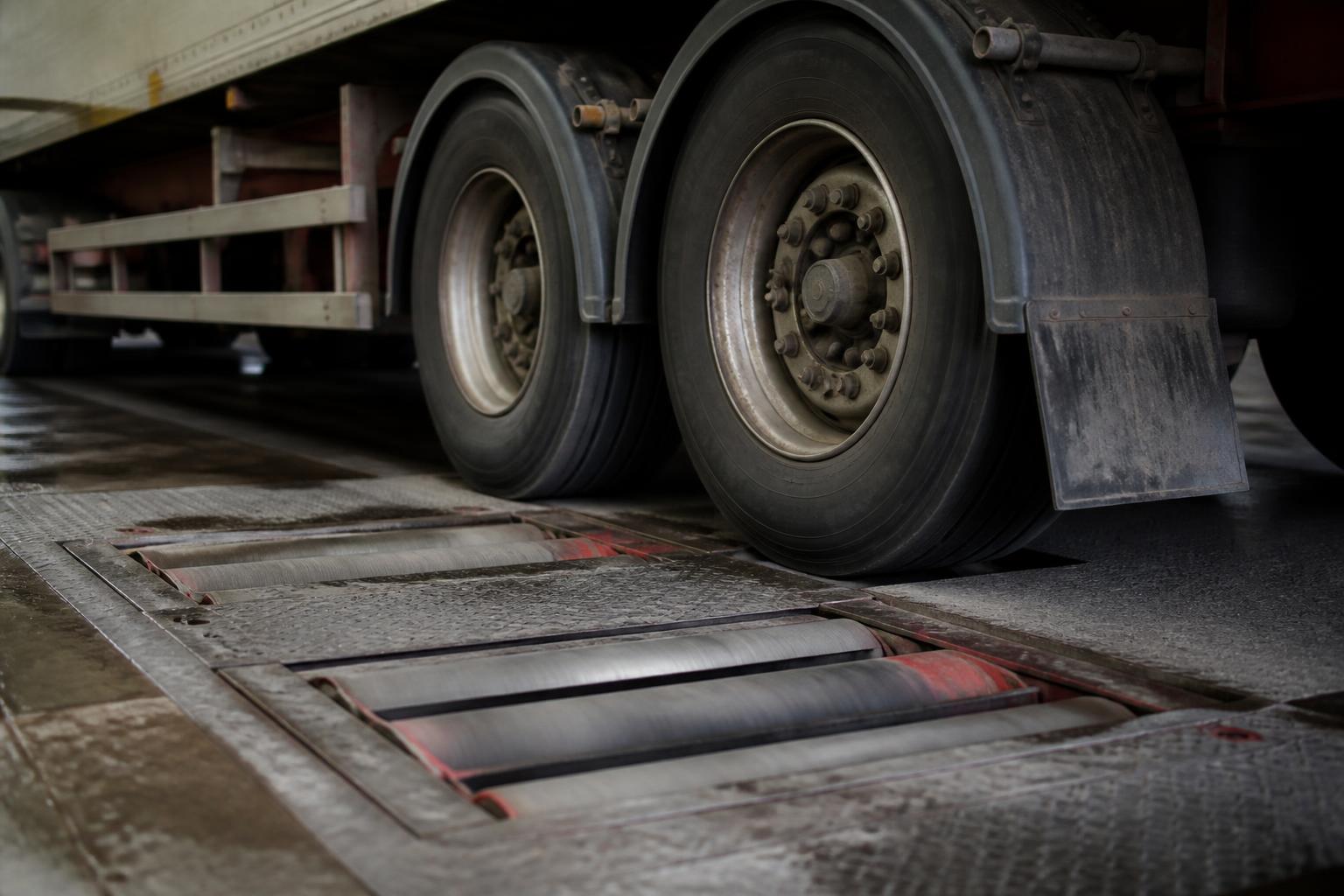
If a trailer’s braking does not feel right, waiting for the annual test is rarely the sensible option. A trailer brake test in Suffolk gives an operator a measured view of what the braking system is doing on each axle, whether the effort is balanced, and whether there is an obvious fault that needs attention before the trailer goes back on the road or into MOT.
For fleets and owner-drivers running through Ipswich, Felixstowe, Stowmarket, Bury St Edmunds, Newmarket and Elmswell, the point is not just compliance. It is stopping a brake issue from turning into missed loads, roadside prohibitions, tyre damage, hub heat, or a trailer that ends up parked when it should be earning. At Woolpit Truck Repairs, based at Bridge Farm in Woolpit near A14 J47, the job is practical triage first, then clear next-step advice.
What a trailer brake test actually tells an operator
A roller brake test measures braking performance at the wheels under controlled workshop conditions. The trailer is positioned so each axle runs over brake rollers, and the workshop checks the brake force produced at each wheel. On a commercial trailer, that gives useful information about overall brake effort, left-to-right balance on an axle, and whether the braking response looks consistent across the trailer.
For an operator, that matters because braking complaints are often vague at first. The driver may report that the trailer feels slow to come in, snatches under load, drags slightly, or seems to push the unit more than expected. A proper test turns that into something measurable.
What the result can confirm is whether there is a clear deficiency in braking output, an imbalance from one side to the other, a likely seized or weak brake assembly, or a parking brake problem. It can also help point toward air system issues, load sensing concerns where applicable, or electronic brake control faults involving ABS or EBS.
What it cannot do on its own is diagnose every cause without further inspection. A poor result tells you something is wrong, but not always whether the root cause is a worn lining set, a maladjusted brake, a sticking caliper, a cracked air line, a faulty modulator, contamination, or a hub-related issue. That is why the test is so useful as a decision tool. It narrows the fault quickly and tells the workshop where to look next.
Operators in Suffolk usually book this type of check for three main reasons.
First, before MOT. A pre-test brake check is one of the simplest ways to avoid presenting a trailer with an obvious braking defect. If there is an imbalance or low effort, the workshop can deal with it before the booking is wasted.
Second, after a defect report. If a driver has reported weak braking, a warning lamp, wheel lock, air loss, or unusual behaviour under braking, the roller test gives a structured starting point.
Third, when braking simply feels wrong, even if there is no warning light and no formal defect yet. Experienced operators know that “not quite right” often becomes “off the road” if it is ignored for another week.
If the immediate need is to get a measured picture of brake performance before deciding on repairs, it makes sense to book a roller brake test for trailers and HGVs.
When to book a test instead of waiting for MOT
The worst time to find a brake issue is when the trailer is already committed to work, loaded, and due somewhere on a tight slot. The sensible trigger points are earlier than that.
Poor braking feel is the obvious one. If a trailer seems to push on, reacts unevenly, feels delayed, or gives the driver less confidence than usual, there is little value in hoping it clears itself. Trailers do not usually fix their own braking faults. Wear, corrosion, air leaks and electronic faults tend to get worse, not better.
Imbalance is another common trigger. A trailer that pulls slightly under braking, shows signs of one wheel or one side working harder than the other, or comes back with one hotter drum or disc than the rest should be checked. Side-to-side imbalance can lead to tyre wear, heat build-up, and more expensive component failure if it is left.
Warning lights matter too. ABS and EBS faults do not always mean the foundation brakes have stopped working, but they do mean the braking system is not behaving as designed. In UK operation, that is not something to leave until annual test time. A warning lamp after coupling, during a route, or on return to yard is a reasonable point to book the trailer in.
Standing time is often overlooked. A trailer parked up for a period can come back with sticking brakes, corroded components, seized linkages, weak chambers, or electrical connection faults. This is especially common where trailers have stood outside through poor weather or have had irregular movement around the yard only. Before sending that trailer back onto regular work, a brake test is a sensible check.
Recent repairs are another good reason. If brake components, hubs, airlines, valves, ABS or EBS parts have been replaced, testing confirms the repair has delivered the result expected. It is better to verify braking performance in the workshop than to assume everything is right because the parts are new.
Fleet inspections should also drive bookings. A routine inspection may find lining wear, adjustment concerns, chamber issues, damaged cables, or signs of uneven operation. In those cases, a measured brake test helps decide whether the trailer can stay in service until planned repair, needs immediate attention, or should go straight into MOT preparation.
Route profile matters in Suffolk as well. Trailers running in and out of Ipswich and Felixstowe often see stop-start work, port traffic, and repeated braking under varying loads. Routes through Stowmarket, Bury St Edmunds, Newmarket and around the A14 can expose weaknesses that a lightly used trailer may hide for a while. If the trailer is doing regular trunking or time-sensitive work, the cost of one planned workshop visit is usually lower than the cost of a failed collection, a roadside issue or an aborted MOT.
Operators who want faults picked up before they become downtime often combine brake concerns with scheduled HGV and trailer inspections, especially where multiple trailers are rotating through the same routes.
How the test is carried out and what the workshop needs
At workshop level, the process is straightforward, but the quality of the result depends on good identification, safe set-up and clear fault reporting.
The trailer first needs to be correctly identified. That means registration or fleet number, trailer type, axle configuration, and any relevant details about the brake system. If the operator already knows the make of axle or EBS equipment, that can help, but the key point is making sure the workshop is testing the right trailer against the right defect report.
The workshop will then connect the trailer properly, with the correct air and electrical supply so the braking system is operating as it would in service. If the issue only appears when coupled to a specific unit, that is worth mentioning at the start. Some faults are trailer-side, some are unit-side, and some only show up in the way the two work together.
Before the rollers are used, basic safety and condition checks are part of the process. These can include looking at tyre condition, obvious mechanical damage, visible air leaks, brake hose condition, electrical connections, warning lamp status, and whether anything makes testing unsafe or likely to produce a misleading result. A trailer with a serious air leak or obvious wheel-end issue may need attention before a full brake run is sensible.
Testing is then carried out axle by axle. Each wheel position is assessed in the rollers to measure brake force and compare one side with the other. The workshop is looking for expected effort, smooth application, reasonable balance, and any signs that a wheel is locking too early, failing to contribute enough, or behaving differently from the axle opposite.
Where the trailer has ABS or EBS, the workshop may also need diagnostic input alongside the roller results. Electronic faults can affect brake timing, modulation and warning status, even where the basic mechanical brake still produces some effort. That is why a brake test and a fault-code check often go together on modern trailers.
What helps speed up diagnosis is good operator information. Useful details include:
- What the driver felt, and when
- Whether the issue happens loaded, empty, or both
- Whether a warning light appeared on the trailer or in the cab
- Whether the fault started after recent repairs, tyre work, coupling issues or standing time
- Whether air pressure drops overnight or during use
- Whether one wheel, one axle, or one side has been running hot
- Whether the trailer is due for MOT soon
That kind of detail saves time. “Brakes not right” is a start. “Nearside rear axle feels weak when loaded after port work from Felixstowe, EBS lamp came on twice, trailer has stood for ten days” is much easier to chase properly.
For operators facing a live defect and needing to decide whether the trailer can be turned round quickly or needs deeper workshop time, practical trailer repair support is often the next step after the test result.
What common trailer brake test failures usually mean
A low brake effort result usually means the trailer is not generating enough braking force at one wheel, one axle, or across the trailer. The likely causes vary. On drum brake set-ups it may be wear, poor adjustment, seized cam or slack adjuster issues, weak chambers, or contamination. On disc systems it may point to sticking calipers, pad wear, seized slides, or air delivery problems. Low effort can also be linked to control issues in the air or electronic system, not just the brake assembly itself.
A side-to-side imbalance often points to one wheel doing more work than the other. In plain terms, one side is braking properly and the other is lagging behind, or one side is overreacting. Common causes include seized or partially seized components, uneven wear, contamination, poor adjustment, a chamber problem, or a fault affecting air delivery to one side. This is the sort of result that can produce driver complaints even before a formal failure.
Wheel lock issues need careful interpretation. If a wheel locks too easily in the rollers, that can suggest an overactive brake at that wheel position, poor balance, or a control problem. It may also indicate that the brake is not releasing and applying as it should. On a road run, that kind of fault can show up as snatching, instability, flat-spotted tyres, or heat.
ABS or EBS faults usually mean the workshop needs to go beyond the roller figures. The test may show acceptable mechanical effort, but stored faults or live system warnings can point to sensor issues, wiring faults, modulator problems, poor electrical supply, or communication faults. On modern trailers, those systems are integral to proper brake control. A trailer that “still stops” is not necessarily a trailer that should keep working until annual test.
Air loss is another frequent finding. If the system cannot maintain pressure correctly, the braking response may be inconsistent, delayed, or weaker than expected. Air loss can come from damaged lines, leaking couplings, faulty valves, chamber leaks, or other system defects. Sometimes the brake test highlights the symptom and the air check finds the cause.
Parking brake concerns can show up where the trailer does not hold properly or where release and application are inconsistent. That may be down to mechanical wear, chamber issues, linkage problems, adjustment, or faults in the spring brake arrangement depending on the trailer set-up. For operators parking on yards, loading bays or uneven ground, this is not a defect to leave for later.
The important point is that a failure result is not a single diagnosis. It is a measured signpost. A decent workshop explains what the figures suggest, what still needs confirming by inspection or diagnostics, and whether the fix is likely to be straightforward or more involved.
If a trailer has already stopped work because of a defect, this guide on what to do when a trailer fault stops you in Suffolk gives the practical order of decisions.
Choosing the next step after the result
Once the brake test is done, the real value is in choosing the right next step quickly.
Some trailers need immediate repair and should not go back into service. That applies where brake effort is clearly poor, imbalance is significant, air loss is active, a wheel-end issue is suspected, or ABS or EBS faults raise safety concerns. In those cases, the cheapest option is usually not to keep moving the trailer around the problem. It is to repair it properly before the defect spreads.
Some need further diagnostics before parts are thrown at them. That is common where the roller figures show a problem but the cause could sit in the mechanical brake, the air system, or the electronic controls. Practical triage matters here. A workshop that explains what is known, what is likely, and what still needs checking helps the operator make a commercial decision instead of authorising guesswork.
Some are really MOT preparation cases. If the trailer is due for annual test and the brake result shows manageable defects, the sensible next step may be to combine repairs, re-test and presentation in one planned visit. That reduces repeat downtime and gives the operator a clearer path to test readiness.
Others fit best into planned fleet maintenance. A trailer may still be serviceable but show early signs of uneven braking, wear, or developing faults. For fleets, that can be the point to schedule repair around work rather than wait for a failure on route. This is particularly useful where several trailers are running similar work and one test result suggests the rest of the group may need checking too.
For operators around Woolpit, Elmswell, Stowmarket, Ipswich, Felixstowe, Bury St Edmunds and Newmarket, location also matters. Woolpit Truck Repairs is based at Bridge Farm near A14 J47, which makes it practical for trailers working the A14 corridor and nearby routes to come in for a measured check before a problem spreads into wider downtime.
The workshop approach matters just as much as the equipment. Operators generally do not need grand claims. They need someone to say, clearly, whether the trailer is safe to continue, whether it needs repair now, whether further diagnostics are needed, or whether it is simply worth preparing it properly for MOT. That is where clear defect explanations help. If the workshop can show the result, explain the likely cause in plain English, and set out the realistic next step, the operator can make a proper decision for the fleet.
Woolpit Truck Repairs works in that HGV-and-trailer-only space, with practical brake testing, inspections, diagnostics and repairs for commercial vehicles in Suffolk. The business operates as FLEETA LIMITED, and for operators using the A14 corridor the value is straightforward, a local workshop that understands trailer faults, explains them properly, and helps decide whether the answer is immediate repair, further investigation, annual test preparation, or planned maintenance before downtime spreads.
Do I need a trailer brake test before MOT?
It is not always mandatory as a separate booking, but it is a sensible step if there is any doubt about braking performance, imbalance, warning lights or recent defects. It can prevent avoidable MOT failure and wasted workshop time.
Can a brake test find ABS or EBS faults?
It can show symptoms linked to ABS or EBS issues, but the roller result alone may not identify the exact electronic fault. If warning lights or abnormal readings appear, diagnostics are usually the next step.
What if the trailer has been standing for a while?
Standing time can lead to seized components, corrosion, poor adjustment or uneven braking effort. A brake test is a practical way to check whether the trailer is ready to return to work safely.
Is this useful for fleet operators as well as owner-drivers?
Yes. Fleets use brake testing to manage compliance, reduce downtime and plan repairs. Owner-drivers use it to make a quick decision before a job, an MOT booking or a longer run through Suffolk and nearby routes.
Why does workshop location matter for trailer brake issues?
If a trailer has a braking concern, easy access matters. A workshop near the A14, including traffic moving between Felixstowe, Ipswich, Stowmarket, Bury St Edmunds and Newmarket, can reduce delay and simplify the next step.