A trailer fault near Stowmarket rarely arrives at a convenient time. It tends to show up with a loaded curtain-sider on an industrial estate, a driver already behind schedule, and a traffic office trying to decide whether that trailer can move safely, whether the load needs shifting, or whether the whole job has just turned into an evening recovery.
A common version is simple enough. It's late afternoon, the driver reports an air leak during unloading, and the next leg is meant to run back toward Ipswich or on toward Felixstowe. At that point, the transport manager isn't looking for theory. The only questions that matter are what has failed, whether the trailer is roadworthy, and what decision keeps the operator out of trouble with the least avoidable downtime.
That's why trailer repairs in Stowmarket can't be treated like generic workshop work. On this corridor, every decision sits under pressure from compliance, booking slots, driver hours, and the cost of leaving freight standing still anywhere near the A14.
Table of Contents
- When a Stowmarket Trailer Cannot Wait Until Tomorrow
- What a Specialist HGV and Trailer Workshop Actually Does
- Common Trailer Faults Seen on Suffolk Fleets
- Roller Brake Testing, Diagnostics and MOT Preparation
- Callouts, Recovery and Keeping Freight Moving on the A14
- Why a Dedicated Workshop Near A14 Junction 47 Matters
- Booking Trailer Repairs and Getting the Workshop Working for You
When a Stowmarket Trailer Cannot Wait Until Tomorrow
Thursday at 16:30 is when small faults start becoming expensive ones. A trailer that looked serviceable at lunchtime suddenly has a leaking red line, a brake fault warning, or a suspension issue once the load is back on and the tractor is ready to pull away. The driver is parked on a tight site. The customer wants the bay cleared. The next booking is already under pressure.
The first decision is never “who can repair this cheapest?”. It's whether the trailer can move at all without creating a roadworthiness risk. If there's uncertainty over brakes, air retention, wheel-end condition, or coupling security, the operator needs to stop thinking in terms of convenience and start thinking in terms of control.
The decisions that matter first
A transport manager usually has four options:
- Transfer the load: Useful when the trailer fault is likely to immobilise the unit for more than the remaining shift.
- Send a callout: Best when the defect is minor, accessible, and likely to be rectified safely on site or at roadside.
- Move it to a local commercial workshop: Sensible only if the trailer remains safe to move and the defect won't worsen in transit.
- Recover it: The right answer when brake, air, hub, suspension, or structural faults put the trailer in doubt.
Practical rule: If the workshop needs to ask whether the trailer can be moved safely, the operator should already be treating recovery as a serious possibility.
Local knowledge matters. The Stowmarket, Ipswich and Felixstowe run isn't forgiving when a trailer is off the road. A missed collection can ripple into a missed port slot, a delayed reload, or a tractor standing idle waiting for a decision that should've been made an hour earlier.
What usually goes wrong in these moments
The costliest mistake is half-committing. Operators sometimes try to squeeze one more leg out of a suspect trailer, hoping it will “get back to the yard”. That approach often turns a contained defect into a larger repair, or worse, into a roadside prohibition risk.
Better practice is straightforward:
- Pin down the defect symptoms clearly
- Confirm load status and site constraints
- Decide whether the trailer is safe to move
- Book the right type of support, not just the nearest slot
A trailer off the road near Stowmarket needs a commercial decision, not a casual one. The job is to protect uptime without gambling on compliance.
What a Specialist HGV and Trailer Workshop Actually Does
A specialist HGV and trailer workshop doesn't just “work on bigger vehicles”. It operates around the reality that trailer defects affect operator licence compliance, brake performance records, annual test outcomes, and fleet availability. That changes both the equipment on site and the way the job is assessed.
A general light-vehicle garage may be able to identify an obvious problem. That isn't the same as properly inspecting, diagnosing and returning a commercial trailer to service with the right checks completed.
The workshop process is different
A proper commercial workshop typically starts with controlled inspection. That means access under the trailer, safe lifting where required, and enough space to inspect axles, brake gear, air systems, running gear and body condition without improvising.
Typical capabilities include:
- Heavy-duty inspection pits: Needed for underside access to brake linkages, air lines, chambers, cross-members and landing leg assemblies.
- Brake roller testing: Used to measure actual braking effort, imbalance and drag rather than relying on visual judgment alone.
- Lifting and support for trailers: Essential when checking wheel-end faults, suspension components, tyre wear patterns and axle-related defects.
- Air-brake diagnostics: Important for tracing leaks, pressure loss, valve faults and electronic braking issues.
For operators trying to understand how commercial demand shapes workshop requirements more broadly, the wider repair and maintenance sectors offer useful context on why specialist capability matters more than a generic service counter.
The technical scope goes beyond brake pads
Trailer work usually overlaps several systems at once. A brake complaint may turn out to involve air leaks, seized components, worn drum hardware, electrical faults feeding warning lamps, or suspension trouble affecting axle loading.
A specialist commercial workshop should be able to handle work such as:
- Brake system faults on service, secondary and parking functions
- EBS and ABS diagnostics where warning systems or fault codes need tracing
- Air suspension repairs including bags, levelling issues and pipework defects
- King-pin and landing-leg work where coupling wear or site damage is involved
- Trailer electrical repairs covering plugs, sockets, lights and loom faults
- Commercial tyre support on trailer-sized wheels and running gear
A trailer doesn't pass or fail in neat categories. One defect often exposes two more once the unit is in the pit and on the brake tester.
That's the difference. The workshop isn't there to swap parts in isolation. It's there to keep the trailer serviceable under real fleet conditions, with the inspection trail and remedial work to support that decision.
Common Trailer Faults Seen on Suffolk Fleets
Suffolk fleets put trailers through a particular mix of work. There's sustained A14 running, port-linked work toward Felixstowe, tight site manoeuvring, and enough rural mileage to expose suspension, tyres and electrics to rougher conditions than motorway work alone. Fault patterns reflect that.
One issue that can't be guessed at visually is brake performance. DVSA-linked guidance sets out service brake efficiency at 50%, secondary brake at 25%, and parking brake at 16%, while also highlighting axle imbalance and brake drag as recurring reasons for failure or repeat defects in heavy vehicle testing, as shown in the DVSA brake test report guidance.
Faults that keep appearing in workshop bookings
Some trailer defects turn up repeatedly because they start small, stay hidden for a while, and then show themselves under load or during inspection.
Common Suffolk trailer faults at a glance Likely cause Operational impact Brake efficiency loss Wear, poor adjustment, seized components, contamination Poor stopping performance, failed test, possible prohibition risk Slack adjusters at end of travel Ongoing wear not corrected early enough Reduced brake response, uneven braking Seized brake chambers or brake hardware Corrosion, lack of timely inspection, heat cycles Drag, imbalance, overheating, repeat brake defects Cracked air lines or worn suzies and couplings Age, chafing, repeated connection wear Air loss, warning alerts, immobilisation risk Suspension air bag failure Perishing, impact damage, age-related fatigue Leaning trailer, axle load issues, unsafe running King-pin wear Repeated coupling cycles, poor lubrication, high utilisation Coupling risk, excessive movement, downtime Corroded electrical connectors Moisture ingress, road dirt, poor contact Lighting faults, ABS or EBS issues, intermittent warnings Uneven tyre wear Alignment issues, suspension faults, one-sided route patterns Premature tyre loss, roadside vulnerabilityWhat these faults usually mean in practice
Brake defects are often the ones that trigger the most serious decision-making because they can't be signed off by appearance alone. A trailer can have usable lining left and still produce poor readings because one axle is underperforming, one side is dragging, or a chamber isn't applying correctly.
Air faults also create confusion for operators because not every leak has the same consequence. A minor leak may still allow controlled movement to a workshop. A significant leak affecting brake application or air retention changes that immediately.
Workshop view: Intermittent trailer faults are usually the ones that waste the most time. The trailer behaves on the bay, then faults again under load or after standing.
Electrical defects cause a different kind of disruption. Lighting faults, poor socket connections and trailer warning signals don't always immobilise the unit, but they can still derail a planned run, especially when the trailer is due for test preparation or a night trunk where the defect can't be ignored.
The useful discipline for transport managers is to stop categorising faults as “minor” or “major” too early. The better split is between faults that are contained and diagnosable, and faults that threaten legal use, schedule confidence, or repeat downtime.
Roller Brake Testing, Diagnostics and MOT Preparation
Brake testing, diagnostics and MOT preparation work properly when they're treated as one job. Splitting them into separate bookings often creates repeat visits, duplicate downtime and late surprises on test day. For trailer repairs in Stowmarket, the stronger approach is a single workflow that starts with mechanical condition and ends with documented readings and rectification.
The legal standard behind that workflow is clear. UK maintenance guidance says braking systems must be kept in good and efficient working order, and operators should carry out a braking performance assessment at every safety inspection using a roller brake test, an electronic braking performance monitoring system, or a decelerometer with temperature readings. The same guidance says that where a trailer doesn't have EBPMS, meeting the best-practice expectation of four laden brake tests spaced through the year means a laden brake test at least every other safety inspection, as set out in the Guide to maintaining roadworthiness.
The sensible workshop sequence
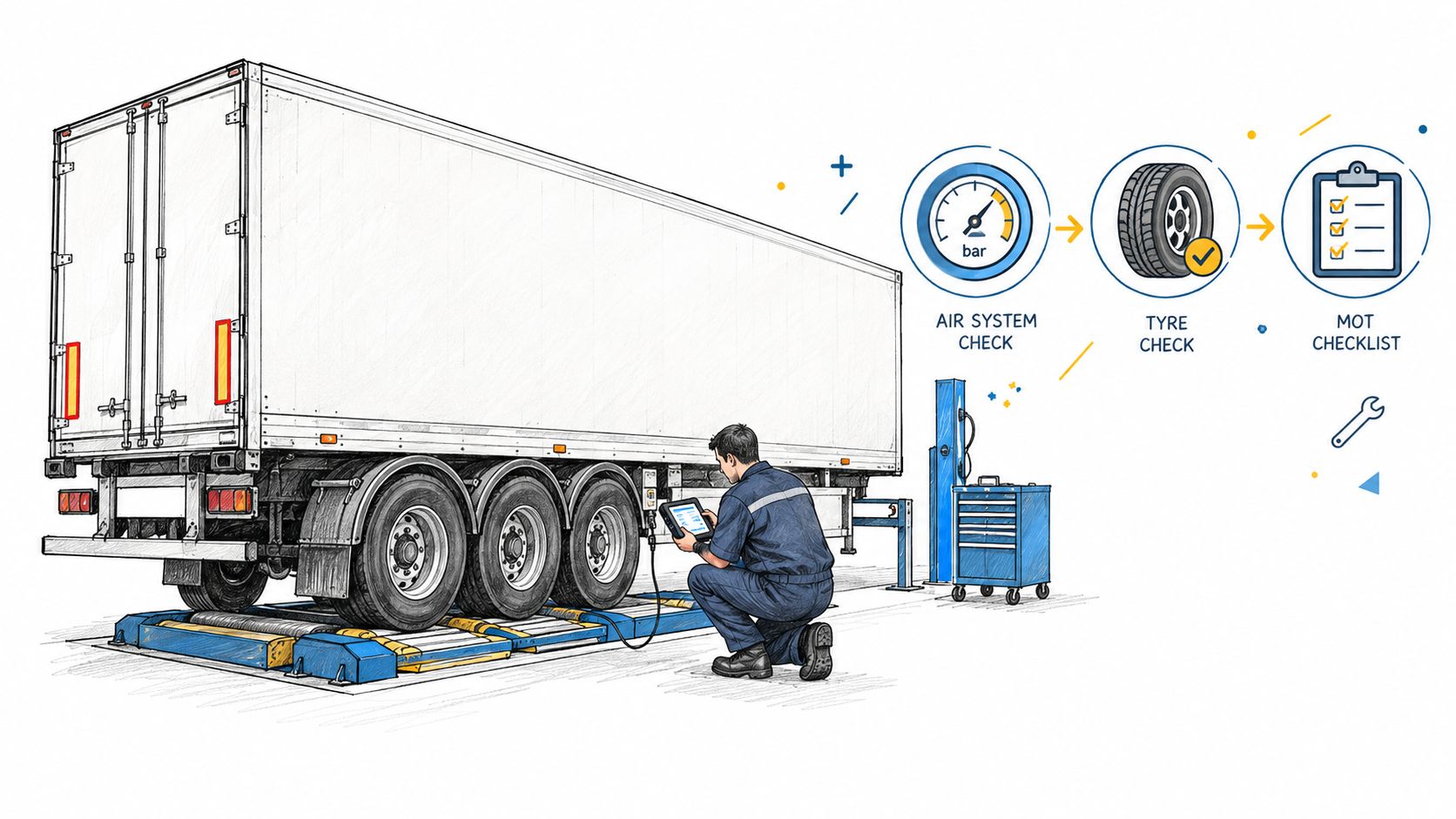
The sequence matters. A competent workshop doesn't push a trailer straight onto the rollers and hope for the best. It checks the hardware that affects the readings first.
That usually means:
Pre-test inspection of brake components
Actuators, slack adjusters, lever travel, drums, chambers, air lines and visible hardware are checked before any formal reading is taken.Roller brake test by axle
The calibrated brake tester shows how each axle is performing, whether there's imbalance, and whether drag is present. Operators looking for dedicated roller brake testing for commercial vehicles should expect the readings to guide the repair, not just sit on a printout.Electronic fault finding
EBS and ABS diagnostics help trace warning signals, communication faults and issues that won't be solved by mechanical adjustment alone.Air system assessment
Supply and service lines, coupling heads and leakdown behaviour need checking because air faults distort brake performance and can create false assumptions.
Why this saves return visits
If brake performance is weak, the workshop needs to know whether the problem sits in adjustment, hardware seizure, air delivery, or control logic. If the trailer also has tyre wear, suspension faults or landing leg issues, those need folding into the same planning decision so the unit doesn't leave with one problem fixed and another waiting to stop it next week.
A trailer that fails on imbalance rarely needs “just a test”. It usually needs diagnosis, rectification, and a clean re-test path.
This is also where MOT preparation becomes useful rather than cosmetic. The trailer is assessed against the faults that cause test trouble, such as brake imbalance, excessive lever travel, seized braking components, warning system issues, worn tyres or visible mechanical defects. Combining those checks before presentation gives the operator a cleaner shot at the booked slot and less chance of an aborted day because one preventable issue was missed.
Callouts, Recovery and Keeping Freight Moving on the A14
The A14 isn't just another road for Suffolk operators. It's a freight artery with heavy trailer use, port-linked timing pressure and very little tolerance for avoidable breakdown delay. Suffolk transport study material using Highways England WebTRIS data shows heavy vehicles make up about 15% of Annual Average Daily Flow on the A14 south of Ipswich and around 16% west of Ipswich, which means roughly one in six vehicles on some nearby sections is an HGV, according to the Suffolk corridor transport study appendix.
That density matters when a trailer goes down between Stowmarket and the port routes. The fault isn't happening in isolation. It's happening in live freight traffic, often with narrow timing windows and limited room for a poor decision.
Why corridor disruption changes the repair decision
Regional reporting has also highlighted how exposed operators are to local disruption. BBC reporting, citing Department for Transport data, said heavy goods vehicles make up 13% of the 60,000 vehicles using the A14 near Ipswich each day, and the same reporting referenced A14 night closures for resurfacing plus enforcement risk for lorries avoiding an official diversion route during 2025 roadworks, as covered in the BBC report on A14 roadworks and HGV traffic.
That changes the value of a callout. The aim isn't only to fix a fault quickly. It's to decide whether roadside repair is realistic, whether the trailer should be shifted to a safer holding point, or whether full recovery is the only controlled option.
Trailer Breakdown Response Options on the A14 Corridor Typical Use Case Equipment Needed Schedule Impact Roadside repair Minor accessible defect, safe working conditions, trailer otherwise serviceable Diagnostic kit, air repair equipment, tools, lighting Lowest disruption if fixed first time Controlled movement to a safe location Fault allows limited movement but not a full return to duty Tractor support, air assessment, location planning Moderate disruption, buys time for workshop repair Full recovery to workshop or yard Brake, hub, suspension, structural or major air fault Recovery capability, safe yard access, workshop facilities Highest immediate impact, best control over compliance riskWhat makes a useful callout request
When operators ring for support, vague fault descriptions waste time. “Trailer's down on the A14” isn't enough to plan the right response.
The useful details are:
- Exact location: Junction, carriageway, layby, depot entrance or industrial estate
- Trailer type: Curtainsider, box, skeletal, fridge or tipper
- Fault symptoms: Air leak, brake warning, wheel heat, suspension drop, lighting loss
- Load status: Laden, empty, part-loaded, time-sensitive or transferable
- Tow condition: Whether the trailer can be moved on its own air or not
For A14 traffic-related support near Stowmarket and Junction 47, operators dealing with an urgent incident may need HGV breakdown help on the A14 near Junction 47 if the issue has moved beyond a routine booking.
Planned downtime also matters more here than many operators allow for. A trailer with a developing fault often causes less disruption if it's booked in overnight, over a weekend window, or at driver changeover instead of being pushed until it fails during a live port run. On this corridor, timing repairs properly is part of keeping freight moving.
Why a Dedicated Workshop Near A14 Junction 47 Matters
Distance on paper isn't the same as downtime in practice. A trailer workshop might look “close enough” on a map, but if access is awkward, yard space is tight, or the site isn't set up for proper commercial inspection, the operator loses time before the repair has even started.
That's why a dedicated workshop near A14 Junction 47 is useful to Stowmarket operators. The value isn't image or branding. It's the ability to get a trailer in, inspected, tested and returned to service without detouring through town centres or trying to fit heavy commercial work into a setup designed around smaller vehicles.
Capability matters more than postcode alone
A trailer repair booking makes more sense near the corridor when the workshop can handle the unit properly. That includes room for tractor and trailer access, proper brake testing, and a workflow that supports PMI, repairs and MOT preparation in one place.
A site near Woolpit and Elmswell also suits operators running between Bury St Edmunds, Stowmarket, Ipswich and the Felixstowe side because the trailer can be dropped or collected by a driver already moving along the route, instead of burning extra time on a separate shuttle plan.
Why this reduces wasted movement
The strongest operational benefit is fewer dead miles and fewer broken plans. If a trailer goes in for brake work and can be inspected, tested and prepared for presentation from the same location, the operator cuts out the stop-start pattern that usually creates delays.
One practical option for fleets needing that kind of commercial support is Woolpit Truck Repairs, which handles HGV and trailer inspection, repair and testing-related workshop work from its base near the corridor. Operators weighing location and workshop suitability can also review the case for an HGV workshop near the A14 when planning where trailer work should be routed.
A trailer workshop close to the route only helps if it saves a second movement, a second booking, or a second failure point.
For a transport manager, that's the advantage. Not cheaper in theory. Simpler in operation.
Booking Trailer Repairs and Getting the Workshop Working for You
The booking call goes better when the operator has the facts ready before picking up the phone. Trailer repairs in Stowmarket are usually delayed less by workshop time than by poor initial information. If the workshop has to spend the first half hour working out what the trailer is, where it is, and whether it can even be moved, the clock is already running against the job.
For scheduled work, operators should treat the call like a handover, not a casual enquiry. For urgent faults, the same principle applies, just faster.
What to have ready before calling
A useful booking starts with the trailer's identity and current condition. The workshop needs enough detail to decide whether the unit needs a workshop slot, a same-day inspection, a callout request, or recovery planning.
Have these points ready:
- Trailer details: Make, model, age, axle setup and trailer type
- Current symptoms: Air leak, poor braking, warning lamp, tyre issue, electrical fault, suspension defect
- Work history: Recent repairs, recurring faults, brake work, tyre replacements, hub or air system work
- Testing status: Last roller brake test, annual test due date, and whether the trailer is already booked for presentation
- Current location: Depot, customer site, industrial estate, roadside, or parked near the A14
- Mobility status: Whether it can be moved safely under its own running condition or needs recovery support
How workshops usually prioritise the queue
A workshop serving commercial fleets won't handle every job in the same order. A planned PMI visit and a stranded trailer aren't the same problem, and they shouldn't be fed through the same urgency filter.
What tends to happen is:
- Immobilised or compliance-critical faults get assessed first
- Booked inspection and maintenance work is fitted around those urgent cases
- Repeat or developing defects are grouped with scheduled work where that avoids another visit
That matters for expectation-setting. A trailer with a dangerous air or brake fault may need immediate attention. A trailer with a non-urgent body or electrical issue may be better booked into the next sensible maintenance window.
Bring the paperwork with the trailer if it exists. Fault notes, prior inspection sheets and recorded warning details save time and reduce duplicate diagnosis.
Operators should also send anything that helps the workshop avoid guesswork, such as lifting axle documentation where relevant, recent defect reports, and any recorded braking or electronic fault information already taken from the vehicle side. The more complete the handover, the faster the workshop can move from triage to repair.
A good commercial workshop should then return the job with usable records. That normally means written brake test readings where applicable, itemised labour, parts traceability and a handover that fits real operating constraints, including driver hours and collection timing.
Woolpit Truck Repairs supports haulage operators, fleet managers and owner-drivers with trailer inspections, PMI support, roller brake testing, diagnostics, repairs, MOT preparation and callouts or recovery subject to availability from its commercial workshop near Woolpit and A14 Junction 47. If a trailer is off the road near Stowmarket, Ipswich, Bury St Edmunds or on the port routes, visit Woolpit Truck Repairs to arrange a booking and get the fault assessed properly.