A driver calls in from the lay-by side of the A14 near Elmswell. The warning light came on miles ago, the trailer feels wrong under braking, and the delivery slot won't wait. Another operator has a unit parked at a customer yard in Woolpit with an air fault that looked minor at first and then turned into a vehicle off road problem by the next shift.
That's usually what sits behind a search for HGV repairs Elmswell. It isn't casual browsing. It's a transport manager deciding whether a vehicle can keep earning, whether a defect risks a prohibition, and whether the next move should be roadside triage, workshop inspection, or recovery subject to availability.
Table of Contents
- When an HGV Needs Attention Near Elmswell
- What Specialist HGV and Trailer Support Covers
- Inspections Diagnostics and Roller Brake Testing Explained
- Repairs MOT Preparation Tyre Support and AC Re-Gas
- How to Book and What Happens on a Callout
- Staying Roadworthy on the A14 Corridor
- Book HGV Repairs Near Elmswell Today
When an HGV Needs Attention Near Elmswell
The local pressure is obvious to any operator running Suffolk regularly. The A14 is the main working route through this area, and Suffolk transport-study data shows heavy vehicles make up about 15% of Annual Average Daily Flow on the A14 south of Ipswich and around 16% west of Ipswich. The same study reports about 61,405 vehicles per day between Junctions 56 and 57, while the Orwell Bridge section can reach 66,000 to 68,000 vehicles on a five-day average and as much as 70,000 on a weekday, according to the Suffolk transport study on A14 corridor traffic flows.
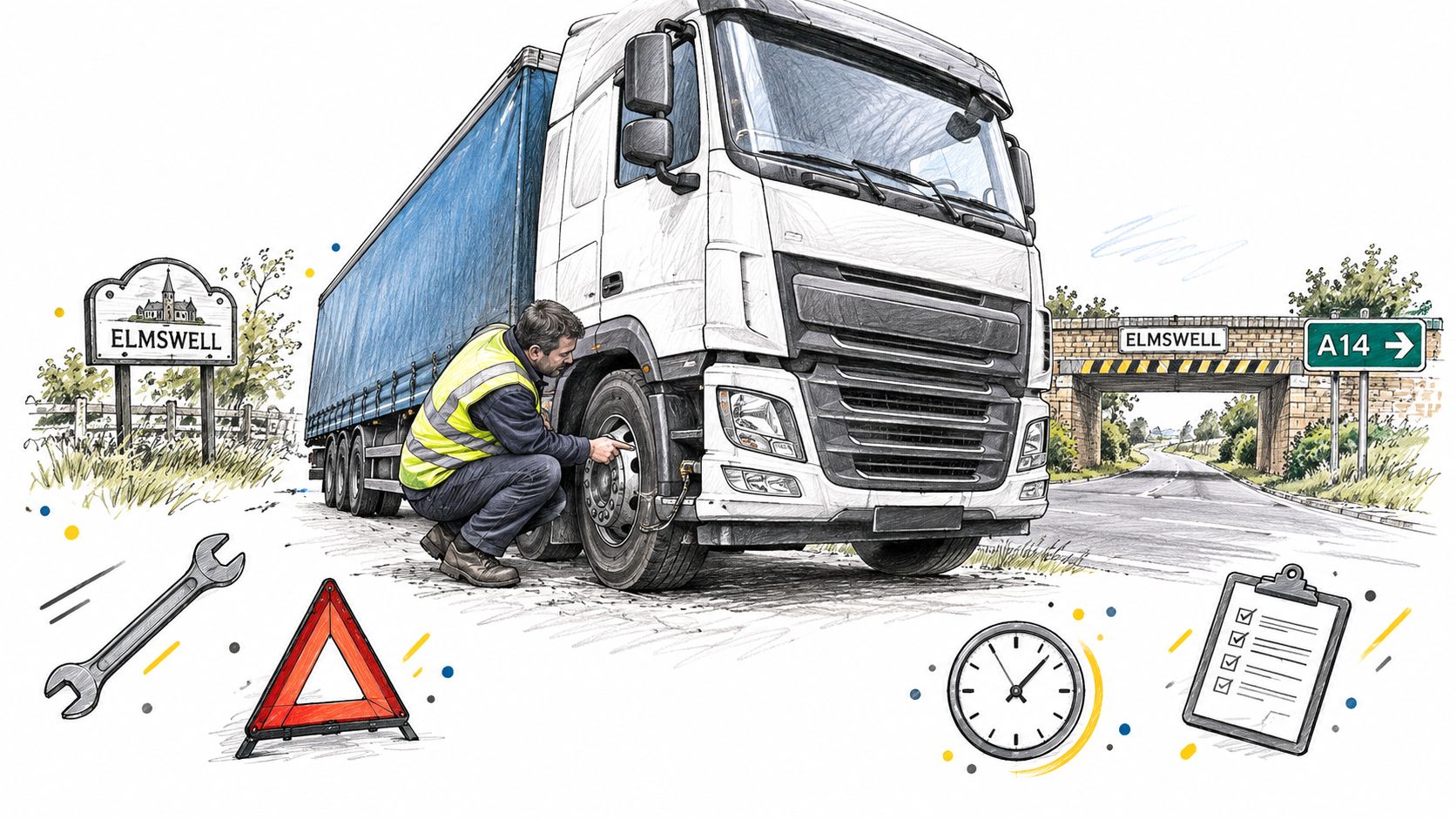
That matters around Elmswell, Woolpit, Stowmarket and Bury St Edmunds because faults don't develop in isolation. They surface on loaded working routes, on trailer changes, at depot exits, or halfway through a timed run toward Ipswich or Felixstowe. A vehicle with a brake imbalance, tyre issue, air leak or running gear defect can move from manageable to operationally expensive very quickly.
Why local commercial support matters
A specialist commercial workshop near A14 Junction 47 is useful because decisions can be made on the basis that affects uptime.
- Can it move safely: Some defects need workshop booking. Others need immediate off-road assessment.
- Is the trailer part of the fault: A unit can present as the problem when the issue sits at trailer brake performance, wheel-end condition or air supply.
- Will the next step protect compliance: Fast isn't enough if the vehicle returns to service with the same defect chain still in place.
The costly mistake isn't always the breakdown. It's sending the vehicle back out before the underlying cause has been isolated.
Operators looking for HGV support near Elmswell are usually balancing the same three concerns. Keep the load moving if it's safe, keep the maintenance file straight, and stop one fault turning into repeat downtime.
What Specialist HGV and Trailer Support Covers
A proper commercial workshop doesn't work like a general vehicle garage. The job isn't just to replace failed parts. The job is to keep HGVs, trucks and trailers roadworthy, inspectable and available for work across Suffolk, Essex and Norfolk.
That means separating faults into the right category first. A vehicle with a dashboard warning and no obvious drivability issue may need diagnostics before any parts decision. A trailer with uneven brake performance may need brake testing and inspection before anyone touches the adjusters. A fleet with repeated defects needs planned intervention, not one more reactive repair.
The four main support categories
Inspection work sits at the front of the process. This includes safety inspections, PMI support and defect checks that catch wear before it turns into a roadside problem.
Diagnostics are there to find the cause, not just the symptom. Warning lights, intermittent faults, air-system problems and electrical issues usually need structured fault tracing rather than guesswork.
Repair work deals with confirmed defects. That can include truck repairs, trailer repairs, brake rectification, running gear work, tyre-related issues and associated mechanical faults.
Preparation support covers the tasks that keep the vehicle ready for test and for work. That includes MOT preparation and presentation support, loaded brake test planning, and defect rectification before annual test presentation.
What specialist support does not mean
It doesn't mean every fault should trigger a roadside attendance. Some issues are safer and cheaper to manage as workshop bookings.
It also doesn't mean software alone solves fleet maintenance. Digital systems can help schedule PMIs, defects and service windows, and some operators use resources such as an open API for smart fleet integration to connect workshop planning with wider fleet processes. But digital visibility only helps if inspections are thorough and the workshop acts on what it finds.
Workshop reality: The best maintenance systems still fail when operators treat warnings, tyre wear, brake feel or trailer defects as admin rather than engineering.
One local option in this category is Woolpit Truck Repairs, which handles commercial HGV and trailer work only, including inspections, diagnostics, repairs, brake testing, MOT preparation and callout support subject to availability. That sort of focus matters because a loaded artic, a fleet trailer and a rigid on urban work all fail in different ways, and they need to be assessed as commercial vehicles, not as generic workshop jobs.
Inspections Diagnostics and Roller Brake Testing Explained
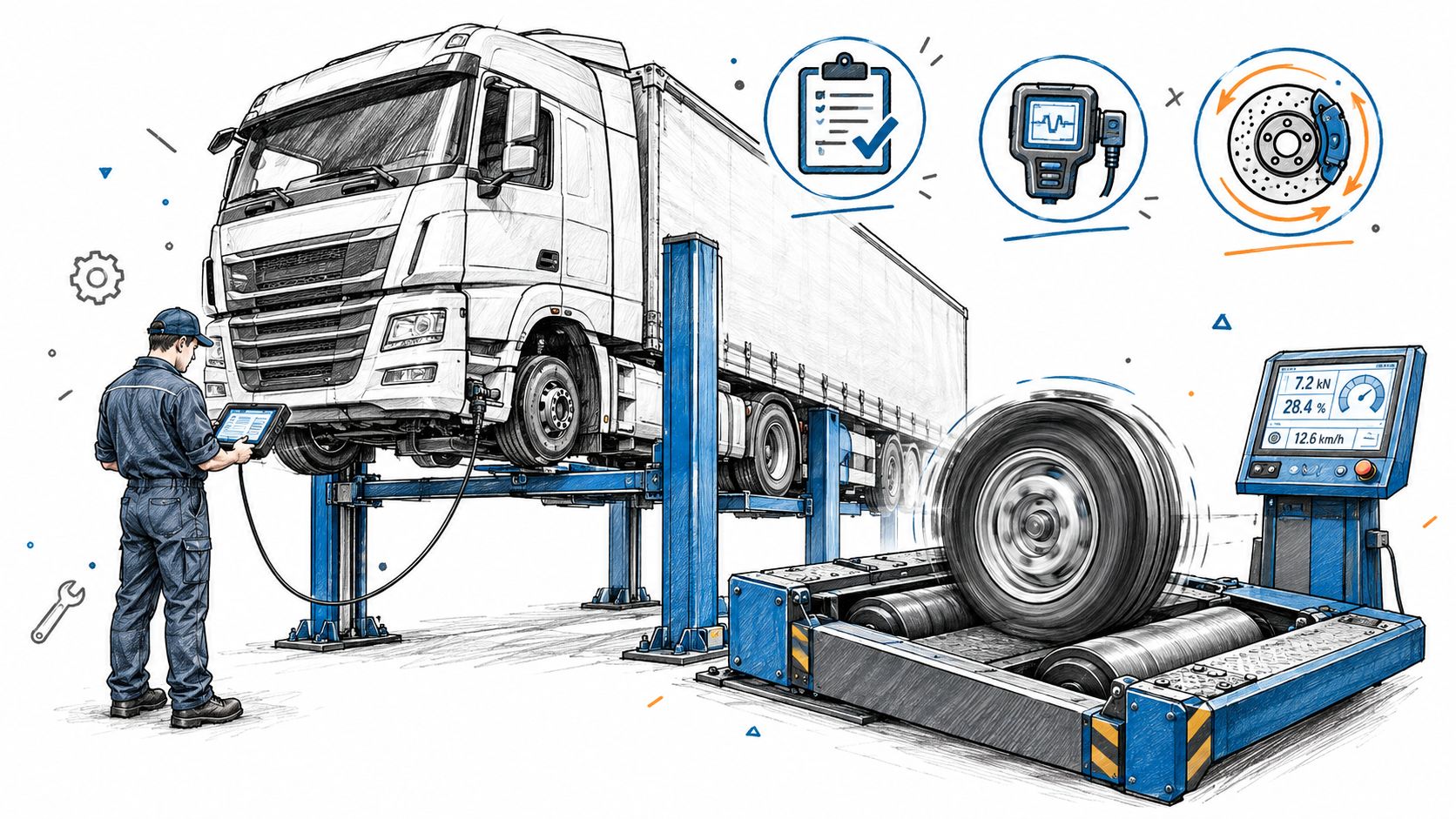
The strongest way to prevent VOR time isn't to wait for a failure and react well. It's to connect inspection, diagnostics and roller brake testing so each one feeds the next decision properly.
Inspections find wear before enforcement does
National compliance data shows why inspections matter. In Great Britain fleet compliance checks, 9.1% of vehicles inspected had at least one prohibitable defect, with running gear responsible for 36.9% of prohibitions and brakes 10.9%, according to the commercial vehicle fleet compliance checks report.
For operators on the A14 and A12, that points to one practical rule. Don't separate suspension, wheel-end, axle and brake concerns into different mental boxes. They interact. A running gear defect can lead to tyre scrub, brake imbalance and roadside attention that could have been avoided by a sharper inspection routine.
A good PMI or safety inspection does more than tick off visible damage. It helps rank defects by risk.
- Immediate safety risks need rectification before the vehicle returns to service.
- Developing wear items need scheduling before they become roadside failures.
- Repeat defects need root-cause attention, not another temporary fix.
Diagnostics stop parts-swapping
Diagnostics matter most when the fault report is vague. “Brake issue”, “pulling”, “warning light”, “air dropping overnight”, or “trailer not right” are all descriptions, not diagnoses.
That's where workshop logic matters. Electrical and pneumatic faults can mimic mechanical defects. Mechanical drag can present like poor brake efficiency. A trailer issue can look like a tractor-unit issue until testing and inspection separate the two.
A vehicle that “still drives” can still be one stop away from a prohibition.
Loaded roller brake testing gives usable evidence
Brake testing is where many operators either save themselves trouble or create it. DVSA guidance says HGVs and trailers should be brake-tested in a loaded condition, ideally at least 65% of maximum total weight, because under-loading can mask brake imbalance, efficiency loss and binding that only appear at higher axle loads, according to the DVSA guide to understanding HGV and trailer brake test reports.
That report format matters in practical terms because it records pass value, achieved efficiency and unsatisfactory wheel performance. Those details help a technician narrow the likely fault path. The issue may sit with pneumatic delivery, friction material condition, adjustment, or mechanical drag at the wheel end.
Operators using decelerometer assessments also need to plan properly. DVSA roadworthiness guidance says they must carry out a minimum of four roller brake tests spread evenly across the year, and the annual test can count toward that total, as set out in the guide to maintaining roadworthiness for commercial goods and passenger-carrying vehicles.
For an operator trying to reduce downtime, that means brake evidence shouldn't be left to one annual event. It belongs inside the maintenance cycle. Booking roller brake testing for HGVs and trailers as part of recurring workshop support gives transport managers something more useful than a last-minute pass attempt. It gives them trend evidence before the vehicle falls out of service.
Repairs MOT Preparation Tyre Support and AC Re-Gas
Once the fault has been identified, the next decision is about type of intervention. Not every vehicle needs the same path. Some need immediate repair to return to safe operation. Some are still serviceable but need planned rectification. Others are approaching annual test and need focused preparation support rather than broad workshop time.
What each service is really for
Truck and trailer repairs are the direct answer to confirmed faults. That may involve brake rectification, running gear work, mechanical repair, air-system issues, electrical faults or trailer defect correction. The key is that repair should follow inspection and diagnosis, not replace them.
MOT preparation and presentation support is different. It doesn't mean the workshop is the test station. It means the vehicle is assessed, defects are rectified where needed, brake performance and general roadworthiness are checked, and the vehicle is presented in the right condition for annual test.
GOV.UK annual-test guidance says that in most circumstances vehicles must be loaded to at least 65% of their design axle weights with cargo or ballast to achieve an appropriately laden test. The same guidance explains that annual-test brake evaluation is based on design weights where they can be established, using 45% of design total axle weight for service braking and 16% of design gross weight for parking braking, as explained in the official guidance on bringing an HGV to annual test appropriately laden.
That's why poor preparation wastes time. A vehicle presented too light may not be assessed in a way that reflects its working condition, and in some cases it can be refused.
Choosing the Right Workshop Intervention
Reported Issue Best First Action Workshop Outcome Brake pull, imbalance, poor stopping feel Inspection plus loaded brake test Fault isolated before rectification Dashboard warning, intermittent fault, electrical issue Diagnostics Cause identified before parts are fitted Trailer defect found during daily walk-round Safety inspection Repair scheduled by severity Unit or trailer nearing annual test MOT preparation and presentation support Defects resolved before presentation Tyre condition concern or uneven wear Tyre support and running gear assessment Roadworthiness risk reduced Driver comfort issue affecting demist or cab environment Air-conditioning re-gas assessment Cab system restored where serviceableTyres and cab systems still affect uptime
Tyre support isn't a minor extra. Tyre condition often points to deeper running gear or alignment-related wear, and it can quickly become a compliance issue if left to the next service window.
Air-conditioning re-gas sits in a different category, but it still matters. For vehicles working long regional runs across Suffolk, Essex and Norfolk, reliable cab cooling and demisting affect driver comfort, visibility and day-to-day usability. It isn't the first thing to prioritise over brakes or safety defects, but it shouldn't be ignored once the vehicle is booked in.
How to Book and What Happens on a Callout
When a vehicle goes down near Elmswell, the speed of first contact matters less than the quality of the information passed over. A workshop can triage properly only if the operator gives enough detail to decide whether the vehicle can move, needs a roadside visit, or should be recovered for off-road inspection.
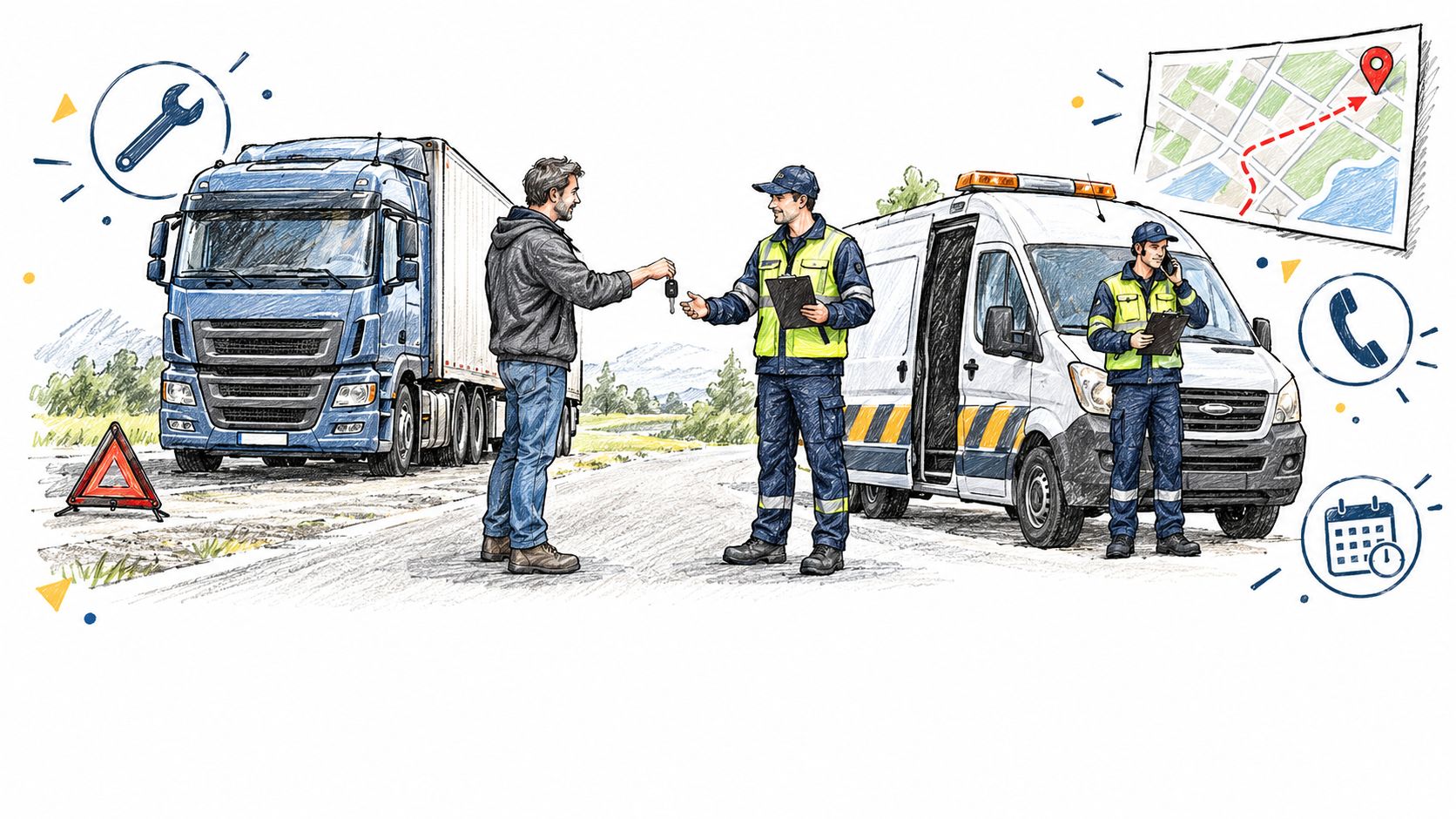
What to have ready before calling
A useful booking or breakdown call should cover the basics first, then the fault picture.
- Location details: Road, direction of travel, nearest junction or landmark. “Near A14 Junction 47” is more useful than “around Elmswell”.
- Vehicle details: Unit registration, trailer number if attached, and whether the fault appears on the tractor, trailer or combination.
- Fault symptoms: Warning lights, loss of air, braking concern, tyre issue, electrical fault, non-start, or physical damage.
- Load status: Loaded, empty, partly laden, hazardous constraints if relevant, and whether the load affects safe movement.
- Safety position: On hardstanding, in a lay-by, at customer premises, or causing obstruction.
Practical rule: The first question isn't “How fast can someone get there?” It's “Is the vehicle safe where it is, and can it be moved without making the risk worse?”
Planned booking versus urgent breakdown
A planned booking usually starts with a defect report, PMI due date, brake concern, warning light or annual-test preparation requirement. In that case, the workshop can allocate time for inspection, diagnostics, repair or presentation support in a controlled way.
A roadside situation works differently. If a trailer is held off the A14 with a suspected brake issue, the first decision is whether roadside attention is even suitable. Some faults can be assessed safely at the roadside or customer depot. Others need recovery and a proper workshop environment. Callouts and recovery are subject to availability, access and safety conditions.
Recent East Anglia disruption shows why this matters operationally. Reporting on the Orwell Bridge repair programme noted traffic used by about 12,000 HGVs daily, highlighting how a single bridge issue can quickly affect freight movement and workshop demand across the wider corridor, as noted in this report on the Orwell Bridge repair programme and freight traffic.
What happens after triage
Once the vehicle is assessed, the next stage should be clear.
- Roadside-safe fix if appropriate: Limited faults may be dealt with where the vehicle stands.
- Recovery or return to workshop: If the defect needs full inspection, the vehicle is brought off-road subject to availability.
- Follow-up inspection and repair plan: The workshop confirms the fault, identifies linked issues, and decides what must be rectified before return to service.
For operators needing commercial vehicle callout support, the value is in that triage discipline. It stops rushed roadside decisions turning into a second failure later the same week.
Staying Roadworthy on the A14 Corridor
For operators running between Woolpit, Elmswell, Bury St Edmunds, Stowmarket, Ipswich and Felixstowe, roadworthiness isn't just a legal concern. It's route protection. The aim is to keep vehicles earning on one of the busiest freight corridors in the region without handing preventable downtime to defects that should have been caught earlier.
The local strategy that works
The strongest approach is simple in principle and disciplined in practice.
- Plan maintenance around working reality: Peak freight periods, trailer utilisation, and port-related movements should shape inspection timing.
- Keep brake evidence current: Don't rely on one annual event to prove roadworthiness across the year.
- Prioritise defects by VOR risk: Some defects are legal risks immediately. Others are reliability risks that become legal risks if ignored.
- Treat trailers as profit-critical assets: Trailer faults still stop loads, miss slots and trigger roadside attention.
Recent highway information underlines the point. Suffolk's trunk routes, including the A11, A12 and A14, are heavily managed strategic roads, and local maintenance context reinforces the value of planned intervention over reactive repair, as reflected in Suffolk highway maintenance information for the county's strategic road network.
Preventing downtime is cheaper than chasing it
The useful shift in thinking is this. HGV repairs Elmswell shouldn't be treated only as a breakdown solution. For serious operators, it's part of a prevention system that includes inspections, defect reporting, brake testing, diagnostics and annual-test preparation.
That's also why fleet planning decisions connect to workshop planning. An operator expanding tractor units or trailer capacity needs funding and maintenance thinking to move together. Where businesses are reviewing replacement or expansion budgets, resources on financing for new rigs can help frame the commercial side, but the operational side still comes back to whether the workshop support is organised enough to keep those assets roadworthy.
A newer vehicle can still lose money if maintenance discipline is poor. An older one can still earn reliably if inspections, brake evidence and repairs are managed properly.
The operators who usually stay out of trouble on the A14 corridor aren't the ones who react fastest. They're the ones who reduce the number of reactions needed in the first place.
Book HGV Repairs Near Elmswell Today
If a unit or trailer is developing a fault near Elmswell, the decision should be based on roadworthiness first and convenience second. That means choosing the right intervention, not just the nearest slot. Inspection for uncertain defects. Diagnostics for warning lights and intermittent issues. Brake testing where stopping performance is in doubt. Planned rectification before the next shift turns a manageable defect into VOR time.
A short checklist helps:
- Is the vehicle or trailer safe to move
- Is the fault clearly identified, or does it need diagnostics
- Could the defect affect brake performance, running gear or annual-test readiness
- Would planned workshop time prevent repeat downtime next week
- Does the situation need callout or recovery support, subject to availability
Operators running Suffolk, Essex and Norfolk don't need generic workshop help. They need commercial HGV and trailer support that protects uptime, compliance and earning time on the A14 corridor.
For bookings around inspections, PMI support, brake testing, diagnostics, repairs, MOT preparation, tyre support, air-conditioning re-gas, planned maintenance or urgent assistance, the right next step is to call with the vehicle details and fault symptoms ready.
Woolpit Truck Repairs provides specialist HGV, truck and trailer workshop support near Elmswell and A14 Junction 47, including inspections, diagnostics, roller brake testing, repairs, MOT preparation and callouts or recovery subject to availability. For operators who want to reduce VOR risk and keep vehicles legal and earning, visit Woolpit Truck Repairs to request a booking or make contact.