A trailer fault rarely arrives at a convenient time. A driver may be approaching Bury St Edmunds with a loaded trailer, a delivery slot may be tied to Felixstowe, and the next run may already be planned along the A14. A warning lamp, weak braking response, damaged air line or defective lamp can turn a routine journey into a roadworthiness decision within minutes.
For operators searching for trailer repairs Bury St Edmunds, the right question isn't which workshop can replace a failed component. It's how to contain the fault safely, establish what failed, complete the necessary checks and return the trailer to work without creating a second defect. The process should connect roadside triage, workshop diagnostics, brake testing, repair, inspection records and MOT preparation.
Table of Contents
- When a Trailer Fault Stops Work Near Bury St Edmunds
- Immediate Actions When a Trailer Develops a Fault
- How to Choose a Trailer Repair Workshop Near Bury St Edmunds
- What to Expect During Diagnostics MOT Preparation and Repairs
- Turnaround Times Cost Factors and How to Reduce Downtime
- Book Trailer Repairs Near Bury St Edmunds With Woolpit Truck Repairs
When a Trailer Fault Stops Work Near Bury St Edmunds
A trailer stopped near Woolpit, Elmswell or the A14 corridor creates several problems at once. The driver needs a safe place to stop, the transport manager needs accurate information, the customer needs an updated delivery plan and the workshop needs enough detail to decide whether a callout, recovery or controlled return is suitable. Treating the event as a simple mechanical repair often delays the operational decision.
The local freight pattern makes that delay more serious. Bury St Edmunds sits close to routes carrying traffic between Suffolk, Ipswich, Felixstowe and wider links into Essex and Norfolk. Suffolk County Council transport material identifies substantial flows on sections of the A14 around Ipswich, including 16% west of Ipswich and 22% on another segment in the referenced study (Suffolk County Council transport material). A trailer that cannot move safely can therefore affect a trunk run, port collection, return load and depot schedule rather than one isolated journey.
The first decision is roadworthiness
A driver shouldn't continue because the trailer still rolls. Brake performance, air pressure, suspension condition, tyre damage, lighting and coupling security all need to be considered. If the fault affects control, braking, load security or statutory equipment, the safe decision is to stop and report it rather than attempt to protect the schedule.
Practical rule: A delayed delivery can be replanned. A trailer with an unresolved safety defect must be controlled first.
The transport manager should record the defect clearly and preserve the driver's observations. “Trailer feels wrong” isn't enough for a useful first assessment. Details such as pulling under braking, delayed air build-up, a persistent warning lamp, visible damage or a change after loading can help a technician prioritise the inspection.
Why a specialist response matters
A commercial trailer needs more than a generic inspection. The repair decision may involve electronic braking systems, air circuits, suspension, running gear, body equipment, tyres or coupling components. A workshop that understands HGV and trailer operating demands can also consider the next inspection, brake test and MOT presentation rather than closing the job when the obvious symptom disappears.
Operators can also use this guide to handling a trailer fault in Suffolk when a defect occurs away from the depot. The useful outcome is a controlled process, accurate information and a clear decision about whether the trailer can move.
Immediate Actions When a Trailer Develops a Fault
The first response should protect people, the load and the vehicle. A driver who notices a braking change, air loss, warning indication, unusual tyre behaviour or visible damage should reduce risk without carrying out an improvised roadside repair in an unsafe location.

A practical roadside sequence
Stop safely. Move away from live traffic where possible, apply the appropriate vehicle controls and follow the operator's roadside safety procedure. The driver shouldn't crawl underneath a trailer or work beside moving traffic to save time.
Make the defect safe to report. Check whether the load, doors, coupling and visible equipment remain secure from a safe position. Don't remove guards, disconnect systems or reset a warning repeatedly if that could hide the fault.
Contact the transport manager. The driver should explain what happened, when it started and whether the symptom changes with braking, speed, load or air pressure. A clear report gives the manager a basis for contacting a commercial workshop.
Capture the essential details. The workshop needs the trailer identification, current location, load state, route, brake symptoms, warning lamps, visible damage and whether the tractor unit has shown any related warning. A location near A14 Junction 47, Bury St Edmunds, Stowmarket or another recognised point is more useful than a vague description of the road.
Choose the movement option. A callout or recovery may be appropriate, subject to availability, when the trailer isn't safe to move or when the fault needs specialist attention at the scene. A controlled return to base is only a management decision after the defect has been assessed as suitable for that movement.
What the workshop should receive
The operator should send photographs only when the driver can take them safely. Useful images show the affected area, warning display, tyre or lamp condition and any visible air or structural damage. They don't replace an inspection, but they can improve preparation before the trailer arrives.
The load also matters. A brake test, repair access and workshop handling plan may depend on whether the trailer is empty, partially loaded or carrying a heavy operational load. Early disclosure prevents a repair booking from becoming an avoidable waiting period.
The fastest response usually starts with the clearest defect report, not the shortest description.
How to Choose a Trailer Repair Workshop Near Bury St Edmunds
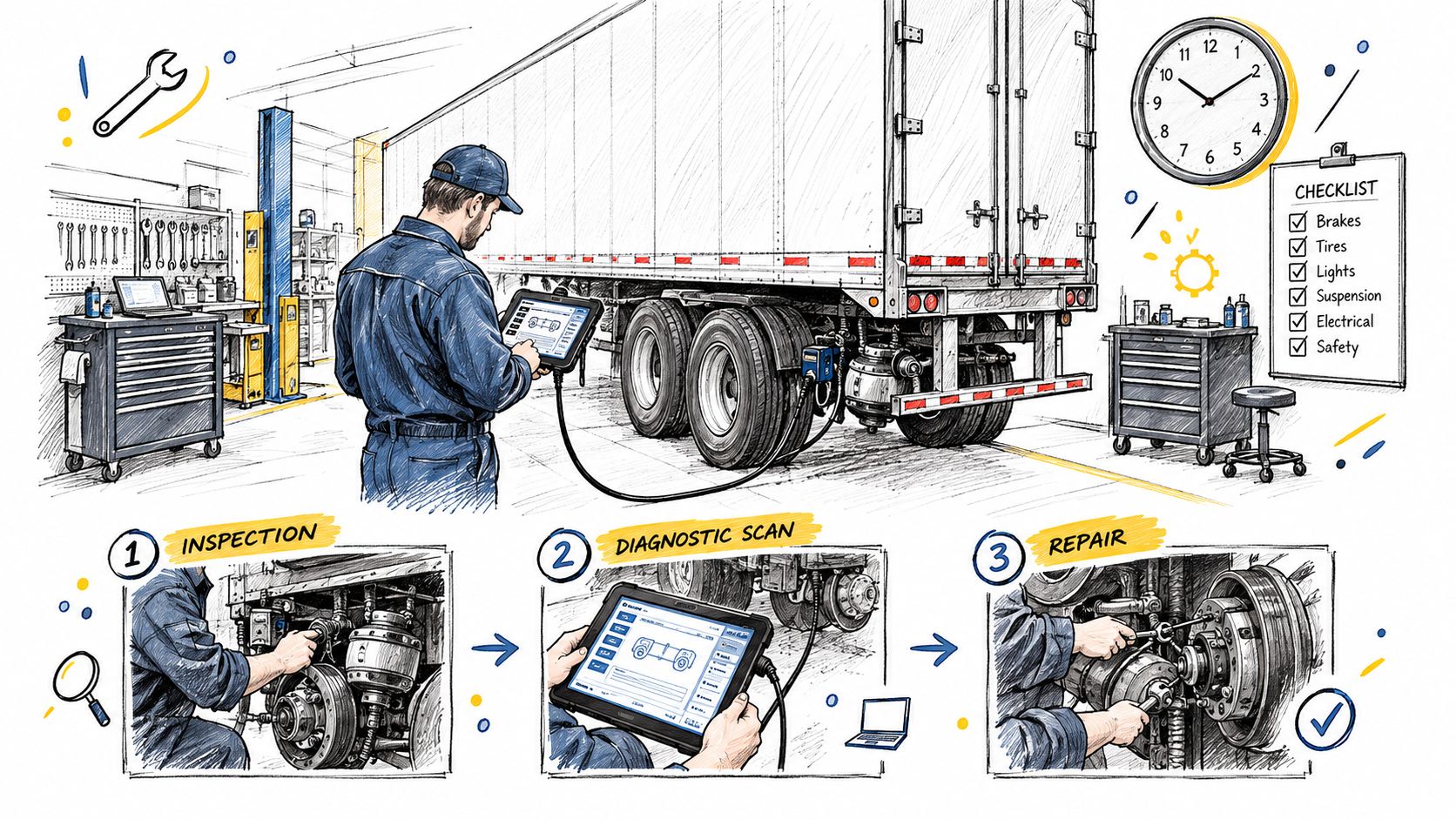
A workshop for trailers should be assessed as a commercial maintenance partner, not selected like a general garage. HGV and trailer work involves inspection discipline, air and braking systems, commercial diagnostics, running gear, tyres and the paperwork needed to support planned maintenance and MOT presentation.
Location still matters. A workshop in Woolpit near Elmswell and A14 Junction 47 can be practical for operators working between Bury St Edmunds, Stowmarket, Ipswich and Felixstowe, while coverage into Suffolk, Essex and Norfolk may help fleets with routes extending beyond the immediate depot area. Proximity, however, shouldn't outweigh the ability to diagnose the fault and verify the repair.
Compare capability, not advertising language
A suitable commercial workshop should be able to discuss:
- Trailer inspections and PMI support: The repair should feed into the operator's inspection record and defect-prevention process.
- Roller brake testing: Brake performance needs to be measured properly, not judged only by a short road test.
- Commercial diagnostics: Electronic systems and warning information need structured fault-finding.
- MOT preparation and presentation support: The workshop can prepare and present the vehicle, but that doesn't make it an MOT test station.
- Planned maintenance: The provider should help identify repeat defects and schedule work around fleet use.
- Callouts and recovery: These options may be available subject to availability, but no operator should assume a guaranteed response.
Operators needing a nearby commercial repair option can review HGV repairs near Bury St Edmunds and then ask direct questions before booking.
Choosing a Trailer Repair Partner Near Bury St Edmunds
Selection Criteria What Good Looks Like Why It Matters for Uptime Commercial scope HGVs, trucks and trailers only, with trailer-specific inspection experience Reduces the risk of treating a trailer defect as a generic vehicle fault Brake capability Roller brake testing and brake performance assessment Confirms whether braking performance matches the repair decision Diagnostic process Fault codes, symptoms and physical findings considered together Prevents repeated component replacement without finding the cause Compliance support PMI records, inspection planning and MOT preparation Connects workshop work with operator control systems Access and coverage Practical location near Woolpit, Elmswell and the A14, with wider local support Helps reduce unnecessary movement and coordination time Recovery decision Callouts or recovery discussed subject to availability Gives the transport manager a realistic contingency optionA car garage may be convenient, but that doesn't mean it has the working practices or equipment required for HGV and trailer maintenance. The selection decision should centre on safe diagnosis, evidence of repair completion and the ability to support the next planned inspection.
What to Expect During Diagnostics MOT Preparation and Repairs
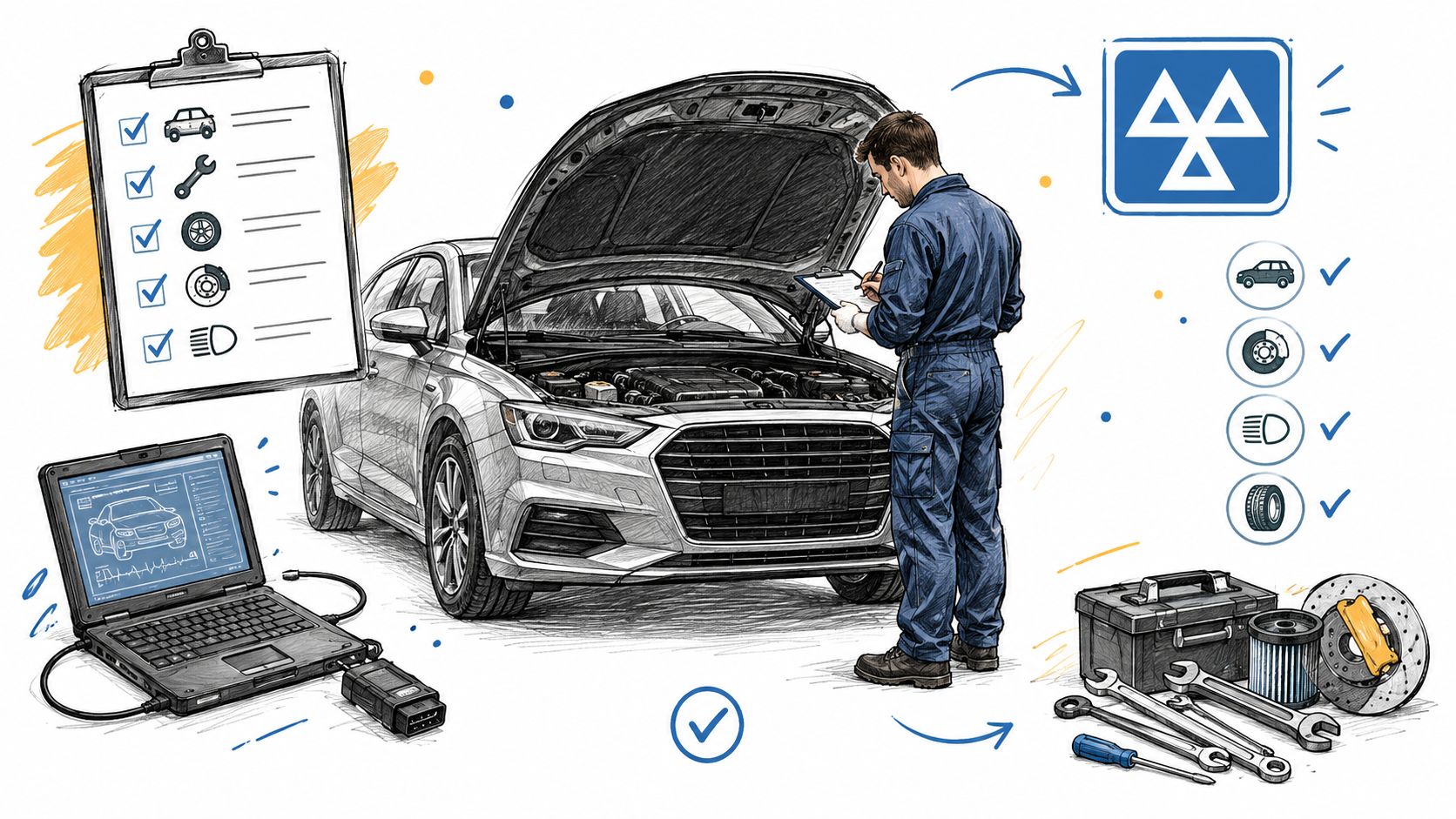
A well-managed trailer repair starts before the first component is removed. The workshop should receive the defect report, trailer identification, load information and any relevant warning details. That information allows the technician to compare the reported symptom with the trailer's condition rather than beginning with an assumption.
Inspection comes before parts
The first workshop stage should establish the defect and identify related risks. A brake complaint may involve friction material, adjustment, air delivery, valves, chambers, drums, discs, electronic control or uneven performance across axles. A lamp fault may be a damaged unit, wiring issue, connector problem or water ingress.
Commercial diagnostics should support, not replace, physical inspection. If the issue involves powered equipment or a hydraulic function, a structured resource on diagnosing hydraulic system faults can help transport staff understand why symptoms, fluid condition, pressure and component testing need to be considered together.
For electronic braking and other monitored systems, the technician should record relevant fault information before clearing it. Clearing a warning without correcting the underlying issue can make the trailer appear fixed while leaving the operational risk in place. The repair decision should follow the evidence found during inspection.
Brake testing needs a proper plan
UK guidance says HGVs and trailers should be tested on a roller brake tester at least four times per year, with one test at the MOT (DVSA brake-test guidance). The same guidance says the vehicle should ideally be loaded to at least 65% of its total maximum weight, with unloading allowed only when loading is impossible because of the design or typical load type.
DVSA guidance also states that the normal expectation is at least 65% of design axle weight for a laden brake test, and an annual test can be refused if the vehicle or trailer isn't satisfactorily loaded (DVSA annual test loading guidance). That makes load planning part of MOT preparation, not an administrative detail to resolve at the last minute.
Repair, retest and record
Once the fault is repaired, the workshop should verify the outcome. Depending on the defect, that may involve a brake test, leak check, diagnostic confirmation, lighting check, tyre inspection or functional test. The operator should receive clear information about work completed, remaining observations and any follow-up inspection requirement.
Woolpit Truck Repairs provides HGV and trailer diagnostics, inspections and MOT preparation and presentation support. It doesn't claim to be an MOT test station. Operators can also review HGV diagnostics in Suffolk when planning a fault investigation rather than waiting for a warning to become a roadside failure.
Turnaround Times Cost Factors and How to Reduce Downtime
Trailer downtime depends on more than the repair itself. Trailer condition, the accuracy of the initial defect report, inspection access, parts availability and any required brake test or MOT preparation all affect the time from workshop arrival to return to service. On the A14 corridor, that delay can also disrupt the next load, driver allocation and planned delivery slot.
Age needs close attention. UK government maintenance guidance reports annual trailer MOT failure rates rising from 2.7% for new trailers to 15.9% for trailers aged 12 years or older (Guide to Maintaining Roadworthiness). Older trailers working around Bury St Edmunds and the A14 therefore need controlled inspection and repair planning, especially where repeated use exposes worn brakes, suspension, lighting or running-gear components.
Brake defects can extend the repair window. Guidance summarising DVSA data for 2022–23 lists trailer test failure categories including service brake performance at 3.20%, parking brake performance at 2.17%, brake systems and components at 1.32%, lamps at 1.21% and suspension at 0.82% (transport industry trailer MOT failure guidance). Brake assessment should therefore form part of planned maintenance, rather than being left until the annual test identifies a problem.
Planning intervals around actual work
Inspection frequency should match operating conditions. Trailers aged 12 years or older should be inspected at least every 6 weeks. General haulage and trunking typically calls for a 6 to 10 week safety-inspection interval, while arduous work calls for 4 to 6 weeks. The interval should also reflect loading, mileage, routes and the trailer's defect history.
Vehicle Profile Recommended Inspection Interval MOT Failure Context Trailer aged 12 years or older At least every 6 weeks Failure rates rise to 15.9% for trailers aged 12 years or older, compared with 2.7% for new trailers General haulage and trunking 6 to 10 weeks Regular inspection supports early detection before annual testing Arduous work 4 to 6 weeks Shorter intervals reflect more demanding operating conditions Brake-focused maintenance Brake performance measured at safety inspections UK practice expects brake performance checks during safety inspections (RHA maintenance guidance)What reduces the repair window
A planned booking can combine inspection, defect repair and brake testing while the trailer is already available. A precise defect report reduces diagnostic time. Include warning symptoms, affected axle or side, load condition, recent work and whether the trailer is safe to move. Early load planning also avoids an unsuitable brake-test presentation.
Parts should be selected after inspection, not ordered solely from the first symptom. If the trailer arrives with several unrelated defects, the workshop can separate immediate roadworthiness work from repairs that can be scheduled later, helping the operator make a clear uptime decision.
Reactive repair remains appropriate for genuine roadside defects. It should not replace a controlled maintenance system. Fleets running heavy loads on the A14 and A12 need contingency cover, clear escalation rules and a defined point at which the trailer is removed from service. That decision protects the driver, the load and the next planned movement.
Book Trailer Repairs Near Bury St Edmunds With Woolpit Truck Repairs
Trailer repair planning works best when the workshop understands both the mechanical defect and the transport schedule around it. A trailer leaving Woolpit for Bury St Edmunds, Stowmarket, Ipswich or Felixstowe may need more than a component change. It may need a safety inspection, PMI record, brake test, diagnostic check, tyre assessment or MOT preparation before the operator can release it confidently.
Woolpit Truck Repairs is a specialist commercial workshop for HGVs, trucks and trailers only. Its services include HGV and trailer inspections and PMI support, roller brake testing, commercial vehicle diagnostics, mechanical truck and trailer repairs, MOT preparation and presentation support, tyre support, air-conditioning re-gas and planned fleet maintenance.
A practical booking conversation
The operator should provide the trailer identification, defect description, load state, current location and required operational date. That gives the workshop a better basis for deciding whether the trailer should come to the Woolpit workshop, whether a callout may be suitable or whether recovery is needed. Callouts and recovery remain subject to availability.
The workshop is based in Woolpit near Elmswell and A14 Junction 47, with relevant service coverage for Bury St Edmunds, Stowmarket, Ipswich, Felixstowe and wider areas of Suffolk, Essex and Norfolk. The focus is commercial uptime, roadworthiness and planned control, not consumer-car servicing.
A transport manager who books early can align inspection work with fleet availability and MOT preparation. An owner-driver can provide the right defect information before arriving. Both approaches reduce the chance of a small trailer issue becoming a missed collection, an unplanned recovery or a return visit.
The next step is straightforward. Call the workshop or request a booking with the trailer details, explain the fault accurately and ask for the appropriate inspection, diagnostic, brake-testing or repair pathway.
Call Woolpit Truck Repairs to discuss trailer inspections, PMI support, roller brake testing, diagnostics, repairs and MOT preparation near Bury St Edmunds. Provide the trailer ID, defect symptoms, load state and location so the workshop can help plan the safest route back to work, with callouts or recovery subject to availability.