A tractor unit leaving Felixstowe for a delivery slot in the Midlands can develop a warning lamp before it reaches Stowmarket. The driver may still have power, the engine may sound normal, and the vehicle may appear capable of continuing. The transport manager still has a decision to make: monitor the fault, divert to a workshop, or stop before a minor issue becomes a roadside failure.
That decision is harder when the vehicle is working an A14 or A12 schedule, carrying a trailer, or heading towards a time-critical port movement. HGV diagnostics Suffolk operators can rely on needs to do more than read and erase a fault code. It should identify the likely cause, establish whether the vehicle remains roadworthy, and feed useful information into inspections, brake testing, repairs and MOT preparation.
The following guidance is written for fleet operators, transport managers, haulage businesses, trailer operators and owner-drivers. It explains what a diagnostic appointment involves, which symptoms deserve urgent attention, how braking assessment fits into the process, and what information helps a workshop reach the right conclusion without wasting downtime.
Woolpit Truck Repairs is a specialist commercial workshop for HGVs, trucks and trailers only. It isn't a car garage. Its diagnostic work sits alongside HGV and trailer inspections, PMI support, roller brake testing, repairs, MOT preparation and presentation support, so operators can treat a warning light as part of a wider roadworthiness decision rather than an isolated electronic nuisance.
Table of Contents
- Introduction When a Warning Light Threatens Your Schedule
- What HGV Diagnostics Really Means for Trucks and Trailers
- Common HGV Fault Codes and Symptoms You Should Not Ignore
- What Happens During an HGV Diagnostic Appointment in Suffolk
- Why Diagnostics Pays Back for Suffolk Haulage Operations
- How to Prepare Your Vehicle and What Costs and Turnaround to Expect
- Booking HGV Diagnostics Near Woolpit and Keeping Your Fleet Roadworthy
Introduction When a Warning Light Threatens Your Schedule
A driver calls from the A14 near Woolpit. The tractor unit has displayed an emissions warning, the delivery window is approaching, and the next job is already allocated. The truck still feels normal, yet the warning has appeared twice, disappeared, and returned under load.
That pattern leaves a transport manager balancing uptime against roadworthiness. Continuing may protect the current journey, but an emissions, air, braking, electrical or sensor fault can develop into reduced performance, a roadside prohibition or recovery. Stopping may protect the vehicle while disrupting the delivery plan and leaving the trailer, driver and onward load out of position.
The response should be based on what the system has detected, how the vehicle is behaving, and whether a safety-critical function is affected. A diagnostic code is evidence that a system has recorded an abnormal condition. It does not automatically prove that the named sensor has failed. Clearing the warning without testing the related system removes information, not the fault.
Diagnostics is part of a maintenance decision
For a busy Suffolk fleet, a useful diagnostic process answers four operational questions:
- What happened? The driver's report, warning-lamp behaviour, operating conditions and recent repairs establish the fault history.
- What is affected? The workshop examines the relevant control unit, wiring, air system, emissions equipment, braking system or mechanical component.
- Can the vehicle continue safely? Safety-related symptoms require a different decision from a minor intermittent electrical warning.
- What should happen next? The outcome may be immediate repair, planned work during PMI, brake testing, further inspection or MOT preparation.
A warning light should therefore be managed within the vehicle's wider maintenance plan. For A14 and A12 work, including Felixstowe corridor movements, the practical objective is to identify defects before they interrupt a scheduled run. That means using diagnostic findings alongside PMI inspections, measured brake performance and MOT preparation, rather than treating a code read as a complete assessment.
The traffic volume on these routes makes planned workshop access valuable, but it does not justify delaying a safety-related decision. An intermittent fault can remain harmless, worsen under load, or point to a developing defect. The driver's observations and the vehicle's behaviour help set the urgency, while testing confirms the repair route.
Woolpit Truck Repairs works with HGVs, trucks and trailers only. Its diagnostic work sits alongside inspections, PMI support, roller brake testing, repairs, MOT preparation and presentation support, allowing operators to connect warning-lamp investigation with a clear roadworthiness decision and a practical return-to-work plan.
What HGV Diagnostics Really Means for Trucks and Trailers
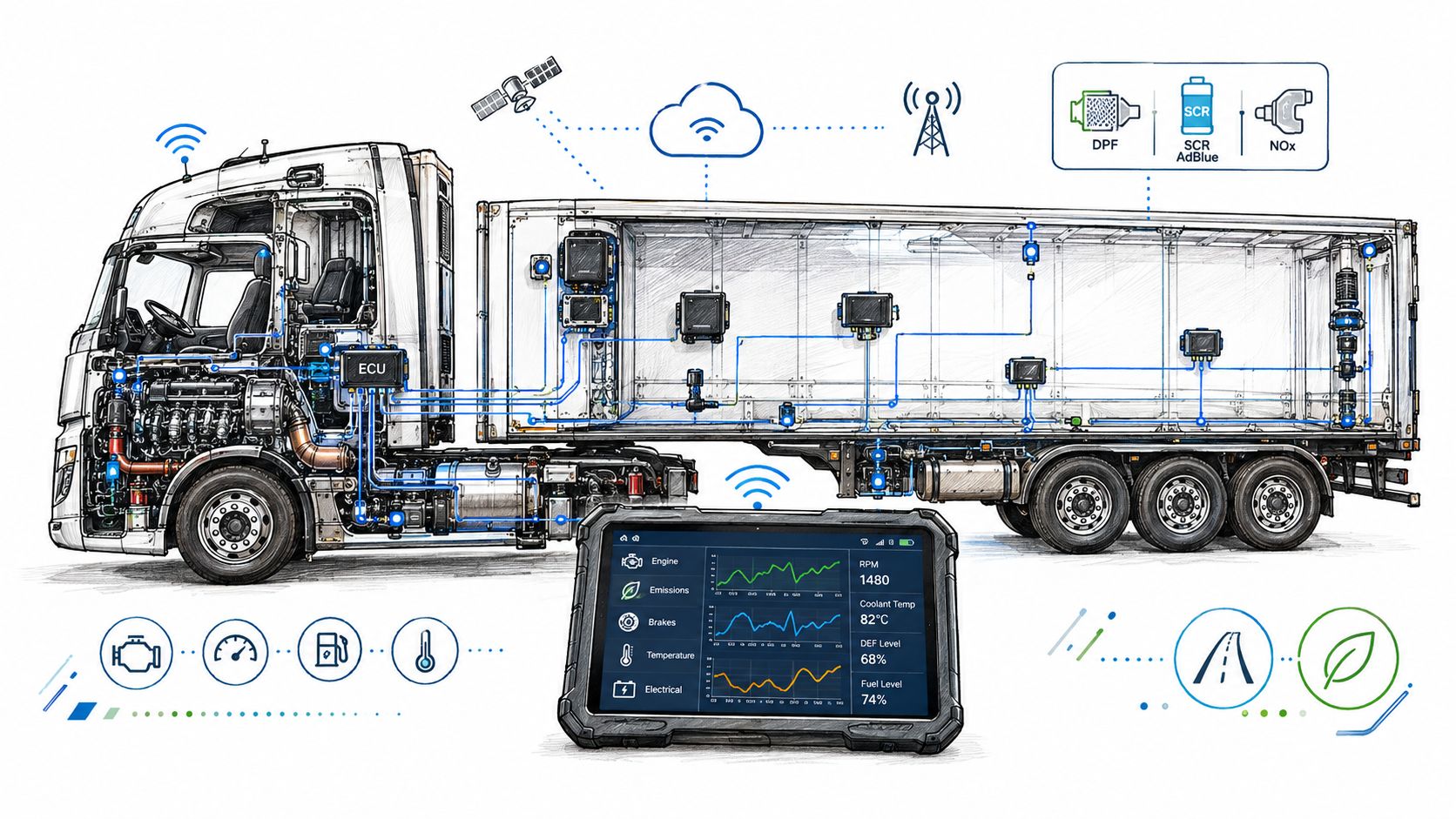
An HGV's electronic systems work like a nervous system. Control units receive information from sensors, compare that information with expected operating conditions, and communicate with other systems over the vehicle's network. When the readings fall outside an expected range, the vehicle may store a diagnostic trouble code and illuminate a warning.
The code is useful, but it's only evidence of where the system has detected an abnormal condition. It may identify a pressure, temperature, speed, position or communication problem without proving which physical component has failed.
The difference between a code and a diagnosis
A proper investigation normally develops through several stages:
Code retrieval
The technician connects suitable diagnostic equipment and records stored, active and historic faults where the system allows. The timing and frequency of the fault can matter as much as the description.Live data review
Readings are assessed while the system operates. A sensor can produce a plausible value at rest and an incorrect value under load, temperature change or vibration. Live data helps show whether the control unit is receiving a stable and credible signal.Targeted physical checks
The technician checks wiring, connectors, pipes, air leaks, grounds, actuators, valves and mechanical components relevant to the fault. A code-led investigation becomes root-cause testing.Repair confirmation
After repair, the system is checked again. A warning disappearing from the dashboard isn't enough if the underlying condition hasn't been verified.
Practical rule: Clearing a code is an action on the record. It isn't evidence that the defect has been repaired.
Emissions and sensor faults particularly benefit from this approach. A warning may relate to a sensor, wiring problem, ECU communication issue or a deeper fault in the associated system. Replacing the first component named by the code can create unnecessary cost and leave the original problem in place.
Diagnostics and mechanical roadworthiness
Electronic investigation can't replace a safety inspection. A scan won't reveal every worn brake component, damaged tyre, air leak, coupling defect or mechanical deterioration. It should support a wider process that includes driver defect information, PMI checks and physical examination.
Braking is a good example. DVSA guidance expects a brake performance assessment at every safety inspection, using a roller brake test, an electronic brake performance monitoring system, or a decelerometer with temperature readings. The most effective method remains a laden roller brake test on a calibrated tester, because it measures braking force wheel by wheel rather than relying on appearance alone. The DVSA explanation of HGV and trailer brake test reports also states that HGV or trailer brakes should be tested at least four times per year, including the MOT.
Diagnostics can help investigate an EBS or ABS warning, but the workshop still needs to establish whether the problem is electronic, pneumatic, mechanical or a combination. That connection between data, inspection and measured performance is what turns a code read into useful fleet maintenance.
Common HGV Fault Codes and Symptoms You Should Not Ignore
Fault descriptions vary by vehicle and system, so transport managers shouldn't rely on a generic code list. The most useful booking information combines the warning shown, the driving symptom, when it occurs, and what changed immediately beforehand.
A vehicle that loses power, develops abnormal braking behaviour or shows an air-pressure warning needs a safety-led response. An intermittent electrical fault may not affect the journey immediately, but it still deserves investigation because repeated resets can conceal a deteriorating connection or component.
Engine and emissions faults
Engine and after-treatment warnings can appear with reduced power, altered engine response, unusual regeneration behaviour, increased fan activity or an inability to complete normal operating cycles. AdBlue-related warnings and DPF symptoms shouldn't be treated as simple dashboard messages. The underlying issue may involve fluid delivery, temperature, pressure, sensor readings, wiring or control logic.
If a warning returns after being cleared, the vehicle needs testing rather than another reset. A driver's description of whether the lamp appeared during acceleration, idling, regeneration or motorway running can save diagnostic time.
Braking, EBS and ABS warnings
A braking warning has a higher priority than a non-safety-critical body or convenience fault. Drivers should report changes in pedal or brake response, unexpected ABS or EBS lamps, wheel-end heat, pulling, binding, unusual air consumption or repeated pressure build-up concerns.
Measured brake performance can expose imbalance or weak axle contribution that a visual inspection may miss. For operators who need a deeper explanation of commercial vehicle fault investigation, the guide to heavy-duty truck diagnostics provides a relevant workshop reference.
Air, electrical and transmission symptoms
Air-system faults may show as slow pressure build-up, frequent compressor operation, audible leakage, suspension changes or repeated warnings. Electrical and sensor issues may present as flickering lamps, faults that appear after rain or vibration, implausible readings, intermittent loss of communication or several unrelated warnings at once.
Transmission warnings can be accompanied by harsh engagement, delayed gear selection, a restricted gear range or a change in clutch behaviour. The vehicle may still move, but continued operation can increase the risk of secondary damage.
What to record before booking
A concise report should include:
- The exact dashboard message or lamp: A photograph can help if the warning disappears.
- The operating condition: Note speed, load, temperature, gradient, traffic and whether the vehicle was braking or accelerating.
- The driving effect: Record power loss, unusual noise, air-pressure change, braking behaviour or gear-selection problems.
- The fault history: Include previous repairs, recent parts replacement and whether the warning has been cleared before.
- The trailer position: A tractor-unit fault and a trailer EBS or ABS fault may require different checks.
A warning that disappears is still useful evidence. Intermittent faults often need the conditions that trigger them reproduced, so the driver's account can be as important as the initial code.
What Happens During an HGV Diagnostic Appointment in Suffolk
A commercial diagnostic appointment should follow a logical sequence. The workshop needs enough information to reproduce or understand the fault, then enough physical evidence to confirm its cause. A code read at the start doesn't mean the vehicle is ready to leave at the end.
1. Fault report and initial inspection
The technician begins with the vehicle history, driver report and current warning status. A walk-around checks visible damage, tyre condition, air lines, connectors, fluid leaks and obvious defects before electronic equipment is connected.
The trailer must be included where relevant. A tractor unit can report a braking or communication fault that originates in the trailer, its wiring or a related connection. Treating the unit in isolation can send the repair in the wrong direction.
2. System connection and data retrieval
Suitable diagnostic equipment is connected to the relevant vehicle systems. The technician records current and stored faults, checks related control units and reviews available live data. This stage distinguishes a single historic event from an active fault that continues to affect operation.
The correct question isn't just, “What code is present?” It's whether the available data supports the code, whether the system response matches the driver's symptom, and what physical checks should follow. Commercial vehicle diagnostics and fault investigation can therefore form part of a broader repair or maintenance booking rather than a standalone electronic service.
3. Targeted testing
The next checks depend on the system involved. They may include wiring continuity, connector condition, air pressure, sensor output, actuator movement, valve operation, temperatures, pressures or mechanical inspection. A technician may need to test the vehicle under operating conditions because a static check can miss a fault that appears only with heat, vibration, load or movement.
A repair recommendation should separate confirmed findings from further investigation. That distinction helps a transport manager authorise sensible work rather than approve a parts-swapping exercise.

4. Brake assessment where required
When the fault concerns braking, EBS, ABS or air performance, electronic results should be supported by measured braking information. DVSA guidance recommends a laden roller brake test on a calibrated tester and says the vehicle should ideally be loaded to at least 65% of maximum weight for brake testing. The test shows force, imbalance and axle contribution in a way that visual inspection alone can't provide.
From 21 August 2025, DVSA introduced load simulation brake rollers as an approved option for HGV and trailer annual testing, as explained in its annual-test update for load simulation brake rollers. Where approved equipment is available, simulation can reduce the need for physical ballast while retaining the requirement to assess loaded brake performance appropriately.
5. Report, repair plan and MOT preparation
The final discussion should explain what was found, what has been repaired, what remains outstanding and whether the vehicle needs follow-up inspection or brake testing. If an annual test is approaching, MOT preparation and presentation support can be planned at the same time, without describing the workshop as an MOT test station.
Turnaround depends on fault complexity, access to the vehicle, required testing, parts and authorisation. A clear report is more useful than an optimistic promise because it allows the operator to plan the next movement around the actual repair requirement.
Why Diagnostics Pays Back for Suffolk Haulage Operations
A warning light that appears during trunking can disrupt a driver's hours, delay a trailer exchange, miss a delivery slot, affect a port movement and require recovery. Diagnostics earns its place when it identifies the cause early enough for the transport manager to choose a repair window instead of reacting to a roadside failure.
Suffolk's freight workload leaves little room for unresolved faults. The East of England contains 7.7% of the UK population but generates 8.9% of journeys by UK-registered HGVs starting there and 9.5% ending there, according to the Suffolk HGV PMI guidance and regional freight context. That movement includes long-distance and port-related work, rather than only short local journeys.
The maintenance system matters more than the scan
PMI intervals commonly vary from 4 to 13 weeks, depending on duty severity, mileage and load profile. Diagnostics should feed into that inspection cycle, not sit as an isolated code-read or repair note. A code identifies where the control system has detected a problem. Inspection and testing establish whether the fault affects the wider vehicle, trailer or braking system.
A practical maintenance arrangement can include:
- Driver defect reporting: Record the symptom, operating conditions and warning message while they are fresh.
- PMI inspection: Examine the wider vehicle and trailer, not only the illuminated system.
- Measured brake testing: Confirm braking performance where a fault involves braking, EBS, ABS or air performance.
- Targeted repair: Correct the underlying cause and verify the result.
- MOT preparation: Address known defects before presentation.
This approach can reduce repeat visits, prevent secondary damage and identify safety concerns before they become roadside events. It cannot prevent every failure, but it gives the transport manager better evidence when deciding what needs immediate repair and what can be scheduled around available work.
Corridor access changes the decision
A vehicle working between Felixstowe, Ipswich, Stowmarket and the wider A14 corridor has less tolerance for an intermittent fault than one that can return quickly to base. The Port of Felixstowe handles about 3.84 million TEU per year and is the UK's busiest container port, according to the commercial vehicle brake-testing update covering Felixstowe freight. Reliable tractor, trailer and braking support therefore matters directly to port-related scheduling.
Diagnostics also produces operational data that should be controlled. A workshop report may contain fault histories, vehicle identifiers, driver comments or access details for fleet-management systems. If a vehicle is connected to wider office or depot networks, unauthorised access could expose maintenance information or disrupt dispatch processes. For businesses reviewing the physical security of sensitive offices, meeting rooms or fleet-management locations, TSCM bug sweeps in Birmingham addresses a separate risk that still affects operational continuity.
How to Prepare Your Vehicle and What Costs and Turnaround to Expect
Preparation affects both the quality of the diagnosis and the time the vehicle remains unavailable. A workshop can work more efficiently when the operator supplies the fault history, presents the correct vehicle combination and explains whether the booking includes inspection, brake testing, repair or MOT preparation.
For annual-test preparation, the loading condition needs particular attention. DVSA says an HGV should be appropriately laden and, in most cases, loaded to at least 65% of its design axle weights. If the vehicle is presented under-laden, the Vehicle Standards Assessor can refuse to test it, the test fee may be lost, and the vehicle must be presented again in the correct condition, as set out in the heavy-vehicle brake-testing industry update.
Preparing for HGV Diagnostics Costs and Turnaround Factors
Preparation Item Why It Matters Impact on Cost and Time Driver defect notes Shows when the warning appeared and what the vehicle did Clear information can reduce exploratory testing. Warning-lamp photographs Captures a message that may disappear before arrival Helps the technician identify the relevant system earlier. Recent repair history Prevents repeated parts replacement and highlights possible recurring faults May shorten diagnosis where a related component or circuit was recently disturbed. Tractor and trailer details Establishes whether the fault may involve the combination rather than one unit Having the correct trailer available can avoid a second visit. Load information Determines whether brake assessment can reflect operating conditions Under-laden presentation can create delay or require re-presentation for annual testing. Requested service scope Clarifies whether diagnostics includes repair, PMI, brake testing or MOT preparation A wider booking may require more workshop time and additional authorisation. Parts and fault complexity A simple connection issue differs from a deeper mechanical or emissions fault Cost and turnaround depend on testing, parts, labour and verification. Breakdown location Gives the workshop the information needed to assess a callout or recovery Callouts and recovery are subject to availability, and access depends on the vehicle's location and condition.What controls the final cost
There isn't a responsible fixed price for every diagnostic fault. Costs depend on whether the problem is readily confirmed, whether live testing or physical inspection is needed, which parts are required, and whether the vehicle also needs brake testing, repairs or MOT preparation.
A transport manager should ask for findings to be separated into confirmed defect, recommended repair and optional follow-up work. That makes authorisation clearer and prevents a warning lamp from turning into an open-ended repair instruction.
Turnaround should be treated in the same way. Workshop capacity, parts availability, diagnostic complexity, load arrangements and the need to test the vehicle after repair all affect the return-to-service decision. If the vehicle is stopped roadside, callouts or recovery can be discussed, subject to availability, rather than assuming a mobile repair is always possible.
Booking HGV Diagnostics Near Woolpit and Keeping Your Fleet Roadworthy
The right booking starts with a workshop that understands HGV and trailer systems, not just generic vehicle fault codes. The operator should be able to discuss warning lamps, driver defects, EBS or ABS concerns, emissions faults, air systems, PMI requirements, brake performance and MOT preparation in one practical conversation.
Woolpit Truck Repairs is based near Elmswell and A14 Junction 47, serving Bury St Edmunds, Stowmarket, Ipswich, Felixstowe and operators across Suffolk, with relevant coverage into Essex and Norfolk. Its commercial services include HGV and trailer inspections and PMI support, roller brake testing, diagnostics, truck and trailer repairs, MOT preparation and presentation support, tyre support, air-conditioning re-gas, planned fleet maintenance, callouts and recovery subject to availability.
A diagnostic booking should lead to a maintenance decision. That may mean repairing the vehicle immediately, scheduling work into the next PMI, arranging a brake test, checking a trailer, preparing for an annual test or adding a recurring defect to the fleet record. Operators reviewing wider fleet resilience can also consider practical guidance on how to protect your fleet assets, particularly where key control and vehicle access affect operational security.
For route access and local workshop planning, the guide to an HGV workshop near the A14 provides useful location context. Woolpit Truck Repairs doesn't service cars and isn't an MOT test station, so its role should be understood accurately: specialist commercial diagnostics, repair, inspection, brake-testing and MOT preparation and presentation support for HGVs and trailers.
Woolpit Truck Repairs can investigate HGV and trailer warning lights, connect diagnostics with PMI and brake testing, and carry out the repairs or MOT preparation work identified. Call the workshop or request a booking through Woolpit Truck Repairs with the vehicle details, warning symptoms, location and preferred maintenance window.