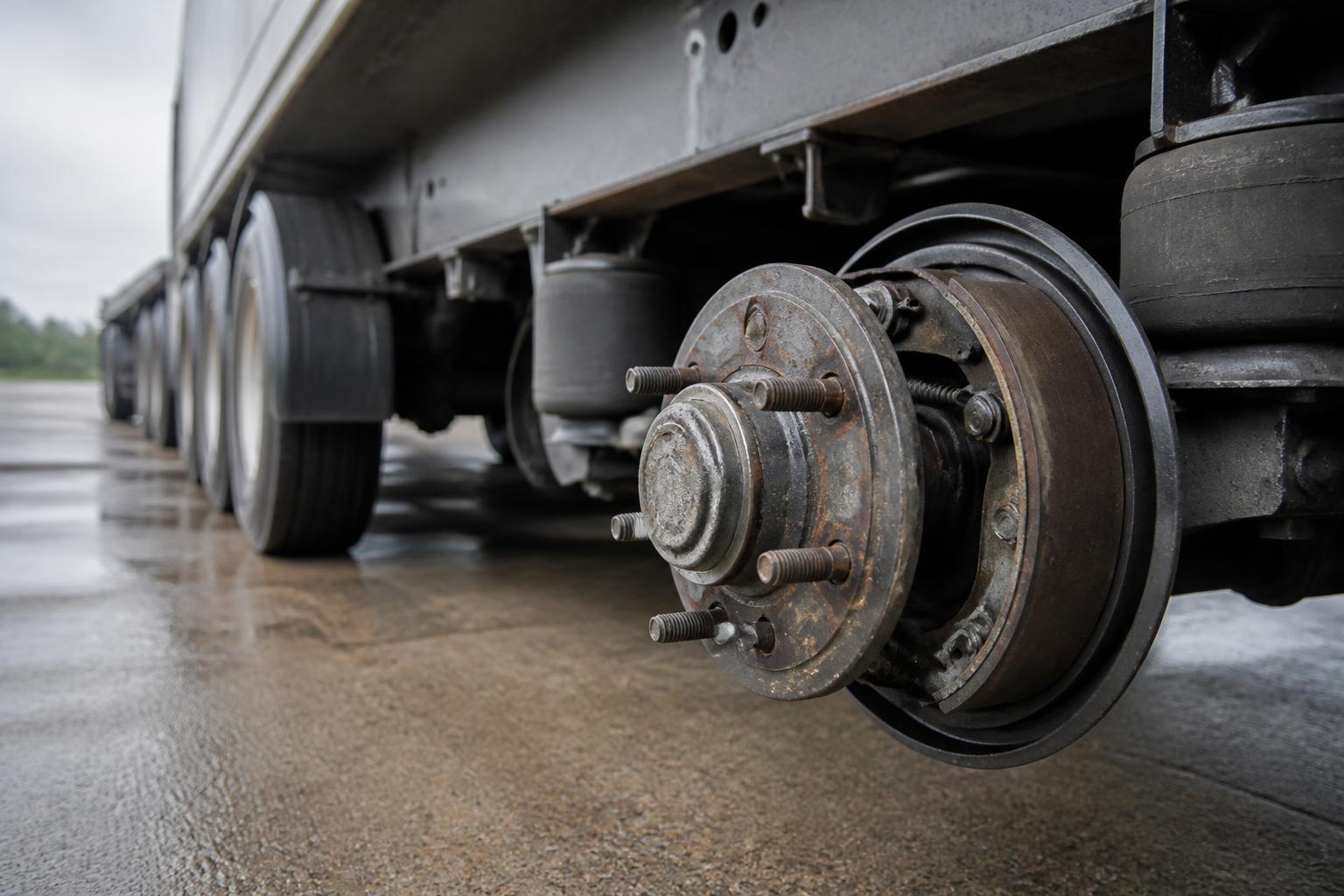
A trailer fault on the A14 rarely costs time because of the first symptom alone. The delay usually comes from what sits behind it, a brake imbalance that turns out to be a seized caliper, an ABS warning that is really a damaged sensor lead, or a tyre issue that has already started to affect the running gear. In day-to-day operation, the quickest route back on the road is not guessing from the dash or from a driver report. It is getting the trailer checked properly, deciding what is safe to move, and separating a simple defect from a fault that needs diagnosis.
At Woolpit Truck Repairs, we deal with this every week from Bridge Farm in Woolpit, just off A14 J47. Operators coming through Suffolk from Ipswich, Felixstowe, Stowmarket, Bury St Edmunds, Newmarket and Elmswell usually want the same thing, a clear next step. If a trailer can be made safe on site, we say so. If it needs workshop time, a brake test, or a deeper inspection before it goes back into service, we say that too.
What trailer repair usually means in day-to-day operation
In practical workshop terms, trailer repair covers far more than replacing a broken part. It includes inspection, fault finding, confirmation of roadworthiness, and the work needed to return the trailer to service safely. On a working trailer, that might mean brake work, electrical repairs, ABS or EBS diagnosis, tyre support, air system repairs, axle and suspension work, lighting faults, or body and ancillary defects that affect safe use.
It helps to separate three things.
First, there is the visible defect. That is what the driver, shunter, transport office or yard team can actually see or report. A lamp is out. A tyre is damaged. The trailer is leaning. The ABS lamp is on. The brakes feel hot after a run. These reported symptoms matter, but they are not always the true fault.
Second, there is the safety issue. Some defects immediately affect whether the trailer should stay in service. Brake performance concerns, exposed cords in a tyre, significant air leaks, wheel-end heat, insecure components, or missing lights on a working route all move quickly into a roadworthiness decision. In the UK, that matters not only for MOT preparation but also for daily walkaround standards and roadside enforcement. A trailer that can still move is not necessarily a trailer that should keep working.
Third, there is the underlying fault that needs diagnosis. A driver may report poor braking, but the workshop may find a chamber issue, a slack adjuster problem, contamination, a seized component, or an EBS control fault. A lighting complaint may be a failed lamp unit, but it may also be a plug issue, a damaged suzie, corrosion in a connector, or a wiring break further back.
That is why proper trailer repair is not just fitting whatever part seems nearest to the symptom. It is confirming what has failed, what else has been affected, and whether the trailer is safe to return to work once the repair is complete.
Which trailer faults need attention first?
The faults that need priority are the ones that affect braking, control, visibility, tyre integrity and the trailer's ability to stay roadworthy under load.
Brakes come first for obvious reasons. If a driver reports binding, poor retardation, pulling, overheating, or unusual brake response, that trailer needs attention before it goes back out. Brake defects can sit in the foundation brakes, the air system, the actuator side, or the electronic control side. A trailer that has stood for a period can also develop seized or partially seized brake components, which often show up only once the unit is back in traffic. Where a brake fault is suspected, a proper assessment and often a roller brake test are the sensible next step. We have covered some of the first checks in our guide to trailer brake faults near the A14 and the safest next step.
ABS and EBS faults are next on the list because they are often misunderstood. An ABS warning lamp does not always mean the trailer has no braking, but it does mean the system needs checking. Sensor gaps, damaged leads, corroded connectors, modulator issues and power supply faults are all common causes. EBS faults can also affect brake response and system behaviour in ways that are not obvious from a quick visual check. The important point is not to treat warning lights as a minor electrical nuisance. They need diagnosis, especially if they are repeated or intermittent. For a starting point, see our article on ABS warning light on a trailer, what to check first.
Tyres also need fast decisions. A cut sidewall, exposed cords, abnormal shoulder wear, a flat, or signs of overheating all need immediate attention. So do repeated pressure losses, because the puncture itself may be only part of the issue. We also look at whether tyre wear is pointing to another defect, such as alignment, suspension wear, axle issues or running gear damage. Replacing a tyre without noticing the cause of the wear often means the trailer comes back with the same problem.
Lights matter because visibility and signalling defects are among the easiest ways to lose time at the roadside or at a loading point. A simple lamp failure may be quick to sort, but multiple lamp faults, intermittent indicators, or repeated bulb loss usually point to a supply or connection problem that needs tracing properly.
Air leaks deserve more priority than they often get. A leak at a line, coupling, valve, chamber or bag may start as a nuisance and become a serviceability problem very quickly. Air loss affects more than convenience. It can affect brake release, suspension height and overall trailer behaviour. If a trailer is dropping, struggling to hold air, or taking too long to build pressure, that should not be left to chance.
Running gear concerns round out the priority list. Worn suspension components, damaged axle parts, wheel bearing issues, hub heat, cracked mountings or abnormal ride height can all create bigger failures if ignored. These are the faults that often show up as a vague driver report, not right behind me, not sitting level, not towing properly, and need a workshop to pin down.
How a workshop works out the real fault
A good workshop starts with the reported symptom, but does not stop there. The aim is to prove the fault, not assume it.
We begin with the basic operating picture. What did the driver notice? Was the fault constant or intermittent? Did it appear loaded, empty, after standing, in wet conditions, or only after a brake application? Has the trailer had recent work, a recent MOT, a tyre replacement, a lamp repair, or an ABS or EBS issue before? This matters because the same symptom can point in very different directions.
Then comes inspection. A proper visual check often narrows the problem quickly. We look for obvious damage, wear, heat signs, leaks, broken fixings, wiring damage, tyre condition, component movement and signs that one side of the trailer is behaving differently from the other. On brake complaints, that may include checking brake lining condition, actuator operation, adjuster movement, disc or drum condition, and whether one wheel end is hotter than the rest. On air faults, it means tracing where pressure is escaping and whether the leak is local or system related.
Diagnostics come next where the system calls for it. On ABS and EBS faults, electronic diagnosis helps identify stored fault codes, signal issues and communication problems. That does not replace physical checks. It supports them. A code may point to a wheel speed sensor problem, but the real cause may still be wiring damage, contamination, poor fitment or a separate issue affecting the signal.
Testing is what separates a likely cause from a confirmed one. For braking concerns, a roller brake test is often the point where the workshop can see imbalance, poor effort or inconsistent performance rather than relying on feel alone. For intermittent electrical faults, testing under live conditions may be needed. For air issues, pressure retention and leak tracing help confirm whether the problem is a minor external leak or a deeper valve or control issue.
This is also where symptom and cause often part company. A driver may report trailer brakes binding. The workshop may find a seized caliper, a restricted line, a control issue, or a problem linked to standing time and corrosion. A trailer may arrive with a tyre problem and leave with tyre replacement plus suspension work because the wear pattern showed the real issue. That is why our truck and trailer repair support is built around practical triage first, not parts changing by guesswork.
When can a trailer be repaired on site and when does it need workshop time?
Some faults are suitable for on-site support, especially where the defect is clear, access is straightforward, and the repair does not depend on deeper testing. Typical examples include certain lighting faults, some tyre issues, obvious air line damage, battery or connection issues on related equipment, and visible defects that can be rectified safely where the trailer stands.
Callout support can also make sense when the immediate need is to make the trailer safe to move or to confirm whether recovery or workshop attendance is the right next step. For an operator stuck at a yard, customer site or roadside location, that first decision can save a lot of wasted time.
But there is a clear point where workshop time is the safer option. Brake concerns are the main example. If the reported issue involves poor braking, binding, imbalance, wheel-end heat, repeated warning lights, or anything that suggests the trailer may not be braking evenly, proper workshop inspection is usually the right route. The same applies where ABS or EBS faults need diagnostics, where air leaks are not obvious, where running gear concerns need lifting and checking, or where the trailer has multiple defects rather than one isolated issue.
Workshop time also matters when the repair needs confirmation after the job. A brake component replacement is not the end of the process if the trailer still needs a brake performance check. Equally, if a tyre has failed because of a suspension or axle issue, fitting a new tyre without checking the underlying cause is not a complete repair.
For many operators on the A14, the practical question is not whether a trailer can be patched up where it sits. It is whether doing that would simply move the delay down the road. If the trailer is due an inspection, has had repeated defects, or is close to MOT, a proper booked assessment is often the more efficient choice. Our HGV and trailer inspection service is often the starting point when the fault is not yet fully defined but the trailer clearly needs a workshop decision.
How trailer defects affect MOT preparation and fleet downtime
Unresolved trailer defects create MOT risk in two ways. The first is straightforward, the trailer fails because a defect that should have been found earlier is still present on test day. The second is more frustrating, the trailer has had previous repairs, but the root cause was not properly identified, so the same issue or a related one appears again during preparation or at test.
Brake performance is a common example. If a trailer has had a reported brake complaint but no proper follow-up brake test, imbalance or low effort may still be waiting to show up at MOT. ABS and EBS faults can create the same problem. So can tyre wear that points to running gear defects, or lighting issues that have been temporarily resolved without fixing the underlying wiring problem.
For fleets, this becomes a planning issue as much as a workshop issue. A trailer that fails unexpectedly does not just lose its test slot. It may lose booked work, load planning flexibility and unit availability. For owner-drivers, one trailer off the road can have an immediate effect on earnings and route commitments.
The knock-on problem is repeat downtime. If a defect is dealt with only at symptom level, the trailer may return to service and then come back off road for the same reason. That means another booking, another movement, more driver time, more rescheduling and more pressure around parts and workshop space. In busy operating periods around Suffolk, especially on routes between Felixstowe, Ipswich, Stowmarket, Bury St Edmunds and Newmarket, avoidable repeat visits cost more than the original repair.
That is why MOT preparation works best when defects are picked up and resolved early, with enough time for repair, test and recheck where needed. In the UK, MOT standards and roadworthiness expectations sit alongside operator maintenance responsibilities. A pass on the day is not the only target. The trailer needs to be fit for service before and after the test as well.
What operators should have ready before booking trailer repair
The more clearly the fault can be described at booking stage, the faster we can triage it and plan the next step.
Start with the trailer details. Registration, fleet number, make, type and axle configuration all help. If the issue relates to braking or electronics, it is useful to know the system fitted if you have that information, but if not, the registration and trailer identity are enough for us to begin.
Then describe the symptom as the operator or driver actually experienced it. Warning light on all the time is better than electrics playing up. Brakes hot on near side rear axle after 40 miles is better than brake problem. Air drops overnight when parked coupled is better than leak somewhere. The workshop can work with plain language, as long as it is specific.
It also helps to tell us when the fault started and whether anything changed just before it appeared. Recent tyre work, recent brake work, standing time, MOT preparation, loading changes, impact damage, a suspected kerb strike, or a problem that only appears loaded are all useful details.
For booking and planning, we need to know where the trailer is, whether it is loaded or empty, whether it can be moved safely, and whether site access affects callout support. A trailer at a customer site with restricted access, or one parked in a way that prevents safe inspection, may need a different plan from one parked in a transport yard.
Photos can help, especially for tyre damage, visible running gear defects, lamp damage, air line issues or body-related concerns. They do not replace inspection, but they can help us decide whether to arrange parts, allow more workshop time, or direct the trailer straight to a brake test or deeper diagnostic process.
Finally, tell us what deadline sits behind the repair. If the trailer is due out that night, due for MOT, or needed for a booked movement to or from Felixstowe, that affects triage. We will still advise on the safe next step first, but knowing the operating pressure helps us plan realistically.
At Woolpit Truck Repairs, near A14 J47 at Bridge Farm, Woolpit, we keep that process straightforward. We support HGV and trailer operators across Suffolk with practical fault assessment, repair, testing and MOT preparation. Woolpit Truck Repairs is a trading name of FLEETA LIMITED, and our focus is simple, clear defect diagnosis, sensible workshop decisions, and repairs that solve the actual trailer problem rather than just the first symptom.
What are the most common reasons a trailer needs repair?
Common reasons include brake imbalance, ABS or EBS faults, tyre damage, lighting defects, air leaks, worn components and issues found during inspection or MOT preparation.
Can a trailer still be used if the fault seems minor?
That depends on the defect. A minor-looking issue can still affect safety or compliance. If brakes, tyres, lights, ABS, EBS or air systems are involved, get it checked before further use.
What information should I give when reporting a trailer fault?
Give the trailer type, registration or fleet ID, the fault symptoms, any warning lights, whether it is loaded, its location, and whether the issue was found on the road, in the yard or at inspection.
Do trailer repairs always need diagnostics?
No. Some defects are obvious on inspection. But diagnostics are useful when warning lights, ABS or EBS faults, intermittent issues or unclear brake concerns need proper fault tracing.
How does trailer repair link to MOT preparation?
Repair work often starts with defects found before test. Fixing them early gives time for rechecks, brake testing and any extra parts needed, which helps reduce avoidable MOT failures.