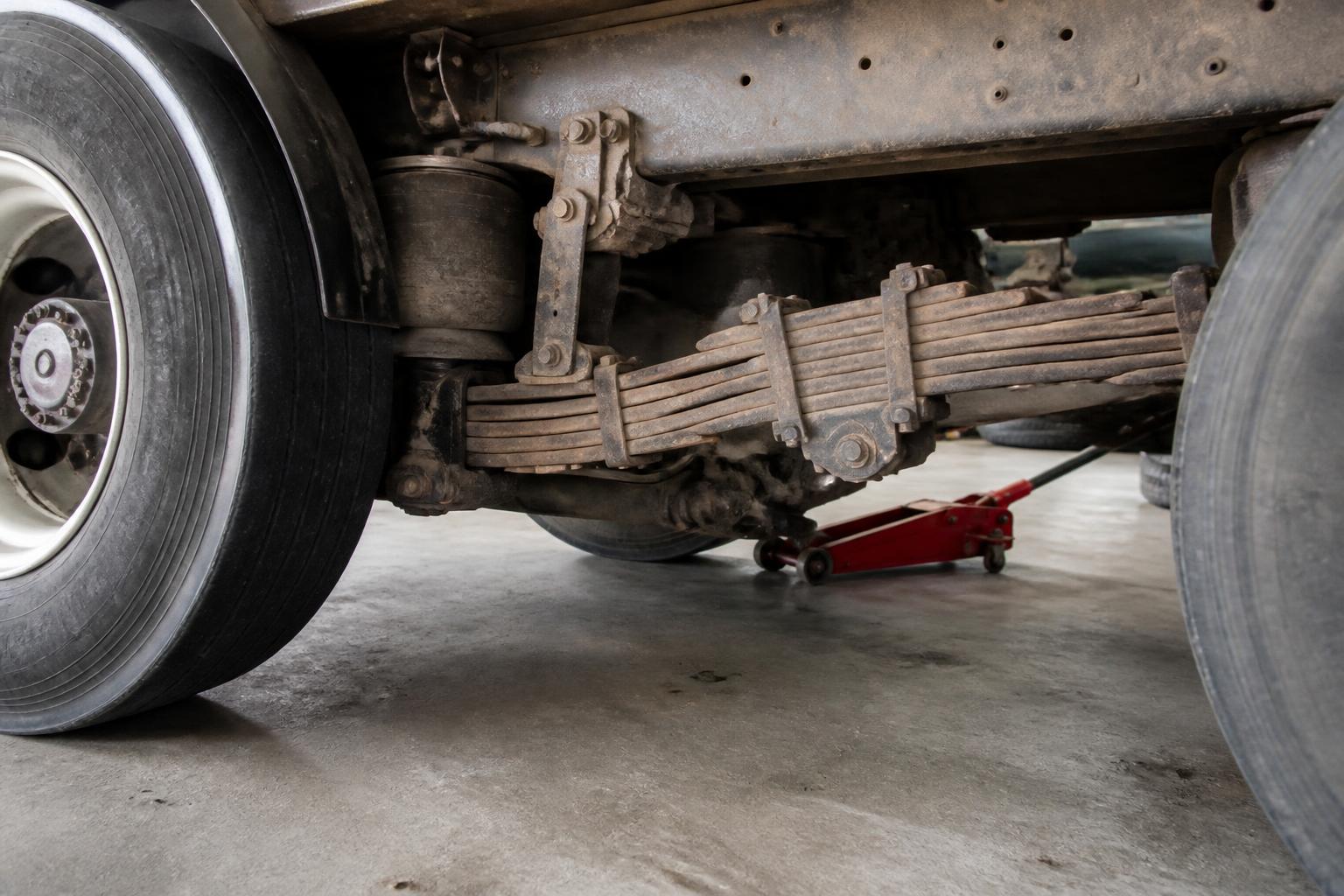
A leaf spring fault can put an HGV off the road very quickly, and in many cases it should. If a spring is cracked, a leaf has broken, the pack has shifted, or the axle is no longer being held where it should be, you are not dealing with comfort. You are dealing with suspension geometry, axle location, tyre contact, braking stability and the risk of a defect getting worse under load.
For operators searching for truck leaf spring repair near me, the important point is not just finding a workshop that will fit parts. It is getting the vehicle assessed properly, so you know whether it is safe to move, what else has been affected, and what the realistic repair route is. At Woolpit Truck Repairs, we see these faults on rigids, artics and trailers coming through Woolpit from across Suffolk and along the A14, including traffic running between Ipswich, Felixstowe, Stowmarket, Bury St Edmunds and Newmarket.
What a leaf spring fault means on an HGV
Leaf springs on an HGV or trailer do more than carry weight. They support the chassis, help control ride height, locate the axle, and work with the rest of the suspension and braking system to keep the vehicle stable under load, over uneven surfaces and under braking. On many steel suspension setups, the spring assembly is a structural part of how the axle stays where it belongs.
Once a leaf spring is cracked, broken or out of position, that changes immediately. A broken main leaf is very different from a minor surface mark on a lower leaf. A shifted spring pack, a worn centre bolt, or movement at the clamp can let the axle creep out of position. Worn bushes or pins can add further movement. If the spring seat or U-bolts are affected, the problem is no longer isolated to one component.
That matters for three practical reasons.
First, safety. If the axle is not properly located, handling can change under braking, cornering or reversing onto a bay. On a trailer, that can show up as unusual tracking or instability. On a rigid or unit, steering feel and brake behaviour can alter enough for the driver to notice. If related components are strained, you can also start to see issues around brake hoses, wiring, ABS or EBS sensor leads where axle movement is no longer what the system was designed around.
Second, tyre life and running gear wear. A leaf spring fault can change ride height on one side, alter axle alignment, and increase scrubbing. Operators often first notice the bill through tyre wear, then find the suspension defect behind it. By the time the tyres show it clearly, the spring fault has usually been there for a while.
Third, uptime. Leaf spring defects rarely improve with use. They usually progress. A crack becomes a break, a slight shift becomes visible axle movement, and a vehicle that could have been planned into the workshop becomes an off-road problem at the side of the road or at a customer site.
Signs the problem is more than a rough ride
Drivers often describe the first symptom as a rougher ride, but the more useful signs are the ones that point to a suspension defect rather than road surface or load variation.
One common sign is a lean. If one corner sits lower, especially when empty on level ground, that needs checking. On a trailer, one side may appear to sit down slightly over one axle group. On a rigid, the body line may not look right relative to the tyres. A lean does not prove a broken spring on its own, but it is a clear reason to inspect.
Noise is another early clue. A broken leaf, a shifted pack, or wear in bushes and pins can produce clunks, knocks, creaks or metallic movement noises when pulling away, braking, crossing uneven yards or mounting kerbs. Drivers often hear it at low speed first. If the noise changes with load, that is useful information for the workshop.
Tyre wear is a major indicator. If one tyre or one axle position is wearing differently from the rest, especially with feathering, scrub or unexplained shoulder wear, we would want to look at the suspension and axle location rather than treating it as a tyre-only issue. The same applies where a trailer appears to drag slightly in tight turns more than it used to.
Operators also notice axle movement concerns. That may be a visual concern during loading, a report that the vehicle feels unsettled under braking, or a defect picked up when someone sees the axle not sitting square to where it should. On some jobs, the first clear sign comes when another repair is being carried out and movement is seen in the spring eye, shackle or hanger.
Inspection and MOT preparation often bring these faults to light. A crack in a leaf, a broken leaf end, loose or stretched U-bolts, displaced spring leaves, worn bushes, damaged hangers or witness marks showing movement can all be found before test day if the vehicle is being checked properly. If you are trying to avoid test-day surprises, it helps to combine suspension checks with HGV brake testing before MOT near the A14, because brake performance concerns and suspension defects often overlap in how the vehicle behaves.
Can you keep running with a damaged spring?
Sometimes no, sometimes only long enough to move it safely for assessment, and sometimes the answer depends on exactly what is damaged. The mistake is guessing from appearance alone.
A visibly broken main leaf, a spring pack that has shifted, a displaced axle, a failed hanger, a loose spring seat, or clear contact between components is not a defect to monitor while carrying on as normal. That is take-it-out-of-service territory until it has been assessed. The same applies if the vehicle is leaning badly, handling differently, or there is concern that the axle is moving under braking or load.
There are also faults that look less dramatic but still need a workshop decision. A crack in one leaf, heavy bush wear, a worn pin, clamp damage, or signs that U-bolts have lost clamping force may not strand the vehicle immediately, but they can quickly become a bigger problem. A spring assembly works as a system. One part failing changes the load on the rest.
This is where severity matters. Two vehicles can both be reported as having a cracked leaf spring and need completely different next steps. One may need immediate recovery support or a controlled move into the workshop. The other may be safe for a short, unloaded movement subject to inspection findings. We do not advise operators to make that call from a photo or from the fact the vehicle still drives.
For fleet managers and owner-drivers, the practical rule is simple. If there is any doubt about axle location, spring integrity, mounting security or related brake and tyre effects, stop treating it as a comfort issue and get it assessed. If the defect is on a trailer, our guide to trailer inspections near Woolpit that cut roadside risk explains why these faults are better found in the workshop than at the roadside.
What a proper leaf spring inspection should include
A proper inspection goes beyond looking for an obvious broken leaf. We need to know whether the spring itself has failed, whether the mounting points are sound, whether the axle has moved, and what else has been affected.
We start with the spring assembly. That means checking for cracked or broken leaves, leaf separation, displacement within the pack, condition of the centre bolt, clamp condition, and any signs that the spring has been moving where it should not. Rust lines, polished witness marks and fresh metal marks can tell you a lot about recent movement.
Then we check the spring eyes, bushes and pins. Excessive bush wear can allow movement even where the leaf pack itself is intact. Pins can wear, seize or work loose. On shackle arrangements, we need to see whether the geometry is still correct and whether there is uneven loading side to side.
Hangers and brackets are equally important. A sound spring attached to a damaged hanger is not a sound suspension. We inspect for cracking, distortion, elongation of holes, poor previous repairs and any sign the mounting points have been under abnormal stress.
U-bolts and axle seats are critical. If U-bolts have lost tension, stretched, corroded badly or been reused when they should not have been, the axle may not be clamped correctly to the spring. We check for movement at the seat, fretting, misalignment and damage around the mounting faces. On many jobs, replacing the spring alone would not be enough because the clamping hardware and seat condition also need attention.
Axle location is the next question. We look at whether the axle is sitting square, whether wheel position in the arch or relative to the chassis is consistent, and whether there are signs of tracking issues. If the defect has allowed the axle to move, tyre wear, brake balance and general handling all need to be considered.
We also inspect linked systems. Brake chambers, pipes, ABS and EBS wiring, load sensing arrangements where fitted, and nearby air lines can all suffer if suspension movement is no longer controlled. On trailers especially, a suspension defect can sit alongside brake defects, so it makes sense to consider both together. If that is the wider issue, our article on the safest next step for trailer brake faults near the A14 covers the same workshop-first approach.
Repair or replace and what affects the decision
In practice, replacement is often the realistic outcome for a damaged leaf spring. Welding or patching a spring is not a proper answer. If a leaf has cracked or broken, the safe route is usually to replace the spring assembly or the affected matched components, depending on the design and condition.
The decision depends on what has actually failed. If the spring pack is damaged but the bushes, pins, hangers and axle seat are all sound, the job may be relatively straightforward. If the spring has been running loose, or the defect has been left until the axle has moved, the parts list can grow. It is common to find that bushes, pins, U-bolts and sometimes hanger or bracket repairs are needed as part of the same job.
Vehicle age and parts access matter as well. Some spring assemblies are straightforward to source. Others depend on exact application, axle setup or trailer specification. That is why workshop triage matters. We would rather identify the full defect properly at the start than fit one obvious part and then lose more time waiting for the hardware that should have been ordered with it.
Load and usage also affect the decision. A vehicle doing local lighter work with an early-stage wear issue is one thing. A heavily worked HGV or trailer running trunk routes through Suffolk and beyond is another. If one side has failed due to age and fatigue, we may need to discuss the condition of the opposite side and whether replacing related components together makes more commercial sense than waiting for the next failure.
The same goes for downtime planning. Operators do not just need a diagnosis. They need a realistic next step. Is it safe to move? Can the repair be staged? Are there linked defects that will affect MOT preparation? Is tyre damage already done? Those are the questions that matter when the vehicle earns its keep on the road.
Getting the vehicle assessed near Woolpit
For operators around Woolpit, Elmswell, Stowmarket, Bury St Edmunds, Newmarket, Ipswich and Felixstowe, or for route-based traffic passing along the A14, the main requirement is practical access to a workshop that understands HGV and trailer faults and can explain clearly what happens next.
That is how we work at Woolpit Truck Repairs. We are based at Bridge Farm, near A14 J47 in Woolpit, Suffolk, which makes us straightforward to reach for local fleets and for operators moving east-west along the route. When a vehicle comes in with a suspected spring fault, we focus on triage first. Is it safe, what has actually failed, what else has been affected, and what is the most realistic repair route?
That matters because leaf spring defects are rarely isolated in the way they first appear. What starts as a report of a rough ride can turn out to be a broken leaf and worn bushes. What looks like a single-side lean can involve axle movement, tyre damage and brake-related concerns. Clear defect explanation saves time, especially for fleet decision-makers who need to authorise work quickly and understand whether the issue is confined to one vehicle or likely to appear elsewhere in the fleet.
If you are comparing workshops for this kind of fault, location alone is not enough. You need HGV-and-trailer-only support, practical workshop assessment, and realistic advice on whether the vehicle should stand, move under control, or be recovered in. Our guide on how to compare HGV workshop support near A14 J47 sets out what to look for when downtime is already a risk.
We also know that for many operators the search starts exactly when the problem appears, often in the cab, in the yard, or during pre-MOT checks. If you are looking for truck leaf spring repair near me around Suffolk, the key is to stop guessing from the symptom and get the assembly inspected properly. A damaged spring can affect safety, handling, tyre wear, braking behaviour and test outcome long before the vehicle is completely immobilised.
At Woolpit Truck Repairs, we assess HGV and trailer defects with that in mind. From Bridge Farm near A14 J47, we support operators who need a clear answer, not vague advice. Woolpit Truck Repairs is operated by FLEETA LIMITED, and our job is to help you make the next safe, workable decision for the vehicle in front of you.
What causes a truck leaf spring to fail?
Common causes include fatigue, overload history, corrosion, impact damage and wear in related mounting parts. A spring can also fail after movement elsewhere in the assembly puts it under abnormal stress.
Is a cracked leaf spring an MOT issue?
It can be. If the spring is cracked, broken, insecure or affecting suspension condition, it may create an MOT problem. The exact outcome depends on the defect and any related damage found on inspection.
Can a bad leaf spring cause tyre wear?
Yes. If ride height, axle position or suspension control is affected, tyre wear can follow. Uneven loading through the axle area can also create handling issues that show up in the tyres.
Do both sides need replacing together?
Not always, but it is a question worth checking at inspection stage. The decision depends on condition, wear balance, manufacturer guidance and whether the opposite side shows fatigue or related defects.
Can a trailer have the same type of spring fault?
Yes. Trailers can suffer spring and mounting defects as well, and the symptoms may show up as lean, tyre wear, instability or defects found during routine checks and workshop inspection.