At 04:30, a transport manager in Stowmarket gets the call no fleet wants. An artic has stopped on the A14 westbound near Junction 47, an EBS warning is showing, the driver is blocking a lay-by and a perishable load is due with the customer by 07:00. The immediate question isn't which workshop has the longest service list. It's whether the vehicle can be made safe, whether it can move without worsening the defect, and who can assess or recover it at that hour.
That decision depends on location, fault evidence, vehicle condition and realistic workshop availability. For operators searching for lorry repairs in Suffolk, the practical choice is a route-and-corridor decision as much as a technical one. Proximity to Woolpit, Elmswell, the A14 and the Felixstowe flow can affect lost hours, recovery arrangements and whether a repair is completed before the next scheduled movement.
Table of Contents
- When a Suffolk Lorry Cannot Wait Until Morning
- Why Suffolk Is a Heavily Worked Freight Market
- Core Services a Specialist HGV Workshop Should Offer
- How the Repair Process Usually Runs From Call to Handover
- Pricing Expectations and What Really Drives Downtime
- Why a Specialist Workshop Beats a Generalist for Lorries
- Callouts and Recovery on Suffolk Roads
- Common Questions and How to Book the Workshop
When a Suffolk Lorry Cannot Wait Until Morning
The driver should first make the scene safe, report the exact position and avoid repeatedly cycling the ignition to clear a warning that may indicate a braking or stability problem. Hazard lights, a safe cab position, high-visibility clothing and clear communication with the control room matter more than trying to diagnose an EBS fault from the roadside.
A transport manager needs a short, useful account before calling a workshop:
- Exact location: Give the carriageway, direction, junction number, lay-by, services or nearby landmark.
- Vehicle details: State whether the problem affects the tractor, trailer or both, along with the vehicle type and load.
- Symptoms: Record warning lights, loss of braking assistance, air-pressure behaviour, unusual noises, fluid leaks and whether the vehicle will select drive.
- Operational risk: Explain whether the load is perishable, whether the vehicle is obstructing traffic and whether the driver can remain safely with it.
- Compliance history: Mention any recent defect report, prohibition, inspection or brake-test concern.
Practical rule: A warning light shouldn't be treated as a nuisance until a competent person has established what system has failed and whether the vehicle remains roadworthy.
The response may be a mobile assessment, a controlled recovery or instructions to remain stationary until a suitable vehicle can attend. Callouts and recovery depend on availability, time of day, location and the nature of the fault. A useful guide to the information needed during an urgent incident is this HGV roadside assistance guidance for Suffolk operators.
Waiting can be sensible if the vehicle is secure and help is already arranged. It isn't sensible if the driver is exposed to moving traffic, the load is leaking, air pressure is falling or the vehicle is obstructing a live route. The least expensive decision is often the one that prevents a second failure after an improvised repair.
Why Suffolk Is a Heavily Worked Freight Market
Suffolk carries unusual weight in road freight because it contains Felixstowe, the UK's largest container port. Official domestic road-freight statistics identified Suffolk as the NUTS3 region with the greatest originating road-freight tonnage in 2016, at 45.4 million tonnes, and the same dataset placed the county among the leading destinations for road-freight tonnage. The figures are discussed in this summary of official road-freight data.
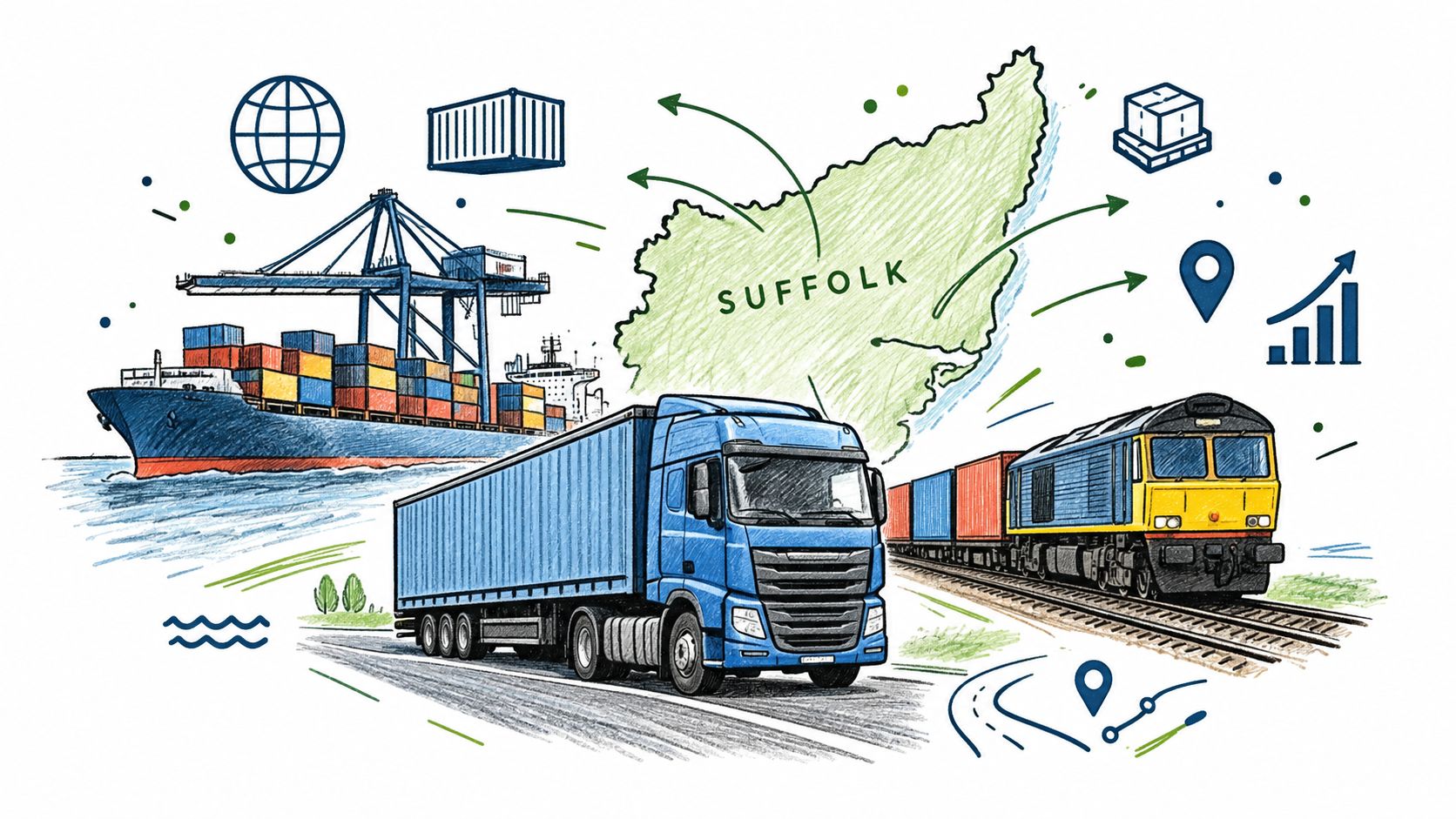
That freight doesn't stay at the port. Articulated vehicles work the A14 and A12 links towards Ipswich, Bury St Edmunds, Stowmarket and the Midlands, while local distribution and trailer movements spread across rural and urban routes. Woolpit and Elmswell sit close to a corridor where a vehicle may be travelling between a port slot, a depot and a customer with little slack in the schedule.
A busy freight corridor changes the maintenance calculation. High vehicle utilisation increases mileage accumulation and exposes small defects to repeated loading, braking and coupling cycles. A fault that might be inconvenient on a lightly used vehicle can become a missed port movement, a failed inspection or an unplanned vehicle-off-road event on a working artic.
UK compliance data shows why early defect control matters. Logistics UK reported that almost 60% of HGV inspections identify at least one defect, with earlier attention to those defects estimated to represent a potential annual saving of £203 million. The same analysis recorded an HGV initial failure rate improving from 32.4% in 2008/09 to 10.3% in 2024/25, while the final failure rate fell from 17.7% to 6.9%. Those figures appear in this HGV maintenance and compliance analysis.
The conclusion for transport managers is straightforward. A repair provider near the route isn't valuable just because it is nearby. It needs to understand the consequences of a missed departure, a trailer held at a port, a driver running out of available hours and a defect that worsens before the vehicle reaches a depot.
Core Services a Specialist HGV Workshop Should Offer
A proper commercial workshop should connect inspection findings to the repair that removes the risk. A transport manager shouldn't have to translate a dashboard warning into a string of separate bookings.
Matching symptoms to workshop work
PMI and safety inspections involve checking the tractor or trailer against the operator's maintenance system, examining brakes, steering, suspension, lighting, tyres, bodywork, couplings and visible defects. Fleets book this work on a planned cycle, after a driver defect or before a demanding route.
MOT preparation and presentation support should focus on finding and correcting likely failure points before presentation. That can include brake, suspension, lighting and emissions repairs. The workshop shouldn't be described as an MOT test station unless it holds that role. Its job may instead be to prepare the vehicle and support correct presentation.
Commercial diagnostics means reading and interpreting fault data from engine, gearbox, ABS, EBS, emissions and AdBlue systems, then testing the underlying cause rather than replacing parts at random. A recurring warning after a reset needs evidence, not another reset.
Roller brake testing checks braking performance and balance using calibrated equipment. DVSA guidance says every HGV and trailer safety inspection should include a brake performance assessment, with a calibrated laden roller brake test preferred. Vehicles can be presented for roller testing up to 14 days before the safety inspection date, as set out in the DVSA guide to maintaining roadworthiness.
Service What it covers Typical trigger HGV and trailer inspections PMI checks, defect identification and maintenance records Scheduled inspection or driver defect Roller brake testing Laden brake performance and balance evidence PMI, MOT preparation or brake concern Diagnostics Engine, gearbox, ABS, EBS and emissions fault investigation Warning light, derate or repeated fault Truck repairs Mechanical, electrical, air and emissions-related work Breakdown, inspection finding or wear Trailer repairs Brakes, landing legs, curtains and tail-lift servicing Failed inspection, damage or operating fault Tyre support Assessment and replacement for steer, drive and trailer positions Damage, wear or pressure concern Air-conditioning re-gas Restoring cooling performance in cab and sleeper units Poor cooling or seasonal preparation Callouts and recovery Mobile attendance or recovery subject to availability Vehicle stopped on routeA workshop's HGV and trailer services should make clear which work is performed on site, which jobs require parts or specialist arrangements and how urgent faults are prioritised. Tachograph calibration and download may also be relevant where offered, but operators should confirm availability before booking because not every commercial workshop provides it.
How the Repair Process Usually Runs From Call to Handover
The first phone call should establish whether the vehicle needs a workshop slot, mobile diagnosis or recovery. A useful workshop will ask for the vehicle's location, fault symptoms, registration or fleet number, trailer details, recent defect history, last inspection and last brake-test date. If a DVSA prohibition is involved, that information must be disclosed before transport is arranged.
From triage to authorisation
The inspection begins with a visual and operational assessment. Technicians may check stored fault codes, air pressure, warning-light behaviour, brake components, suspension, tyres, steering, couplings, lighting and any area identified in the driver's report. A code reader alone doesn't prove which component has failed, so physical checks remain essential.
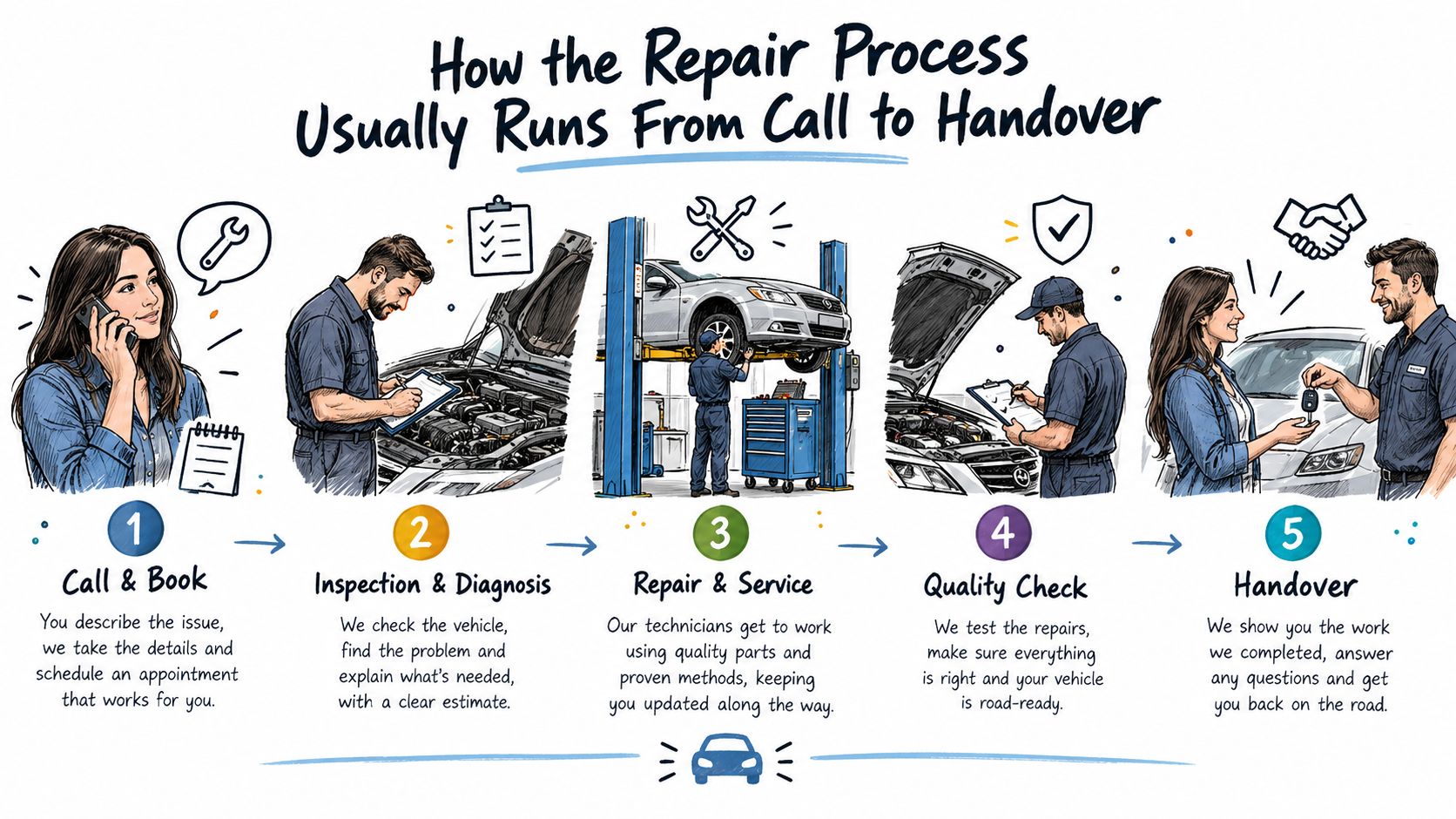
A written estimate should separate parts, labour, testing and any recovery or additional inspection charge. That gives the operator a basis for authorisation and makes it easier to compare a repair with the cost of keeping the vehicle out of service. If the inspection reveals a safety-critical issue, the vehicle may need to remain stopped even when the original booking was for a minor complaint.
Good HGV diagnostics support in Suffolk should lead to a fault explanation and repair recommendation, not just a list of codes. The operator can then approve the work, decline it, or request a staged approach where the vehicle is made roadworthy first and non-critical work is scheduled later.
What happens before handover
Repair sequencing normally starts with safety and mobility. Braking, steering, air-system, tyre and coupling faults take priority over comfort items or cosmetic work. Parts availability can determine whether a same-day diagnosis becomes a multi-day repair, particularly for trailer components or faults involving several linked systems.
Before collection, the workshop should confirm what was repaired, identify any remaining advisory items and return relevant job cards, defect lists and test paperwork. The operator should also understand whether a brake test, road test or further inspection was completed. Handover is not complete until the driver or fleet contact knows what has changed and what needs monitoring.
DVSA says an HGV presented for annual test must be appropriately laden. If it isn't, the examiner can refuse the test and the operator loses the fee, as explained in this DVSA guidance on presenting a heavy goods vehicle appropriately laden.
Pricing Expectations and What Really Drives Downtime
A cheap hourly rate doesn't guarantee a cheap repair. The final cost depends on diagnostic time, technician access, parts availability, testing, vehicle configuration and whether the defect has already caused secondary damage.
Modern HGVs combine mechanical, pneumatic, electronic and emissions systems. An AdBlue warning may require measured checks rather than a quick component swap. A brake complaint may involve linings, chambers, imbalance, air delivery or load-sensing equipment. The invoice grows when the first diagnosis is wrong, because the vehicle returns to service with the original fault still present.
The cost of a failed first attempt
Brake-test scheduling also matters. DVSA's published test information gives an average brake-test length of 15 minutes, with a published authorised-facility fee of £24.58 or £27.49, depending on the vehicle and test category. Those figures are listed in the DVSA annual test cost table, and they don't represent the wider repair bill or the cost of presenting an incorrectly prepared vehicle.
A vehicle that fails because it arrives unladen, has an unresolved imbalance or needs a retest can disrupt the workshop booking, driver plan and customer delivery. For a working HGV, downtime often costs more than the invoice because it can affect the load, the next booking and the tractor-trailer combination.
Repair type Indicative cost range Typical downtime Notes Brake adjustment or minor brake repair Confirmed after inspection Same day where parts and access allow Balance and component condition still need checking EGR or DPF investigation and repair Confirmed after diagnostics Same day to several days Cause must be established before parts are replaced Trailer brake chamber work Confirmed after inspection Same day to longer if parts are needed Check related air and braking components Electrical or EBS fault Confirmed after testing Diagnosis may be quicker than repair Intermittent faults can require additional evidenceSpecific prices and timings can't be stated responsibly without the vehicle, fault and parts requirement. Operators should ask for a written scope, confirm whether testing is included and distinguish diagnosis time from repair time before authorising work.
Why a Specialist Workshop Beats a Generalist for Lorries
A general repairer may be competent with light vehicles yet lack the working environment, access equipment, diagnostic coverage or heavy-vehicle routine needed for an artic and trailer combination. HGV maintenance involves air systems, fifth-wheel and coupling checks, axle loads, trailer brakes, EBS, commercial tyres and compliance paperwork. Those requirements shape the inspection from the first minute.
The skills constraint makes capacity a practical issue. UK industry commentary published in 2026 reported more than 23,000 HGV mechanic vacancies, representing about 4% of the workforce, and stated that one missing mechanic can leave 2 to 4 vehicles off the road while overtime costs rise 30% to 40% above plan. These figures come from this 2026 HGV mechanic workforce analysis. The lesson isn't that every workshop will have the same queue. It's that operators should plan PMI, brake testing and known repairs early rather than assume urgent capacity will always be available.
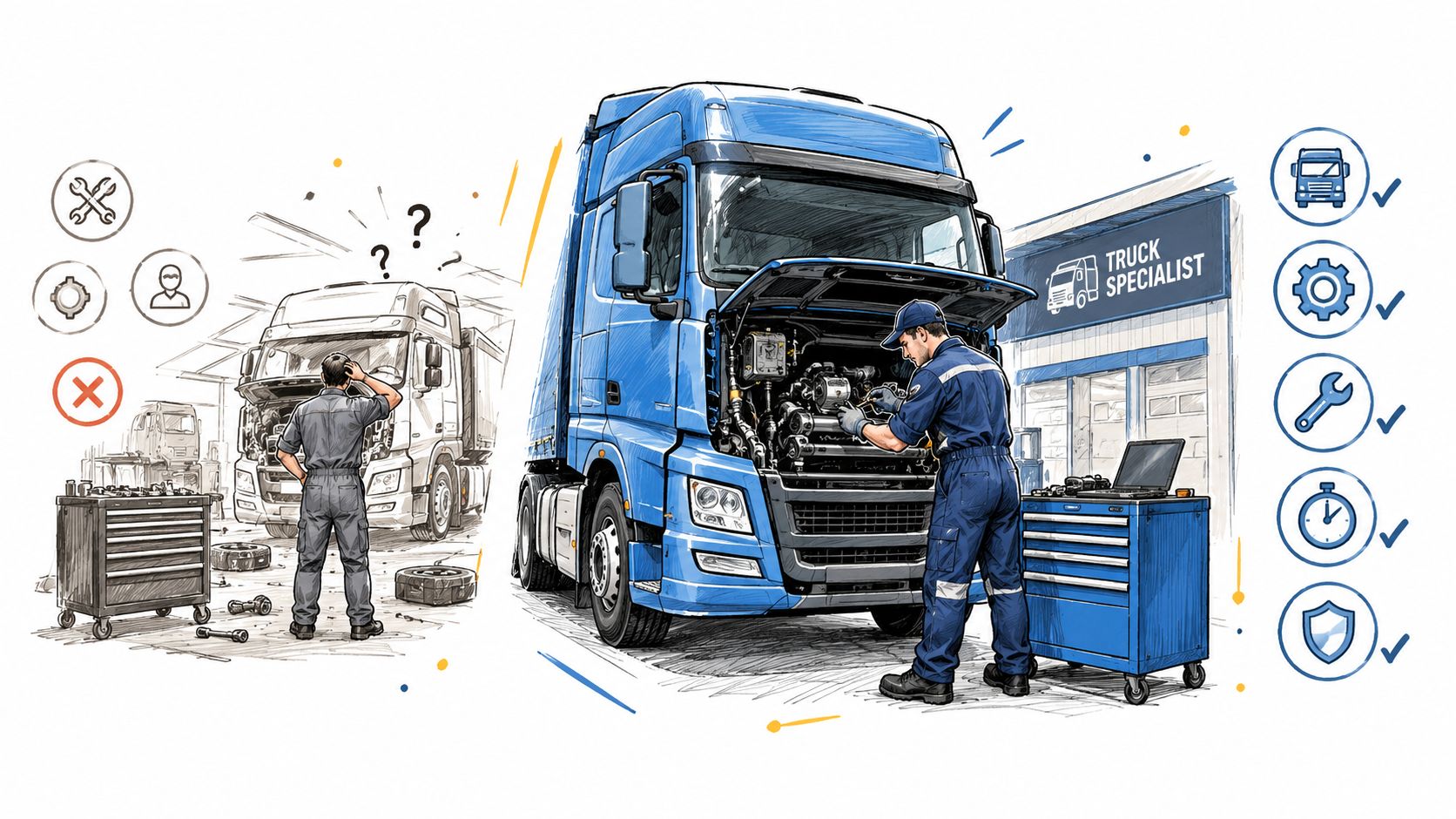
A dedicated HGV and trailer workshop is more likely to recognise patterns that matter to fleets. A worn brake component, leaking air line, loose suspension point or recurring electrical fault can be recorded during planned maintenance before it becomes a roadside event. That doesn't remove the need for operator inspections, but it adds a second trained assessment.
Location adds another layer. A workshop near Woolpit, Elmswell and A14 Junction 47 can be a practical option for vehicles moving between Bury St Edmunds, Stowmarket, Ipswich and Felixstowe, subject to capacity and the job's requirements. Transport businesses should also keep customer-facing communication organised when a vehicle is delayed. Guidance on managing auto dealer reviews online can be useful for businesses that need a consistent way to handle public feedback, although it doesn't replace direct operational updates to customers.
Callouts and Recovery on Suffolk Roads
A stranded HGV creates two separate problems, safety and transport continuity. The driver should deal with the first before discussing the second.
Where it is safe, the driver should switch on hazard lights, secure the cab, put on high-visibility clothing and move to a safer position away from live traffic. Wheel chocks can be used where appropriate and safe, but the driver shouldn't enter a dangerous area to fit them. The load area, doors, curtains and any visible leak should be secured or reported before a recovery vehicle arrives.
Information that makes attendance useful
The workshop needs more than “the lorry has broken down”. The caller should provide:
- Vehicle and combination: Tractor, rigid, drawbar or articulated vehicle, plus trailer type and approximate loaded condition.
- Fault description: Warning lights, loss of power, brake symptoms, air-pressure readings and noises.
- Position: A14, A12, A11 or a rural road, with direction, junction number, lay-by, exit or landmark.
- Access conditions: Whether the vehicle can be reached safely and whether traffic management or specialist recovery may be needed.
- Leak and load details: Fuel, coolant, oil or air leaks, along with any perishability or security concern.
From Woolpit and Elmswell, routes towards Ipswich, Bury St Edmunds, Stowmarket, Newmarket and the Felixstowe corridor can vary significantly in accessibility and traffic conditions. No responsible workshop should promise a fixed attendance time without checking availability, location, vehicle size and the type of recovery required.
Nights, weekends, bank holidays and remote lanes can extend attendance. Callouts and recovery remain subject to availability, and a mobile technician may only be able to make the vehicle safe or establish the fault before a workshop repair is needed.
When help arrives, the driver should explain what happened, provide keys and paperwork, identify the safest recovery point and confirm where the vehicle is being taken. The fleet contact should record the diagnosis, destination and any restrictions placed on moving the vehicle.
Common Questions and How to Book the Workshop
Does the workshop repair trailers as well as tractors? A specialist commercial workshop may handle trailer brakes, landing legs, curtains, tail-lifts, lighting, air systems and related defects. The operator should describe the trailer problem during the first call so the workshop can confirm capacity and parts requirements.
Can the workshop perform DVSA-related testing? Operators should confirm which inspections, PMI support and roller brake tests are available in-house. DVSA guidance says HGVs and trailers should normally be brake-tested at least four times per year, including at the MOT, with the vehicle loaded for the test and ideally at 65% or more of its total maximum weight. The DVSA brake-test report guidance explains the loading principle and the limited circumstances in which unladen testing may be acceptable.
How quickly can diagnostics or repairs start? That depends on workshop capacity, fault complexity, vehicle access and parts. A same-day diagnosis doesn't guarantee a same-day repair, so the operator should ask what happens if the first inspection identifies additional work.
How are quotes and payment handled? Quotes should be confirmed before non-authorised work begins, with any change in scope referred back to the fleet contact. Regular operators can ask whether account facilities are available, while urgent callers should establish accepted payment methods before recovery or repair is arranged.
For urgent work, calling is usually faster than sending a long web form. For planned PMI, brake testing, MOT preparation or fleet maintenance, an email or booking form can provide the vehicle list and preferred dates. The fleet number, last service date, dashboard warnings and recent driver reports will speed up triage.
Woolpit Truck Repairs provides HGV and trailer inspections, PMI support, roller brake testing, diagnostics, mechanical repairs, MOT preparation, tyre support, air-conditioning re-gas, planned maintenance and callouts or recovery subject to availability. Operators can contact Woolpit Truck Repairs to discuss a vehicle near Woolpit, Elmswell, the A14, A12, Bury St Edmunds, Stowmarket, Ipswich or Felixstowe and request a practical booking.