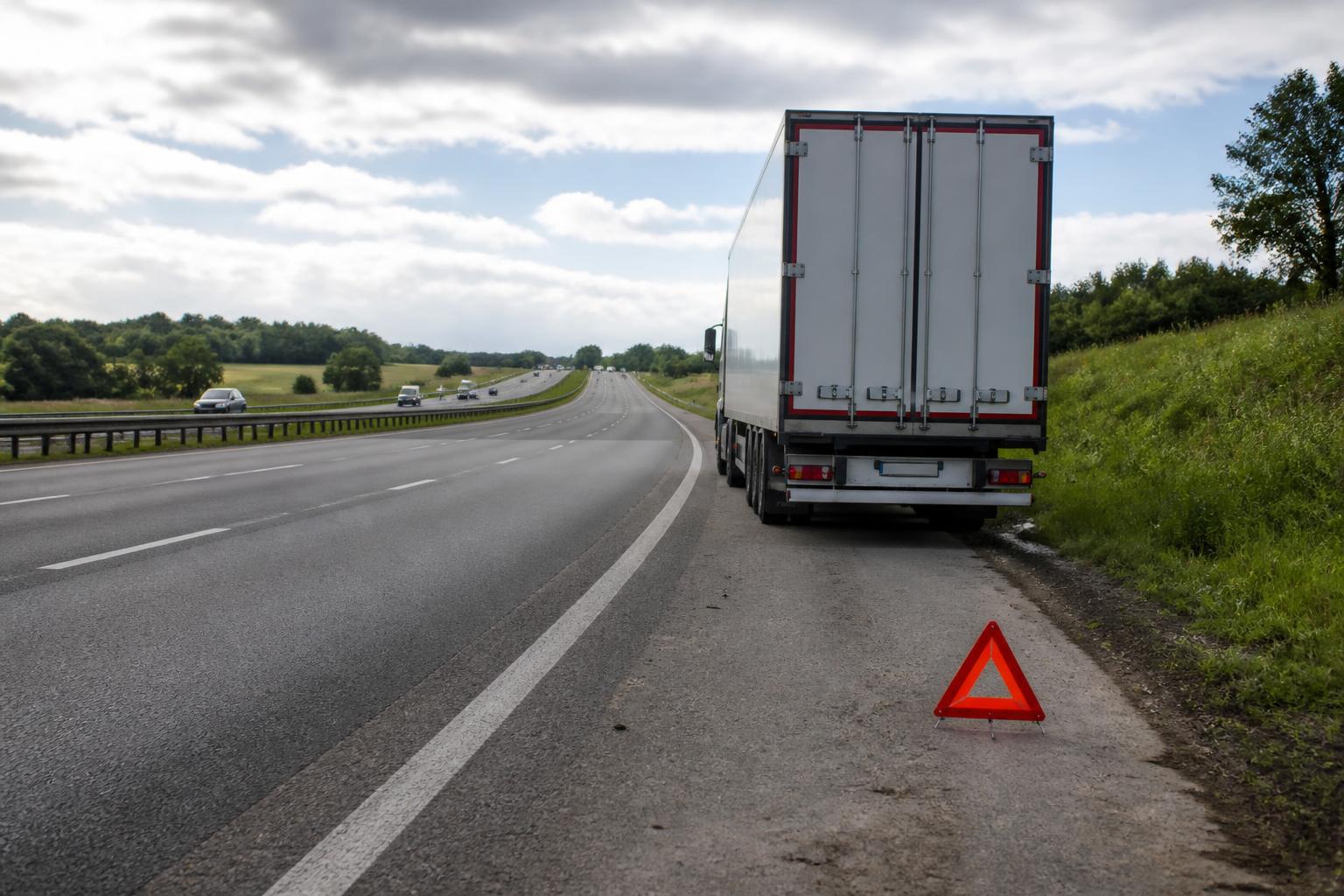
When an HGV stops on the A14, the first job is to make the scene safe, confirm exactly where the vehicle is, and decide whether the defect is suitable for a roadside visit or whether recovery is the safer next step. On a fast route such as the A14, a few accurate details at the start can save a wasted attendance, shorten downtime, and reduce the risk to the driver and other road users.
At Woolpit Truck Repairs, we deal with roadside support enquiries from operators running between Felixstowe, Ipswich, Stowmarket, Bury St Edmunds, Newmarket and beyond. Because we are based at Bridge Farm in Woolpit, close to A14 J47, we can focus on a practical next step rather than guesswork. If you need a truck roadside callout on the A14, the quality of the first phone call usually decides how quickly the right help gets moving.
The first priority at the roadside is safety and location - what the driver or operator should do first when an HGV or trailer has stopped on the A14 and what location details matter
If the vehicle has lost power, suffered a tyre failure, shown a serious warning, or developed a brake or air fault, the driver should first get as far off the live carriageway as possible. That may mean a lay-by, the hard shoulder where present, an emergency area, or a safe refuge depending on the section of road. The objective is simple, get the vehicle out of danger if it can be moved safely.
Once stopped, secure the vehicle. Apply the parking brake, select a safe gear position, switch on hazard warning lights, and assess whether it is safer to remain in the cab or leave it. On a high speed road, the driver should not stand near the offside of the vehicle or inspect defects from the traffic side. If there is smoke, overheating, a suspected wheel end issue, or any sign of fire risk, stop the engine if safe to do so and keep clear.
For the operator, the next priority is precise location. "Broken down on the A14 near Ipswich" is not enough for a useful dispatch decision. We need the details that let us judge access, travel time, and the safest attendance point. The most useful location details are:
- carriageway direction, for example eastbound toward Felixstowe or westbound toward Bury St Edmunds
- nearest junction number, such as A14 J47
- nearest marker post, emergency telephone reference, or identifiable lay-by
- whether the vehicle is on the main carriageway, slip road, lay-by, service area, industrial estate access, or local road just off the A14
- whether police, National Highways traffic officers, or recovery are already on scene
- whether the vehicle is obstructing a lane or fully clear of traffic
A dropped pin can help, but it should support the spoken location, not replace it. Pins can be inaccurate on dual carriageways and slip roads. The best call starts with a human description first, then a pin or What3Words if available.
If the vehicle is carrying a load that affects risk, say so immediately. A loaded trailer, ADR related restrictions, livestock, refrigerated cargo, abnormal width, or a shifted load may change what can safely be done at the roadside. The same applies if the trailer is detached, partly detached, or at an angle that affects access.
What to report before a roadside callout is arranged - which vehicle, trailer and defect details help a workshop decide the safest and quickest next step
Before we arrange a roadside visit, we need enough detail to triage the job properly. That is not admin for the sake of it. It is how we decide whether to send a technician, advise recovery, or direct the vehicle into the workshop.
Start with the basic vehicle identity:
- registration number
- make and model
- unit number if part of a fleet
- whether it is a rigid, tractor unit, or trailer issue
- trailer registration or fleet number if a trailer is involved
- axle configuration if relevant to the defect, especially for tyres, brakes, and suspension
Then report the defect as the driver sees it, not just the dashboard message. "ABS light on" is useful, but "ABS light on after a loud air leak from the trailer and now the brakes feel different" is much better. We want the sequence of events. What happened first, what changed, and whether the fault is constant or intermittent.
The most useful fault details include:
- warning lights shown, including ABS, EBS, engine, brake, suspension, or trailer system warnings
- whether the vehicle will still move under its own power
- whether air pressure is building normally
- whether there is an audible air leak, and from roughly where
- whether a tyre has deflated fully, blown out, or only lost pressure slowly
- whether there is visible damage to wheel, mudguard, airline, suzie, lamp, or bodywork
- whether the trailer brakes are binding, not releasing, or applying unevenly
- whether there is overheating, smoke, or a burning smell
- whether the issue appeared after coupling, loading, reversing, striking debris, or a wheel change
Photos and short video clips can save time if sent safely after the vehicle is secure. A photo of the damaged tyre, a split air line, a warning display, or a trailer coupling issue can tell us very quickly whether a roadside repair is realistic. This is especially helpful for tyre support, trailer electrical faults, and visible air system damage. If the fault points to a more involved issue, our commercial vehicle diagnostics support may be the better next step once the vehicle is off the road.
Operators should also say what deadlines are in play. If the vehicle is loaded for a timed delivery to Felixstowe or returning from Ipswich docks, that matters. If there is an MOT booking due, a booked reload, or a driver hours constraint, tell us. We cannot ignore safety, but we can prioritise the most commercially sensible next step once we understand the pressure on the job.
Which faults can be assessed at the roadside and which may not - how common defects such as tyre damage, brake concerns, warning lights, air leaks and trailer issues affect whether a roadside repair is realistic
Some faults are well suited to roadside assessment. Others are technically possible but commercially poor choices. Others should not be attempted at the roadside at all.
Tyre issues are often the clearest roadside jobs. A puncture, cut sidewall, tread separation, or rapid pressure loss may be suitable for roadside tyre attendance if the vehicle is safely accessible and the correct replacement can be sourced. The key points are tyre size, axle position, whether the wheel itself is damaged, and whether debris or brake heat has caused further damage. We cover this in more detail in our guide to HGV tyre help by the A14.
Air leaks can sometimes be narrowed down quickly at the roadside. A damaged suzie, split trailer air line, failed gladhand seal, or obvious external leak may be straightforward enough to inspect and, in the right circumstances, rectify. But if the leak is internal, intermittent, or linked to valves, brake chambers, or deeper system faults, a roadside fix may not be sensible. Air system defects can affect braking performance, suspension behaviour, and legal roadworthiness, so they need a cautious decision.
Brake concerns need the same caution. If a driver reports binding brakes, a wheel running hot, poor brake feel, trailer brake imbalance, or a brake warning with changed vehicle behaviour, the issue may go beyond what should be signed off at the roadside. A visual check is one thing. Confirming braking performance properly is another. In many cases, workshop assessment and roller brake testing are the safer route, especially if the defect is not obvious externally.
Warning lights on their own do not always mean the same thing. An ABS or EBS warning can be caused by a sensor, wiring damage, a tone ring problem, a power supply issue, or a trailer communication fault. Sometimes the vehicle remains driveable to a place of repair. Sometimes the fault links to braking behaviour and should not be moved except under controlled recovery. The UK approach is always to judge roadworthiness on the actual defect and its effect, not just the presence of a lamp. That practical judgment matters more than a generic rule.
Trailer faults vary widely. A lighting problem, damaged plug, or suzie issue may be roadside-assessable. A trailer with brake imbalance, suspension trouble, axle damage, wheel bearing concerns, or a structural issue usually points away from a roadside repair. If the trailer has shifted load, landing leg damage, or coupling concerns, we will usually look first at stability and safe movement before discussing any repair.
Engine faults sit in the middle. A warning light with reduced power may be diagnosable enough to advise the next move. But if the engine has shut down, there is a serious fluid leak, overheating, or suspected turbo or DPF related failure, roadside attendance can quickly become time lost if the vehicle really needs workshop diagnostics or recovery.
How roadside triage works when downtime is already costing money - how a practical workshop-led callout process narrows the fault, sets expectations and avoids wasted attendance
Downtime starts costing money the moment the vehicle stops, but rushing the wrong resource to the job often makes it worse. Our roadside triage process is built to reduce wasted attendance and get to a defensible next step quickly.
First, we take the safety and location details. Then we confirm the vehicle, trailer, and load situation. After that, we narrow the defect with a short sequence of workshop-led questions. We are not trying to turn the driver into a technician. We are trying to separate faults that are likely to be external and accessible from faults that need equipment, workshop space, or recovery.
A typical triage call may cover:
- what the driver felt before stopping
- whether the fault came on suddenly or gradually
- whether there was a bang, warning light, smell, vibration, pull under braking, or loss of air
- what checks have already been made safely
- whether another party has already attended or moved the vehicle
- whether the unit and trailer can still be separated if needed
From there, we set expectations. If the symptoms point to a likely roadside tyre replacement, damaged air line, or visible trailer electrical issue, we can move toward a roadside attendance through our HGV and trailer roadside callout support. If the symptoms suggest a brake issue that needs proper testing, a complex EBS fault, or a defect that cannot be safely verified on the roadside, we will say so early.
This matters because operators do not just need attendance, they need a decision. A technician arriving without the likely parts, without enough access, or to a fault that was never suitable for roadside work is avoidable downtime. Good triage reduces that risk.
It also helps with internal fleet decisions. Many operators need to update a planner, customer, transport office, or hire desk while the vehicle is down. A realistic estimate of whether the next step is roadside repair, recovery, or workshop booking is more useful than a vague promise that someone is on the way.
Because we are positioned near A14 J47 in Woolpit, with access across Suffolk routes including Stowmarket, Elmswell, Bury St Edmunds, Newmarket and toward Ipswich and Felixstowe, we can often judge quickly whether the vehicle is better dealt with where it stands or moved to us at Bridge Farm.
When recovery, workshop repair or MOT preparation is the better option - when the safest next step is not a roadside fix and why moving the vehicle to Woolpit Truck Repairs near Bridge Farm may make more sense
Not every stopped vehicle on the A14 should be repaired where it sits. In many cases, recovery or controlled movement to the workshop is the more sensible option.
Recovery is often the right answer where there is:
- suspected brake overheating or wheel end damage
- significant air loss with uncertain source
- steering concerns
- axle, suspension, or structural trailer damage
- repeated warning shutdowns
- serious engine or coolant loss
- unsafe roadside access
- a defect that needs lifting, stripping, or proper test equipment
When that applies, we can discuss the most practical route through our commercial vehicle recovery support. Moving the vehicle to our workshop at Bridge Farm is often faster overall than spending hours trying to prove a roadside repair that was never likely to hold.
Workshop repair also makes more sense where the fault needs confirmation after the immediate incident. A trailer that has had an ABS or EBS warning, a unit with a brake complaint, or a vehicle with repeated air system issues may need a full inspection before it goes back into service. At that point, the objective is not only to get moving again, but to avoid the same stop on the next run.
This is especially relevant if the vehicle is close to test date or already carrying known defects. A breakdown can expose issues that need dealing with properly before MOT presentation. If the roadside incident has highlighted brake performance concerns, warning lights, tyre condition, or trailer defects, it can be more efficient to combine repair with MOT preparation and presentation support rather than patching the immediate problem and hoping the rest will wait.
For UK operators, this practical approach matters. The legal question is not whether a vehicle can physically move, but whether it is roadworthy in its actual condition. That is why we do not treat every A14 breakdown as a simple mobile repair job. Sometimes the best commercial decision is the one that removes uncertainty.
Woolpit Truck Repairs works with fleets, owner-drivers and route-based operators who need clear advice when an HGV stops in Suffolk. We are HGV-and-trailer focused, close to A14 J47, and set up to narrow the fault, explain the risk, and point to the next step that stands up technically and commercially. FLEETA LIMITED is the registered company behind our operation, but at the roadside what matters is straightforward support, accurate triage, and getting your vehicle, trailer and schedule back under control.
What information should I have ready for an A14 roadside callout?
Have the exact location, direction of travel, vehicle registration, trailer number, fault symptoms, warning lights and whether the vehicle is loaded. Clear details help decide whether roadside attendance, recovery or workshop repair is the right next step.
Can all HGV faults be repaired at the roadside?
No. Some faults can be made safe or repaired on site, but others need workshop time, parts, testing or recovery. Brake defects, major air loss, trailer issues and some ABS or EBS faults may need more than a roadside visit.
Why does the exact A14 location matter so much?
It affects access, safety and response planning. A clear location near A14 J47, Ipswich, Stowmarket, Bury St Edmunds or Felixstowe helps avoid delays and makes it easier to send the right support first time.
Is a warning light enough reason to stop and ask for help?
It can be, especially if the warning light is linked to brakes, ABS, EBS, air pressure or drivability. The right response depends on what the vehicle is doing, not just the lamp itself, so the symptoms matter as much as the dash warning.
When is workshop repair better than waiting at the roadside?
Workshop repair is often better when the fault needs diagnostics, brake testing, parts fitting, trailer work or a proper inspection before the vehicle returns to service. That can be the more efficient option if the vehicle can be moved safely.