A fault rarely starts as downtime. Most off-road jobs begin with something that was visible earlier, a warning lamp that came and went, an uneven brake reading, a trailer issue that only showed up under load, or a tyre losing pressure slowly enough to finish the shift. The operators who keep vehicles moving are usually the ones who separate defects properly and act before a roadside prohibition, missed delivery, or failed test makes the decision for them.
At Woolpit Truck Repairs, we deal with that decision point every day from Bridge Farm in Woolpit, just off the A14 at A14 J47. For fleets, owner-drivers and route-based operators working through Suffolk, Ipswich, Felixstowe, Stowmarket, Bury St Edmunds, Newmarket and Elmswell, the practical question is simple. Is this a defect to monitor and book in, or a fault that means the HGV or trailer needs stopping now?
What counts as a repair issue and what needs stopping now
Not every defect means an immediate stop, but some faults do. The key is to separate wear, deterioration and minor defects from anything that makes the vehicle unsafe, illegal to use, or likely to fail before it gets back.
A repair issue that can often be booked into a workshop without immobilising the vehicle straight away might include a minor air leak that is not affecting brake performance, a damaged lamp lens where the lamp still works correctly, uneven tyre wear that has not yet reached legal limits, or an advisory from a routine inspection that shows a component is deteriorating but still serviceable.
A stop-now fault is different. In practice, we would treat the following as requiring immediate assessment before the vehicle continues:
- Brake imbalance, poor brake response, or a brake pulling under application
- Low air pressure that is not building correctly
- ABS or EBS warning lights where the fault may affect braking performance or stability functions
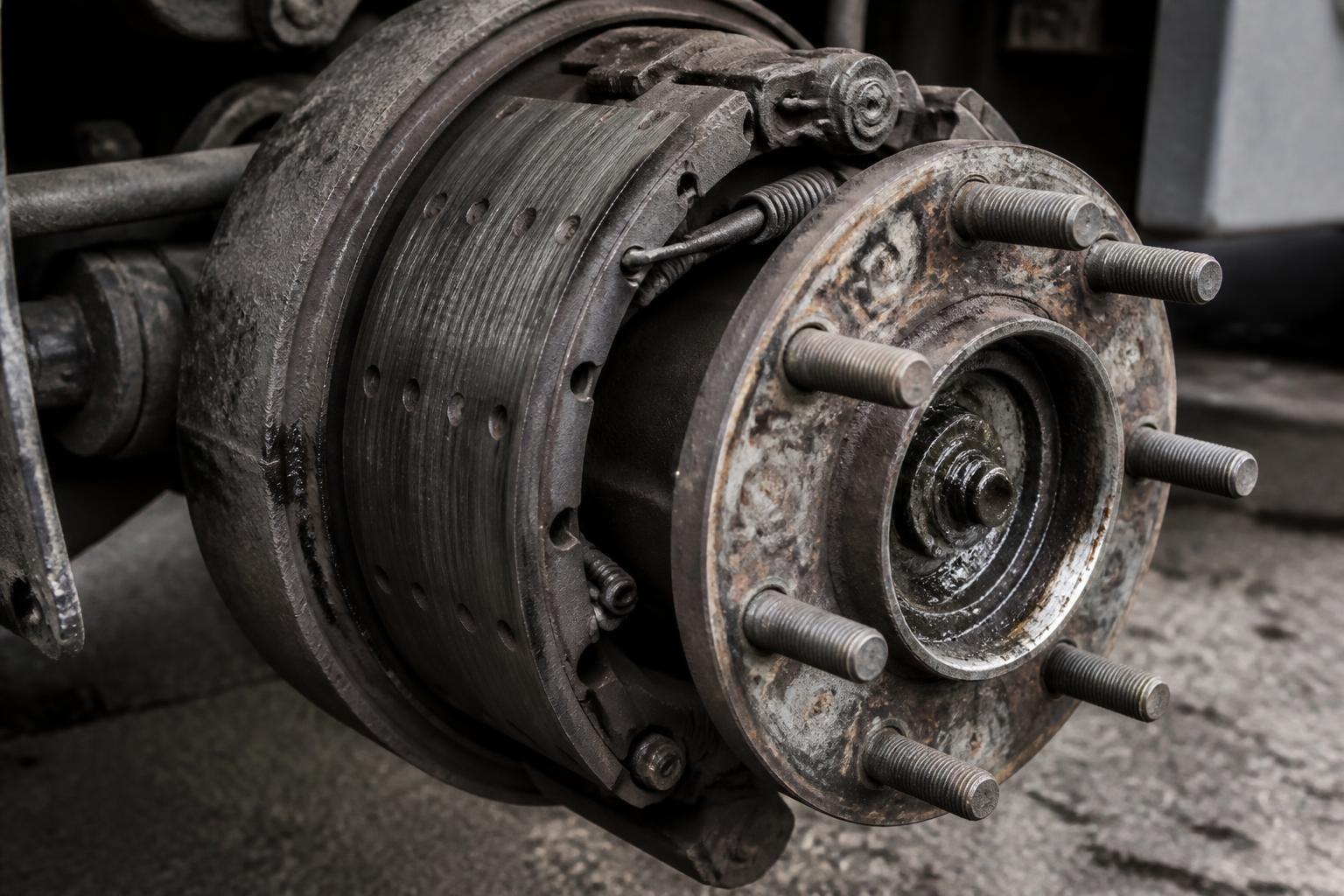
- Wheel-end heat, bearing noise, or signs of hub damage
- Tyres with exposed cords, sidewall damage, bulges, or rapid pressure loss
- Steering play, instability, or suspension defects affecting control
- Trailer brake, lighting, or coupling faults that make the combination unsafe
- Fuel, oil, coolant, or air leaks that are severe enough to risk breakdown or fire
- Any defect likely to attract an immediate prohibition if checked at the roadside
For UK operators, this sits alongside daily walkaround checks, regular safety inspections and MOT requirements. The legal framework is not just about whether a vehicle can physically move. It is about whether it is roadworthy and safe to use. A defect that looks minor in the yard can become a serious issue once the unit is loaded, the trailer is coupled, or the vehicle is running at road speed on the A14.
This is why the first step matters. We advise operators to record the defect clearly, note whether it is getting worse, and avoid vague descriptions like "brakes not right" or "warning light on sometimes". Better descriptions help triage. For example:
- "Nearside rear trailer brake feels delayed under load"
- "ABS lamp on after startup, clears then returns when moving"
- "Unit losing air overnight, gauge slow to recover from 6 bar"
- "Offside steer tyre shoulder wearing faster than nearside"
- "Trailer pulls slightly when braking with loaded curtainsider"
That level of detail helps us judge whether the vehicle should come in under its own steam, whether it needs a same-day workshop slot, or whether you should ask about callout support for HGV faults on the road or recovery support when the vehicle should not continue.
How a workshop should triage warning lights, brake faults and poor running
Good triage is not guessing from the dashboard. It is a sequence. We start with the driver report, confirm the symptom, inspect the vehicle, then use diagnostics and testing to narrow the fault down before parts are changed.
Warning lights are a good example. An ABS or EBS lamp does not automatically mean the same thing on every HGV or trailer. The fault could be a wheel speed sensor issue, damaged exciter ring, wiring fault, modulator problem, poor voltage supply, or a communication issue between unit and trailer. On a trailer, the fault may only appear with a particular tractor unit, which is why unit and trailer history matters.
A proper workshop process usually includes:
- Visual inspection of wiring, connectors, sensors and obvious damage
- Check of battery and charging condition where voltage may be involved
- Electronic fault code readout
- Live data review where available
- Functional checks to confirm whether the fault is current or historic
- Road test or controlled running test if safe and necessary
- Brake performance testing if the warning light may relate to actual braking
For poor running complaints, the same principle applies. "Lack of power" can mean many things. We need to know whether the issue is constant or intermittent, hot or cold, loaded or unloaded, and whether there are any associated symptoms such as smoke, excessive regeneration, rough idle, poor throttle response, or warning messages. Diagnosis may include fault code checks, sensor readings, boost or air system checks, fuel system inspection, and confirmation that the complaint can actually be reproduced.
Brake faults deserve particular care because they are often described by feel, not measurement. A driver may report poor braking, dragging, grabbing, or pulling. The workshop then has to determine whether the cause sits in the foundation brakes, air supply, valves, sensors, load sensing, actuator operation, contamination, or trailer interaction.
That is where roller brake testing earns its place. A road test can tell you that something feels wrong. A roller brake test shows measured brake effort across axles and sides, highlights imbalance, and helps confirm whether the issue is unit, trailer, or both. It is one of the most useful tools for commercial truck repairs because it turns a general complaint into an actionable defect list.
When we carry out diagnostics for HGV and trailer fault finding and roller brake testing for measured brake performance checks, the aim is not to create extra work. It is to stop operators spending time and money on the wrong fix. A warning lamp with no proper diagnosis often becomes repeat downtime. A brake complaint without measured testing often comes back as "still not right".
Why trailer faults are often missed until they cause downtime
Trailer faults are easy to miss because many of them develop gradually, and because the trailer is not always with the same unit, driver or route pattern long enough for the problem to become obvious early.
A unit gets more day-to-day attention because the driver feels every change in steering, power and braking. A trailer can hide deterioration until loading conditions, road surface, weather, or a different tractor unit expose it. That is why trailer defects often become downtime jobs rather than planned repairs.
Common examples include:
- Brake wear that is uneven across axles
- ABS or EBS faults that appear intermittently
- Air leaks from suzies, lines, valves or chambers
- Tyre wear caused by alignment or suspension issues
- Lighting faults that only show up with vibration or poor connection
- Worn bushes, damaged shock absorbers, or axle-related wear
- Door gear, body and landing leg faults that worsen with repeated use
Operators should watch for early signs, not just obvious failures. Those signs include a trailer that seems slower to release brakes, repeated lamp issues with more than one unit, tyres scrubbing on one axle, a trailer that feels unstable under braking, air loss while parked, or a defect that appears only when loaded.
Checking the trailer on its own is not always enough. Unit and trailer need checking together because some faults only show up as a combination issue. A trailer ABS or EBS fault may be traced to trailer wiring, but it may also be influenced by the tractor connection, voltage supply, or communication through the electrical line. Brake timing complaints may involve both sides of the combination. A trailer that tows poorly behind one unit but not another tells you something useful straight away.
For operators running mixed fleets, subcontract trailers, or route-critical work in and out of Felixstowe and Ipswich, this matters. If the trailer is treated as separate from the unit until test time or breakdown time, defects build up unnoticed. Regular HGV and trailer inspections that catch defects before they stop the job are usually far less disruptive than waiting for the trailer to declare the problem on the road.
When MOT preparation saves time instead of adding another booking
Some operators avoid MOT preparation because they see it as an extra workshop visit. Done badly, it can be. Done properly, it saves time because it brings defects to light early enough to fix them before the test slot is at risk.
Useful MOT preparation is not a quick wash and a look around. It should include a structured inspection against the likely failure points for the HGV or trailer, including brakes, lights, tyres, steering and suspension components, air system condition, warning lights, underbody checks, and anything else likely to lead to a refusal or delayed presentation. Where needed, it should also include brake performance checks and fault code investigation rather than waiting for the official test to uncover them.
The timing matters. If you book MOT preparation too close to the test date, there may be no room to source parts, complete repairs, or retest brake performance before the booked presentation. If you book too early and then run the vehicle heavily, the condition can change before the test. The right window depends on usage, but the principle is straightforward. Leave enough time for defects to be corrected properly without losing the test slot.
For busy fleets, that often means planning around inspection cycles and workshop capacity rather than treating the MOT as a last-minute event. For owner-drivers, it means avoiding the common trap of driving right up to the deadline and then discovering brake imbalance, tyre condition, lamp faults or suspension wear that should have been dealt with earlier.
In the UK, MOT presentation for HGVs and trailers follows the domestic testing system rather than a single EU-wide process. Operators still need to think in practical roadworthiness terms, but the booking, preparation and presentation need to fit UK requirements and deadlines. That is why a workshop-led pre-test process is useful. It should not duplicate your normal maintenance. It should bridge the gap between routine servicing and what is likely to matter on test day.
Our approach to MOT preparation and presentation support for HGVs and trailers is to identify what will actually hold the vehicle back, explain it clearly, and leave time to put it right. That is usually faster than finding out at test stage, losing the slot, and then trying to reorganise repairs around delivery commitments.
Choosing the next step when the vehicle is off road or route critical
Once a fault has appeared, the next decision is commercial as much as technical. The right answer depends on safety, location, urgency, and whether the vehicle is genuinely off road or simply needs a controlled workshop booking.
A booked workshop visit is usually the right next step when:
- The defect is real but the vehicle can be moved safely
- The fault needs inspection, diagnosis or brake testing rather than roadside intervention
- The vehicle is near Woolpit, Stowmarket, Bury St Edmunds, Newmarket, Elmswell, Ipswich or on the A14 corridor
- You want the issue confirmed properly before parts are fitted
- The job may involve both unit and trailer checks together
Tyre support is the better first move when the immediate issue is clearly tyre-related and is stopping the vehicle from continuing safely. That might be a rapid deflation, sidewall damage, road damage, or a tyre condition issue that cannot wait for a planned booking. Tyres are one of the clearest examples of a defect that can shift quickly from manageable to immobilising.
Callout support makes sense when the vehicle is route critical, the fault may be resolved safely on site, and moving the vehicle first would add risk or delay. Typical examples are certain air leaks, electrical faults, battery and charging issues, some lighting defects, and trailer connection problems where an on-site assessment can establish whether the vehicle can continue, be repaired in place, or needs to return to the workshop.
Recovery support becomes the right choice when continuing would be unsafe, when the vehicle cannot move under its own power, or when the likely defect is serious enough that roadside attendance is only the first step. Severe brake issues, major driveline failure, significant wheel-end problems, or damage after an incident usually fall into that category.
This is where clear triage matters more than broad promises. If a driver reports "brakes binding", "ABS light on", and "burning smell from trailer axle", that is not just another workshop booking. If the report is "engine warning lamp on, no obvious running issue, vehicle due back via A14 this afternoon", the next step may be very different.
At Woolpit Truck Repairs, we work from Bridge Farm near A14 J47 because access matters when a commercial vehicle fault is disrupting the day. Operators running through Suffolk do not need vague advice. They need to know whether to stop, whether to continue carefully to the workshop, whether unit and trailer both need checking, and whether the quickest option is a booked repair, tyre support, callout or recovery support enquiry.
That practical approach is also how we work with fleet maintenance arrangements and operator records. Clear defect descriptions, realistic booking advice, measured brake testing, proper diagnostics, and sensible preparation before MOT all reduce repeat downtime. They also help operators explain decisions internally, whether the vehicle belongs to a larger fleet, an owner-driver, or a business structure such as FLEETA LIMITED.
The earlier a fault is assessed properly, the more options you usually have. Leave it until the warning light becomes a breakdown, the trailer issue becomes a missed slot, or the brake concern becomes a prohibition, and the choice narrows fast. If the vehicle is showing signs that something is not right, the best next step is the one that matches the actual risk, not the most convenient guess.
What should I do first if an HGV warning light comes on?
Record the warning, note any change in braking, power or air pressure, and decide whether the vehicle is still safe to move. A proper diagnostic check helps separate a sensor issue from a fault that needs immediate repair.
Can a brake problem be diagnosed without changing parts first?
Yes. A workshop can inspect components, check fault codes and use roller brake testing to see how the system is performing. That is usually more useful than fitting parts based on guesswork.
Do trailer defects always come from the trailer itself?
No. Some faults come from the trailer, some from the unit, and some from the air or electrical connection between them. Checking both sides helps avoid replacing the wrong part.
How early should MOT preparation be booked?
Early enough to leave time for repairs if defects are found. If the vehicle is close to test date and already showing faults, booking MOT preparation sooner gives more options and less pressure.
When is callout or recovery support the better option?
If the vehicle is unsafe to drive, immobilised, or likely to cause more damage by moving, callout or recovery support enquiries are usually the safer next step than trying to reach a workshop unaided.