A tractor-trailer has stopped on the A14, the delivery window is tightening, and the first search is usually simple: HGV workshop near A14. The difficult part comes next. The nearest premises may not have the capacity, equipment or commercial-vehicle experience to inspect a heavy combination, diagnose an electronic fault, test the brakes and deal with the paperwork properly.
For operators running between Felixstowe, Ipswich, Bury St Edmunds, the Midlands, Essex and Norfolk, workshop choice is part of disruption planning. Woolpit Truck Repairs is a specialist commercial workshop for HGVs, trucks and trailers only, based near Woolpit, Elmswell and A14 Junction 47. The useful question isn't just whether a workshop can repair a truck. It's whether it can help a vehicle return to safe, documented service without creating another avoidable delay.
Table of Contents
- Why an A14 Specialist Workshop Matters for Suffolk Hauliers
- Services a Specialist HGV and Trailer Workshop Should Cover
- HGV Inspections, PMI and Roller Brake Testing Explained
- MOT Preparation, Diagnostics, Tyres and Air Conditioning Re-Gas
- Callouts, Recovery and A14 Breakdown Support
- Why Proximity to A14 Junction 47 Reduces Downtime
- Directions and Access to Woolpit Truck Repairs
- Haulier Questions and Booking Your Workshop Slot
Why an A14 Specialist Workshop Matters for Suffolk Hauliers
An articulated truck loses power westbound near Bury St Edmunds during a busy afternoon. The driver gets clear of live traffic, reports the location to the transport office and describes a sudden loss of boost, warning lights and the load being carried. The office then needs more than a phone number. It needs a workshop that understands HGV access, roadside diagnosis, recovery limits and the difference between a repairable fault and a non-runner.
That's where a specialist base near Junction 47 can change the outcome. A technician may be able to attend for roadside triage, or the operator may arrange safe recovery to a workshop equipped for the tractor, trailer and the fault involved. A general garage might be close on a map but still unable to accept the vehicle, lift it safely or complete the necessary commercial inspection.
The A14 carries exceptionally heavy freight in Suffolk. At Department for Transport Count Point 89242, the route recorded 49,429 all motor vehicles in 2025, including 6,794 heavy goods vehicles, compared with 45,450 vehicles and 7,971 HGVs in 2024. These figures are recorded in the Department for Transport A14 traffic count. Transport East says the A14 carries 70% of freight moving through Felixstowe port, as described in its A14 freight corridor information. The route connects the port gateway with distribution and manufacturing areas inland, so a stopped HGV can affect more than one delivery.
The cost of choosing on geography alone
A workshop's location matters, but capability decides whether that location is useful. Operators should check whether the site supports HGV and trailer inspections, PMI work, roller brake testing, diagnostics, mechanical repairs, tyre assistance and MOT preparation. They should also ask how the workshop handles a vehicle that arrives with a defect report rather than a scheduled booking.
Practical rule: A nearby HGV workshop is valuable when it can assess the complete vehicle, record the defect clearly and advise whether repair, recovery or further testing is the safe next step.
Woolpit, Elmswell and Junction 47 sit in a practical position for traffic moving through Suffolk. That makes a specialist workshop part of an A14 disruption-response network, not merely a place to send vehicles for routine servicing.
Services a Specialist HGV and Trailer Workshop Should Cover
A commercial workshop needs to match the vehicle in the bay. An HGV tractor and trailer combination brings different demands from a light vehicle, including air systems, braking components, suspension, couplings, electrical networks, trailer running gear and load-related safety concerns. Operators should confirm those capabilities before sending a vehicle across the county.
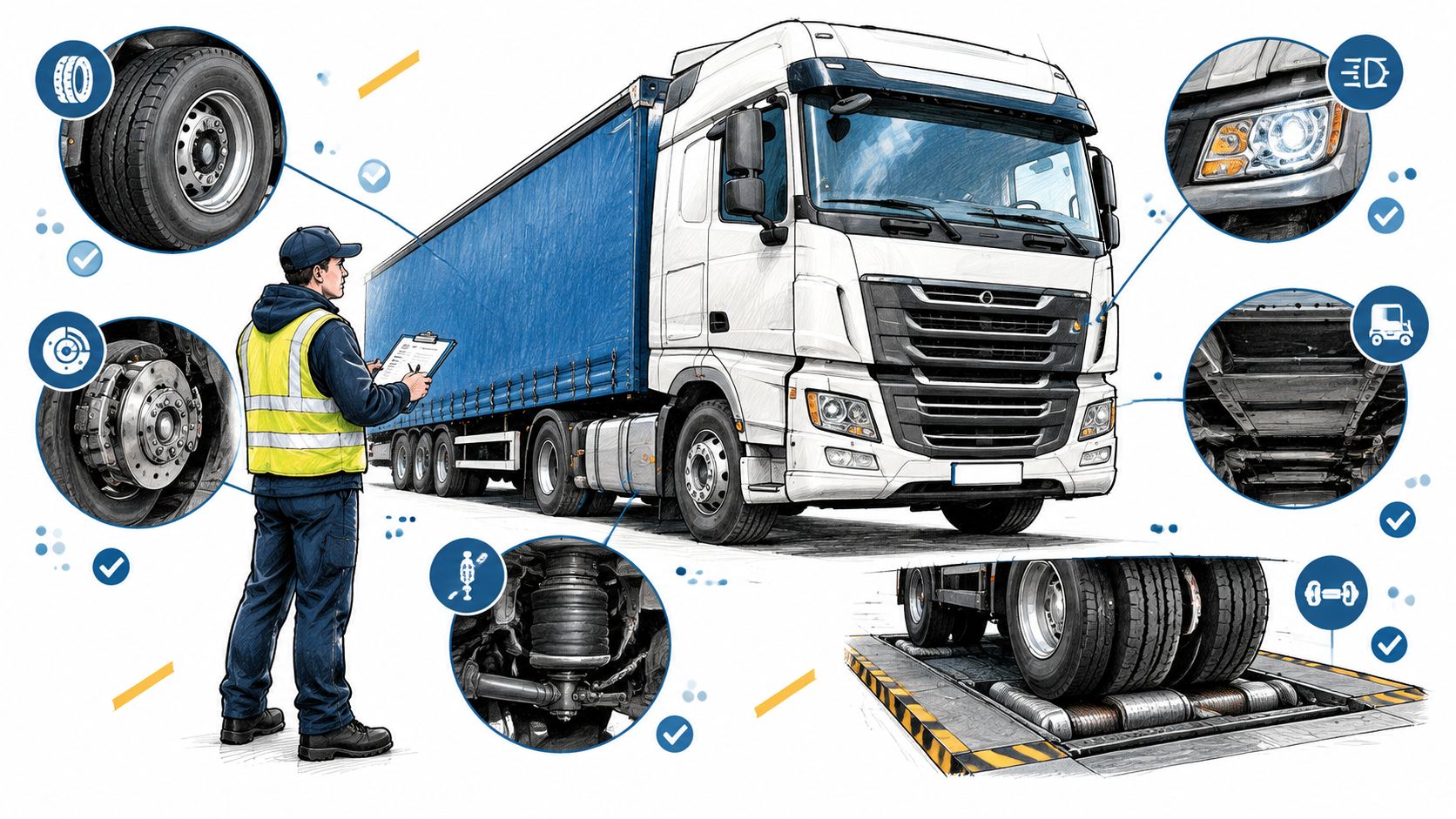
Core support normally includes:
- Safety inspections and PMI support: Scheduled checks help operators identify defects before they become roadside failures, with records prepared for fleet maintenance systems.
- Roller brake testing: A proper brake test provides axle-by-axle evidence for maintenance decisions and MOT preparation.
- Truck and trailer repairs: Lighting, electrical, braking, suspension, steering, air, hydraulic and running-gear faults need commercial-vehicle handling.
- Diagnostics: Fault-code reading and live-data investigation can help separate a sensor issue from a wider engine, emissions or control-system problem.
- Tyre support: Commercial tyre inspection, repair and replacement need to account for steer, drive and trailer positions.
- Air-conditioning re-gas: Cab cooling matters to drivers working long shifts and overnight operations, particularly when a vehicle is already booked into the bay.
- Planned fleet maintenance: A workshop can help coordinate inspections, brake tests and repairs around vehicle use rather than waiting for a defect to stop the truck.
LOLER-related inspection requirements may apply to lifting equipment, but the exact scope depends on the equipment and its use. The same caution applies to other specialist work. Tachograph calibration, fixed-price repairs, response times and accreditations shouldn't be assumed unless the workshop confirms them directly.
What the booking conversation should establish
Before a bay is allocated, the transport manager should provide the registration, vehicle type, trailer details, reported defect, current location and any relevant warning messages. The workshop can then decide whether the job is a scheduled inspection, a diagnostic appointment, a repair, a callout or a recovery request.
A useful reference for understanding why rotating assemblies and driveline condition deserve planned attention is this gearbox maintenance guide. It reinforces a broader workshop principle, planned checks are usually less disruptive than waiting for a failure during a loaded journey.
Woolpit Truck Repairs provides the commercial workshop services described above for HGVs, trucks and trailers. It doesn't service cars or unrelated light vehicles, which keeps the booking conversation focused on the equipment and compliance needs of operators using the A14 freight route.
HGV Inspections, PMI and Roller Brake Testing Explained
A daily walkaround, a safety inspection, a PMI and a roller brake test serve different purposes. Treating them as interchangeable creates gaps in the maintenance record and can leave a vehicle with a defect that routine servicing hasn't addressed.
The GOV.UK guide to maintaining roadworthiness says the driver or responsible person must complete a meaningful daily walkaround check, preferably immediately before use. The guidance also requires operators to maintain vehicles safely through inspection, maintenance and record keeping.
What happens at each stage
A daily walkaround gives the driver or responsible person an opportunity to identify obvious defects, including tyre damage, lighting faults, leaks, coupling problems and visible brake or suspension concerns. It isn't a substitute for workshop inspection.
A safety inspection is a structured examination of the vehicle's roadworthiness. The technician checks areas such as brakes, steering, suspension, lights, tyres, couplings, leaks and structure, then records the findings. A PMI follows the operator's planned maintenance system and may include deeper checks scheduled according to vehicle type, use and manufacturer requirements.
Periodic maintenance inspections are usually scheduled at intervals of 6 to 13 weeks, depending on the vehicle and its operation, and PMI records should be retained for 15 months, according to industry guidance aligned with DVSA practice in the GOV.UK roadworthiness material. Operators commonly require completed inspection records to return within 24 hours, so the workshop's documentation process matters as much as the physical inspection.
Why the brake sheet matters
DVSA guidance expects a roller brake test at least four times per year, including the MOT, for HGV workshop safety-inspection arrangements. The HGV and trailer brake test report guidance explains that the report should show axle-by-axle brake performance and efficiencies.
A loaded test is also important. DVSA best practice says the vehicle should be presented at least 65% loaded to design axle weight, because insufficient load can reduce tyre grip on the rollers and cause wheel lock before the brakes' real capacity is measured. The heavy vehicle brake test best-practice guide identifies commonly used standards of about 50% service brake efficiency, 25% secondary brake efficiency and 16% parking brake efficiency.
The result isn't just pass or fail. Imbalance, binding and uneven force distribution can point to defects that a visual check won't reveal. Operators should book the HGV PMI inspection service in Suffolk with the vehicle's maintenance schedule and brake-test requirements in view.
MOT Preparation, Diagnostics, Tyres and Air Conditioning Re-Gas
MOT preparation works best when the workshop treats the truck and trailer as one operating problem, even if they arrive separately. A pre-test check should cover braking, lights, steering, suspension, tyres, emissions, leaks, body condition, couplings and other visible defect areas.
High-mileage tractors often arrive with several small issues rather than one dramatic failure. A damaged lamp, worn tyre, air leak, loose body fitting or brake imbalance can each create delay, especially when the vehicle is already close to its test date. Trailer defects deserve the same attention because a sound tractor can't compensate for an unsafe trailer.
The HGV MOT preparation guide for Suffolk fleets provides a useful planning reference. Preparation isn't a guarantee of a pass, and Woolpit Truck Repairs provides MOT preparation and presentation support rather than claiming to be an MOT test station.
Diagnostics should answer a question
A warning light is a symptom, not a diagnosis. The technician needs the vehicle's fault codes, operating conditions, recent repairs and driver observations before deciding whether the next step is a sensor check, wiring investigation, emissions-system diagnosis, forced regeneration or mechanical inspection.
Commercial diagnostic work may involve manufacturer-specific systems alongside multi-brand equipment. The important point for the operator is whether the workshop can investigate engine, transmission, ABS, EBS, AdBlue, SCR and other control-system faults across the fleet's marques, then explain which defects prevent safe operation.
Tyres and cab comfort
Tyre support should distinguish between steer, drive and trailer axle positions. Repair or replacement decisions depend on damage, condition and legal roadworthiness, while alignment and running gear can influence uneven wear. Callout fitting is subject to availability, location and the type of vehicle or tyre required.
Air-conditioning re-gas is a separate job, but it can often be arranged during the same workshop visit. Leak detection, refrigerant handling and PAG oil top-up should be discussed before booking. Combining approved work on one visit can avoid a second bay appointment, although urgent repairs and parts availability will always affect the schedule.
Callouts, Recovery and A14 Breakdown Support
A stopped HGV on the A14 needs a safe plan before it needs a repair. The driver should move as far from live traffic as possible where conditions allow, apply the vehicle's warning and safety procedures, wear high-visibility clothing when safe to do so, contact the operator and provide an accurate location. Hazard triangles should be used only where it's safe and appropriate under the driver's operating procedure.
The first call to a workshop should include:
- Exact location: Give the carriageway direction, junction, marker post, lay-by, industrial estate or nearby landmark.
- Vehicle details: Provide the registration, tractor and trailer type, and whether the combination is loaded.
- Fault description: State what happened, including warning lights, air pressure symptoms, smoke, loss of power, tyre damage or brake concerns.
- Safety position: Explain whether the vehicle is secure, obstructing traffic, in a lay-by or already off the carriageway.
- Recovery limits: Confirm whether the vehicle can move under its own power and whether the trailer needs separate attention.
Roadside triage is not full recovery
A mobile engineer may handle a fault that can be safely repaired at the roadside, such as an airline issue, fuse fault, tyre change or straightforward adjustment. Diagnosis can also establish that the vehicle must not continue, which prevents a driver from worsening the damage or creating a road safety risk.
A non-runner may need a suitable heavy recovery vehicle or low-loader collection. Off-road retrieval, casualty towing and access to a secure yard require different planning from a normal callout. The nearest available resource may depend on traffic, time of day, weather, vehicle size, load and current demand.
A recovery booking should describe the vehicle's condition honestly. “It won't start” doesn't tell the recovery operator whether the brakes are holding, the steering works, the trailer is attached or the vehicle is carrying a heavy load.
Suffolk has recorded serious A14 incidents involving HGVs, including a March 2026 collision involving two HGVs that closed the road in both directions, with recovery and fuel-spill clearance required, as reported by Suffolk Fire and Rescue Service. A January 2026 HGV crash near Kirton and Trimley also closed the A14 overnight while the vehicle was recovered. These incidents show why a workshop near the corridor needs to be considered alongside the operator's recovery arrangements.
Callouts and recovery remain subject to availability. The practical advantage comes from having a known commercial workshop to contact for triage, inspection, repair planning and off-road support when a roadside problem threatens the delivery schedule. Operators can review HGV breakdown assistance in Suffolk before an incident occurs.
Why Proximity to A14 Junction 47 Reduces Downtime
The A14 is more than a local road. It carries freight from Felixstowe into Suffolk and towards the Midlands, while connecting operators in Ipswich, Bury St Edmunds, Stowmarket, Essex and Norfolk with major distribution routes. The A14 traffic count cited earlier records sustained vehicle and freight pressure, and Transport East links the route directly to freight moving through Felixstowe port.
That context makes Woolpit near Junction 47 a practical workshop location. A vehicle can leave the main route for a commercial inspection or repair without an unnecessary cross-country diversion. For a transport manager, the benefit isn't just distance. It's the chance to reduce idle time, protect a delivery slot and return the vehicle to the planned route after the repair is signed off.
The corridor has also faced temporary restriction and prohibition orders between Junction 47 at Woolpit and Elmswell Interchange and Junction 49 at Tot Hill Interchange, as reflected in GOV.UK commercial vehicle testing data. Operators need contingency options because a route that looks straightforward on the planning screen can become difficult for a disabled HGV.
Approximate travel times to Woolpit Truck Repairs from A14 corridor towns
Origin Approx. Distance Approx. Drive Time Bury St Edmunds Local A14 corridor journey About 20 minutes Stowmarket Local A14 corridor journey About 25 minutes Central Ipswich A14 corridor journey About 30 minutes Norfolk depots Via A14 and A11 Under an hour for many locationsThese are planning estimates, not guarantees. Congestion, road restrictions, weather and the vehicle's permitted route can change the journey. Essex operators may also find the Woolpit location useful when a vehicle is already working the A12 and A14 corridor, but the transport manager should check the specific route and access requirements before dispatch.
The decision works best when made before the breakdown. A planned relationship with a specialist HGV workshop gives the office a known destination for PMI, brake testing, diagnostics, repairs and MOT preparation instead of forcing a rushed search while the vehicle is stopped.
Directions and Access to Woolpit Truck Repairs
Drivers approaching from the A14 corridor should plan the final route for the vehicle they're operating. An articulated combination, drawbar outfit and rigid truck may have different turning, width, height and road-classification considerations, so a satnav's shortest route isn't automatically the right route.
From the A14, the usual local approach is through Junction 47, then towards Woolpit via the A1308 and the Elmswell area. Drivers should check the signed route and any restrictions before leaving the main carriageway, particularly when operating an artic or drawbar combination. If the satnav directs the vehicle into an unsuitable village approach or places it on the wrong side of the destination, the driver should stop safely and call the workshop rather than attempt a tight or restricted manoeuvre.
Local planning estimates
Starting point Approximate drive time Bury St Edmunds About 15 minutes Stowmarket About 10 minutes Ipswich About 30 minutes Felixstowe docks About 45 minutesPeak A14 congestion can extend every journey, especially around Bury St Edmunds, Rougham, Stowmarket and Ipswich. The estimates are therefore useful for dispatch planning, not a promise of arrival time.
On arrival, the driver should follow the workshop's instructions for the entrance, yard turning area and reporting point. The vehicle should not block access while the office confirms the booking or checks whether the bay is ready. Registration details, trailer information and the defect description should be available at the gate.
Overnight parking shouldn't be assumed. Out-of-hours arrivals need prior agreement, including where the vehicle can stand, whether the trailer may remain attached and how keys and paperwork will be handed over. Callouts and recovery are subject to availability, so a transport manager should confirm access before sending a non-runner or late arrival to Woolpit.
Haulier Questions and Booking Your Workshop Slot
Transport managers usually want practical answers before committing a vehicle. The first is turnaround. A PMI may fit a planned inspection slot, while a vehicle needing a full defect investigation, brake work, diagnostic testing or parts replacement can require more time. No responsible workshop should promise a fixed completion time before seeing the vehicle and confirming the fault.
The second question is availability. Same-day and weekend callouts may be possible subject to workload, location, weather, vehicle type and engineer or recovery availability. A scheduled workshop booking and an emergency recovery booking are different jobs, so the enquiry should state which one is required.
Information to send with the first enquiry
- Vehicle identity: Registration, tractor model, trailer number and operating configuration.
- Maintenance need: PMI, safety inspection, roller brake test, MOT preparation, repair, diagnostics or tyre support.
- Defect detail: Driver report, dashboard warnings, recent work and whether the vehicle can move safely.
- Timing: Test date, delivery commitments, preferred drop-off and collection arrangements.
- Records: Existing inspection sheets, brake-test reports, defect reports and relevant maintenance history.
A roller brake test should be booked alongside MOT preparation when the operator needs the results available for maintenance planning and presentation support. The workshop can confirm how the vehicle should be presented, whether loading arrangements matter and what documentation should accompany it.
Payment terms also need agreement before work starts. Account-holder terms, collection arrangements and authorisation limits vary between operators, so the transport office should confirm them during booking rather than assuming that an emergency callout follows the same process as planned fleet maintenance.
Mixed fleets can be managed when the operator supplies accurate vehicle information. Different marques may use different systems and maintenance requirements, but the booking still begins with the same essentials: identify the vehicle, explain the defect and provide the relevant records. Woolpit Truck Repairs handles HGV and trailer workshop enquiries for operators in Woolpit, Elmswell, Bury St Edmunds, Stowmarket, Ipswich, Felixstowe, Suffolk and nearby routes into Essex and Norfolk.
For a planned slot, the process is straightforward. The operator makes contact, the workshop confirms scope and availability, the vehicle arrives or is recovered, the technician records findings, and the transport office receives the agreed repair or inspection information before collection.
For HGV and trailer inspections, PMI support, roller brake testing, diagnostics, MOT preparation, repairs, tyre support, air-conditioning re-gas and planned maintenance near A14 Junction 47, contact Woolpit Truck Repairs. Call with the vehicle registration, location and fault details to discuss a workshop booking, callout or recovery requirement, subject to availability.