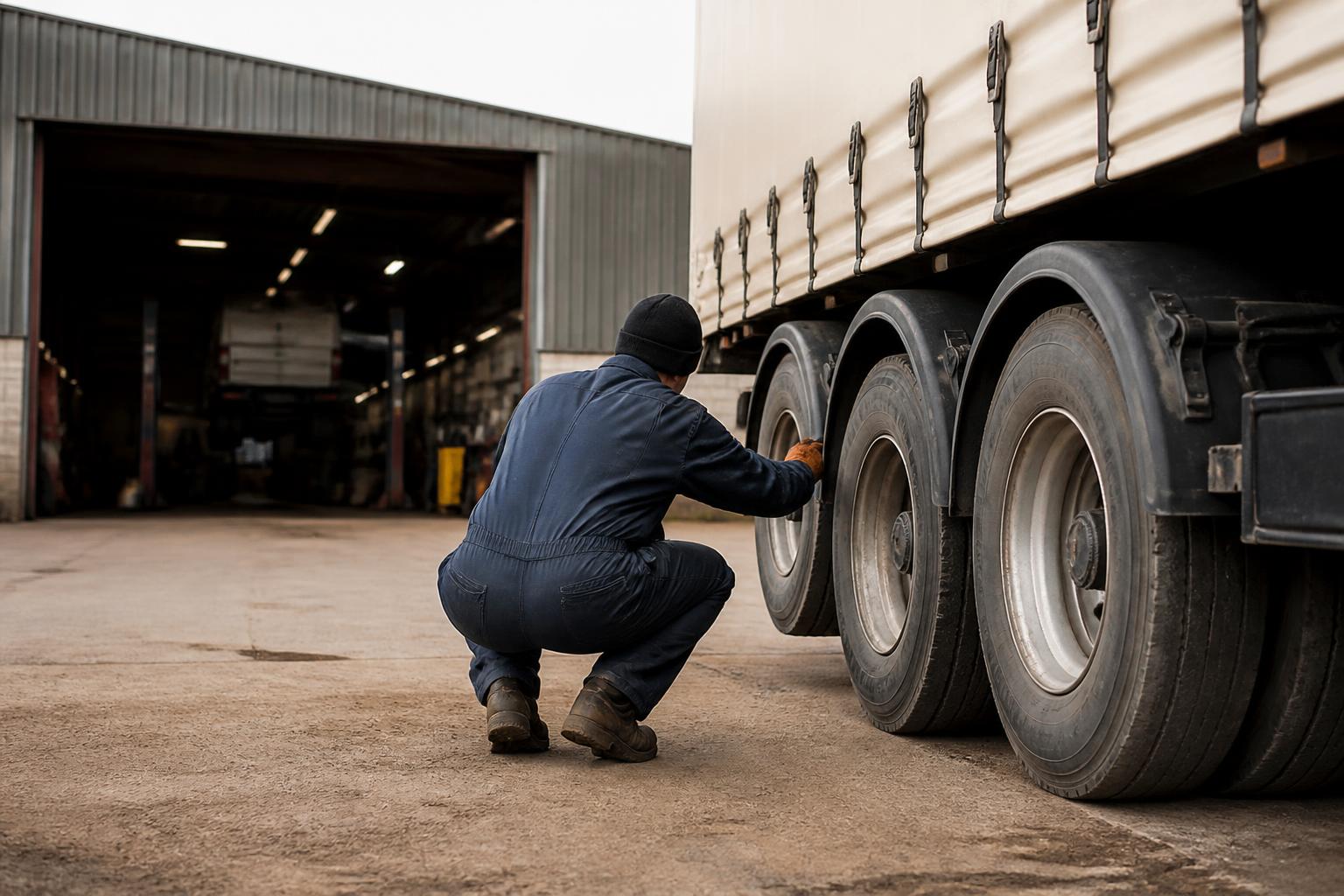
When an operator searches for local truck tyre help, the real question is usually simpler than the search term. Can we move this vehicle safely, do we need a tyre only, or is there a deeper fault that will put it straight back off the road?
That is the point where speed matters, but so does judgement. A fast answer is useful only if it separates a straightforward replacement from a brake, hub, alignment or suspension issue. At Woolpit Truck Repairs, we deal with HGV and trailer tyre problems from that practical angle, so operators get a safe next step rather than guesswork.
What operators usually mean when they search for local tyre help
Most searches for nearby tyre replacement are not routine buying decisions. They happen because a vehicle has developed a fault on shift, during a pre-use check, or while loading, tipping or running trunk work. The operator wants to know who can assess the defect quickly and whether the vehicle can continue, come into workshop, or needs roadside support.
On HGV work, the most common triggers are:
- A puncture with clear pressure loss
- Sidewall damage from kerbing, debris or impact
- A tread cut where the casing may be exposed
- A bulge, separation or impact break
- Rapid shoulder wear on one side
- Feathering or scrub wear across the tread
- A trailer tyre found flat after standing
- Twin wheel issues where one tyre has failed and the paired tyre has been overloaded
- Vibration, pulling, heat or a change in handling
- A defect found during a driver walk-round before a loaded run
Trailer tyres create their own problems. A trailer may have been left at a customer site, moved around yards, clipped kerbs, or picked up damage that is not obvious until the next hook-up. We often see tyres that look like a simple replacement job until the tread pattern or wheel end condition suggests something else is going on.
That is why a search for local tyre help often means, in practice, "I need someone nearby who understands commercial vehicles, can ask the right questions, and can tell me whether this is a tyre problem or a vehicle problem."
For operators around Woolpit, Suffolk and the wider A14 corridor, time matters because a tyre defect can quickly affect route planning, delivery windows and driver hours. If you are trying to keep work moving between Ipswich, Felixstowe, Stowmarket, Bury St Edmunds, Newmarket and Elmswell, you do not need vague advice. You need a workshop that deals with HGV and trailer defects every day.
When a tyre needs replacement and when it needs a wider inspection
Some tyre failures are exactly what they appear to be. A tyre with sidewall damage, exposed cords, a serious cut, a bulge, or damage from running underinflated will usually need replacement, not repair. The same applies where tread depth is below the legal minimum.
For UK commercial vehicles, the legal tread depth requirement differs by vehicle type and gross weight. For most goods vehicles over 3,500kg GVW, the minimum is 1mm across at least three quarters of the breadth of the tread, around the entire circumference. That is lower than the 1.6mm passenger vehicle rule many people know, which is why it is worth being precise. Legal minimum is one thing, serviceable and commercially sensible is another. Many operators will replace earlier to avoid downtime, poor wet grip and failed inspections.
The wider inspection starts when the tyre wear pattern does not fit a simple puncture or damage event. Typical examples include:
- One shoulder worn smooth, suggesting alignment or suspension issues
- Both shoulders worn, suggesting chronic underinflation
- Centre wear, suggesting overinflation
- Cupping or scalloping, pointing to suspension, balance or wheel end concerns
- Localised flat spots from brake lock-up or dragging brakes
- Heat damage after running with brake issues
- Repeated failures on the same wheel position
At that point, replacing the tyre alone is only half a job. We need to check whether the underlying cause sits elsewhere on the vehicle or trailer.
On an HGV or trailer, that wider inspection may include:
- Brake condition and brake balance
- Wheel bearing play or hub condition
- Signs of overheating at the wheel end
- Axle alignment
- Suspension wear or damage
- Air suspension ride height
- Shock absorber condition where fitted
- Evidence of brake drag
- ABS and EBS fault indications
- Valve, rim and wheel condition
If the defect links to braking, a roller brake test can help confirm whether the issue is tyre-related or part of a bigger brake performance problem. If you are trying to avoid a repeat failure before test, our guide on where to get an HGV brake test near the A14 before MOT explains how we approach that side of the inspection.
The same principle applies to trailers. A trailer tyre with odd wear can be the first visible sign of axle misalignment, worn suspension components, brake imbalance or a wheel end defect. If the trailer is due for inspection or has had recent roadside issues, it often makes sense to combine the tyre work with a broader trailer check rather than treat it as an isolated problem.
What to check before moving the vehicle
Before deciding to drive to a workshop, the first question is whether the vehicle is safe to move at all. That decision needs to be based on the actual condition of the tyre and the risk around the vehicle, not just how urgent the job feels.
Start with the wheel position. A damaged steer axle tyre is a very different risk from a trailer axle tyre found low during a yard check. A defect on a steer tyre, especially involving sidewall damage, rapid pressure loss, exposed cords, bulging or heat, needs a much more cautious decision. In many cases, the right answer is not to move the vehicle until it has been properly assessed.
Then check the load and axle position. Ask:
- Is the vehicle loaded or empty?
- Which axle is affected?
- Is it a single fitment or one of a twin set?
- Has one tyre in a twin pair failed, potentially overloading the other?
- Has the trailer been standing with unknown pressure loss?
- Is the load stable, legal and suitable for any movement to workshop?
Visible damage matters. If there is a cut into the casing, sidewall tearing, a bulge, exposed cords, signs of separation, or any object embedded in a way that suggests structural damage, assume the tyre may not be safe to run.
Pressure loss matters too. A tyre that is visibly low but has held shape may still have internal damage if it has been run underinflated. If the driver reports the vehicle has been driven while soft, or the tyre has become hot, that pushes the decision towards replacement and inspection rather than inflation and carry-on.
Heat is a major warning sign. A hot wheel end can indicate more than a tyre problem. It may point to a binding brake, bearing issue or hub fault. If one wheel position is markedly hotter than others after a run, do not assume the tyre is the only concern.
Handling changes are another clue. Pulling, vibration, steering changes, trailer instability, or brake feel changes can all point to a fault that goes beyond the tyre itself.
Finally, think about roadside risk. Where is the vehicle now? A defect in a secure yard is one thing. A defect on or near the A14 hard shoulder, a live carriageway, a narrow access road, or a loaded site entrance is another. A poor location can turn a manageable tyre problem into a recovery or traffic management problem very quickly.
If you need tyre support, the best first step is usually to describe the condition properly before moving the vehicle. Our truck and trailer tyre replacement support is built around that sort of practical first assessment.
What useful tyre triage sounds like
Good tyre triage is not just, "Yes, bring it down." It should narrow the problem, identify immediate safety concerns and set realistic expectations about what happens next.
On the first call, we want the basics quickly and clearly:
- Vehicle type, rigid, unit or trailer
- Registration or fleet reference if available
- Exact location
- Whether the vehicle is loaded or empty
- Which wheel position is affected
- What the defect looks like
- Whether pressure has been lost fully or gradually
- Whether there has been a bang, vibration, pull, warning light or heat
- Whether the vehicle has already been driven on the damaged tyre
- Whether there are any ABS or EBS warnings
- Whether there is a brake concern as well
- How urgent the movement is
For trailers, useful details include axle type, whether it is parked or coupled, and whether the defect was found during a walk-round or after a road run. That helps us judge whether the issue is more likely to be simple damage, a standing-pressure problem, or part of a wider trailer defect.
Useful triage also means being honest about next steps. Sometimes the answer is that the vehicle should not be moved until it has been seen. Sometimes it is safe to come into workshop carefully for inspection. Sometimes the tyre issue is likely to be secondary, and the job really needs brake, hub or suspension checks first.
That is the difference between workshop-led advice and a generic booking line. We would rather explain why a tyre failure may be linked to an axle or brake issue than fit a replacement and send the same vehicle back out to fail again.
If trailer defects are part of the picture, our article on trailer inspections near Woolpit that cut roadside risk sets out why early checks matter.
Why location and route access matter for downtime
For commercial operators, local does not just mean the nearest pin on a map. It means somewhere you can reach without turning a tyre defect into half a day lost.
That is especially true in Suffolk, where many fleets and owner-drivers are balancing trunking, port work, regional distribution and timed deliveries along the A14 corridor. If you are running between Felixstowe, Ipswich, Stowmarket, Bury St Edmunds and Newmarket, access matters almost as much as workshop capability.
A tyre problem near A14 J47 is not the same as a tyre problem deep into a town centre industrial estate or a site with awkward access for artics and trailers. Operators care about whether they can get in, get assessed and get a realistic answer without wasting driver time or creating more route disruption.
That is why Woolpit matters as a working location. From Bridge Farm, we are placed for operators who need practical support near the A14 rather than a long diversion off route. For vehicles working across Woolpit, Elmswell and the wider Suffolk area, that can make the difference between a manageable delay and a lost shift.
Access also matters because tyre issues are often mixed with something else. If a vehicle may need tyre work, brake checks, a hub inspection or trailer defect assessment, it helps to bring it to a workshop set up for HGV and trailer work, not somewhere focused mainly on cars and vans. That avoids the common problem of getting the tyre changed but still needing a second stop for the actual root cause.
We cover that broader workshop choice in our guide on how to choose an HGV workshop near the A14.
How Woolpit Truck Repairs fits into the decision
When you are looking for nearby tyre replacement for an HGV or trailer, the decision is usually not just about who can supply a tyre. It is about who can help you decide, quickly and properly, what the vehicle needs next.
At Woolpit Truck Repairs, we support fleets, owner-drivers and other operators from Bridge Farm in Woolpit, Suffolk, with workshop-led tyre triage and related defect checks for commercial vehicles. That means we do not treat every tyre issue as a standalone job. If the signs point to brakes, alignment, wheel end condition, ABS, EBS or suspension, we say so and inspect accordingly.
Our work covers HGVs, rigids, artics and trailers. Depending on the defect, that may include:
- Tyre assessment and replacement support
- Inspection of wear patterns and likely causes
- Brake checks and roller brake testing
- Hub and wheel end checks
- Trailer inspections
- Repairs linked to the original defect
- MOT preparation where the tyre issue is part of a wider pre-test problem
- Practical advice on whether to move, inspect, repair or recover
That approach is particularly useful when the first symptom is unclear. A driver may report a flat, a pull, or a hot wheel, but the real issue may be a dragging brake, poor alignment, a damaged rim or a trailer axle problem. By starting with triage, we help operators avoid the expensive version of a quick fix.
We also understand the route pressures around A14 J47 and the surrounding areas, including Ipswich, Felixstowe, Stowmarket, Bury St Edmunds, Newmarket and Elmswell. Commercial vehicle support needs to fit the working day, not the other way round.
Woolpit Truck Repairs is operated by FLEETA LIMITED, and our focus on HGV and trailer work shapes the way we handle these jobs. We keep the conversation practical. What has failed, where is the vehicle, can it move safely, and what inspection will prevent the same problem putting you back off the road next week.
If you are dealing with a tyre defect now, the quickest route is to treat it as an operating decision, not just a parts request. Tell us what the tyre is doing, where the vehicle is, and what changed before the fault appeared. We will help you work out whether it is a straightforward replacement or the first sign of a bigger issue that needs attention before the vehicle goes back into service.
Can a truck tyre be replaced without checking anything else?
Not always. Uneven wear, heat damage or repeated pressure loss can point to brake drag, alignment, suspension or hub issues. A tyre change may solve the immediate problem but miss the cause.
Should I drive an HGV with a damaged tyre to a workshop?
That depends on the damage, axle position, load and how the vehicle is handling. If there is sidewall damage, rapid pressure loss, heat or instability, stop and get advice before moving.
What information should I have ready when I call for tyre support?
Have the vehicle type, axle position, tyre size if known, defect description, exact location, whether loaded or empty, and whether the issue is on the unit or trailer.
Why would a tyre fault affect MOT preparation?
Tyres are not looked at in isolation. Wear patterns and damage can lead to checks on brakes, suspension and other defects that may also affect MOT readiness.
Do trailer tyre problems need different triage from unit tyre problems?
Yes. Trailer axle position, load distribution, brake condition and EBS-related symptoms can change the likely cause and the safest next step.