A warning lamp appears as an artic passes Newmarket, or a driver reports that a trailer brake feels wrong just before joining the A14. The delivery slot is already tight, the vehicle is loaded, and a decision is needed quickly: can the vehicle continue safely, can a roadside repair resolve the fault, or does recovery prevent a larger failure?
That's the practical meaning of HGV repairs in Newmarket. Operators aren't just looking for a workshop address. They need a sound roadworthiness decision, an accurate diagnosis and a route back into service without creating a second defect. Woolpit Truck Repairs is a specialist workshop for HGVs, trucks and trailers only, supporting operators around the A14 corridor with inspections, repairs, diagnostics, brake testing, MOT preparation and presentation support, callouts and recovery subject to availability.
Table of Contents
- When an HGV Fault Near Newmarket Becomes Urgent
- What HGV and Trailer Repairs Cover for Commercial Fleets
- Why Location on the A14 Corridor Matters for Newmarket Operators
- Key Services That Keep HGVs Roadworthy and Compliant
- How Booking Diagnostics and MOT Preparation Work in Practice
- Roadside Triage Recovery and Getting Back on the Road
- Book HGV Repairs Near Newmarket With Woolpit Truck Repairs
When an HGV Fault Near Newmarket Becomes Urgent
A vehicle that loses power on the A14 isn't automatically a recovery case, but continuing without proper triage can turn a manageable defect into an unsafe stoppage. The driver's first responsibility is to protect people and other road users, move to a safe position where possible, use the vehicle's warning equipment and report the exact symptoms to the transport office or repair provider.
A dashboard message, unusual brake response, air-pressure loss, steering change, tyre damage or smoke needs more than a quick assumption that the vehicle can “make it back”. A fault may be intermittent while the vehicle is stationary and become serious under load, at motorway speed or during repeated braking.
Practical rule: A vehicle should only continue when the fault has been assessed as safe to run. A delivery deadline doesn't change the roadworthiness decision.
The cost of waiting
Downtime includes more than workshop hours. It can involve a missed delivery window, a replacement vehicle, driver planning, customer communication, recovery arrangements and a second journey for the load. On a busy freight route, an apparently minor defect can also become harder to manage if the vehicle reaches a less suitable stopping place.
Electronic and emissions-related faults deserve particular care. Recent UK claims data reports that NOx sensors account for over 12% of HGV warranty claims, with average repair claims around £1,765 and major failures often exceeding £9,000. Those figures are reported by Logistics UK in its analysis of vehicle inspections and operating costs, and they show why a warning lamp shouldn't be dismissed just because the engine still runs.
A useful first report
The workshop needs the vehicle registration or fleet number, exact location, vehicle and trailer details, load status, warning messages, recent repairs and whether the vehicle can move safely. The driver should also describe changes in braking, steering, suspension, air pressure, temperature, engine performance and tyre condition.
That information helps separate a possible roadside repair from a recovery requirement. It also prevents wasted time sending the wrong support to a loaded artic or trailer combination.
What HGV and Trailer Repairs Cover for Commercial Fleets
Commercial HGV and trailer repair is broader than replacing a failed component. The work starts with identifying whether a defect affects safety, legal roadworthiness, reliability or planned availability, then selecting the least disruptive safe intervention.
A car-style approach based mainly on symptoms and convenience doesn't suit a commercial vehicle. An HGV may operate at different weights, pull several trailer types, run long distances and depend on interconnected braking, air, electrical and emissions systems. The inspection needs to consider how the vehicle is used.
Inspection before repair
A safety inspection or PMI can identify worn, damaged or deteriorating components before they cause a roadside failure. It should lead to a recorded defect decision, not just a general comment that the vehicle “looks fine”.
Typical support includes:
- HGV and trailer inspections: Checks focused on the vehicle's operating condition, defect history and maintenance requirements.
- PMI support: Planned inspection work that helps transport teams control recurring defects and schedule repairs around operations.
- Mechanical repairs: Work on truck and trailer systems where a component has failed or requires replacement.
- Commercial diagnostics: Investigation of electronic, engine and emissions-related faults rather than replacing parts based only on a warning lamp.
- Tyre support: Assistance with tyre condition issues that may prevent safe operation or lead to further damage.
- Air-conditioning re-gas: Commercial vehicle support where cab climate control needs attention.
- MOT preparation and presentation support: Inspection and remedial work before presentation at an appropriate test facility. The workshop isn't an MOT test station.
Brake testing is especially important because visual inspection alone can't measure braking force, imbalance, binding or efficiency. DVSA guidance says each safety inspection should include a brake performance assessment, preferably with a calibrated laden roller brake test, because the test assesses individual wheel performance rather than appearance. Where braking problems are suspected, the vehicle must be tested loaded for the result to provide meaningful roadworthiness evidence, as set out in the DVSA Guide to maintaining roadworthiness.
For operators reviewing wider risk controls, Duncan & Associates Insurance Brokers trucking guide provides useful background on the insurance considerations around commercial truck fleets. Repair records and inspection discipline remain practical parts of that wider operational control.
Match the intervention to the fault
Fault or need Best service to request Why it reduces downtime Warning lamp or intermittent electronic fault Commercial diagnostics Identifies the likely root cause before parts are changed Brake imbalance or uncertain braking performance Roller brake testing Produces measurable performance information for repair decisions Worn or damaged trailer component Trailer inspection and repair Prevents the trailer becoming the reason an otherwise serviceable unit stops Repeated defects between inspections PMI support and planned maintenance Gives the fleet a controlled repair pattern instead of repeated emergency work Tyre damage or unsafe condition Tyre support and inspection Helps decide whether the vehicle can move safely or needs recovery Defect found before annual test MOT preparation and presentation support Allows remedial work before the vehicle is presentedWhy Location on the A14 Corridor Matters for Newmarket Operators
A fault near Newmarket can become a route-planning decision within minutes. The transport manager must judge whether the vehicle can continue safely, needs a roadside inspection, or should be recovered before a minor defect becomes a breakdown or a roadworthiness issue.
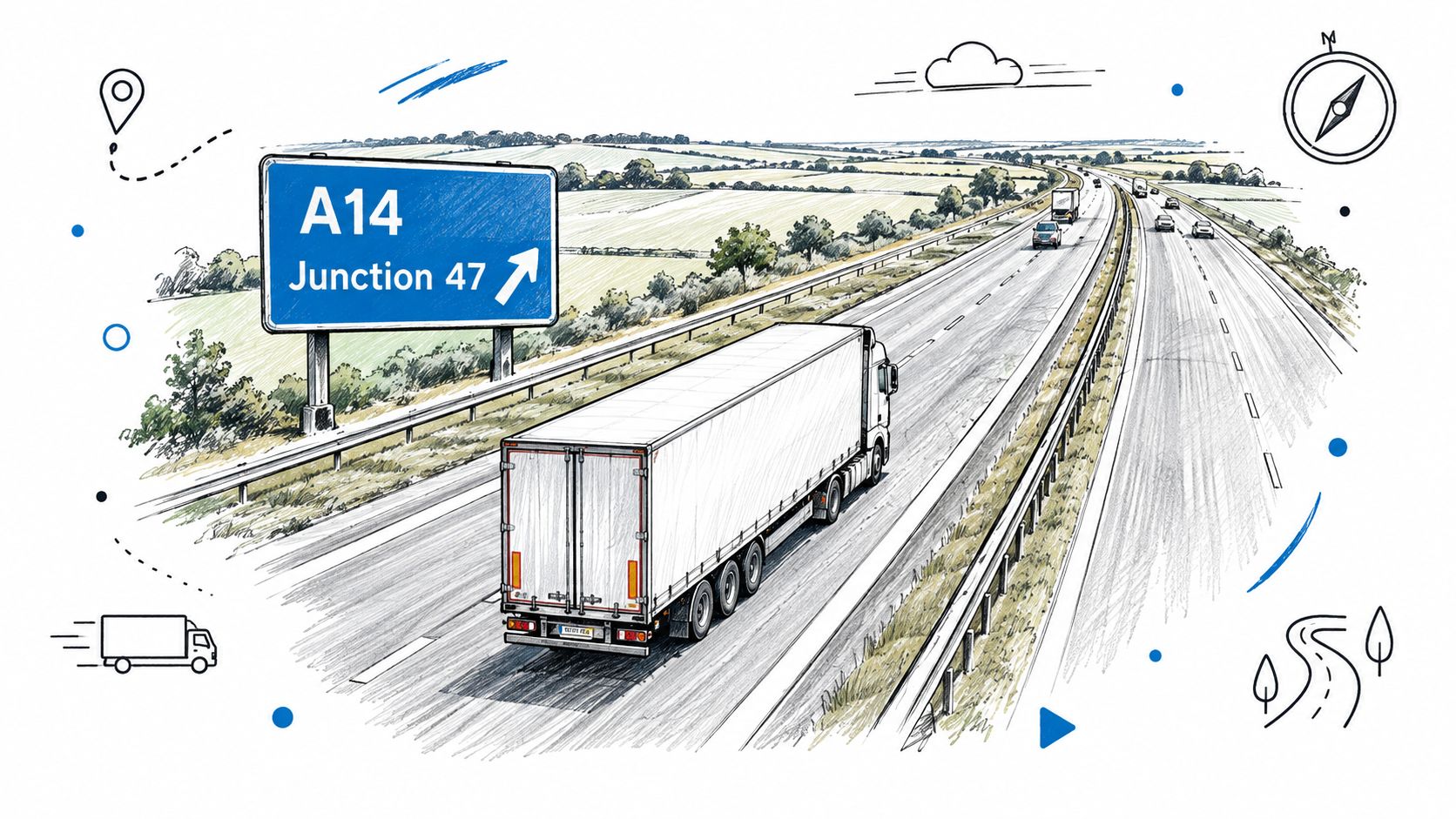
Workshop location affects recovery distance, technician response and how easily planned work fits the vehicle's normal operating pattern. Woolpit, near Elmswell and A14 Junction 47, supports movements involving Newmarket, Bury St Edmunds, Stowmarket, Ipswich and Felixstowe, with coverage across Suffolk and into Essex and Norfolk.
The A14 links the Midlands, East Anglia and the Port of Felixstowe. Workshop bases along the corridor between Bury St Edmunds and Ipswich therefore sit on a main freight route, rather than serving only local traffic. For an operator, that can shorten the gap between a reported defect and a practical inspection or recovery decision, subject to technician and recovery availability.

Freight density changes the downtime calculation
HGV traffic typically reaches 2,500 to 3,000 vehicles per day in each direction along much of the A14 corridor. The busiest sections between Cambridge and Huntingdon and around Ipswich rise to about 5,000 HGVs per day per direction, while the core A14/M11 to Huntingdon section recorded 11,000 HGVs eastbound and 9,500 westbound. These figures appear in the BBC's coverage of the A14 freight corridor.
Those volumes change the cost of an uncertain decision. A vehicle stopped near Newmarket may be part of a trunk movement to Suffolk, the Midlands or Felixstowe, or a return journey through East Anglia. Continuing with an unresolved brake, tyre or steering concern creates a roadworthiness risk. Recovering too early can protect safety but add delay and cost, so the first assessment needs to be clear.
Planned work protects the route plan
A workshop close to the routes vehicles already use makes it easier to schedule inspection, brake testing or remedial work around a depot movement. That can avoid an additional empty journey and reduce the chance that a planned repair becomes an emergency callout.
Operators can use the Newmarket HGV repair and workshop area page when arranging support for vehicles between Newmarket and the wider Suffolk freight network. The practical question is whether the vehicle can reach the workshop safely, or whether recovery is the correct decision. That judgement protects uptime without treating roadworthiness as a scheduling preference.
Key Services That Keep HGVs Roadworthy and Compliant
The right service depends on the risk presented by the defect. A warning lamp needs a different response from a damaged tyre, and a brake concern needs a measured performance test rather than reassurance based on appearance.
Inspections and PMI support
HGV safety inspection intervals normally range from 4 to 13 weeks, with many general haulage operators using a six-week cycle, according to the guidance summarised in this HGV safety inspection explanation. The interval should reflect vehicle age, mileage, operating conditions, defect history and the type of work being performed.
A good PMI process records what was found, what was repaired, what needs monitoring and when the next inspection is due. It gives transport managers a usable maintenance history instead of a collection of informal driver comments.
Brake testing and loading
DVSA expects HGVs and trailers to be brake-tested at least four times per year, including the annual test, and recommends loading the vehicle to at least 65% of its total maximum weight for a roller brake test. The loading requirement matters because an under-laden test may hide reduced braking force or axle imbalance that appears when the vehicle operates at a realistic mass, as explained in the DVSA guidance on HGV and trailer brake test reports.
The heavy vehicle brake test guide also states that the vehicle should be fully loaded where possible and that an Authorised Test Facility normally expects at least 65% of design axle weight before MOT testing. Where load simulators can't be positioned above rear axles, the vehicle or trailer must be presented laden unless its design provides an exemption. The DVSA heavy vehicle brake test best-practice guide sets out that presentation principle.
Diagnostics and repair selection
Commercial diagnostics should identify the system and likely cause before a repair is authorised. Electronic and emissions faults can affect drivability, warning status and test preparation, while mechanical truck and trailer repairs address the physical defect once the diagnosis is clear.
For route planning and fleet visibility, operators may also find OnRoute's truck GPS review useful background when assessing how drivers communicate locations and incidents. That information can make a callout more efficient, but it doesn't replace a roadworthiness assessment.
A practical service request
When booking, the operator should state whether the request concerns:
- Prevention: PMI, safety inspection or scheduled fleet maintenance.
- Measurement: Roller brake testing or confirmation of braking performance.
- Diagnosis: Electronic, engine or emissions fault investigation.
- Correction: Truck, HGV or trailer mechanical repair.
- Preparation: Remedial work and MOT presentation support.
- Immediate assistance: Tyre support, callout or recovery, subject to availability.
How Booking Diagnostics and MOT Preparation Work in Practice
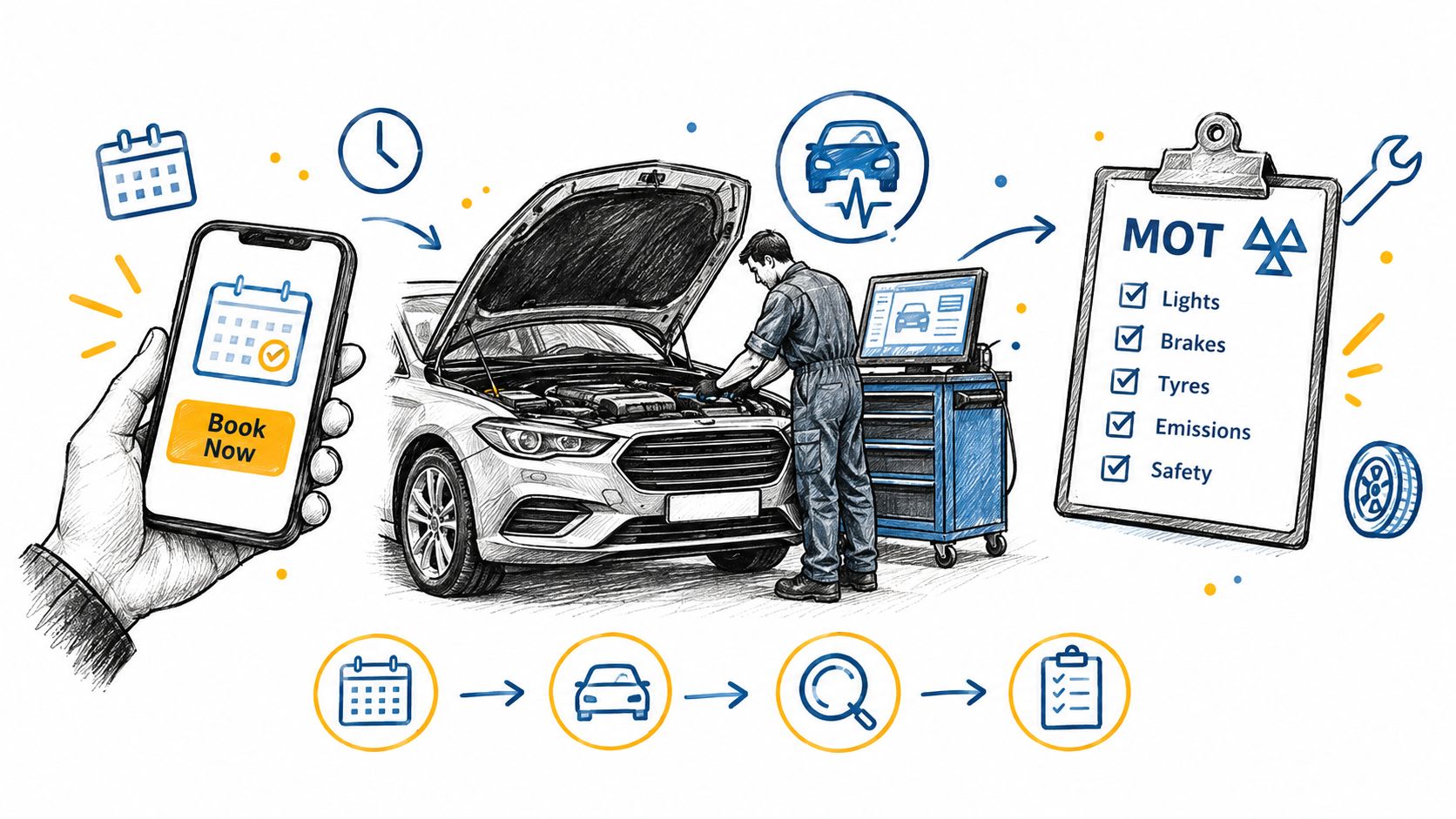
A productive booking starts before the vehicle reaches the workshop. The transport manager or driver should provide the registration or fleet identifier, trailer details, current location, load status, warning messages, symptoms, recent work and any known inspection deadline.
That information helps the workshop assess whether the vehicle should travel in, whether a callout is more suitable or whether recovery is safer. It also allows the repair team to prepare for the vehicle type and the reported system.
From symptoms to a repair decision
Diagnostics should follow the evidence. A warning lamp may identify a system but not prove which component has failed, so the technician checks fault information alongside the vehicle's symptoms, condition and maintenance history.
For brake work, the operator should confirm how the vehicle will be presented. A roller test is most useful when the HGV or trailer is loaded appropriately, because tyre-to-roller grip improves under load and braking performance can differ from an under-laden result. The workshop can then assess force, efficiency, imbalance and signs of binding rather than relying on a visual check.
Operators arranging commercial fault investigation can use the HGV diagnostics service information for Suffolk when deciding what details to provide at booking.
Preparing for the annual test
MOT preparation isn't the same as guaranteeing a pass. It involves checking likely failure areas, addressing recorded defects, confirming that brake testing and loading arrangements are suitable, and presenting the vehicle at the correct test facility.
DVSA commercial vehicle testing data for April to June 2026 reported an overall initial HGV MOT failure rate of 10.32%. The rate was 16.55% for single-vehicle operators and 3.61% for fleets with more than 101 vehicles, according to the published data discussed by Hutchinson Transport. The difference indicates how consistent inspection and repair processes can influence first-time presentation outcomes, although every vehicle still needs an individual assessment.
Authorisation and release
A clear repair process separates the reported symptom, confirmed defect, recommended work and any further observation. The operator should understand what work is urgent, what can be planned and whether additional defects were found during inspection.
Turnaround and cost depend on the diagnosis, vehicle condition, parts and workshop workload. No responsible provider should promise a fixed result before inspecting the vehicle. Once work is complete, the fleet record should show the repair and any follow-up inspection or brake test requirement.
Roadside Triage Recovery and Getting Back on the Road
A roadside decision starts with three questions: is the vehicle safe where it has stopped, can the fault be repaired without adding risk, and should the vehicle go to a workshop? On the A14 corridor, the answer depends on the load, road position, weather, traffic and defect type.
Take a tractor unit near the A14/A142 corridor showing an electrical warning and reduced ancillary function, with no change in braking, steering, temperature or air pressure. Once the driver has stopped safely, the warning details and exact location can guide the response. If the fault can be diagnosed and repaired without affecting roadworthiness, a callout may return the vehicle to work without moving the load.
That decision still requires a record and follow-up. A temporary roadside repair should not replace a workshop inspection where the underlying cause remains uncertain.

When recovery is the better decision
A loaded trailer with damaged tyres, suspected brake defects, major air loss, steering problems, smoke, overheating or unstable handling should be recovered rather than kept on a freight route. A vehicle that can move is not necessarily safe to continue.
Tyre defects are a recurring cause of roadside concern. Tyre condition appeared in 7.97% of vehicles inspected in April to June 2025, while HGV annual-test tyre failures were 3.77% in the same period, according to roadside and operator-premises information. The figures do not decide an individual case, but they show why a suspected tyre defect needs prompt assessment rather than casual deferral.
A recovery request should include:
- Exact location: Road, direction, junction, lay-by or safe stopping point.
- Vehicle combination: Tractor, rigid, artic, trailer type and registration details.
- Load information: Whether the vehicle is loaded, its approximate operating condition and any special handling concerns.
- Fault symptoms: Warning lamps, air pressure, brakes, tyres, steering, temperature and visible damage.
- Safety status: Whether the vehicle is secure, accessible and able to move without worsening the defect.
Recovery to a specialist workshop near Woolpit allows a controlled inspection and repair after the vehicle leaves the live route. Where required, the workshop can also arrange a brake test and record the repair before release. Guidance on choosing between roadside assistance and workshop movement is available in truck recovery services in Suffolk.
Book HGV Repairs Near Newmarket With Woolpit Truck Repairs
For operators using the Newmarket section of the A14, repair planning should combine fast triage with disciplined maintenance. A warning lamp, brake concern or tyre defect needs an evidence-based decision, not an assumption that the vehicle can complete the next leg. PMI, recorded inspections, properly loaded brake testing and timely diagnostics reduce the chance that a scheduled movement becomes an emergency recovery.
Woolpit Truck Repairs operates from Woolpit near Elmswell and A14 Junction 47, supporting HGVs, trucks and trailers serving Newmarket, Bury St Edmunds, Stowmarket, Ipswich, Felixstowe and the wider Suffolk network, with relevant coverage into Essex and Norfolk. Services include HGV and trailer inspections and PMI support, roller brake testing, commercial diagnostics, truck and trailer repairs, tyre support, air-conditioning re-gas, planned fleet maintenance, MOT preparation and presentation support, callouts and recovery subject to availability.
The workshop is for commercial HGVs, trucks and trailers only. It doesn't service cars or unrelated light vehicles, and it isn't an MOT test station. Operators can request the appropriate inspection, repair or presentation support based on the vehicle's actual defect and operating requirements.
Transport managers, haulage businesses and owner-drivers can contact Woolpit Truck Repairs to discuss HGV or trailer inspections, diagnostics, repairs, roller brake testing, MOT preparation, planned maintenance or callout support near Newmarket. Provide the vehicle location, load status and fault details when requesting a booking so the safest route back to work can be assessed promptly.