A driver heading south on the A14 towards the Copdock interchange notices the cab cooling has gone flat. Within minutes, the windscreen starts misting, the demist setting struggles to clear it and warm air is blowing through the vents while low sun catches the glass near Ipswich. The vehicle may still move, but the driver is working harder to maintain a clear view and a tolerable cab temperature.
That situation is familiar across Suffolk, particularly on long runs using the A14 and A12 or rural routes around Bury St Edmunds, Stowmarket and Newmarket. HGV aircon regas Suffolk operators need isn't just a comfort top-up. Proper air conditioning maintenance supports driver welfare, demisting and defect prevention. A vehicle that repeatedly loses refrigerant shouldn't be sent back out after another blind refill. It needs a proper diagnosis, a documented repair where required and a controlled recharge.
Table of Contents
- Why HGV Aircon Matters on Suffolk Roads
- What an HGV Aircon Regas Actually Involves
- UK F-Gas and Refrigerant Handling Compliance
- When an HGV Genuinely Needs a Regas
- HGV Aircon Scenarios Across Suffolk Fleets
- Cost, Downtime and Planning a Regas
- Aircon Regas as Part of Planned Fleet Maintenance
- Booking HGV Aircon Regas at Woolpit Truck Repairs
Why HGV Aircon Matters on Suffolk Roads
Cab air conditioning affects more than temperature. A driver dealing with excessive heat, poor airflow or a misted windscreen can become distracted while trying to adjust controls, wipe glass or find a workable ventilation setting. In winter, a weak system can also leave the demist function unable to deal with moisture quickly enough, particularly after a loaded vehicle has been parked overnight.
For transport managers, the operational issue is straightforward. An HGV may be scheduled for a long A14 trunk, a Felixstowe collection or a sequence of local deliveries around Suffolk. If the driver reports that the cooling has failed at the start of the shift, delaying the vehicle for diagnosis may be inconvenient. Sending it out with a known fault can create a more serious problem if visibility deteriorates or the driver can't work safely.
The defect often appears before the breakdown
Aircon faults usually give warning. The cab might take longer to cool, the airflow may weaken at idle, or the compressor may cycle irregularly. A driver may report that the system works on the first leg but fades during a motorway run. Those details matter because they help a workshop separate low refrigerant from condenser airflow problems, electrical faults, compressor issues or a blocked cabin filter.
A seasonal reduction in performance doesn't automatically prove that a regas is required. Refrigerant doesn't get used up like fuel. If a system has lost enough charge to stop cooling properly, the workshop should investigate where the refrigerant went and whether another component is failing.
Workshop rule: A warm cab is a symptom, not a diagnosis. The correct repair depends on pressure readings, leak evidence and the condition of the complete system.
Suffolk routes expose weak systems
High-mileage vehicles working between Ipswich, Felixstowe and the wider East Anglia distribution network place repeated demands on their cab systems. Long engine-running periods, frequent depot stops and exposure to road dirt can all reveal weaknesses that remain unnoticed on shorter journeys.
That makes air conditioning a sensible item to raise during HGV inspections, planned fleet maintenance and driver defect reviews. It can be dealt with alongside truck diagnostics, trailer repairs, tyre support, roller brake testing or MOT preparation and presentation support, rather than becoming an unplanned roadside disruption in hot or damp weather.
What an HGV Aircon Regas Actually Involves
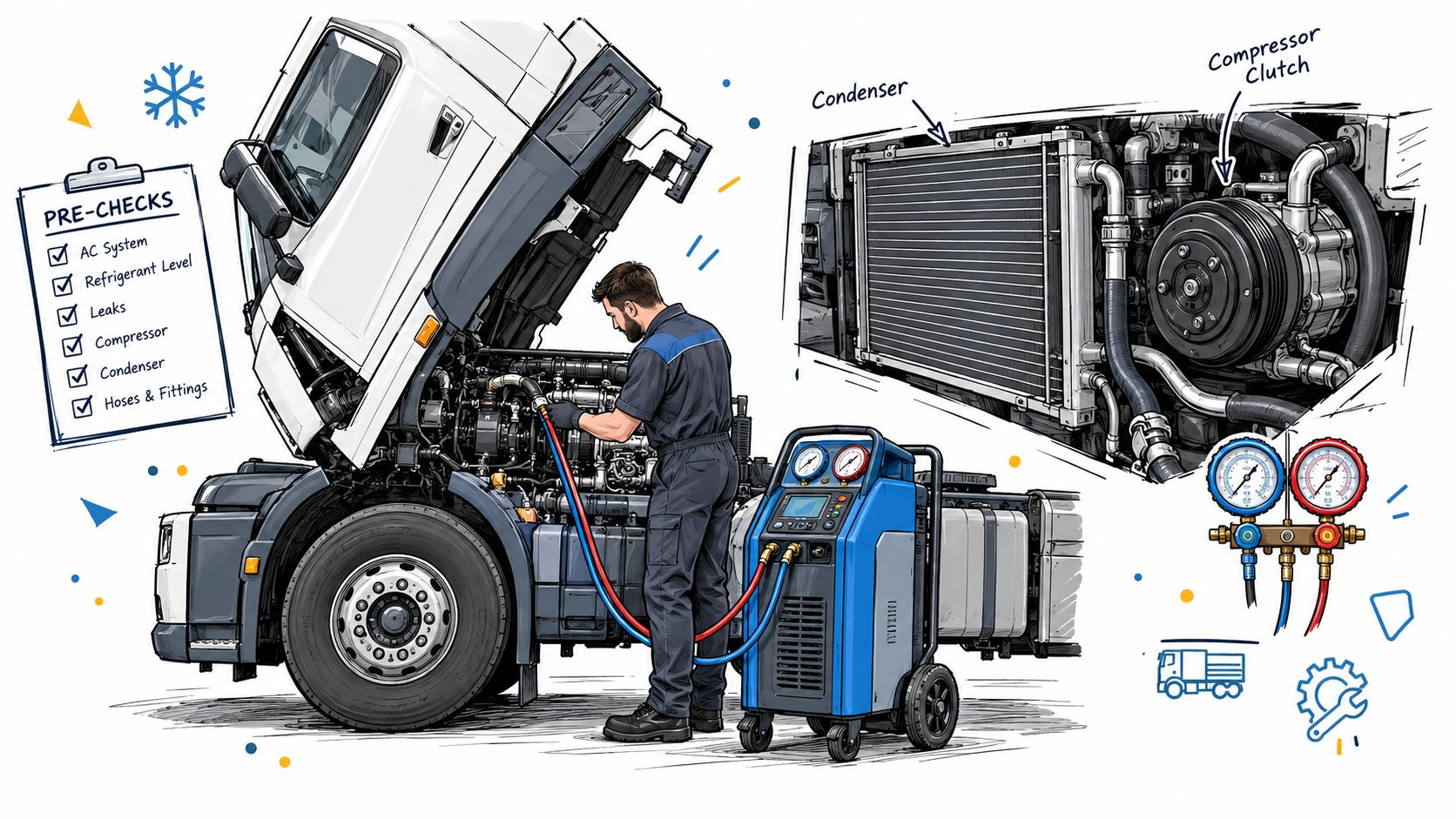
A proper regas begins before the recovery machine is connected. The technician should inspect the hoses, condenser, compressor clutch, drive belt area and cabin filter, then check the vehicle's repair history. Repeated entries for gas additions are an important warning because they suggest a leak or an unresolved system fault.
The old refrigerant must be recovered rather than vented. UK guidance requires controlled recovery and qualified handling, and a proper recharge involves recovering the existing charge, pressure-testing for leaks, evacuating moisture and refilling by weight to the manufacturer's specification. UK vehicle air-conditioning guidance also explains why a weighed recharge and function test are preferable to a pressure-based top-up.
The workshop sequence
Pre-checks identify the likely fault. The technician checks visible pipework, condenser condition, compressor engagement, airflow and the cabin filter. The driver's description of when the fault appears can be as useful as a gauge reading.
Recovery removes the existing charge. A certified F-gas machine draws out refrigerant and associated oil so the system can be handled without deliberate release. The recovered quantity can also show whether the system was significantly undercharged.
Evacuation removes air and moisture. A deep vacuum prepares the circuit for charging. Moisture left in the system can affect operation and contribute to longer-term component problems.
Leak testing checks whether the circuit holds. A vacuum hold test may be followed by an electronic search around joints, hoses, the condenser, compressor and evaporator area. If abnormal leakage is suspected, refill must wait until the cause has been addressed.
Measured charging restores the specified amount. Refrigerant, commonly R134a or R1234yf depending on the vehicle, is added by weight. The oil balance must also be considered, particularly after component replacement.
Function testing confirms the result. The technician checks pressures at idle and raised engine speed, compressor operation and outlet temperature at the dashboard vents.
The same practical discipline appears in other workshop planning decisions. For managers organising temperature-controlled or storage operations, this pallet rack for warehouse managers resource offers useful context on keeping warehouse systems organised around equipment and access.
UK F-Gas and Refrigerant Handling Compliance
The rules governing vehicle refrigerant handling have applied tightly in the UK since 7 September 2009, when the Motor Vehicles (Refilling of Air Conditioning Systems by Service Providers) Regulations 2009 came into force. Those rules prohibit a service provider from refilling a system where an abnormal amount of refrigerant has leaked until the repair is completed. They also sit alongside wider F-gas controls requiring refrigerant recovery during servicing and dismantling. The 2009 regulations set out the legal basis.
The distinction between a tractor cab system and a trailer transport refrigeration unit matters. A cab system manages the driver's environment. A fridge unit protects the load and may have different charge sizes, inspection obligations and records. Treating both as an ordinary aircon top-up can leave the operator with incomplete maintenance evidence and the wrong technician for the work.
Two systems, different compliance considerations
Area HGV Cab Aircon Trailer Transport Refrigeration Primary purpose Driver comfort and windscreen demisting Maintaining temperature-controlled freight Handling Refrigerant must be recovered and refilled by suitably qualified personnel Specialist recovery, leak checking and record keeping apply Leak response Abnormal leakage must be repaired before refilling Leak checks and documented maintenance depend on the system charge and applicable F-gas rules Records Keep the refrigerant label, work details and defect history with the vehicle file Operators must retain equipment records for at least 5 years under the applicable rules, as described by the F-gas register guidance Planning Combine with inspections, diagnostics or planned repairs Coordinate with trailer maintenance and load-protection checksFor refrigerated trucks and trailers, mandatory leak checks apply from 1 January 2015 for systems containing more than 3 kg of refrigerant, and from 1 January 2017 for smaller systems below 3 kg but above 5 tonnes CO2e. From 1 January 2020, use of F-gases with a GWP above 2,500 for maintaining transport refrigeration systems with a charge size of 40 tonnes CO2e or more was prohibited. These thresholds and dates are set out in the linked guidance.
The environmental consequence is also material. R134a has a GWP of 1,430, and 1 kg of R134a equates to about 1.43 tonnes CO2e, according to the UK government's MAC F-gas obligations guidance. Illegal venting, undocumented work and repeated refilling expose an operator to compliance, insurance and operational risk. The vehicle file should show what was recovered, what was added and whether a leak was found, particularly when the truck later receives PMI or MOT preparation support.
Further guidance confirms that refrigerant must be recovered from refrigeration systems in trucks and trailers, rather than released during servicing or dismantling. GOV.UK recovery guidance and NetRegs vehicle air-conditioning guidance both support the practical position. A system that keeps losing gas needs fault-finding before another refill.
For broader workshop planning, operators can also review truck air-conditioning regas guidance alongside their vehicle maintenance records.
When an HGV Genuinely Needs a Regas
The strongest reason to book a regas is a measured loss of refrigerant combined with evidence that the rest of the circuit is serviceable. Driver reports still provide the starting point, but warm air by itself doesn't prove that low charge is the cause.
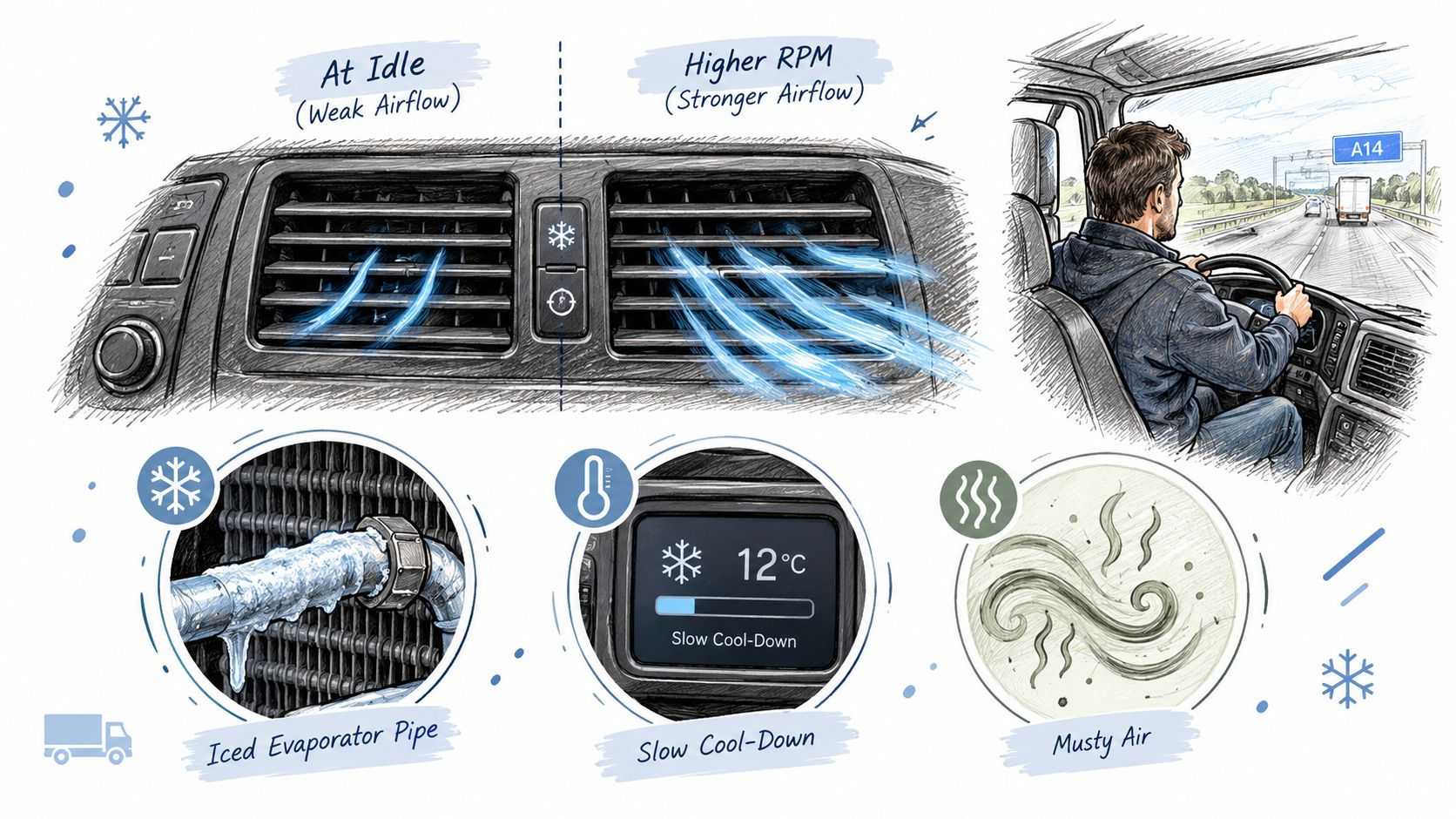
Common reports include weak cooling at idle, a cab that takes too long to cool after a delivery stop, intermittent compressor engagement and poor performance during a long A14 run. Some drivers notice ice forming on a pipe or evaporator area, while others report musty smells after using the system. Each symptom points towards a different line of investigation.
Symptoms that deserve inspection
- Cooling fades at idle: The workshop should check charge, condenser airflow, compressor performance and engine-speed behaviour.
- Airflow is weak: A restricted cabin filter, blower fault or evaporator contamination may be more likely than low refrigerant.
- The system cuts in and out: Electrical controls, pressure protection or compressor clutch operation need checking.
- The cab smells musty: Moisture, contamination or drainage issues may need attention, rather than refrigerant.
- Cooling disappears suddenly: A leak, damaged hose, failed seal or electrical fault should be considered before charging.
A competent inspection includes system pressures, condenser airflow, receiver-drier condition and an electronic leak search. Where the system has suffered abnormal leakage, HGV air-conditioning fault diagnosis guidance should be treated as a repair process, not a reason to add gas immediately.
Diagnosis beats the seasonal top-up
A system that has gradually lost cooling may need a recharge after a leak test confirms that the circuit is sound. A system that empties repeatedly needs a repair. Repeated top-ups waste refrigerant, increase the chance of compressor strain and create a pattern that becomes more expensive as seals, hoses or major components deteriorate.
Undercharging can reduce evaporator pressure and cooling capacity. Overcharging can raise head pressure and compressor load, so charging by weight to the manufacturer's specification matters. The sensible trigger is a driver complaint or inspection finding, followed by evidence from the workshop, not an automatic annual calendar booking.
HGV Aircon Scenarios Across Suffolk Fleets
A regas decision changes with the vehicle's work. The following situations are representative of the questions raised by Suffolk operators, not fixed diagnoses.
Felixstowe port fridge trailer
A tractor unit collecting a refrigerated trailer from Felixstowe may arrive with a driver focused on the load temperature and refrigeration unit. The cab system can be neglected because the trailer equipment appears to be the urgent priority.
If the cab cooling is weak but still operating, a system check during the tractor's next planned visit is sensible. The cab and trailer systems must be treated separately. A regas may be appropriate after recovery and leak testing, but a condenser blocked with road debris or a compressor control fault needs a different repair.
Ipswich to Birmingham trunking
A regional tractor unit working a repeated Ipswich to Birmingham route spends long periods at motorway speed and may run the cab system through much of the year. The driver might report cooling that fades after several hours, poor performance when stationary or intermittent compressor cycling.
Here, the first move should be a documented diagnostic check. If the charge is low and no abnormal leak is found, a weighed recharge may restore service. If the charge has fallen sharply or the system has been refilled before, the workshop should search for a leak and quote for the repair before returning the vehicle to trunking.
Multi-drop rigid around Stowmarket and Bury St Edmunds
An owner-driver operating a rigid vehicle around Stowmarket, Bury St Edmunds and Sudbury may notice intermittent cooling but need to control workshop spend carefully. Shorter routes can make the fault seem less urgent, yet repeated stops and cab entry can make heat and demisting problems more noticeable.
A check may be enough if the system works consistently and the complaint points to airflow or a control issue. If the charge is low, a regas can be part of the repair, but the operator should still ask what evidence supports adding refrigerant. The cheapest immediate option isn't always the lowest-cost decision if it creates another visit.

Across all three examples, driver feedback should be recorded with the vehicle defect history. Route, engine-speed and weather details can help the technician reproduce an intermittent fault instead of treating every complaint as low gas.
Cost, Downtime and Planning a Regas
No responsible workshop should quote a fixed HGV regas price without knowing the vehicle, refrigerant, charge quantity and system condition. The cost can change according to whether the truck uses R134a or R1234yf, how much refrigerant the system requires by weight, whether leak detection is needed and whether repairs or replacement components are found.
A straightforward cab recharge on a single-evaporator tractor unit is usually a short workshop job and may fit within a working day. Multi-evaporator sleeper cabs, access issues, additional heating equipment and an identified leak can extend the visit. The important distinction is between a controlled recharge and a repair that happens to include a recharge.
What changes the invoice
Factor Effect on Cost and Downtime Refrigerant type The specified gas and required handling affect the service cost Refrigerant quantity A larger charge requires more refrigerant by weight Leak diagnosis Electronic testing and follow-up investigation add workshop time Hose, seal or condenser fault Parts availability and repair complexity can extend the booking Multi-evaporator cab More circuits and access points can increase testing time Existing planned work Combining jobs can reduce duplicated vehicle movements and waiting Recovery or callout requirement Availability, location and vehicle access affect the practical arrangementQuestions to ask before booking
A transport manager should ask whether the quote includes recovery of the existing charge, vacuum evacuation, leak testing, a weighed refill and a function test. The workshop should also confirm what happens if an abnormal leak is found, because the vehicle may need a repair before refrigerant can legally be added.
The cheapest quote can become the most expensive option if it skips evacuation, charges by pressure alone or sends the vehicle out without establishing why the gas was lost. A written record of recovered and added refrigerant gives the operator a clearer maintenance history and helps identify repeat leakage across the fleet.
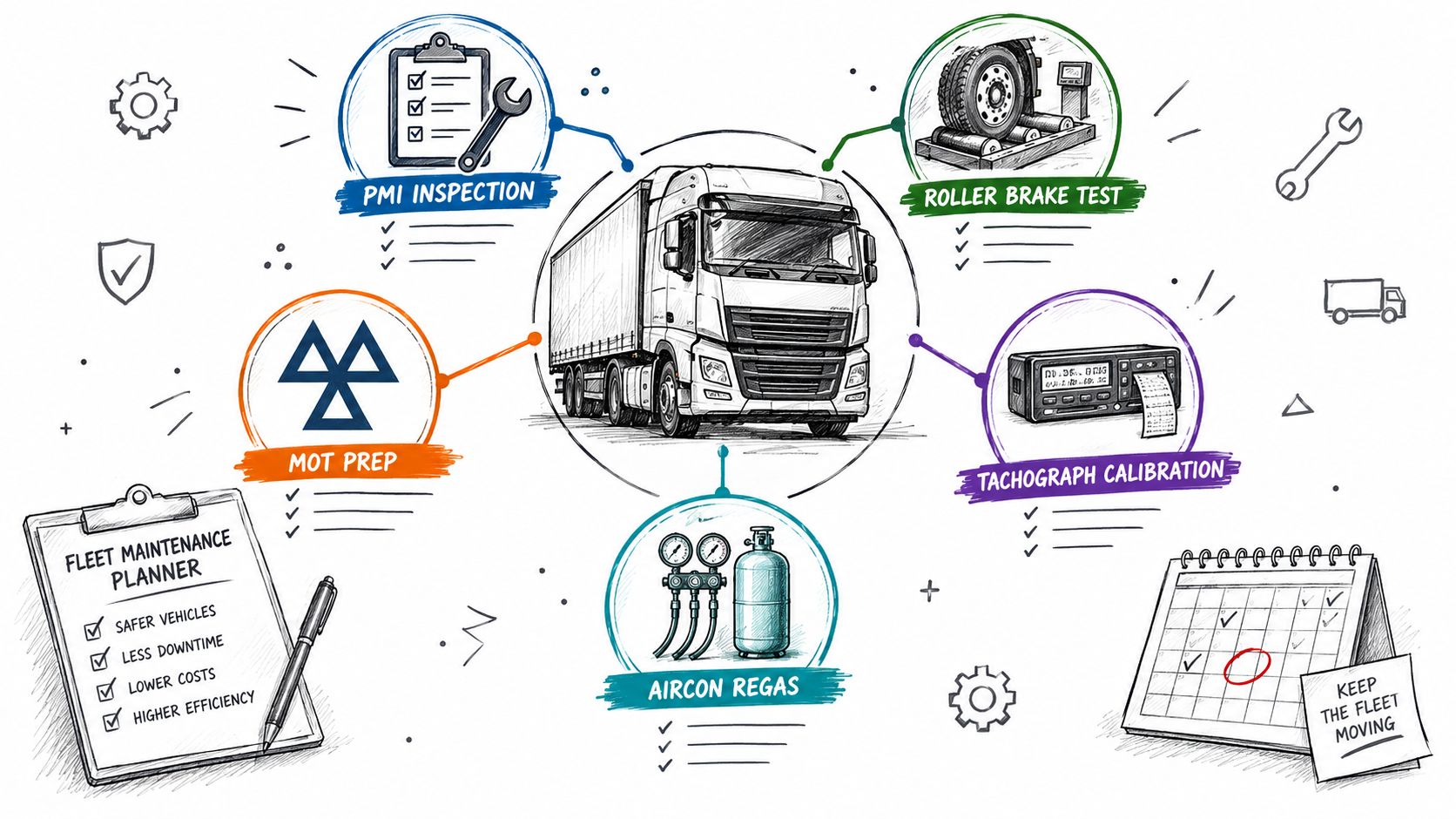
Planned scheduling offers the simplest downtime saving. A regas can be considered during an existing PMI visit, a roller brake test appointment, truck diagnostics, trailer repairs or MOT preparation and presentation support. The vehicle then spends one planned period off the road rather than returning for separate comfort-related work later.
Aircon Regas as Part of Planned Fleet Maintenance
Air conditioning belongs on the same maintenance conversation as inspections, brakes, tyres, steering, lighting and defect rectification. It isn't normally a roadworthiness test item by itself, but poor cooling or demisting can affect driver welfare, visibility and the likelihood of a defect being reported before a vehicle leaves the depot.
A transport manager can add a simple aircon prompt to the planned maintenance checklist. The technician records the driver complaint, checks the system condition and notes whether the vehicle received a recharge, leak repair or no refrigerant work. This approach turns an informal seasonal complaint into traceable fleet information.
Use one workshop window properly
A vehicle already booked for a PMI inspection or trailer repair can be assessed for cab cooling while it is on site. The same visit may include a roller brake test, commercial diagnostics, tyre support or MOT preparation and presentation support, subject to the workshop's scope and scheduling.
DVSA maintenance guidance says roller brake testing should be strongly considered at each safety inspection, with the printout attached to the safety inspection record. It also says testing should be undertaken in a laden condition where possible, and that a laden measured brake efficiency test is needed when rectification isn't obvious before the vehicle or trailer is regarded as roadworthy. The DVSA guide to maintaining roadworthiness provides the relevant maintenance context.
Aircon records should sit alongside those wider documents. Useful entries include the date, refrigerant recovered, refrigerant added, leak-test result and any component recommendation. A pattern of repeated losses then becomes visible before the operator wastes more refrigerant or faces a compressor failure on the A14, A12 or rural Suffolk routes.
The same planning principle applies to mixed fleets operating through Essex and Norfolk. A clear defect reporting route, scheduled inspections and sensible authorisation process help the transport manager decide whether a vehicle needs a recharge, a repair or a wider diagnostic visit.
Booking HGV Aircon Regas at Woolpit Truck Repairs
Before calling a specialist commercial workshop, the operator should gather the vehicle registration, make and model, cab type and any information about a separate fridge system. The most useful symptom is specific: weak cooling at idle, intermittent operation, poor demisting, unusual compressor noise, water pooling or cooling that disappears after a long run.
The last known service or regas date also matters. If the vehicle has needed repeated gas additions, that history should be disclosed before the booking is accepted. It changes the job from a routine recharge request to a likely leak-diagnosis appointment.
Details that make the booking efficient
- Vehicle identity: Provide the registration, make, model and whether the vehicle is a tractor unit, rigid or trailer.
- System type: Clarify whether the request concerns cab air conditioning or transport refrigeration equipment.
- Driver evidence: Note when the fault appears, whether airflow changes with engine speed and whether the windscreen demist is affected.
- Existing workshop work: Say whether the vehicle is already due for PMI support, brake testing, diagnostics, repairs, tyre support or MOT preparation.
- Location and urgency: For a vehicle stopped on the road, provide the precise location, safe access information and whether callout or recovery is required.
Woolpit Truck Repairs operates as a specialist workshop for HGVs, trucks and trailers in Woolpit near Elmswell and A14 Junction 47. The workshop's HGV air-conditioning re-gas service can be considered alongside planned fleet maintenance, inspections, roller brake testing, truck and trailer repairs, diagnostics and MOT preparation and presentation support.
Operators should ask directly whether the work includes refrigerant recovery, leak diagnosis, evacuation, charging by weight and a recorded function test. They should also confirm the process if an abnormal leak is found, because adding gas without repairing that fault isn't a proper resolution.
Callouts and recovery are subject to availability. For Suffolk operators near Woolpit, Elmswell, Bury St Edmunds, Stowmarket, Ipswich and Felixstowe, with relevant coverage into Essex and Norfolk, the practical route is to discuss the vehicle and symptoms before sending it in. A suitable booking can then combine aircon work with other scheduled maintenance where the workshop timetable allows.
Woolpit Truck Repairs provides HGV and trailer air-conditioning re-gas, diagnosis, inspections, roller brake testing, commercial repairs and MOT preparation support for operators across Suffolk, Essex and Norfolk. Contact the workshop to arrange a diagnosis-led booking and reduce the chance of repeat downtime. Visit Woolpit Truck Repairs to request a slot.