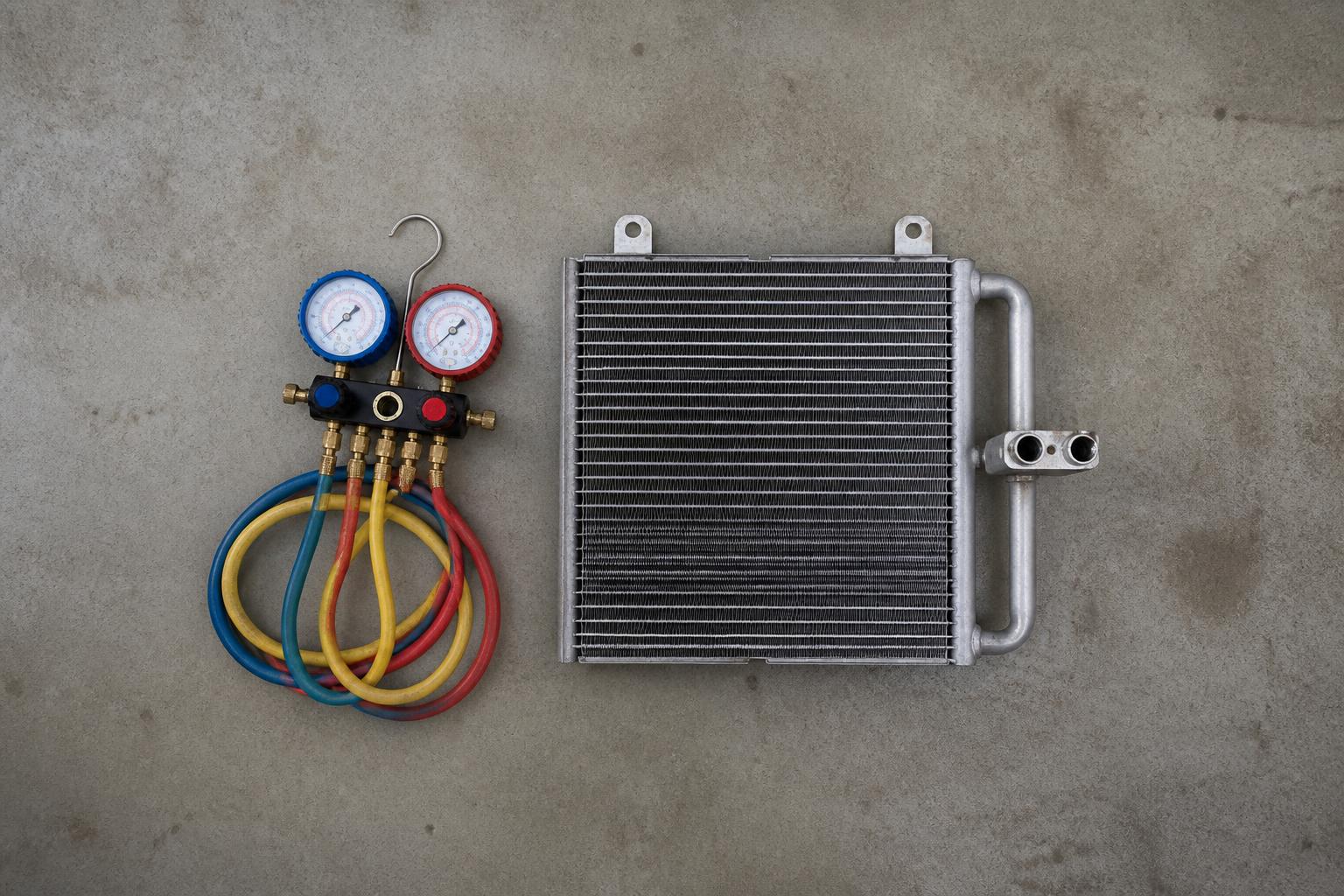
Weak cab cooling does not automatically mean an HGV needs an air con re-gas. A re-gas is the right next step when the system is undercharged and the rest of the circuit is still doing its job. If refrigerant level has dropped over time, cooling performance falls away, the cab takes longer to pull down, and the system may cycle poorly. In that situation, restoring the correct charge can bring it back.
If the real fault is elsewhere, a top-up will not solve it. Leaks, compressor faults, pressure sensor issues, blocked condensers, fan problems, electrical defects and control faults can all produce the same complaint from the driver, “the air con isn’t cold”. That is why we treat HGV air conditioning as a workshop diagnosis first, not just a quick refill. For operators looking for truck air con regas in Suffolk, that distinction matters because the wrong booking wastes time and moves the vehicle no closer to a fix.
What a re-gas actually fixes on an HGV
An HGV air con re-gas means recovering any remaining refrigerant, checking the system condition, then recharging it to the correct specification and weight for that vehicle, with the right oil balance as required by the equipment and manufacturer data. In simple terms, we return the refrigerant charge to where it should be, if low charge is the actual problem.
Air conditioning does not consume refrigerant in normal use like fuel or AdBlue. But systems can lose a small amount over time through seals, joints and service connections. As charge level drops, the system loses its ability to move heat effectively. The first thing most drivers notice is weaker cooling, especially in traffic, on long summer runs, or when the cab has been parked in the sun. It may still blow cool-ish air, but not properly cold. Pull-down time gets longer. Window demist performance can also suffer because air con helps dry the air, not just cool it.
On a working system with low charge, a re-gas can be exactly the right next step. It restores the refrigerant quantity the system needs to circulate properly through the compressor, condenser, expansion device and evaporator. Once the charge is back to spec, vent temperature and system behaviour often return to normal.
What it does not do is repair a failed component. If the compressor clutch is not engaging, if the variable displacement compressor is not controlling correctly, if the condenser fan is not running, or if the system has a significant leak, refrigerant alone will not change that. The same applies if a pressure switch or sensor is reporting incorrectly, if wiring faults are preventing operation, or if a blocked condenser is causing poor heat rejection.
That is the practical point operators need. A re-gas fixes low refrigerant charge. It does not fix every air con complaint. If we assess the system and find another defect, we say so clearly and move to the real next step.
Signs your truck needs more than a top-up
There is a difference between gradual loss of performance and a fault that points to something more than low charge.
A typical undercharged system often shows a steady decline. The driver may say it was “never as cold this year as last year”, or that it cools on the move but struggles when stationary. The system may still operate, but not well. There may be no unusual noises, no obvious warning lamps, and no sudden change.
By contrast, some symptoms point away from a simple re-gas.
If cooling stopped suddenly, think fault before top-up. A sudden complete loss can indicate an electrical issue, a failed compressor clutch, a blown fuse, a relay problem, a pressure sensor issue, or a control head fault. On modern HGVs, system logic may also inhibit compressor operation if pressure readings are out of range.
If the compressor is noisy, seizing, or repeatedly cutting in and out, low charge may be part of the picture, but it is unlikely to be the whole story. Mechanical compressor issues need diagnosis before any decision to recharge.
If there are visible signs of refrigerant oil around pipe joints, hose crimps, the condenser, compressor body or service ports, suspect a leak. Refrigerant leaks often leave an oily residue because compressor oil travels with the gas. A system with an active leak may accept a charge and cool briefly, but it will not stay right.
If system pressure is poor or unstable, that matters too. High side and low side readings tell us far more than the cab complaint alone. Incorrect pressures can point to undercharge, overcharge, restriction, fan failure, condenser inefficiency or compressor weakness. This is why pressure readings and operating behaviour matter more than assumptions.
If several vehicles in a fleet are showing the same issue, especially same make and model, it may still be low charge through age and use. But it can also suggest a common maintenance gap, a known model-related weakness, or operating conditions affecting condensers and airflow. Where one truck is affected and the rest are fine, we look harder at that vehicle’s own defect.
Electrical faults can overlap with other dash concerns. While air con issues do not automatically tie into brake electronics, operators know modern vehicles can present multiple warnings at once. If a truck is already booked for fault tracing, warning lights or communication issues involving ABS or EBS, it can make sense to deal with the air con complaint in the same workshop visit through proper HGV diagnostics and fault finding.
Checks operators can make before booking in
There are sensible checks a driver, owner-driver or fleet desk can make before booking air con work. These do not replace diagnosis, but they help narrow down whether the issue looks like weak performance or a more obvious fault.
First, check the basic controls. It sounds obvious, but mixed cab use, driver changes and unfamiliar hire or relief vehicles do create simple mistakes. Confirm the air con is actually switched on, temperature is set correctly, and the system is not in an economy mode that limits compressor operation. If the vehicle has climate control, check whether the complaint is in auto mode, manual mode, or both.
Next, check airflow from the vents. Strong airflow that is not cold points in a different direction from weak airflow. If airflow is poor, the problem may be cabin filter restriction, blower motor issues, flap motor faults, or blocked vents rather than refrigerant charge. A system cannot cool the cab properly if it cannot move enough air through it.
Look for warning signs when the air con is commanded on. Does the engine note change slightly when the system engages. Do condenser fans run where fitted. Is there any clicking, squealing or repeated cycling. Does the air become cooler at road speed but warm again in traffic. These details help us distinguish airflow and condenser issues from low charge.
Drivers can also make a visual check around the front end, if safe to do so. A condenser packed with dirt, insects or road debris cannot reject heat properly. On route work around Felixstowe, Ipswich, Stowmarket, Bury St Edmunds, Newmarket and local roads around Elmswell and Woolpit, front end contamination is not unusual. Bent fins, impact damage and heavy debris all affect performance.
For fleet desks, ask whether the fault is isolated or repeated across vehicles. If several trucks are reporting weak cooling after the same service interval or seasonal change, book them before the hot period becomes peak downtime season. If one unit alone has stopped cooling altogether, note whether there were any recent repairs at the front end, accident damage, belt issues or electrical faults.
Also note whether the complaint is comfort only, or whether demisting is affected. Air conditioning is part of visibility management as well as comfort. If the cab will not clear moisture properly, the issue is more operationally serious.
What operators should not do is attempt informal top-ups with passenger-car assumptions or guesswork. HGV systems need the correct refrigerant handling equipment, recovery process and charge quantity. In the UK, refrigerant handling is controlled work and should be done properly in the workshop.
What happens during an air con visit at the workshop
When an HGV comes to us for poor cooling, we start with the complaint and the vehicle details. We want to know what the driver is experiencing, whether the fault is constant or intermittent, and whether cooling has faded gradually or stopped suddenly. That saves time and often points us in the right direction before gauges are connected.
From there, we carry out an initial assessment. That includes visual checks of obvious system condition, service ports, pipework, condenser condition, belt drive where relevant, fan operation and any visible signs of leakage. We also confirm the controls are calling for air con operation and look for any related fault indications.
If the vehicle and symptoms suggest the system may simply be low on refrigerant, we move into the air conditioning service process. That means recovering the existing refrigerant, measuring what comes out, assessing whether the quantity recovered supports the low-charge theory, vacuum testing as appropriate within the service process, and recharging to the correct specification if the system condition allows it. This is the point at which a proper re-gas becomes the right next step, not before.
If the evidence points elsewhere, we do not pretend a charge will fix it. We diagnose the defect. That may mean pressure-related checks, electrical testing, compressor command verification, sensor checks, fan circuit checks or further leak investigation. If there is a fault beyond refrigerant level, we explain it plainly and tell you the realistic next step.
That practical triage matters more than a “yes or no” on a refill. Some vehicles arrive needing only a recharge. Others need leak repair before any recharge is worthwhile. Others again need component diagnosis because the system is not operating at all. Our job is to separate those cases quickly so you can make a commercial decision with clear information.
If you are comparing workshop options for a faulting commercial vehicle, the same principle applies beyond air con. We have set out that workshop-led approach in how to choose a Suffolk workshop for rigid truck faults. For air conditioning specifically, you can also see our HGV air conditioning re-gas support.
Where a vehicle is off-road rather than just uncomfortable, the booking decision changes. If the truck cannot continue or the defect sits alongside another breakdown issue, route support may be the first step rather than workshop attendance. In those cases, our commercial vehicle callout options may be more relevant.
When to book air con work to avoid downtime
The best time to deal with weak cooling is before it becomes a route problem. Once the weather turns hot, workshop demand rises and the same minor complaint becomes a driver issue across multiple vehicles at once. Booking early is usually simpler than reacting when every cab is already uncomfortable.
Cab comfort is not a soft issue on HGV work. Drivers spending long hours in stop-start traffic, urban drops, port work, trunking or night heating and day cooling cycles notice weak air con quickly. A cab that will not cool properly is harder to work in, more tiring on long shifts, and slower to demist when conditions change. Owner-drivers feel it directly. Fleet operators feel it through driver complaints, vehicle swaps and avoidable workshop pressure.
There is also a route planning point. If a unit based in Suffolk is regularly working the A14 corridor, or moving between Ipswich, Felixstowe, Stowmarket, Bury St Edmunds, Newmarket and surrounding areas, it makes sense to book air con work somewhere that does not drag the vehicle miles off route. We are at Bridge Farm in Woolpit, close to A14 J47, which is practical for operators moving across Suffolk rather than trying to squeeze workshop time into a more awkward detour.
That location matters when the truck is still usable but needs attention soon. A planned stop near A14 J47 is easier to manage than waiting until the complaint worsens and affects a committed run. For local operators in Woolpit, Elmswell and nearby areas, the same applies. Deal with weak cooling while it is still a scheduled workshop job, not after it starts affecting availability.
For fleets, seasonal planning helps. If a few vehicles are already showing reduced performance, do not assume the rest will be fine through the summer. Booking checks in phases can prevent several cabs developing the same issue at once. For owner-drivers, the decision is usually even simpler. If cooling is clearly fading, get it assessed before a hot week turns it into an avoidable problem.
At Woolpit Truck Repairs, we keep the advice straightforward. If the system is low on charge and otherwise healthy, an HGV air con re-gas is the right next step. If it has another defect, we tell you what it is and what comes next. That is the practical answer operators need when they are looking for truck air con regas in Suffolk, especially when the vehicle is working the A14 and time off the road has to be managed properly.
Woolpit Truck Repairs is part of FLEETA LIMITED, and our workshop focus stays where operators need it, on HGV and trailer faults, clear diagnosis and realistic next-step advice. If your cab cooling has dropped off and you need a sensible workshop assessment near A14 J47, we can help you decide whether it is a re-gas job or something more.
How do I know if my HGV only needs a re-gas?
If cooling has gradually weakened but the system still operates normally, low refrigerant may be the cause. If it has stopped suddenly, cycles badly or shows other faults, it may need diagnosis first.
Can a leaking air con system just be re-gassed?
It can be re-gassed, but that does not solve the leak. If refrigerant is escaping, the proper next step is to identify the fault and decide whether repair is worthwhile before repeating the job.
Does poor cab airflow mean the refrigerant is low?
Not always. Weak airflow can come from blower, control or blockage issues. Low refrigerant usually affects cooling temperature rather than how strongly air comes through the vents.
Is air con work worth doing outside summer?
Yes. A weak system is easier to deal with before hot weather and heavy route pressure. Sorting it early can reduce driver complaints and avoid avoidable downtime later.
Who typically books this kind of work?
Owner-drivers, fleet operators and route-based HGV operators often book air con checks when cooling drops off, a driver reports a fault or a vehicle is already in for other workshop work.