A truck loses power on the A47, a brake warning appears on the A11, or a trailer defect is found just before a booked delivery. The transport manager has to make a decision quickly, but speed can't come at the expense of roadworthiness, evidence, or the operator's licence. Finding suitable HGV repairs in Norfolk is therefore about more than getting a vehicle moving again. It's about restoring a safe, testable and properly documented vehicle.
Norfolk's network carries substantial commercial activity. The county recorded 5.54 billion vehicle miles travelled in 2024, while a Norfolk local-road count recorded 892 HGVs in 2024, demonstrating the continuing presence of heavy vehicles that require inspections, diagnostics, brake work and repairs (Norfolk traffic statistics). For fleets travelling between Norfolk, the A14 and wider East Anglia, even a modest defect rate across that mileage creates constant maintenance pressure.
Table of Contents
- When an HGV Fault Disrupts a Norfolk Route
- Core Workshop Services for Commercial Fleets
- The Technical Reality of Roller Brake Testing
- Documentation and Compliance After the Repair
- Choosing a Specialist Commercial Workshop
- Securing Uptime with Woolpit Truck Repairs
When an HGV Fault Disrupts a Norfolk Route
A power-loss warning on the A47 can turn a scheduled trunk run into a roadside safety problem. The driver may be managing fast traffic, limited stopping options and a delivery window that was already tight. If the warning concerns braking, steering, suspension or an air system, continuing to protect the timetable may create a more serious defect, a delayed recovery and potential enforcement consequences.
The immediate temptation is to accept the quickest available roadside patch. Sometimes a temporary repair is appropriate to move a vehicle to a safe location, but it shouldn't be confused with a completed repair. A warning light still needs diagnosis, the underlying component needs inspection, and the vehicle needs a clear decision about whether it can return to work legally.
Roadside decisions need workshop follow-through
A specialist commercial response should establish three points:
- What failed: The driver's report, dashboard warnings, defect description and visible condition should be recorded before parts are changed.
- Whether the vehicle is safe to move: A vehicle that can be repositioned isn't automatically fit to resume a full route.
- What happens next: The callout should lead to workshop diagnostics, repair scheduling, inspection or recovery, rather than an undocumented reset.
This distinction matters for owner-drivers as much as for larger fleets. A truck that reaches the depot with a recurring brake warning or intermittent engine fault may appear usable, yet the next journey could expose the same defect under heavier load or different operating conditions.
Practical rule: A roadside fix should close the immediate hazard, not close the investigation.
The A14 connects the Port of Felixstowe with the Midlands and northern England, so a defect affecting a port-linked vehicle can interrupt more than one delivery. Operators working across Norfolk, Suffolk and Essex need a repair route that understands trunking, trailer movements, depot handovers and the practical consequences of taking a vehicle out of service.
Operational planning also matters before a fault occurs. Transport businesses building a dependable local service pipeline may find the home service lead generation bible useful when reviewing how customers discover specialist support, but the workshop decision itself must remain grounded in vehicle safety, technical competence and documentation.
A general car garage isn't the right answer for every heavy vehicle problem. HGV repairs require commercial diagnostics, safe access to truck and trailer systems, competent brake assessment and a repair record that allows the operator to explain what happened and what was done.
Core Workshop Services for Commercial Fleets
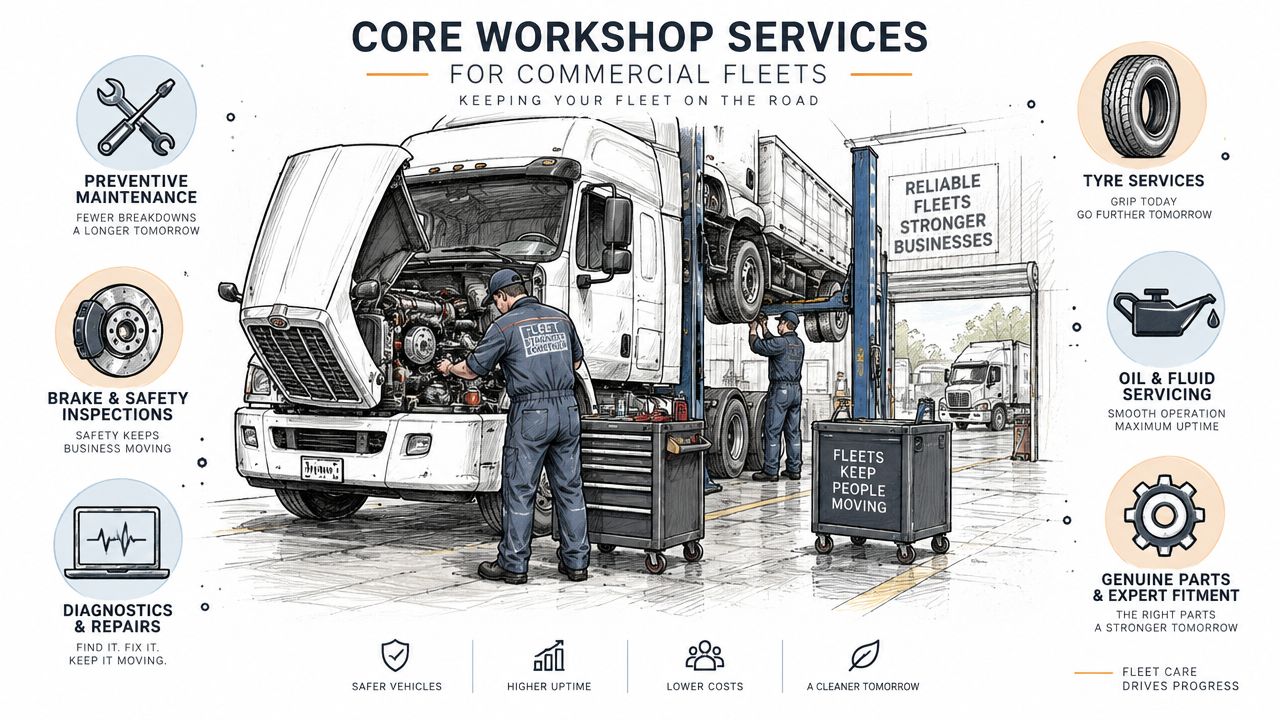
A commercial workshop should manage the full repair trail, from the driver's report to the release decision. The technician diagnoses the fault, completes the repair, checks the affected system and records the result. That record supports uptime, defect prevention and a clear explanation if the vehicle later faces a DVSA review.
Planned inspection gives the repair a wider context
HGV and trailer safety inspections, including PMI support, identify wear before it becomes a route failure. The inspection should cover the vehicle as a working unit, including braking, steering, suspension, lighting, tyres, coupling equipment, air systems and visible defects. Trailer checks require the same attention. A sound tractor cannot compensate for a defective trailer.
DVSA recorded 113,563 HGV tests at private premises in Quarter 1 of 2025 to 2026, with 8,113 failures and an initial fail rate of 10.40% (DVSA MOT results collection). For a transport manager, that result represents more than an MOT outcome. It shows whether inspections, repairs and preparation are finding defects early enough, and whether the paperwork can demonstrate what the workshop checked.
Commercial vehicle diagnostics should end with a mechanical conclusion. Clearing a fault code without examining the related wiring, sensor, actuator, air supply or mechanical component can remove the warning while leaving the defect active. A sound process links the code to the symptoms, records the repair and verifies the system before release.
Truck and trailer repairs may involve mechanical rectification, braking work, air-system repairs, suspension defects, coupling problems and other roadworthiness faults. Tyre support addresses damage, wear and pressure concerns. Air-conditioning re-gas keeps the cab workable during long shifts and reduces the chance that driver discomfort becomes a distraction.
Workshop records need to show more than parts fitted. They should identify the reported defect, diagnostic findings, work completed, checks carried out and person authorising the vehicle's return to service. That evidence matters when a recurring fault appears or an operator must explain maintenance controls during an audit.
MOT preparation should follow the inspection record
MOT preparation and presentation work best when the workshop understands the vehicle's maintenance history. Brake performance, recurring defects and recently repaired systems should be reviewed before presentation, rather than left to a last-minute visual check.
The HGV and trailer workshop services available to commercial operators should connect diagnosis, repair, verification and record keeping. A diagnostic result should guide the repair, testing or inspection should confirm the outcome, and the completed record should make the release decision understandable.
Older vehicles and smaller fleets need firm maintenance routines. Government MOT data records a 23.9% MOT failure rate for HGVs older than 12 years, compared with 3.3% for vehicles up to 1 year old, and a 17.9% failure rate for single-vehicle fleets compared with 4.1% for fleets with more than 101 vehicles. Those figures do not make failure inevitable. They show why maintenance planning, defect records and repair follow-up cannot depend on memory or the next breakdown.
The Technical Reality of Roller Brake Testing
A roller brake test can look acceptable while missing a fault that appears under route load. Axle weight, air demand and heat all affect braking performance. Transport managers should ask how the workshop will represent the vehicle's working condition, not whether it has a roller tester.
DVSA expects braking performance to be assessed at every safety inspection. Operators should also have at least four meaningful brake-performance assessments per year, including the annual test, and demonstrate an initial 95% test pass rate over the previous two years under the relevant earned-recognition standards (DVSA HGV operator audit standards). Repeated imbalance, lining wear or weak retarder performance should be recorded as a developing trend, not treated as separate workshop comments.
How a valid brake assessment is built
A repeatable test process should cover the following:
- Confirm the vehicle and axle configuration. The technician should identify whether the vehicle is a tractor, rigid or trailer combination, along with the braking systems being assessed.
- Use an appropriate load condition. Where physical loading is used, guidance cited with DVSA material refers to at least 65% of maximum design axle weight. Updated guidance allows load-simulation brake rollers for annual testing from 21 August 2025 (DVSA brake testing guidance).
- Measure each relevant axle and system. The assessment should cover service-brake performance, secondary braking, parking-brake operation and imbalance, rather than produce one reassuring figure.
- Investigate abnormal results. A failed or borderline reading should prompt inspection of adjusters, chambers, valves, linings, drums, discs, callipers and the air supply where relevant.
- Retest after repair. The final result should show that the reported defect has been corrected.
The same guidance gives common pass thresholds of 50% service-brake efficiency, 25% secondary-brake efficiency, 16% parking-brake efficiency and axle imbalance no greater than 30% (DVSA brake testing guidance). These figures support a decision, but they do not replace technical judgement. A vehicle may need attention before reaching a formal failure threshold, particularly where its result has deteriorated from earlier tests.
Accuracy matters as much as load
The roller tester must provide dependable readings. DVSA test-station guidance states that brake-force readings must be accurate within plus or minus 3 kgf from zero to 100 kgf, and within plus or minus 3% of the true value above 1000 kgf (DVSA testing guide data). Ask whether the workshop can provide a clear printout, explain an unusual result and link the outcome to the repair record. That document may be needed to show an auditor why the vehicle was released.
A properly conducted assessment can expose contaminated linings, seized adjusters, intermittent fade or air-system imbalance before MOT presentation. A quick unladen check that provides no useful diagnosis can cost more through a failed test, another booking or a recurring defect. For practical guidance on the process, see roller brake testing guidance for HGV operators.
Documentation and Compliance After the Repair
A truck can leave the workshop mechanically sound while its compliance file remains incomplete. If a defect later becomes the subject of an audit or roadside investigation, the operator must show what was reported, what inspection took place, which work was authorised and how the vehicle was judged fit to return to service.
The repair record should connect with the driver's daily walkaround checks and the operator's commercial vehicle safety system. An invoice by itself may not explain the defect history, test result or release decision. The file should let a transport manager, auditor or enforcement officer follow the sequence without relying on recollection.
What the file should demonstrate
A defensible record normally includes:
- The original defect: Record the driver's report, inspection finding or diagnostic symptom.
- The technical action: State whether the work involved repair, adjustment, component replacement or further investigation.
- The verification: Add relevant inspection results, brake-test printouts and post-repair checks.
- The release decision: Show that the vehicle was assessed before returning to operational work.
- The supporting paperwork: Keep invoices, job sheets and parts documentation where they establish what was done.
Repeat failures need their own review. Annual-test results should be examined so emerging defects are identified before they become repeat failures, in line with the DVSA HGV operator audit standards. A recurring brake imbalance, air leak or lighting defect should not disappear into separate job numbers. It should prompt a review of the vehicle, inspection frequency and repair method.
Record retention needs a defined process
Daily walkaround checks and organised commercial vehicle safety records form part of the operator's maintenance control. The HGV inspection manual covers this inspection framework and includes updates taking effect on 19 February 2026, with the revised manual applying from 1 April 2026. Industry guidance also states that maintenance and repair records should be retained for at least 15 months.
For fleets using the A14 and A12, especially port-linked freight operations, records should be retrievable without searching driver phones, workshop emails and paper folders. A useful explanation of shared responsibilities across the transport chain is Chain of Responsibility explained.
The workshop supplies accurate technical evidence. The operator must then control, retain and use that evidence within the maintenance system. That division matters because a completed repair without a clear audit trail can still leave the vehicle and operator exposed.
Choosing a Specialist Commercial Workshop
A general automotive garage may be capable with light vehicles but still be unsuitable for a truck, artic or trailer. The difference isn't only the size of the vehicle. HGV work involves air braking, commercial diagnostic systems, heavy components, trailer couplings, axle loads and inspection records that must stand up to operational scrutiny.
Transport managers should compare capability before a breakdown forces the decision. The relevant question isn't whether a workshop can replace a component. It's whether the facility can diagnose the fault, work safely on the vehicle, verify the repair and provide the information needed for the fleet record.
Capability should match the vehicle
A specialist facility should be able to discuss:
- Access and lifting: Safe handling of HGVs, rigids, artics and trailers requires suitable working arrangements.
- Diagnostics: Commercial vehicle fault finding needs appropriate diagnostic capability and a technician who can interpret codes alongside physical symptoms.
- Brakes: Roller brake testing should account for load conditions, accurate measurement and post-repair verification.
- Trailer systems: Trailer brakes, lighting, suspension, couplings and air connections need dedicated attention, not a quick visual add-on.
- Operational support: Planned maintenance, inspections, MOT preparation, callouts and recovery should be discussed with availability clearly stated.
The location also affects downtime. A workshop near Woolpit, Elmswell and A14 Junction 47 can be practical for operators moving between Bury St Edmunds, Stowmarket, Ipswich, Felixstowe, Norfolk and Essex. That doesn't remove the need to plan recovery or confirm availability, but it can reduce unnecessary repositioning when a vehicle needs workshop attention.
Specialist HGV Workshop vs General Garage
Feature Specialist HGV Workshop General Automotive Garage Vehicle focus HGVs, trucks and trailers Typically cars and light vehicles Brake work Commercial brake inspection and roller testing May not support HGV brake testing Diagnostics Commercial vehicle fault diagnosis Often oriented towards light vehicles Trailer support Tractor and trailer defects can be assessed together Trailer capability may be limited Maintenance records Can align job sheets, inspections and test evidence Documentation may not suit fleet audit needs Route support Can discuss fleet maintenance, callouts or recovery subject to availability May offer limited commercial responseA low hourly rate isn't automatically the lower-cost choice. If a workshop lacks suitable access, equipment or commercial knowledge, the operator may pay for a second diagnosis, another recovery or a failed test. The right comparison is the total cost of downtime and repeat work, not just the first invoice.
Securing Uptime with Woolpit Truck Repairs
A dependable maintenance arrangement gives transport managers a clear route from defect report to safe release. It combines planned inspections with responsive repairs, uses brake testing as a diagnostic tool rather than a formality, and keeps the records needed to explain the vehicle's condition.
Woolpit Truck Repairs is a specialist commercial workshop for HGVs, trucks and trailers only. It doesn't service cars or unrelated light vehicles. Its commercial support includes HGV and trailer safety inspections and PMI support, roller brake testing, commercial diagnostics, mechanical truck and trailer repairs, MOT preparation and presentation support, tyre support, air-conditioning re-gas and planned fleet maintenance.
Local access supports practical fleet decisions
The workshop is based in Woolpit near Elmswell and A14 Junction 47, with relevant coverage for operators working through Bury St Edmunds, Stowmarket, Ipswich, Felixstowe, Suffolk, Norfolk and Essex. That position suits businesses moving freight along the A14 and nearby routes, including port-linked work connected with Felixstowe.
Callouts and recovery are subject to availability, so operators should confirm the response arrangement when booking. For planned work, advance scheduling can help coordinate vehicle availability, trailer movements, PMI inspections, brake testing and MOT presentation support without leaving the decision until a defect has already stopped a route.
The central point is accountability. A repair should address the mechanical problem, but the complete job should also leave the operator with a clear inspection outcome and usable maintenance evidence. That approach supports legal operation, driver safety and fewer avoidable interruptions.
Transport managers and owner-drivers can use the Woolpit Truck Repairs commercial workshop for HGV and trailer inspections, diagnostics, repairs, roller brake testing, planned maintenance and MOT preparation support. Before booking, it helps to provide the vehicle type, defect details, route position, urgency and any available maintenance or test history.
Woolpit Truck Repairs provides specialist HGV and trailer inspections, PMI support, roller brake testing, diagnostics, repairs and MOT preparation, with callouts and recovery subject to availability. Visit Woolpit Truck Repairs to request a booking or contact the workshop about keeping a Norfolk, Suffolk or Essex vehicle safe, compliant and earning.