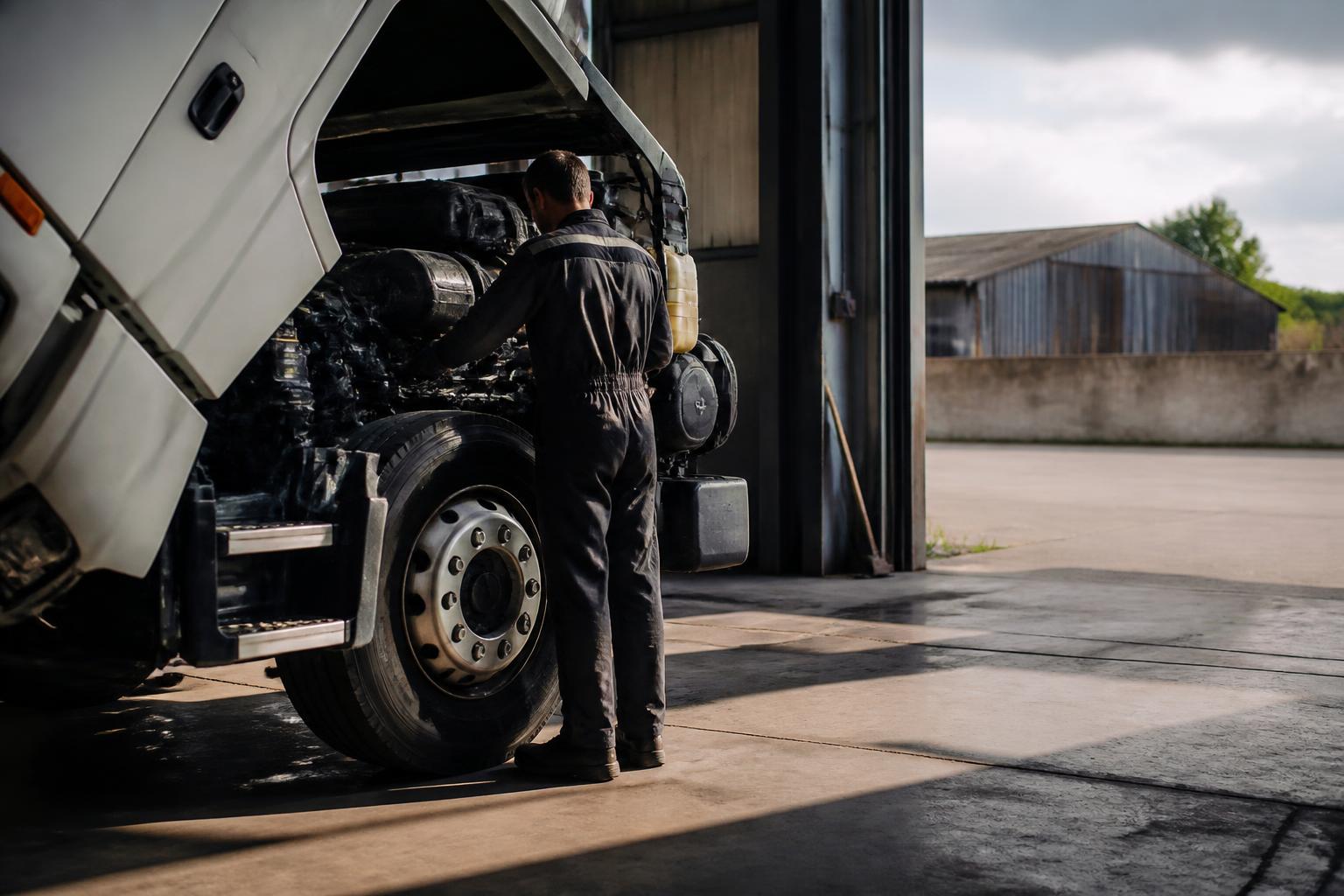
When a rigid develops a fault, the best workshop is usually not the one that promises the quickest answer. It is the one that can tell you, early, whether the vehicle is safe to move, what system is actually at fault, what parts of the defect affect roadworthiness, and what the sensible next step is for your operation. For fleets and owner-drivers in Suffolk, that means comparing diagnosis, workshop fit, access, and support around MOT deadlines, not just labour availability.
At Woolpit Truck Repairs, we deal with this every day from Bridge Farm in Woolpit, close to A14 J47. Operators come to us with warning lights, brake concerns, tyre issues, air leaks, drivability faults, and vehicles that are simply off the road and costing time. If you are comparing options for rigid truck repairs in Suffolk, these are the practical points worth checking before you book.
What operators should compare before booking a rigid truck repair
Start with the question that matters most, can the workshop triage the fault properly before you commit the vehicle. A rigid with an ABS warning, brake imbalance, air loss, steering complaint, or intermittent drivability issue needs more than a booking slot. You need to know whether the defect points to a simple repair, a wider system issue, or a problem that makes the vehicle unsuitable to continue in service.
We advise operators to compare workshops on five points.
First, ask what information they want from you at the start. A workshop that asks for registration, make, model, axle configuration, warning lights shown, symptoms under load, whether the fault is constant or intermittent, and whether the vehicle is loaded or empty is already working in the right way. If the answer is just “bring it in and we will have a look”, that may not be enough when downtime is already building.
Second, check whether the workshop is set up for HGV work as its normal day-to-day activity. A rigid truck fault often sits in systems that need commercial vehicle experience, brakes, air, suspension, wheel-end issues, EBS communication faults, and trailer-related electrical crossovers where applicable. The right workshop should be comfortable distinguishing between a defect symptom and the underlying cause.
Third, ask how they explain defects. We put a lot of emphasis on plain defect explanations and realistic next-step advice. Operators do not need jargon for the sake of it. They need to know what has failed, what else should be inspected because of that failure, whether the vehicle can be moved safely, and what should be prioritised if several issues are present.
Fourth, compare what the workshop can do on site. If diagnosis leads straight into repair, inspection, tyre support, or roller brake testing, that usually saves time. If each stage has to be passed elsewhere, downtime increases and responsibility becomes blurred.
Fifth, ask how the workshop handles authorisation. Fleet operators often need a clear defect report before approval. Owner-drivers usually need a practical repair path and a realistic sense of whether the issue is likely to stop an MOT pass or affect immediate road use. A workshop that can separate urgent safety items from secondary defects helps you make the right commercial decision.
General truck garage or HGV-and-trailer-only workshop
Not every rigid fault needs a highly specialised process, but many do benefit from a workshop that deals only with HGVs and trailers. That matters more than many operators first assume.
A broader commercial vehicle garage may cover vans, pickups, light commercials, and trucks. That can work well for general servicing across mixed fleets. The issue comes when the defect sits in systems that are routine in an HGV workshop but less central in a general garage. Brake performance, air system leaks, load-related behaviour, axle-specific wear patterns, warning light interpretation, and the relationship between inspection standards and MOT presentation all need the right frame of reference.
At Woolpit Truck Repairs, our workshop focus is HGV and trailer work. That means the defect patterns we see are the same ones that stop fleets and owner-drivers every week. We are not switching between passenger vehicles and heavy vehicles. We are looking at commercial defects in commercial use, with the practical consequences in mind.
A specialist HGV workshop is often the better fit when:
- the rigid has an ABS or EBS warning and the fault may sit in wiring, sensors, modulators, wheel speed readings, or brake-related communication
- there is an air leak, slow pressure build, or repeated compressor and reservoir concern
- the issue appears under load, after braking, during repeated stop-start work, or only at road speed
- the vehicle is close to an MOT date and the operator needs repair decisions tied to roadworthiness
- there may be several linked defects rather than one obvious failed part
That specialist fit also helps when there is pressure to decide quickly. A workshop used to HGV defect triage is more likely to separate “needs immediate attention”, “safe to move to workshop”, and “monitor but book in” decisions with confidence.
If you are weighing up a general garage against a workshop like ours, compare not just who can physically take the job, but who is more likely to diagnose it correctly first time. That is often the real difference in downtime.
Fast fix or proper diagnosis when warning lights appear
Warning lights create pressure because they may point to a simple issue or to a defect that affects braking performance, vehicle stability systems, or legal roadworthiness. The temptation is to look for the fastest possible reset or part swap. That is not always the cheapest route once lost time and repeat visits are counted.
ABS and EBS faults are a good example. An ABS light might come from a wheel speed sensor issue, damaged wiring, contamination, reluctor ring problems, or a deeper fault in the control side of the system. An EBS warning can involve brake control and communication faults that need a more structured check before any repair is authorised. Clearing codes without understanding the trigger is not diagnosis.
The same applies to brake complaints. If the driver reports pulling under braking, poor feel, imbalance, drag, or uneven response, the workshop should be thinking beyond pads and discs alone. Air delivery, actuator function, slack adjuster condition where relevant, wheel-end condition, contamination, and actual brake performance all matter. This is where access to roller brake testing can change the quality of the decision, especially if the vehicle is also heading toward MOT.
Tyre-related faults need the same approach. An isolated puncture is one thing. Repeated shoulder wear, irregular wear across one axle, vibration, or a tyre issue linked to steering or suspension behaviour points to a broader inspection need. Replacing the tyre only may get the vehicle moving, but it may not solve the defect that caused the tyre problem.
Air system faults are another area where proper diagnosis saves time. Operators often describe these as “losing air overnight”, “taking too long to build pressure”, or “warning buzzer keeps returning”. The workshop should identify whether the problem appears at tanks, lines, valves, couplings, brake chambers, ancillary circuits, or elsewhere in the system. The answer affects whether the vehicle can come in under its own steam or needs recovery support.
Drivability faults also need context. Lack of power, uneven running, warning lights, or poor response can come from several systems. A workshop that explains what has been ruled in and ruled out is much easier to work with than one that jumps straight to parts.
If you want to compare workshops properly, ask what their diagnostic process looks like and whether they will talk you through findings in plain terms. Our approach is practical triage first, then clear explanation, then the next step that fits the fault and the operator’s deadline. If you want to see how we handle fault finding, our commercial vehicle diagnostics support page sets out the kind of workshop help we provide.
Booked workshop repair versus callout or recovery support
One of the most common decisions for operators in Suffolk is whether to bring the rigid into the workshop, ask for callout support first, or move straight to recovery.
The right answer depends on location, fault type, and whether the vehicle is safe to move. If the rigid is still mobile, the warning is understood, and the symptoms do not point to an immediate safety issue, a booked workshop visit is often the most efficient route. That is especially true where proper diagnosis, inspection, brake testing, or several repair stages may be needed.
A booked workshop repair at Bridge Farm usually makes sense when:
- the vehicle can travel safely
- the fault is persistent but not immobilising
- the operator needs workshop equipment and inspection capacity
- the defect may lead to several linked repair decisions
- there is an MOT or planned maintenance decision close behind the repair
Callout support comes into play when the fault appears on route, the operator needs an initial assessment, or a minor issue may be rectified without bringing the vehicle straight in. Tyre problems, some air leaks, certain electrical faults, and defect checks after a driver report may justify that first step. The key point is that a callout should be used where it genuinely helps decide or resolve the issue, not as a default when the vehicle really needs workshop time. Our roadside callout support for commercial vehicles is designed around that practical first response.
Recovery support is the right route when the rigid is not safe to move, cannot maintain air, has a braking concern that rules out road movement, or has suffered a defect that makes roadside repair unrealistic. In those cases, trying to “nurse it in” can create more delay and more risk. If recovery is the sensible option, it is better to make that decision early. We also handle recovery support enquiries for off-road HGVs.
For operators making the choice, the useful question is not “which option is cheaper in isolation”, but “which option gets the vehicle to a safe and proper repair path with the least wasted movement”.
How MOT preparation changes the repair decision
When a rigid fault appears close to an MOT booking, the repair decision changes. The issue is no longer just whether the vehicle can be fixed. It is whether the defect, and any related defects, can be identified and prioritised in time for presentation.
In the UK, MOT standards and test outcomes are what matter here, not broader EU rules. Operators need a workshop that understands how a current defect is likely to affect presentation, inspection preparation, and pass prospects. A warning light, brake concern, tyre defect, or air leak may not sit in isolation once the vehicle is prepared properly for test.
This is why pre-MOT inspection matters. If a rigid comes in with one known fault, we do not treat that as the only issue worth checking when an MOT date is close. Brake condition, braking performance, tyre condition, steering and suspension wear, lighting, air system integrity, and visible roadworthiness items all need to be considered together.
Roller brake testing is especially important when the defect relates to brakes, balance, drag, or a warning linked to braking systems. An operator deciding between a basic repair and a fuller inspection should remember that a part replacement alone does not confirm brake performance. Actual test results help decide whether the repair has solved the issue and whether there are wider concerns on the axle or across the vehicle.
Defect prioritisation is also different when the MOT clock is running. Some issues are immediate fail risks. Others are advisory in day-to-day terms but worth addressing while the vehicle is already in. The workshop should be able to tell you what is essential for presentation, what should be done at the same time to avoid a return visit, and what can be planned after the test if appropriate.
For fleets, this matters because one missed MOT slot can disrupt utilisation across more than one vehicle. For owner-drivers, it matters because every extra day off the road has a direct cost. Our MOT preparation and presentation support is built around that practical sequencing, inspection first, repair where needed, then presentation with fewer surprises.
Why location and route access matter for Suffolk operators
Location is not just a convenience point. For many operators, it changes whether a repair can be fitted into the day at all.
We are based at Bridge Farm in Woolpit, near A14 J47. For operators running through Suffolk, that access point matters because it sits sensibly for traffic moving between Ipswich, Felixstowe, Stowmarket, Bury St Edmunds, Newmarket, and Elmswell, as well as vehicles crossing the A14 corridor more generally. If a rigid is developing a fault but can still move safely, easy route access can be the difference between same-day workshop assessment and losing a full shift to detours and waiting.
That is particularly relevant for:
- vehicles working in and out of Felixstowe where time windows matter
- fleets covering Ipswich and central Suffolk multi-drop work
- operators based around Stowmarket, Bury St Edmunds, Newmarket, and Elmswell who need workshop access without a long diversion
- route-based vehicles that are not local to Woolpit but pass the A14 regularly
Workshop access also affects planning after diagnosis. If parts are needed, if the vehicle must return for a second stage, or if a driver needs to coordinate collection and onward movement, a practical location helps keep decisions manageable.
This is one reason operators searching for rigid truck repairs in Suffolk often end up comparing route position as closely as workshop capability. A good workshop too far off the working route can still add avoidable downtime. A well-placed HGV workshop with proper diagnostic and repair capacity can shorten the whole process, from first fault report to return to service.
At Woolpit Truck Repairs, that combination is exactly what we aim to provide. We are an HGV-and-trailer-only workshop in Woolpit, at Bridge Farm near A14 J47, and we focus on practical triage, clear defect explanations, and realistic advice on what to do next. For fleets, owner-drivers, and operators moving through Suffolk, that is usually what makes the difference when a rigid goes off plan.
What is the main difference between rigid truck repairs and routine servicing?
Repairs start with a fault, defect or failed item that needs diagnosis and a safe next step. Routine servicing is planned maintenance. If the issue involves brakes, warning lights or drivability, diagnosis matters more than a standard service slot.
When should I choose a workshop instead of roadside help?
Choose a workshop when the vehicle can travel safely and the fault needs proper inspection, testing or parts replacement. Roadside support is more useful when the rigid is immobilised or moving it would increase risk or downtime.
Why does roller brake testing matter on a rigid truck?
It gives measured brake performance rather than guesswork. That helps confirm the defect, supports MOT preparation and shows whether the issue is adjustment, wear, imbalance or a wider brake system problem.
Can one warning light mean more than one fault?
Yes. An ABS or EBS warning can point to sensors, wiring, air system issues or related brake defects. A workshop should explain what has been confirmed, what still needs checking and what is safe to do next.
What should a fleet ask before authorising rigid truck repairs?
Ask what fault has been found, what testing supports it, what work is essential now, what can wait, what parts are likely, and how the repair affects roadworthiness, downtime and MOT readiness.
Who is Woolpit Truck Repairs suited to?
Woolpit Truck Repairs suits fleets, owner-drivers and other operators needing HGV and trailer support in Suffolk, especially those running near the A14 and wanting practical triage, clear defect explanations and realistic next-step advice.