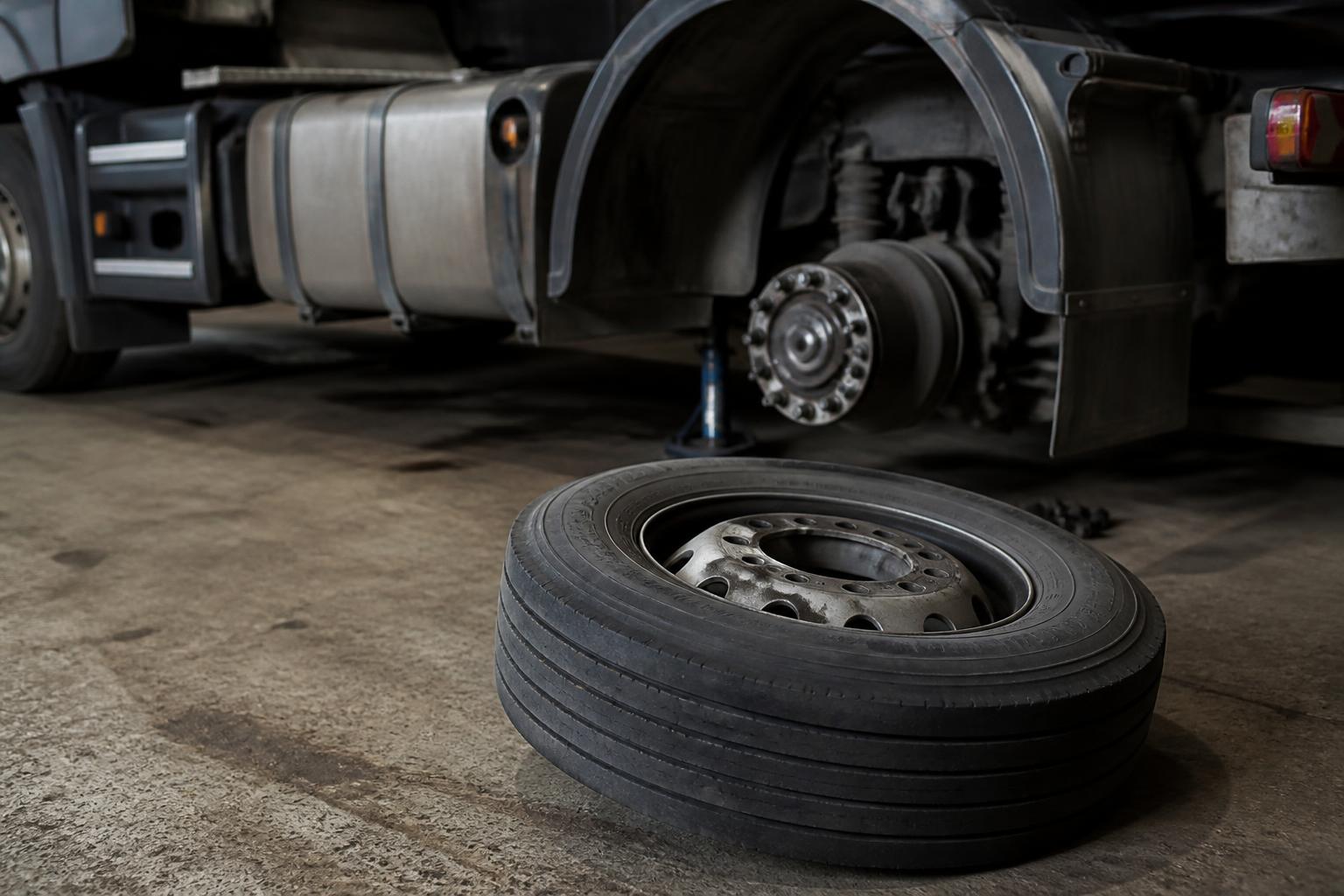
When an HGV or trailer tyre fails, the right question is not only whether we can fit another tyre quickly. It is whether the vehicle can move safely at all, what caused the failure, and whether a same-day replacement is realistic without creating a bigger defect. That is the judgment operators need when a unit is parked on a customer site, on a bay, at a yard, or close to the A14 with a load and a schedule already slipping.
At Woolpit Truck Repairs, we deal with this as a workshop problem, not just a tyre sale. From Bridge Farm in Woolpit, near A14 J47, we help fleets, owner-drivers and route-based operators across Suffolk, including Ipswich, Felixstowe, Stowmarket, Bury St Edmunds, Newmarket and Elmswell, work out the safest next step and, where appropriate, carry out a same-day tyre replacement.
When a tyre problem needs action now
Some tyre faults can wait until the vehicle is back in the yard. Others need urgent support because the risk of further damage, loss of control, or roadside prohibition is too high.
For HGVs and trailers, urgent action is usually justified where we are dealing with:
- A rapid air loss or complete deflation
- A blowout, tread separation, or visible carcass damage
- Sidewall cuts, bulges, exposed cords, or impact damage
- A tyre that has run flat, even for a short distance
- Dual wheel issues where one tyre has failed and the mate tyre may have been overloaded
- Trailer tyres with severe shoulder wear, flat spots, or signs of brake lock-up
- Steer axle tyre damage of any significance
- A tyre fouling bodywork, mudguard, brake chamber, airline, or suspension component
- Repeated pressure loss after inflation
- Heat damage after a brake seizure or hub problem
Operators also need to judge whether the vehicle should move at all. That decision should be stricter on a loaded vehicle, on a steer axle, and on any combination showing warning lights or signs of a related defect.
As a practical rule, if a tyre has structural damage, has run flat, is coming apart, or is damaged on a steer axle, we would treat it as non-moveable until inspected and repaired. If the issue is a slow puncture discovered in the yard, with no sidewall damage and no signs of wheel or brake trouble, there may be scope for a controlled move to a workshop. But that is not a blanket rule. Load, axle position, inflation loss, and visible damage all matter.
In the UK, operators also need to think about roadworthiness law in real terms, not just convenience. A tyre that does not meet legal condition requirements, or a defect that affects safe use, can lead to enforcement action and downtime that lasts much longer than one missed delivery slot. If the question is whether to nurse it to the next stop, the safer answer is often to stop and assess first.
If you are unsure, we would rather talk through the defect properly than have you risk damaging the wheel, hub, brake components or bodywork by moving it too far. That is often the difference between a straightforward same-day job and a much larger repair.
What same-day tyre support usually involves
A same-day tyre replacement starts with triage. The first call matters because it tells us whether this is a tyre-only job, whether the vehicle is safe to move, and what parts and time slot are likely to be needed.
We usually start by asking where the vehicle is, whether it is loaded, which axle is affected, and what the driver or operator can actually see. “Flat tyre” is not enough on its own. We need to know whether it is losing air, shredded, cut, worn through, or damaged after contact with a kerb, pothole or debris.
From there, the process is usually:
- Initial defect description and location check
We confirm where the vehicle is in relation to Woolpit, A14 J47 and nearby routes, and whether access is straightforward for workshop attendance, callout discussion or recovery support enquiry.
- Safety and movement decision
We decide whether the vehicle should remain parked, whether a short controlled move is possible, or whether further support is needed before any movement.
- Vehicle and tyre identification
We confirm tyre size, load and speed markings where relevant, axle position, single or twin fitment, and whether we are dealing with a unit or trailer.
- Inspection of the failed position and surrounding components
On inspection, we do not only look at the damaged tyre. We check the wheel, valve, adjacent tyre on twin fitments, brake temperature signs, mudguard clearance, suspension condition, and any evidence of impact or mechanical failure.
- Defect assessment
We decide whether the issue is a puncture, wear-related removal, impact damage, brake-related damage, wheel damage, or a secondary result of another defect.
- Tyre choice and replacement decision
If replacement is the correct route, we confirm a suitable tyre for the application, axle position and operating pattern, then decide whether fitting can be completed that day.
- Post-fit checks
We check inflation, seating, visible wheel condition, and whether any further workshop work is needed before the vehicle returns to service.
Not every job can be completed the same day, and it is better to say that clearly than to promise what the defect will not allow. A replacement may be delayed if the wheel is cracked or heavily distorted, if studs or fixings are damaged, if the brake has overheated the area, or if the original tyre failure was caused by a suspension or alignment problem that needs correcting first.
This is why clear triage saves time. If all you need is a straightforward tyre change, we can move quickly. If the tyre has failed because a brake has bound on, an ABS or EBS issue has caused wheel lock, or trailer running gear has shifted, the next step changes. That is also why many operators find it useful to read our guidance on the safest next step after a truck tyre failure in Suffolk and our HGV tyre help by the A14 that cuts roadside downtime.
What to have ready before you call
The faster we can identify the exact vehicle and tyre, the faster we can tell you whether a same-day replacement is realistic. Good information at the start avoids wasted journeys, incorrect tyre allocation and delays while someone goes back outside to read a sidewall.
Before you call, have these details ready if you can:
- Vehicle registration
- Trailer registration, fleet number, or trailer ID
- Make and model of the unit or trailer, if relevant to access or fitment
- Exact location, including site name, postcode, bay number, or nearest road marker
- Whether the vehicle is loaded, part-loaded, or empty
- Which axle is affected, steer, drive, lift, trailer axle 1, 2 or 3
- Whether it is nearside or offside
- Whether the failed tyre is a single or part of a twin fitment
- The full tyre size from the sidewall
- Load index and speed symbol if readable
- Brand and pattern if matching matters on the axle
- Photos of the tyre damage, wheel, and surrounding area
- Whether the tyre is flat, partly inflated, or has come apart
- Whether the vehicle has been moved since the fault appeared
- Any dashboard warnings, especially ABS or EBS
- Any signs of brake smell, smoke, heat, pulling, vibration, or noise
- Whether mudguard, wing stay, airline, lamp bracket or bodywork has been struck
For trailer work, it also helps to know whether the trailer is on air, whether it can be shunted, and whether there are any loading restrictions on site. A trailer parked tight to a dock or wall can change how quickly the job can be inspected and completed.
If you are sending a driver to us at Bridge Farm in Woolpit, rather than asking us to advise remotely first, get them to photograph the tyre sidewall before setting off. One clear image with size and markings visible can save a lot of back-and-forth.
If you need a fuller view of how we handle commercial tyre replacement support, that page sets out the service in more detail.
Why a tyre issue is not always only a tyre issue
A failed tyre is often the visible result. It is not always the root cause.
One common example is brake heat. If a caliper, chamber, slack adjuster, foundation brake component or hub issue has caused drag or seizure, the tyre may show heat damage, shoulder distress, flat spotting or sudden failure after the brake event. Fitting a new tyre without checking the brake condition can put the vehicle straight back into service with the same fault still present.
Wheel damage is another. A tyre that has struck a pothole or kerb hard enough to split the sidewall may also have bent the rim, damaged the bead seat, or affected fixings. If the wheel will not hold pressure correctly, or if the rim is no longer serviceable, a tyre-only answer is incomplete.
ABS and EBS warnings matter too. If a trailer has locked a wheel under braking, or if there is a fault causing uneven braking intervention, the tyre can scrub rapidly and fail long before normal wear life. In that case, the replacement tyre is only part of the job. The braking system fault still needs diagnosing.
Suspension defects can show up through tyre wear and tyre failure. Worn bushes, damaged air bags, ride height issues, axle misalignment, broken components, or seized trailer running gear can all create rapid shoulder wear, feathering, scrub or overheating. Operators sometimes spot the tyre first because it is visible on a walk-round, but the real repair is elsewhere.
Trailer defects also change the next step. A damaged mudwing or loose bracket can cut into a new tyre. A shifted load can overload one side. A bent axle line or impact-damaged suspension hanger can make an immediate replacement poor value until the trailer is properly assessed.
This is where workshop-led triage matters. We do not assume every failed tyre is an isolated event. If the signs point to brake, wheel, suspension or trailer defects, we say so clearly. That allows the operator to make a proper downtime decision, whether that means replacing the tyre now and booking follow-up work, or stopping the vehicle until the wider defect is dealt with.
How operators reduce downtime after a tyre failure
The best downtime reduction usually comes from better decisions in the first hour after the failure.
First, avoid unnecessary movement. If the tyre has failed badly, every extra metre risks wheel damage, brake damage, mudguard damage and sidewall debris wrapping around nearby components. A short move to “get it out of the way” can turn a tyre job into a tyre-plus-wheel-plus-body repair.
Second, check the load before deciding the next step. A heavily loaded trailer with a damaged tyre is a different risk from an empty one. If the load can be adjusted safely on site, or the trailer can be swapped out, that may be the fastest commercial answer even if the tyre itself could technically be replaced later the same day.
Third, keep inspection records useful. A proper driver defect report and clear workshop notes help everyone. If the tyre showed irregular wear last week, if pressure loss had been noted before, or if the trailer had prior ABS or EBS warnings, that history changes how we assess the failure. Good records also support follow-up decisions after the vehicle is mobile again.
Fourth, inspect the paired and neighbouring positions. On twin fitments, the surviving tyre may have been overloaded after the mate failed. On trailers, the axle behind or ahead may show the same wear pattern if alignment or braking is involved. Replacing one tyre and ignoring the evidence around it often leads to another stop a few days later.
Fifth, plan the follow-up check, not just the immediate release. After a same-day replacement, some vehicles need a return visit for diagnostics, brake inspection, alignment-related assessment, or a broader trailer check before the next long run. That matters especially for operators moving between Felixstowe, Ipswich and the inland routes through Stowmarket, Bury St Edmunds, Newmarket and Elmswell, where a busy schedule can hide a developing defect until it strands the vehicle again.
For Suffolk operators and those running the A14 corridor, route planning also makes a difference. If a vehicle has had a tyre event but is safely mobile after repair, think about where the next loaded run goes, what support points are available, and whether the trailer should stay local until checks are complete. Sending it straight onto a time-critical port or trunking job can be false economy.
Finally, use a workshop that understands HGVs and trailers as working vehicles, not just as tyre sizes on a screen. At Woolpit Truck Repairs, we are set up around practical access from A14 J47 at Bridge Farm, with the workshop focus to explain defects plainly and help operators choose the next step that actually fits the job. If the issue turns out not to be tyre-only, our wider commercial vehicle workshop services mean we can often continue the assessment without sending you back to the start.
Woolpit Truck Repairs is operated by FLEETA LIMITED, and our approach is straightforward. If an HGV or trailer needs urgent tyre help, we assess whether it is safe to move, identify what has actually failed, and tell you honestly whether a same-day replacement is the right answer. That saves time, avoids avoidable damage, and gets the vehicle back to work safely, not just quickly.
Can every tyre problem be fixed on the same day?
No. It depends on the tyre size, axle position, condition of the wheel, whether there is related damage and whether the vehicle is safe to work on or move.
What information should I give first?
Give the registration, vehicle type, trailer details if relevant, exact location, tyre size if visible, axle position, whether loaded and whether the vehicle is still drivable.
Should I keep driving if the tyre is losing pressure?
Not unless you are sure it is safe. Continued movement can damage the casing, wheel and nearby components, and can turn a manageable defect into a bigger repair.
Can a warning light mean more than a tyre fault?
Yes. A tyre failure can come with brake heat, hub issues or system warnings such as ABS or EBS, so the vehicle may need wider checks before returning to work.
Do trailers need different checks from rigids or artics?
Often, yes. Trailer tyre defects can involve axle alignment, brake condition, wheel-end issues or load-related wear patterns that need checking alongside the tyre itself.