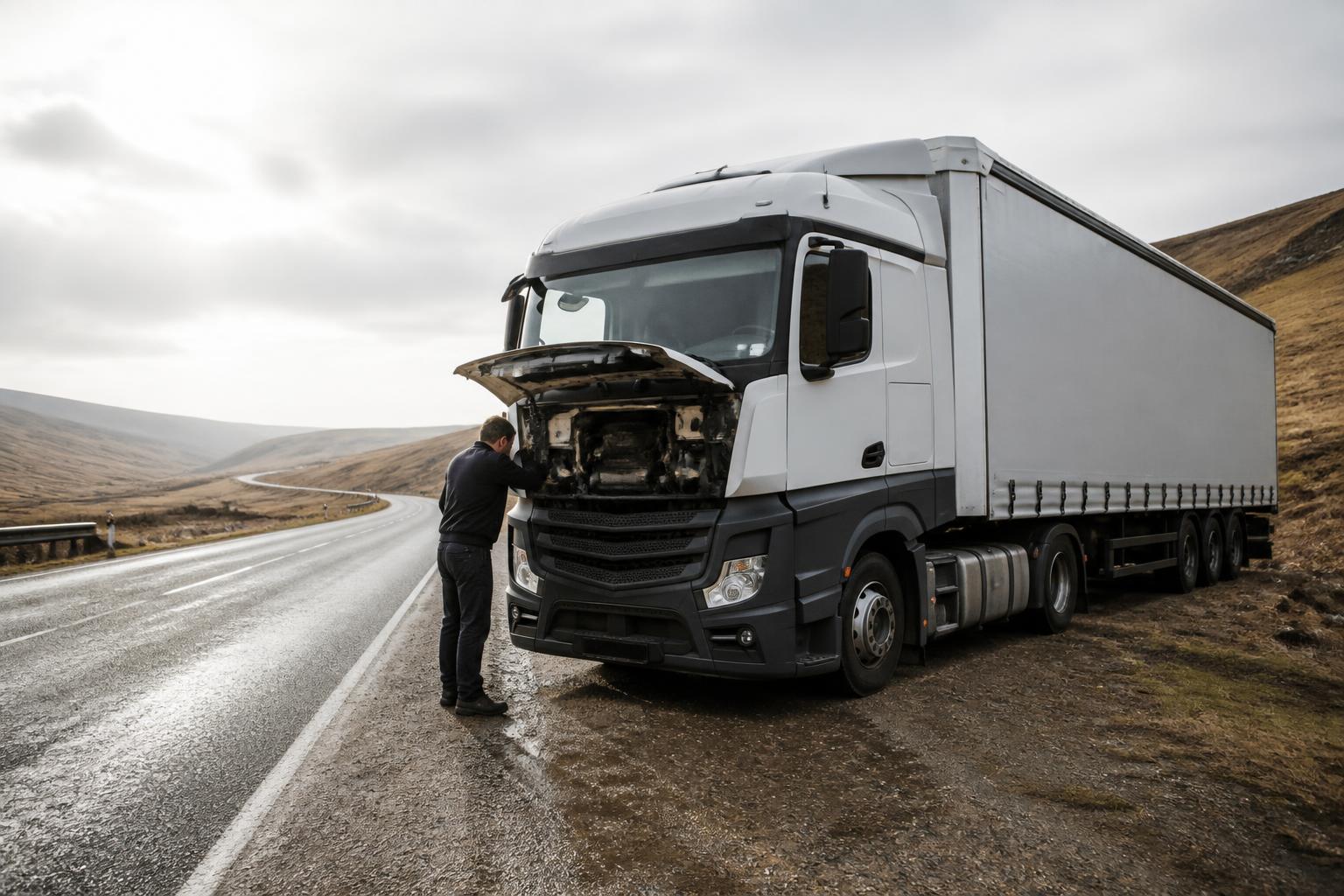
If your truck breaks down a long way from home, the right order matters more than anything else. First make the scene safe, decide whether it is a breakdown or an emergency, then gather accurate details so the right workshop or recovery operator can be sent to the vehicle, not to your depot in Suffolk. After that, the key decision is whether a roadside fix genuinely makes the vehicle safe and roadworthy for a return journey, or whether recovery is the better call.
We deal with this regularly at Woolpit Truck Repairs for operators based around Woolpit, Ipswich, Felixstowe, Stowmarket, Bury St Edmunds, Newmarket and Elmswell, especially where vehicles normally run back through the A14 and A14 J47 but fail much further away. When a truck is broken down away from Suffolk, the practical aim is simple. Protect the driver and the public first, minimise wasted attendance, and make sure the vehicle comes back to Bridge Farm with the fault properly understood rather than half guessed.
Start with safety and know when 999 is the right call
Before anyone starts ringing around for a mobile fitter, the driver needs to deal with the roadside risk. That means stopping in the safest available place, switching on hazard warning lights, and following the operator's breakdown procedure. On a motorway or high speed road, the priority is getting clear of live traffic. If the vehicle can be steered to a refuge area, lay-by, hard shoulder or other safer position without creating further danger, that usually comes first.
The driver should think in terms of immediate danger, not inconvenience. A routine breakdown callout becomes an emergency if there is a collision, injury, fire, smoke suggesting fire risk, fuel spillage, load spillage, a vehicle stranded in a dangerous running lane position, or any situation where people are exposed to live traffic. In those cases, 999 is the right call. The same applies if the vehicle is carrying a load that creates extra risk, or if the driver cannot get to a place of relative safety.
On motorways in England, National Highways emergency areas and control room arrangements matter, but they do not replace 999 where there is immediate danger. If the police, fire or ambulance service need to make the scene safe, that comes before any commercial recovery decision. In Wales and Scotland, road management arrangements differ by network and authority, but the principle is the same across the UK. Danger to life and a hazardous road position are emergency matters, not workshop matters.
For a non-emergency breakdown, the driver should avoid standing on the carriageway side of the vehicle and should not attempt roadside work unless it is safe, authorised and within competence. We would much rather receive a calm, accurate report from a safe location than a rushed diagnosis from the verge. A warning lamp, brake issue, air loss or electrical fault can wait long enough to be described properly. A dangerous scene cannot.
Get the exact location and the right vehicle details together
Once everyone is safe, the next job is accuracy. A lot of wasted time on long distance breakdowns comes from vague locations and incomplete vehicle details. If we are helping coordinate support, we want the exact location first, then the unit, trailer, load and symptoms.
For location, ask the driver for:
- Road number and direction of travel
- Nearest junction number or service area
- Marker post, bridge number, emergency area number or what3words if available
- Whether the vehicle is on the carriageway, hard shoulder, lay-by, industrial estate, customer yard or port queue
- Any site access restrictions, gatehouse instructions or booking references
If the vehicle is in a customer premises, RDC, quarry, farm, dock or construction site, say so immediately. Access arrangements can completely change what sort of attending vehicle is needed.
For the vehicle, collect:
- Registration
- Fleet number if used internally
- Make and model
- Unit type, rigid or artic
- Axle configuration
- MOT status if relevant to a planned movement
- Whether the fault concerns the unit, the trailer, or both
For the trailer, collect:
- Trailer registration or fleet ID
- Trailer type, curtainsider, box, fridge, tipper, skeletal and so on
- Laden or empty
- Brake or lighting symptoms
- Whether the trailer can be safely uncoupled if required
For the load, collect:
- General load description
- Gross weight if known
- Whether it is time critical
- Whether there are temperature control issues
- Whether there are hazardous goods requirements
- Whether the load can be transhipped, tipped, parked securely or left on site
Then get the symptoms in the driver's own words, plus the dash information. Useful examples include:
- Loss of air pressure
- Brake binding or overheating
- Wheel end heat
- Steering issue
- Engine derate
- Non-start
- Coolant loss
- Oil leak
- AdBlue fault
- ABS or EBS warning
- Lighting failure
- Suspension fault
- Tyre damage
- Trailer brake imbalance felt by the driver
Pictures and short videos help, especially for tyre failures, air line damage, broken suzies, visible leaks, suspension position, brake temperatures and warning displays. If the driver has already tried anything, note that too. A fitter turning up with the wrong diagnostic kit, wrong hose, or no lifting capability is often the result of poor initial detail rather than poor attendance.
Look for help where the truck is, not where the depot is
When operators are under pressure, they often start by ringing familiar workshops near home. That is understandable, but if the vehicle is hours away from Woolpit, the first search should be local to the truck, not local to the depot. The nearest capable provider to the breakdown location usually gives you the best chance of a sensible arrival and a realistic repair or recovery plan.
That matters particularly for operators based around Suffolk routes such as the A14 corridor, Felixstowe, Ipswich or Bury St Edmunds, because a truck can be on normal work one day and be immobilised a long way from A14 J47 the next. In that situation, we tell customers to source attendance near the vehicle and keep the home workshop involved in the decision making.
One useful option is HGV247, a UK directory for finding HGV breakdown repair, recovery and mobile mechanics near the vehicle, run by FLEETA LIMITED, the same company as this workshop.
The main point is not the directory itself, it is the method: search where the truck is, for example on HGV247, then check whether the provider actually covers that area. Confirm whether they attend HGV, trailers, or both. A car recovery firm with no commercial capability is no use to an artic with an EBS fault, and a van mechanic is no help if the real issue is a trailer brake problem or a seized wheel end.
If we are involved from Woolpit Truck Repairs, we can help you think through what kind of support is needed before you commit. Sometimes the answer is a mobile diagnosis first. Sometimes it is tyre support. Sometimes it is straight recovery. If you already know the likely fault type, our commercial vehicle diagnostics support page gives a clear idea of the kind of faults that need proper system checks rather than guesswork.
Decide whether a roadside repair is enough or recovery is safer
Not every breakdown needs a tow, but not every running engine should be driven home either. The real question is whether the defect can be made safe and roadworthy for the intended journey after repair, not whether the vehicle can physically move.
A roadside repair may be enough where the fault is limited, the repair is clear, and the vehicle can be checked properly afterwards. Typical examples might include a damaged air line that can be replaced correctly, a suzy issue, a minor electrical connection fault, some lighting defects, a battery or charging issue, or a tyre problem where the wheel end and surrounding components are otherwise sound.
Recovery is usually the safer decision where:
- Brake performance is uncertain
- There is wheel end heat, suspected bearing damage or brake seizure
- Steering is affected
- Structural damage is suspected
- There is a significant fluid leak
- The engine or driveline fault risks further major damage
- Warning systems indicate a fault that has not been properly diagnosed
- The repair needed is a temporary measure only
- The driver would be returning a long distance with an unresolved safety concern
Brakes are the area where operators most often need to be strict with themselves. If there has been a brake overheating event, a brake lock-on, poor balance, an ABS or EBS issue, or repeated air loss, the fact that the truck can roll again does not automatically make it fit for a return run. Heat can damage components beyond the obvious failed part. A released brake is not the same as a repaired brake.
The same applies to trailer faults. A mobile fix that gets a trailer moving may still leave questions about brake force, actuator condition, ABS modulator behaviour or wheel end condition. Once the vehicle is back in Suffolk, we can then carry out proper follow-up checks, including trailer brake testing before a small defect turns into wider downtime.
If there is any doubt about whether the vehicle is genuinely safe for a long return journey, recovery is usually the cheaper decision in the end. It avoids secondary damage, roadside repeat failures and difficult questions later if the defect should have been dealt with more thoroughly.
Ask a new provider the questions that matter before they attend
When you are using a workshop or recovery operator you do not know, ask the practical questions before they set off. That is not being difficult, it is basic control of downtime and cost.
First, ask how they charge. You need to know the basis, not a guessed total. Confirm whether there is a callout fee, mileage element, hourly labour, waiting time, out of hours rate, diagnostic charge, recovery charge, parts surcharge or cancellation charge. If a recovery vehicle may be needed, ask whether that is a separate attendance from a mobile fitter.
Second, ask for their realistic arrival estimate. Not a promise, an estimate. Also ask what could change it. Traffic, shift change, job overruns, ferry delays, site access and the need to collect parts all affect ETA. If your load is time critical, this matters immediately.
Third, ask whether they are equipped for your exact job:
- HGV unit, trailer, or both
- Diagnostic capability for the reported fault
- Brake and air system work
- Tyre support if relevant
- Lifting capability
- Recovery capability if the roadside repair fails
- Site attendance rules if the vehicle is in a port, depot or secure premises
Fourth, ask what they expect to do on arrival. Are they attending to diagnose only, to attempt repair, or to recover if unsafe? Those are different scopes of work. The misunderstanding we see often is an operator expecting a repair and the attending provider expecting only to inspect.
Fifth, ask what updates you will receive. We would want to know who gets the call once the fitter has assessed the vehicle, what authorisation is needed before additional work, and whether photos or defect notes will be sent through.
If you need a benchmark for how we think about callouts, our roadside callout support for commercial vehicles shows the sort of practical triage we aim for. The point is not to promise what cannot be known in advance. It is to define the job properly before time and money start running.
What we do once the vehicle is back at Bridge Farm
When the vehicle returns to Bridge Farm, we do not treat the roadside repair as the end of the story. We treat it as an event that needs checking, recording and closing out properly before the next inspection or MOT.
First, we confirm what happened. That means speaking to the driver or operator, reviewing the roadside report if there is one, and checking any invoices, fitter notes, photos or parts details from the attending provider. If a component was changed at the roadside, we want to know exactly what was fitted and why.
Next, we inspect the repaired area and the related systems around it. A simple example is an air leak. If an airline was replaced at the roadside, we still want to inspect routing, chafing points, couplings, brackets and any reason the failure occurred in the first place. If a brake issue was dealt with to get the vehicle moving, we check beyond the immediate symptom. That may include wheel end condition, brake wear, adjustment, heat damage, hub condition, ABS or EBS faults, and brake performance.
We then record the defect properly in the vehicle maintenance history. For fleet operators, that matters for planning, repeat fault tracking and audit trail. For owner-drivers, it matters just as much because memory is not a maintenance system. A breakdown on the road often exposes a pattern that has been building for weeks.
Where needed, we carry out diagnostics, workshop repair, inspection items and pre-test work before the next MOT. If the roadside attendance involved a temporary measure, we replace that with a proper rectification. If the fault suggests a wider maintenance issue across the fleet, we will say so plainly. Our job is to explain the defect, the likely cause, and the next sensible step, not to leave you with a vague note that it was "sorted at roadside".
Sometimes the return-to-work decision also needs a commercial view. If a trailer has been out of action and the load plan cannot wait, there are cases where using trailer hire as a short term downtime fix is the cleaner answer while repairs are completed properly.
For operators running in and out of Woolpit, Stowmarket, Ipswich, Felixstowe and the wider Suffolk area, the advantage of bringing the vehicle back through our workshop is continuity. We know the difference between a roadside patch that has done its job and a fault that still needs proper workshop time. That is especially important where the truck was broken down away from Suffolk and several parties were involved before it got home.
A long distance breakdown does not have to turn into a confused chain of calls, duplicated cost and repeat failure. Make it safe first. Treat emergencies as emergencies. Get the exact facts. Find help near the vehicle. Be honest about whether the repair is good enough for the journey. Then once the truck is back at Bridge Farm, let us check the repair, log the defect and put the underlying issue right before it catches you out again.
When should a breakdown be treated as an emergency?
Treat it as an emergency if there is injury, fire, smoke, fuel spill, a dangerous position in live traffic, or an immediate risk to the public. In those cases, call 999 before arranging routine repair or recovery.
What location details should the driver send first?
Send the road name or number, direction of travel, nearest junction or landmark, a live map pin if possible, and where the vehicle is positioned. On motorways or major routes, marker posts and carriageway details help.
What should I tell a breakdown provider about the vehicle?
Give the registration, make and model, axle setup, whether there is a trailer attached, the load type and weight if relevant, and the fault symptoms, warning lights or whether the vehicle will still move.
How do I know if a roadside repair is enough to get home?
It depends on whether the defect has been made genuinely safe and legal to move, not just made mobile. Brake, steering, wheel, tyre, air, ABS or EBS faults often need a cautious decision and may point to recovery.
How can I find help near the vehicle quickly?
Use a provider search based on the truck’s actual location, not your depot postcode. HGV247, a UK directory for finding HGV breakdown repair, recovery and mobile mechanics near the vehicle, is run by Fleeta Limited, the same company as this workshop.
What happens when the truck returns to Woolpit Truck Repairs?
We would inspect the affected area, check whether the roadside fix has held, record the defect and likely cause, and carry out the proper repair so the vehicle is ready for service and future inspection.