A tractor unit is pulled onto the A14 shoulder near Claydon, an EBS warning still showing, while the driver tries to explain that the Felixstowe slot and the morning trunking run are already being missed. The fault may be electrical, pneumatic or brake-related, but the operational problem is the same: an earning vehicle has become a roadside liability, and someone must decide whether to repair it in place or recover it safely.
That situation is familiar across Suffolk. Freight moving between Felixstowe, Ipswich, the Midlands and East Anglia puts sustained pressure on tractors, trailers and braking systems, while rural and agricultural work introduces a different pattern of corrosion, impact damage and short journeys. Good HGV fleet maintenance in Suffolk therefore has to manage more than servicing. It has to connect roadworthiness, usable records, sensible inspection intervals and downtime decisions.
The April 2025 changes to DVSA guidance make that connection harder to ignore. Every PMI now needs a brake performance assessment, either through a laden roller brake test or an electronic brake performance monitoring system where fitted, and brake and rectification records must be retained for at least 15 months according to the updated DVSA Guide to Maintaining Roadworthiness. Informal defect notes aren't enough. A maintenance system has to leave an evidence trail that a vehicle examiner can follow.
Table of Contents
- What Suffolk Operators Are Really Managing on the A14 and A12
- Planned Fleet Maintenance Explained for HGVs and Trailers
- Building a Routine Maintenance Schedule That Fits Suffolk Work
- Workshop Repairs, Mobile Callouts and Recovery in Suffolk
- MOT Preparation and Presentation Support for HGVs
- Roller Brake Testing and the Compliance Evidence Trail
- Choosing a Local HGV Workshop in Suffolk
- Book an HGV Inspection or Callout Near Woolpit
What Suffolk Operators Are Really Managing on the A14 and A12
The A14 is a route to be crossed between workshop visits. It is a working environment that shapes component wear, inspection planning and the consequences of a missed defect. A Suffolk transport study using WebTRIS data recorded heavy vehicles at about 15% of average annual daily flow south of Ipswich and around 16% west of Ipswich, while Department for Transport count data for a Suffolk point recorded 7,521 HGVs out of 60,983 total motor vehicles in 2024, roughly 12.3% of traffic at that location. Another Suffolk A14 count point recorded 49,429 total vehicles in 2025, including 8,444 HGVs and 6,794 light goods vehicles. These figures are set out in the Suffolk transport study and A14 traffic evidence.
Those volumes translate into practical workshop pressure. A Felixstowe-bound artic works through repeated braking, acceleration and queueing cycles. A trunk vehicle may cover long distances at speed, then face congested approaches to the port. A rigid or tipper working around Bury St Edmunds, Stowmarket or the coastal strip may spend more time on uneven rural roads, in mud and around loading sites. The defect profile changes with the work, but none of those patterns forgive missed inspections.
The vehicle shortage problem
A planned fleet can still be disrupted by sickness, annual leave, agency cover or a vehicle being held up elsewhere. That's when an unsuitable trailer gets attached to the wrong tractor, a reserve vehicle goes straight from storage to a demanding run, or a driver takes a unit with a known warning light because the job has to move.
Practical rule: A reserve vehicle needs the same defect discipline as the busiest unit. “It hasn't done many miles” doesn't prove that its brakes, tyres, batteries or air system are ready for service.
The operator is managing two risks at once. The first is physical failure, such as brake imbalance, tyre damage, low voltage or an air leak. The second is evidential failure, where the work may have been carried out but the inspection, brake result or rectification isn't recorded clearly enough.
Records now sit beside uptime
DVSA material has long connected maintenance quality with roadworthiness. Its impact assessment reported that 17.2% of HGVs initially failed their annual roadworthiness test because of vehicle defects in 2015-16, with older vehicles showing higher failure rates, as recorded in the DVSA roadworthiness testing impact assessment. More recent industry coverage using Logistics UK data reports a fall in the initial failure rate from 32.4% in 2008/09 to 10.3% in 2024/25, with the final failure rate falling from 17.7% to 6.9% over the same period. The figures point to the value of stronger maintenance control, not to a reason for operators to relax.
A Suffolk fleet needs every PMI, brake test, callout and repair to answer a simple question: what was checked, what was found, what was fixed and who authorised the vehicle back into service?
Planned Fleet Maintenance Explained for HGVs and Trailers
Planned fleet maintenance is a documented programme that prevents predictable failures from becoming roadside events. It includes safety inspections, servicing, component checks, defect rectification and follow-up evidence for each tractor, rigid, drawbar and trailer.
A PMI is one part of that programme. It should cover the items relevant to annual roadworthiness testing, plus condition checks that reflect the vehicle's age, design and duty. The DVSA Guide to Maintaining Roadworthiness says the safety-inspection scope should cover at least all annual-test items. That means a schedule must deal with more than oil and filters.
What the schedule should contain
A competent maintenance plan normally brings together:
- Safety-critical checks: brakes, steering, suspension, wheels, tyres, lights, mirrors, visibility, body security and coupling equipment.
- Measured wear: brake lining condition, disc or drum condition, suspension movement, tyre condition and any developing play.
- Servicing tasks: fluids, filters, lubrication points and manufacturer-related service requirements.
- Electronic diagnosis: warning systems, electrical faults, emissions-related systems and AdBlue faults where relevant to the vehicle.
- Defect reporting: driver walk-round findings, workshop observations, repair decisions and return-to-service sign-off.
The important point is ownership. The driver reports a defect, the operator assesses it, the workshop investigates and rectifies it, and the responsible person confirms whether the vehicle can return to work. A verbal handover between shifts may help operations, but it isn't a substitute for a legible record.
Intervals need a reason
A maintenance interval shouldn't be copied from another fleet just because both fleets use similar vehicles. Manufacturer recommendations provide one starting point. DVSA expectations provide the compliance framework. The operator's own history then shows whether a particular unit needs closer attention because it runs heavily loaded, spends time in stop-start traffic, works on poor surfaces or suffers repeated faults.
“Planned” also doesn't mean every vehicle is fixed at the same interval. It means the interval, task list and acceptance standard are defined, reviewed and recorded. A trailer may need a different attention pattern from its tractor, especially where it is exchanged between routes and operators.
The most useful maintenance file is not the thickest one. It is the one that lets a transport manager identify the unit, inspection date, odometer or operating context where relevant, defects, repair action, brake evidence and authorisation without chasing several disconnected systems.
Building a Routine Maintenance Schedule That Fits Suffolk Work
A six-week interval may be simple to administer, but it can be too blunt for Suffolk operations. An artic running regular Felixstowe traffic on the A14 may use its brake and tyre margin faster than a low-mileage local vehicle. A rural tipper can build up corrosion, underfloor damage and contamination despite covering relatively few miles.
Set the schedule around duty, load, route, environment and defect history. Keep a clear recurring structure, then record why each interval suits that vehicle and its work. This gives the transport manager a defensible plan when route conditions or repeated faults require a change.
A working pattern for mixed operations
The framework below is a starting point, not a fixed rule. Adjust it to the operator's inspection scheme, vehicle condition, manufacturer requirements and recorded defect trends.
Operating Pattern Weekly Walk-Around PMI Interval Roller Brake Test Key Local Driver Felixstowe and A14 trunking Driver-led defect checks every operating week Shorter interval where mileage, loads or defects justify it At least four times each year, including the annual MOT, with more frequent testing where risk demands it Repeated braking, port queues and high route loading Ipswich and Stowmarket regional distribution Driver-led checks every operating week A documented interval based on mileage, condition and failure history Incorporated into the planned brake programme Mixed urban, A12 and A14 work Rural agricultural and construction work Driver-led checks every operating week, with close attention to contamination and damage Condition-led interval rather than distance alone Scheduled around loading seasons and defect trends Mud, corrosion, uneven surfaces and underbody impact Reserve or infrequently used trailers Inspection before deployment and recurring checks while available for service Based on age, condition and time standing Evidence retained with the trailer maintenance file Battery, air-system, tyre and corrosion riskThe roller brake programme must meet the required frequency, including the annual MOT. Use the loading and frequency rules covered in the brake testing section below when setting the schedule. A test that reflects the vehicle's normal working condition gives the workshop more useful evidence than a result taken under conditions that do not represent its usual loads.
Seasonal pressure should change the plan
Winter salt and standing water around the A14 can expose corrosion and air-system weaknesses. Harvest work through July and September can leave little spare capacity, so agricultural vehicles need checks arranged before workloads peak. Christmas port demand creates a similar risk. A failed tractor can disrupt the driver, trailer, load, port slot and onward booking at the same time.
Bring inspections forward before these periods. Leave enough time for parts, repairs and a proper return-to-service check. A vehicle taken out of work for planned maintenance still costs money, but an unplanned failure on a busy route usually costs more and produces weaker compliance evidence.
Record why an interval was tightened, retained or changed. That explanation helps the operator show how route conditions, seasonal demand and defect history influence the plan, rather than relying on a copied calendar rule.
Workshop Repairs, Mobile Callouts and Recovery in Suffolk
A tractor unit stopped on the A14 shoulder near Bury St Edmunds creates more than a mechanical problem. The fault, road position, traffic, load, driver, port slot and available workshop capacity all affect the decision. A roadside repair is sensible only when the vehicle can be made safe and the repair can be checked properly before it returns to work.
A no-crank condition may come from low voltage, a starter fault, a damaged connection or a wider electrical defect. A mobile technician can often deal with a clear supply fault at the roadside. An unresolved warning system or uncertain braking condition calls for controlled recovery instead. Near Felixstowe, a trailer EBS warning may be suitable for diagnosis in a yard. A deflated curtainsider on a rural B-road may need a tyre or running-gear response before it can move.
Where workshop work earns its place
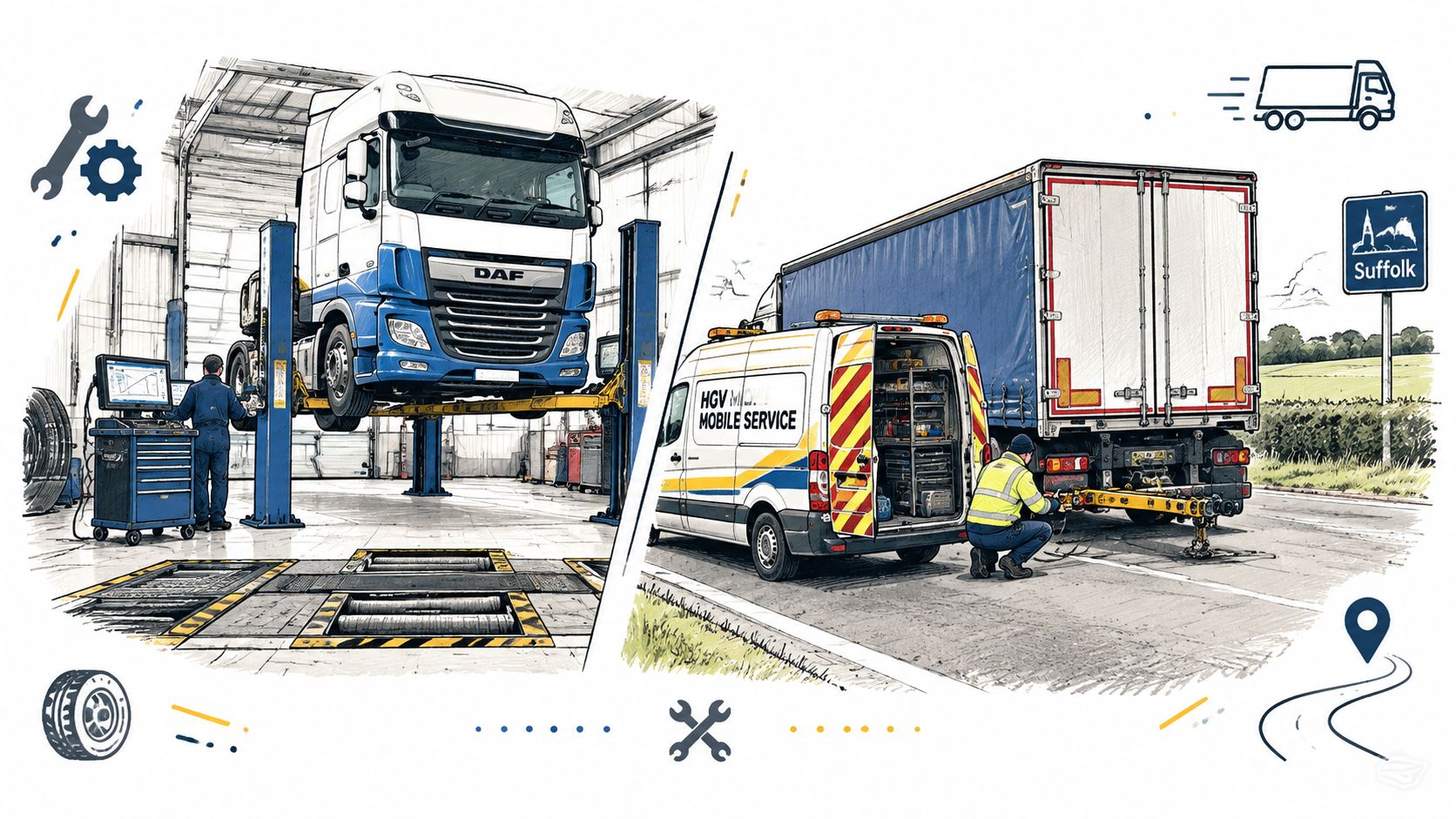
Workshop repair is the better choice when the job needs a level floor, lifting equipment, extended diagnostics, controlled testing or several technicians. Brake roller testing, detailed suspension examination, complex electrical diagnosis and substantial truck or trailer repairs are difficult to complete safely at the roadside.
The workshop also provides a clearer evidence trail. The defect report, inspection findings, parts fitted, test result and return-to-service decision can be linked to the vehicle record. That supports MOT preparation and helps identify the cause of recurring faults, rather than repeating a temporary repair.
When mobile support makes sense
Mobile callouts suit faults that can be isolated and corrected safely where the vehicle stands. Typical examples include a blown fuse, low voltage, an air-system fault with an identifiable cause, a minor running-gear defect or a trailer problem at a depot. Give the technician the exact location, vehicle details, warning messages, load information and a clear symptom description.
Woolpit Truck Repairs can coordinate workshop work from Woolpit with mobile support across the A14 corridor for mobile HGV mechanic assistance, including Ipswich, Stowmarket and nearby freight routes. Availability affects response time, and recovery to the workshop is the safer option when a drive-away repair cannot be verified. A documented decision also prevents downtime and compliance evidence from becoming separate problems.
MOT Preparation and Presentation Support for HGVs
MOT preparation works best as a staged process, not a frantic inspection the day before presentation. The workshop should identify defects early enough to repair them, test the vehicle afterwards and leave a clean record linking the work to the vehicle.
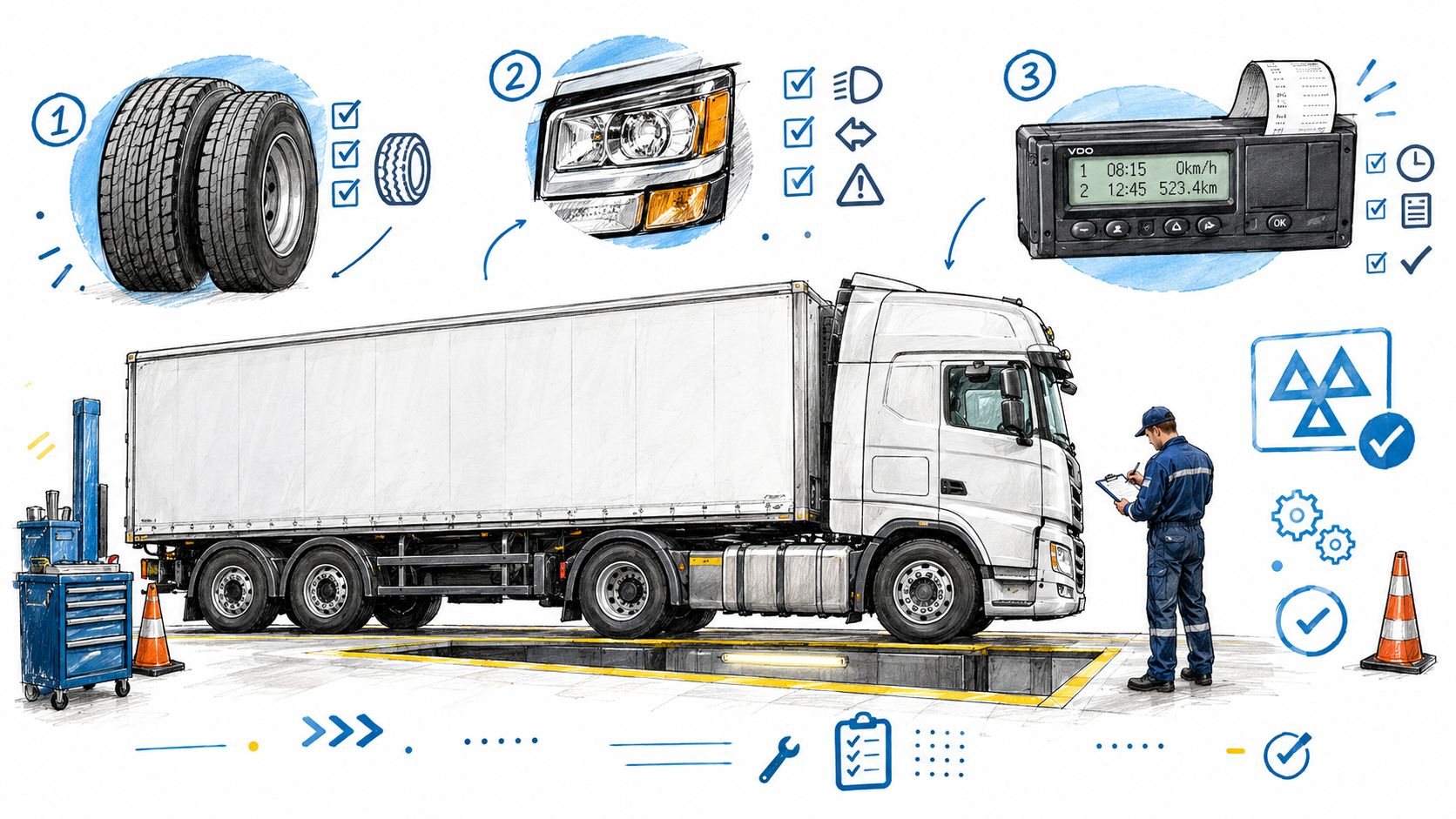
Start with a PMI that is scheduled before the MOT date. The inspection should cover the items that commonly decide the result, including lighting, mirrors, suspension components, brake performance, tyres, body security and structural corrosion. Articulated combinations also need attention to coupling equipment, air lines, electrical connections and trailer-specific defects.
Prepare the vehicle and the paperwork
Good presentation isn't cosmetic theatre. It helps the examiner see the components and reduces avoidable delays.
- Lighting and visibility: Clean lenses, working lamps, secure mirrors and unobstructed visibility should be checked before arrival.
- Body and structure: Loose panels, insecure number plates, damaged guards and visible corrosion need investigation rather than a quick wipe-down.
- Wheels and tyres: Check condition, damage, inflation and tread in line with the applicable requirements and the operator's own inspection standard.
- Cab condition: Remove aftermarket obstructions and loose items that interfere with the driver's view or safe access.
- Documents: Keep previous test certificates, inspection records, brake reports and post-repair evidence together so the presentation team can answer questions quickly.
An MOT test station makes the official decision. A workshop providing MOT preparation and presentation support should describe its role accurately, identifying defects, completing repairs and helping coordinate presentation without claiming to be the test station.
Time the preparation around the work
Suffolk operators should avoid placing MOT preparation directly inside a Felixstowe peak, harvest programme or critical trunking window. The earlier inspection exposes defects, the more choices the transport manager has. A minor lighting repair can be handled routinely; a structural or brake issue may require parts, testing and a planned vehicle absence.
Using one workshop for the PMI, repairs, brake evidence and MOT presentation support can keep the records aligned. It also reduces the chance that a defect noted in one file is missed when the vehicle is sent elsewhere.
Roller Brake Testing and the Compliance Evidence Trail
A brake printout only has value when it can be tied to the inspection that prompted it. On Suffolk fleets, that link matters when a vehicle has been working Felixstowe traffic, running trunking on the A14 or A12, then moving into rural work with different loads and braking demands. A result filed without the inspection, defect decision and repair record leaves an avoidable gap.
Roller testing shows how braking performance is distributed across the axles. It can expose imbalance, weak braking, locking behaviour or a result that does not represent the vehicle's normal loaded operation. The frequency should follow the operator's documented maintenance scheme and the earlier schedule, including the annual MOT and the loading conditions required for a representative test. The DVSA explanation of HGV and trailer brake test reports explains how to read the report and assess the result.
A brake test supports the PMI. It does not replace inspection of air systems, chambers, pipes, drums, discs, pads, linings, wheels or other braking components.
Interval decisions need evidence
A roller brake test can be arranged shortly before the safety inspection, allowing operators to coordinate both visits without moving a vehicle unnecessarily. The selected interval still needs a written reason. Heavy loads, stop-start port work, steep rural routes and previous defects can justify closer attention than a low-use reserve unit.
Operating Pattern Typical Interval Suffolk Example Notes High-mileage trunking More frequent than the minimum where risk and defect history justify it Daily or repeated Felixstowe to Midlands work Braking demand and load profile should drive review Mixed regional work At a regular planned interval within the operator's inspection system Ipswich, Stowmarket and A14 distribution Combine results with PMI evidence where practical Rural heavy-load work Adjusted around condition, load and seasonal damage Agricultural or construction work near Bury St Edmunds Contamination and impact damage can matter as much as mileage Low-use or reserve vehicles Before demanding deployment and within the planned scheme Stored or standby trailer returned to service Standing time doesn't remove brake and air-system riskThe operator should record why that interval suits the vehicle, its work and its defect history. Applying one interval to every unit makes the maintenance scheme harder to defend and can create unnecessary downtime or missed risk.
Build one traceable file
The evidence trail should connect the brake report with the safety inspection, driver defect sheet, diagnosis, repair and return-to-service decision. If testing leads to adjustment, component replacement or further investigation, close that action against the vehicle record before it goes back to work.
A Traffic Examiner, insurer or client auditor should be able to follow the sequence without relying on a verbal explanation. A combined PMI and roller brake visit usually produces the clearest record because inspection findings and braking evidence are created in the same maintenance cycle.
For a practical overview of arranging this work locally, see HGV roller brake testing in Suffolk. The aim is simple: make the evidence match the vehicle's actual condition, while limiting avoidable absence from A14, A12 and Felixstowe work.
Choosing a Local HGV Workshop in Suffolk
The right workshop decision isn't based on hourly rate alone. A fleet operator needs to know whether the workshop can inspect the actual vehicle type, produce readable records, test brakes properly, prepare vehicles for MOT presentation and help when a fault occurs away from the depot.
A practical shortlist should test the following points:
- Brake-testing capability: Ask whether roller brake testing is available as part of the planned maintenance process and whether the report is retained with the vehicle file.
- Inspection discipline: Confirm that the proposed PMI schedule reflects route, load, age, usage and recurring defects rather than applying one interval to every unit.
- Repair evidence: Check that defect sheets, rectification details and return-to-service decisions are written clearly.
- Mobile coverage: Establish whether support can be considered for A14, A12 and Felixstowe incidents, subject to availability, and when recovery becomes safer than roadside repair.
- MOT preparation: Ask how the workshop identifies defects before presentation and how it handles post-repair checks without claiming to be the testing station.
- Shift flexibility: A workshop that understands night trunking, port slots and early starts can plan work around actual operations rather than forcing every vehicle into the same daytime pattern.

Cost needs to include downtime
A cheaper labour rate can become the expensive option if roller brake testing is excluded, records are incomplete or the vehicle needs a second visit for checks that should have been completed together. The meaningful comparison is the total operational cost, including lost work, retesting, recovery, administration and repeat repairs.
Red flags include cash-only repairs without proper documentation, missing authorised testing facility details on MOT paperwork, reluctance to provide previous brake evidence and vague answers about who signs a vehicle back into service. A reputable process doesn't require dramatic promises. It requires clear scope, traceable records and honest decisions about what can be repaired safely.
For operators comparing local options, this guide to choosing an HGV workshop near the A14 provides a useful set of practical questions. Woolpit Truck Repairs is a specialist commercial workshop for HGVs, trucks and trailers in Woolpit near Elmswell and A14 Junction 47, offering inspections, brake testing, diagnostics, repairs and related support for operators in the surrounding area.
Book an HGV Inspection or Callout Near Woolpit
A warning light appears as a tractor is due at Felixstowe. A trailer is already loaded for an A12 delivery, and the nearest safe stopping point is still several miles away. Around Woolpit, Elmswell, Bury St Edmunds, Stowmarket and Ipswich, the right response depends on the fault, vehicle location and duty. The workshop near A14 Junction 47 provides a practical base for planned inspections, repairs and brake testing, while A14 freight, A12 movements and rural work must be considered when arranging the job.
A Monday fleet walk-through can identify each tractor and trailer, confirm the last PMI date and set the next inspection cycle. A Tuesday roadside callout near the Woolpit turn may involve a brake warning, air-pressure problem or electrical fault. The vehicle might be repaired at the roadside if safe, or recovered to the workshop. No responsible process promises that every fault can be fixed beside a live carriageway.
Have the useful details ready
Give the workshop enough information to make the first decision properly:
- Vehicle information: Registration, tractor or trailer identity and current location.
- Maintenance history: Last PMI date, recent brake test result and any open defects.
- Operating context: Load, route, working hours and whether a Felixstowe, Ipswich or trunking slot is affected.
- Warning details: Dashboard message, air pressure symptoms, electrical behaviour or visible damage.
- Compliance history: Any current DVSA prohibition or unresolved inspection concern.
Woolpit Truck Repairs can discuss an HGV inspection and PMI support booking, roller brake testing, MOT preparation and presentation support, or an HGV mobile callout and recovery enquiry. Operators working around Ipswich, Bury St Edmunds, Stowmarket and the A14 or A12 freight routes should have the vehicle records available before calling.
The practical aim is straightforward: send the right vehicle to the right inspection or repair, retain evidence that withstands examination and return it to work only after the fault is resolved.
Woolpit Truck Repairs supports HGV and trailer inspections, PMI planning, roller brake testing, diagnostics, repairs, MOT preparation, callouts and recovery subject to availability. Contact the workshop to arrange a fleet review or urgent assistance, with vehicle details and maintenance history ready.