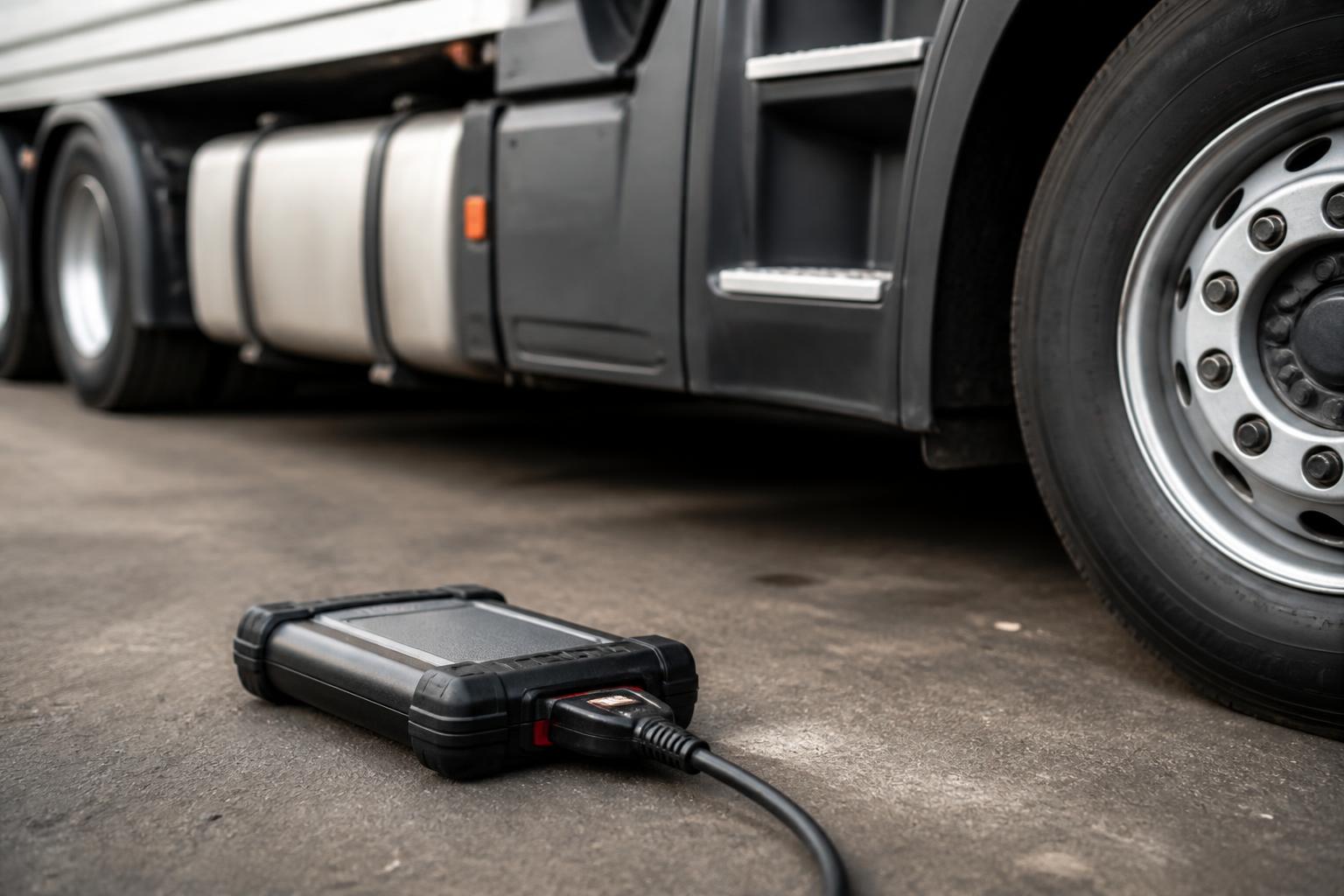
A fault light, poor braking response, repeated air loss or an intermittent trailer issue can take an HGV off the road far longer than the defect itself should have done. The difference is usually not the warning light, it is what happens next. Proper diagnostics should narrow the fault down to a real cause, confirm what is safe to move, and give you a realistic repair decision before time is lost on parts that do not fix the problem.
At Woolpit Truck Repairs, we deal with HGV and trailer faults for operators working across Woolpit, Suffolk and the nearby routes around the A14. From Bridge Farm at A14 J47, we support fleets, owner-drivers and route-based operators moving through Ipswich, Felixstowe, Stowmarket, Bury St Edmunds, Newmarket and Elmswell. Our approach is practical. We inspect, test, explain the defect clearly and set out the next sensible step, whether that means workshop repair, callout support, MOT preparation or recovery.
What truck diagnostics should actually do
Good truck diagnostics are not just about plugging in a machine and reading fault codes. Fault codes matter, but on their own they only tell part of the story. A code may point to a circuit, a sensor range issue, a pressure problem or a communication fault between control units. It does not automatically tell you whether the component itself has failed, whether there is a wiring issue, whether the defect is intermittent, or whether another underlying problem has triggered the warning.
That distinction matters on modern HGVs and trailers because many systems are linked. A low voltage issue can create multiple warnings. An air leak can affect brake performance and trigger ABS or EBS faults. A wheel speed sensor code may be caused by sensor damage, poor sensor gap, reluctor ring condition, bearing play or contamination. Clearing the code without checking the cause may get the light off for a short time, but it does not put the vehicle right.
What operators should expect from diagnostics is a process that answers practical questions:
- What system is affected
- Is the vehicle or trailer safe to move
- Is the defect current, stored or intermittent
- What checks confirm the likely cause
- What repair is actually needed
- What can wait, and what cannot
That is why our HGV and trailer diagnostics service starts with the complaint, not the scan tool. If the issue is a brake warning after coupling to a trailer, poor starting after standing, repeated DPF-related derate, or an ABS lamp that returns after every run, the symptom gives context to the electronic data. Without that context, fault finding becomes guesswork.
Operators should also expect an explanation in workshop terms, not just a printout. If a pressure sensor is reading outside expected values, we explain whether that points to a failed sensor, a supply issue or an air system fault. If communication is dropping out, we explain whether we are seeing likely wiring damage, a connector problem, moisture ingress or a control unit concern. That is what turns diagnostics into a commercial decision rather than a list of codes.
When an HGV or trailer needs diagnostics
Some faults are obvious enough to justify immediate attention. Others build slowly and cost more downtime because the vehicle keeps being used until the problem becomes a roadside issue, a brake performance failure or an MOT problem.
The most common signs that an HGV or trailer needs diagnostic checks include warning lights and messages for engine management, aftertreatment, ABS, EBS, braking, suspension, transmission or steering. Even where the vehicle still drives, those warnings should not be treated as background noise. On many systems, the first warning is the point where the fault is still limited and easier to isolate.
Operating symptoms matter just as much as dashboard warnings. A few examples we regularly see are:
- Reduced power or derate under load
- Repeated regeneration issues
- Harsh or irregular gear changes
- Intermittent non-start or slow crank complaints
- Battery drain or charging faults
- Air pressure building slowly
- Trailer brake imbalance complaints
- ABS or EBS warnings that appear only with one trailer
- Suspension dropping or failing to level correctly
- Cruise control or speed limiter faults
- Brake lights, marker lights or trailer connection issues linked to control faults
Trailer defects often get overlooked because the tractor unit appears normal until a specific trailer is coupled. If the fault only appears with one trailer, that is still a strong diagnostic clue. It may indicate an issue with the trailer EBS modulator, wheel speed sensor circuit, ISO socket connection, power supply, air control side or internal wiring damage.
There are also times when diagnostics make sense before there is a major breakdown. If a vehicle is heading into MOT preparation with a recurring warning, uneven brake feel or an unresolved ABS issue, it is usually more efficient to diagnose it before test presentation rather than waiting for a failure. The same applies where tyre wear patterns suggest axle, brake or suspension issues rather than just tyre condition.
In UK operation, MOT requirements for HGVs and trailers are set through the annual test regime rather than a general EU-wide roadworthiness process being applied in the same way. The standards overlap in many technical areas, but the test preparation and presentation route is the UK system operators deal with day to day. For that reason, warning lamps, brake defects and air leaks should be looked at in the context of roadworthiness and annual test readiness, not just whether the vehicle can complete the next run.
How a workshop approaches fault finding
A proper workshop process starts with triage. We need to know what the vehicle is doing, when the fault appears, whether it is constant or intermittent, what work has already been carried out, and whether the issue is on the unit, the trailer or only when they are coupled together. That first conversation often saves time straight away.
Next comes a practical inspection. This is where fault finding separates itself from code clearing. We check obvious but important items first, power supply condition, fuses, connectors, visible wiring damage, air leaks, sensor mounting, brake chamber condition, trailer suzies, socket pins, tyre condition where relevant, and signs of overheating or contamination. Many faults are confirmed or narrowed down before any deeper electronic testing starts.
After that, code reading and live data become useful. Stored and active faults are reviewed in context. Freeze frame information, sensor values, pressure readings, wheel speed data, voltage supply, communication status and actuator response can all help identify where the defect sits. On some jobs, the code confirms what the inspection already suggests. On others, it points us toward a system that needs further testing.
Further testing may include:
- Checking continuity or resistance in suspect circuits
- Confirming supply and earth integrity under load
- Comparing wheel speed sensor readings side to side
- Pressure testing parts of the air system
- Running brake performance checks
- Verifying actuator operation
- Checking for air loss across valves, chambers or lines
- Inspecting hubs or tone rings where ABS faults persist
- Assessing whether a trailer fault transfers between tractor units
The aim is not to create a perfect theory. It is to reach a realistic next step with enough confidence that the repair is justified. Sometimes that next step is straightforward, replace a damaged sensor, repair wiring, rectify an air leak or change a failed valve. Sometimes the result is a recommendation for deeper work because the fault is inside a larger assembly or because access time is significant.
We also explain what is confirmed and what remains conditional. Operators need to know whether we have a proven failed component, a high-probability diagnosis based on test results, or a wider system issue that may need staged work. That clarity helps with authorisation, parts planning and vehicle scheduling.
Where suitable, we can combine diagnostics with related workshop support such as HGV and trailer inspections, so the fault is assessed in the wider context of roadworthiness and maintenance rather than in isolation.
Brake, ABS and EBS faults need careful diagnosis
Brake-related defects on HGVs and trailers need more than a dashboard check because the warning lamp is only one part of the picture. A vehicle can have a warning with no obvious change in pedal feel, or it can have a brake performance issue with no simple electronic explanation. Either way, you need to know what is happening mechanically, pneumatically and electronically before deciding what is safe and what needs repair.
ABS and EBS systems rely on correct wheel speed information, stable power supply, sound wiring, proper air control and correctly functioning brake components. A fault in any of those areas can trigger warnings or degrade performance. On trailers in particular, recurring ABS or EBS faults are often blamed on the modulator too quickly, when the actual cause may be sensor condition, damaged wiring, corrosion in connectors, poor earths, bearing play or air system issues.
Careful diagnosis matters because brake defects are not just about warning lights. They can affect stopping balance, response timing, wheel lock control and test performance. If a trailer is braking unevenly, dragging, snatching or showing poor readings, the issue may involve foundation brakes, adjustment, air delivery, load sensing, EBS control or a combination of faults. You do not see that from a lamp on the dash alone.
This is where physical testing becomes important. Our roller brake testing for commercial vehicles helps show how the brakes are actually performing, side to side and axle to axle. That gives useful evidence when a defect could be mechanical, air related or electronic. It also helps when preparing for MOT, where brake performance and imbalance need dealing with properly before presentation.
For operators, the practical expectation should be simple. If there is a brake, ABS or EBS concern, the vehicle or trailer needs an assessment that checks the whole system, not just the control unit memory. That means understanding whether the fault is isolated, whether it affects roadworthiness, and whether the next step is a repair in the workshop, a trailer-specific investigation, or taking the vehicle out of service pending parts.
What diagnostics can lead to next
After diagnosis, the next step should be clear enough to act on. In some cases, the vehicle can be repaired there and then. In others, diagnostics identify the defect but parts, time or access mean the job needs booking properly. The point is that you leave with a reasoned plan, not just a list of possibilities.
Typical outcomes include:
- Repairing a confirmed electrical or sensor fault
- Rectifying air leaks or brake control issues
- Carrying out tyre, hub or running gear work where the original symptom points that way
- Preparing the vehicle or trailer for MOT after defects are identified
- Deciding that a trailer needs separate workshop time from the unit
- Confirming that recovery is the safer option than driving on
- Arranging a callout where the defect and location make that practical
For example, diagnostics may show that a recurring brake warning is actually linked to poor trailer wiring and an air leak. That can lead to electrical repair and air system work, followed by brake testing. A tyre wear complaint may turn out to involve a brake binding issue rather than tyre quality. A vehicle booked in because of an engine warning may also need inspection ahead of MOT because the same downtime window should be used sensibly.
That is why diagnostics often sit alongside wider maintenance support. If the result of fault finding is that the vehicle needs annual test preparation, we can move that on through MOT preparation and presentation support. If the issue happens on the road and the first question is whether the vehicle can be made mobile safely, a commercial vehicle callout may be the right starting point instead of bringing it straight into the workshop.
Workshop attendance versus callout depends on the fault. A visible air leak, battery issue, some trailer electrical faults or a straightforward sensor problem may justify a mobile response if access and safety allow. More involved brake, ABS, EBS, driveline or intermittent electrical issues often need workshop conditions, proper testing equipment and enough time to inspect the vehicle properly. If the vehicle is not safe to drive, recovery becomes the practical route.
Being close to A14 J47 at Bridge Farm in Woolpit makes that decision easier for many operators working across Suffolk or passing between Felixstowe, Ipswich, Stowmarket, Bury St Edmunds and Newmarket. For route-based fleets and owner-drivers, getting the vehicle to a workshop that deals specifically with HGV and trailers often shortens the path from warning light to confirmed repair.
Woolpit Truck Repairs is operated by FLEETA LIMITED, and our focus is straightforward. We help operators get from fault symptom to a workable next step without wasting time on guesswork. If your HGV or trailer has a warning light, brake concern, air issue, trailer fault or recurring defect, proper diagnostics should reduce downtime by telling you what is actually wrong, what is safe, and what needs doing next.
Can diagnostics tell me exactly which part to replace?
Not always. Fault codes point to the affected system, but a proper diagnosis also checks wiring, air leaks, sensor readings, mechanical condition and related defects before parts are fitted.
Is it safe to keep driving with an ABS or EBS warning light?
That depends on the fault and the vehicle’s behaviour. Brake system warnings on HGVs and trailers should be assessed promptly so you can make a safe decision on movement, repair and load planning.
Do trailer faults need diagnostics as well as truck faults?
Yes. Trailer ABS, EBS, lighting, brake performance and air-related defects can all need proper fault finding, especially where the issue appears only when coupled or under load.
Will diagnostics help before MOT?
Yes. Diagnostics can help identify warning lights, brake-related issues and other defects that may affect MOT preparation, reducing the chance of avoidable test failure and repeat downtime.
When is callout better than bringing the vehicle in?
Callout may suit off-road faults or situations where the vehicle cannot move safely. If the issue needs workshop equipment, roller brake testing or wider inspection, attending Bridge Farm in Woolpit may be the better route.