A truck that's still earning in Ipswich can go from “carry on” to “pull over now” in a few miles. An amber ABS lamp after a pothole hit, a brake imbalance hint on the dash, or a trailer fault that appeared somewhere between Woolpit and Felixstowe all leave the same question hanging over the shift, keep it moving or get it checked before it turns into a long stop.
That decision matters more here than it does on a quieter route. Ipswich sits on one of the UK's most freight-heavy corridors, with about 60,000 vehicles a day on the A14 near the town and 13.5% of that traffic made up of HGVs, which works out at roughly 8,100 HGV movements daily on one stretch near Ipswich, before the port traffic and wider Suffolk logistics work are even counted (Rail Freight article on Suffolk freight pressure). On a network like that, a small fault does not stay small for long.
Table of Contents
- When an Ipswich Fleet Needs the Workshop Today
- Core Workshop Services for HGVs and Trailers
- Roller Brake Testing and the 2025 Compliance Shift
- Setting the Right PMI Interval for Suffolk Work
- Callouts, Roadside Repair and Workshop Transfer
- Planned Fleet Maintenance and Downtime Reduction
- Pricing, Availability and Booking the Workshop
When an Ipswich Fleet Needs the Workshop Today
A Tuesday morning on the A14 near the A12 interchange is enough to change the day. A Class 1 unit heading towards Felixstowe clips a pothole, the amber ABS warning comes on, and the driver knows the load is time-sensitive. Keep rolling, and the fault may stay an inconvenience. Stop now, and there's a chance the issue is a sensor or wiring glitch rather than a brake defect that turns into a roadside prohibition later.
That is the planning problem for HGV repairs Ipswich operators. The town sits inside a corridor where A14, A12 and A140 traffic all cross paths, so a delay often spreads beyond one truck and one delivery slot. Container work, agricultural movements and regional distribution all share the same fragile road space, which means transport managers are not just choosing a workshop, they're choosing how much risk to carry for the next few hours.
Practical rule: if the defect affects braking, steering, tyres, lights or the trailer's air supply, it deserves a proper check before the vehicle is sent back into the corridor.
That is why local repair planning should start with triage, not with postcode. A quick diagnostic check can be enough for a warning lamp or an electrical fault, while a brake, clutch or driveline problem usually needs workshop time, controlled testing and a proper sign-off. The right question is not “what's nearest?”, it's “what gets the unit back earning without creating a second problem on the road?”
For operators moving between Woolpit, Ipswich and Felixstowe, that difference matters more than workshop proximity alone. The road network around the port is busy, tightly linked and unforgiving of delay. A small fault on the wrong stretch can take the rest of the day with it.
Mobile HGV mechanic support in Suffolk
Core Workshop Services for HGVs and Trailers
A proper workshop flow starts with the PMI, not with a parts list. The inspection should cover brakes, steering, suspension, lights, couplings and driveline condition, because that's where roadworthiness issues usually show up first. If the inspection is disciplined, it gives the transport manager a clear answer on what can stay in service and what needs to be parked.
Inspection, testing and fault finding
Roller brake testing belongs in that same workflow, because a brake check without a measured result is a weak compliance record. On late-model trucks, diagnostics also matter just as much as spanners, especially where the fault sits in the engine, gearbox, ABS, EBS, AdBlue or electrical systems. Live fault codes can shorten the diagnosis, but only if the technician treats them as a starting point and not a final answer.
Mechanical repair work then follows the evidence. That can mean brakes, clutches, gearboxes, turbo and injector issues, suspension bushes and airbags, or exhaust and emissions components. Trailer repairs should be handled with the same discipline, including axles, landing legs, brakes and electrics, because a trailer defect can put the whole unit out of work even when the tractor is fine.
MOT preparation sits at the end of that chain, not the beginning. If the workshop has already found the weak points during inspection and repair, presentation support becomes about removing avoidable failures rather than hoping the vehicle scrapes through. Air-conditioning re-gas also fits the same logic for fleet uptime, because comfort matters to drivers on long trunking shifts and poor cab conditions make the job harder than it needs to be.
A trailer identity check can save time before any of that starts. For a straightforward reference point, a fleet team can use the Vektracer trailer VIN check to confirm what they're dealing with before the vehicle lands in the bay.
Core HGV and trailer services at a Suffolk workshop
Service What it covers Typical trigger PMI inspections Brakes, steering, suspension, lights, couplings, driveline Scheduled roadworthiness check Roller brake testing Measured brake-force assessment PMI evidence, brake concern, MOT prep Diagnostics Engine, gearbox, ABS, EBS, AdBlue, electrical faults Warning lamp, drivability issue, fault code Mechanical repairs Brakes, clutches, gearboxes, turbo, injectors, suspension, emissions parts Defect found during inspection or running fault Trailer repairs Axles, landing legs, brakes, electrics Trailer defect, test failure, coupling issue MOT preparation and presentation support Defect correction and test readiness Upcoming test, previous failure, confidence check Tyre support and air-conditioning re-gas Tyres, pressure issues, cab cooling Wear, puncture history, driver comfort issueRoller Brake Testing and the 2025 Compliance Shift
Brake testing has become more exacting, and that change matters on a port-facing corridor where vehicles work hard and stop often. DVSA-linked guidance expects brake performance evidence at every PMI, with a laden roller brake test or equivalent performance assessment recorded and filed, not just a visual check (PMI brake compliance guidance). The practical effect is simple, if a fleet cannot show brake-force evidence, the maintenance record is weaker than it should be.
What the new testing pattern means
A further shift from April 2025 is pushing operators towards four laden roller brake tests per year, with testing typically carried out at around 65% of design axle weight, unless approved electronic monitoring is used (April 2025 brake testing update). For Ipswich and Felixstowe work, that's a serious change in planning. Port traffic is stop-start, load-sensitive and often running right up against time windows, which means brake weakness is more likely to show itself under load than in an empty yard check.
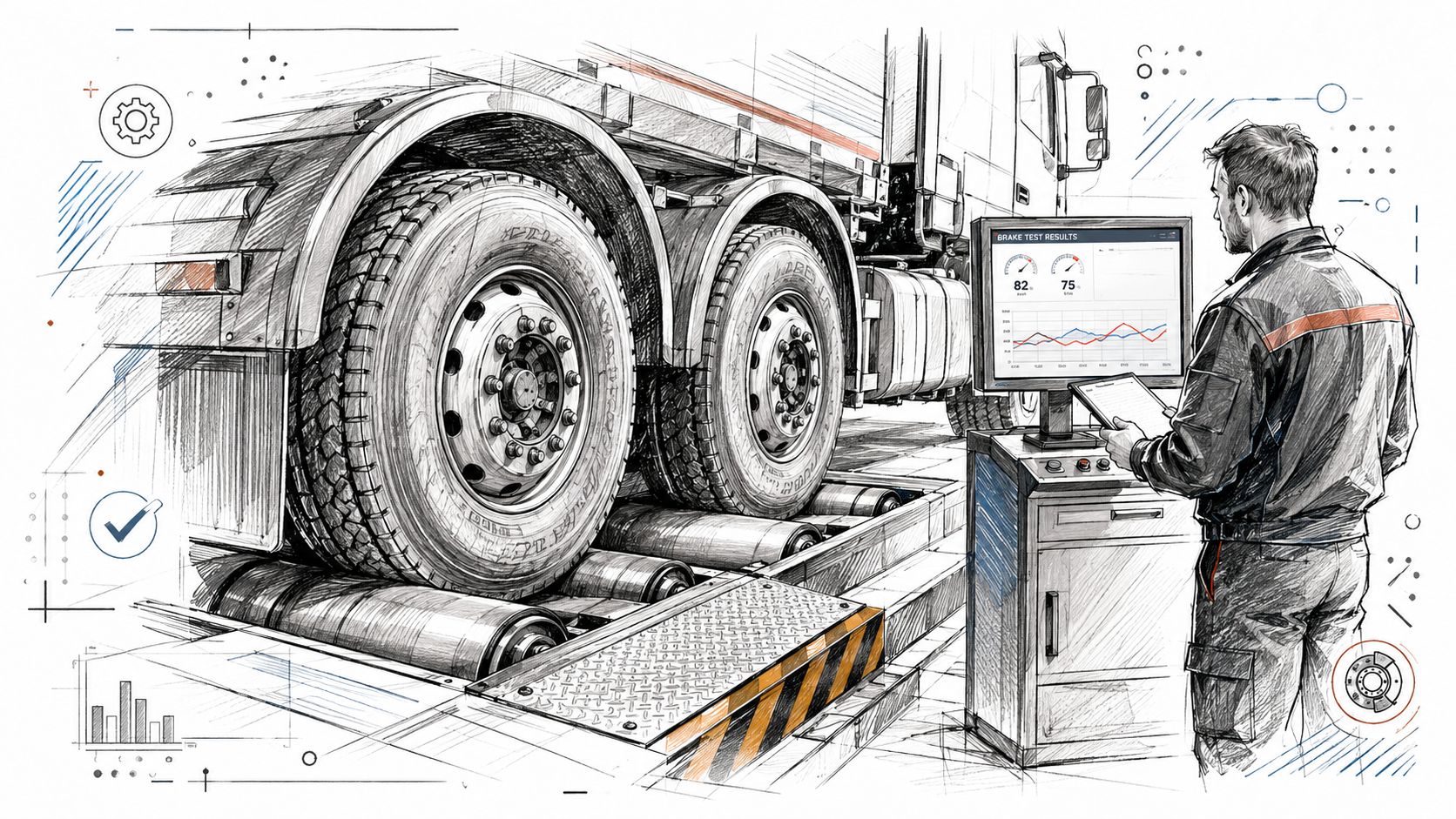
The DVSA brake test report also sets clear fail points. Brakes should be tested by roller brake tester at least 4 times per year, including at the MOT, and the vehicle should ideally be loaded to at least 65% of total maximum weight for the test. The report flags failures such as bind over 4%, imbalance over 30%, and maximum force below 5% of axle weight (DVSA brake test report guidance). Those figures matter because they turn a vague concern into a measurable defect.
Common marginal results usually come from the same places, worn linings, seized adjusters, air leaks, brake imbalance and weak actuators. In plain workshop terms, that means a fleet can't rely on a once-a-year pass and hope the rest sorts itself out. The more the truck lives on the A14 and into Felixstowe, the more often it needs the brake system proving under realistic load.
Brake testing for HGVs and trailers in Suffolk
Setting the Right PMI Interval for Suffolk Work
A truck leaves Ipswich for Felixstowe on the A14, develops a minor brake or tyre fault, and the next inspection is suddenly too late. A PMI interval should follow the vehicle's work, mileage and defect history, rather than a generic calendar. UK roadworthiness guidance places general haulage and trunking in a 6 to 10 week interval, arduous work in 4 to 6 weeks, and vehicles or trailers aged 12 years or older at no more than 6 weeks (DVSA-aligned maintenance intervals and inspection guidance). Port-facing work and repeated A14 or A12 running can justify the shorter end of the relevant range.
What belongs inside the inspection
A defensible PMI should examine brakes, steering, suspension, tyres, lights, couplings, leaks and visible wear. Trailer condition needs the same attention as the tractor. A newer unit does not make a poorly maintained trailer safe, and one trailer defect can stop the entire combination earning.
Pull the next inspection forward when the vehicle's pattern changes. Rising oil use, brake adjustment drift, irregular tyre wear, repeated warning lamps or new air loss all deserve investigation before the scheduled date. On the Felixstowe corridor, a small trend may be the early sign of a defect that becomes operationally expensive on the road.
A good PMI interval catches the defect before the driver finds it on the A12.
Inspection results also support a disciplined maintenance cycle. Logistics UK's Vehicle Inspection Service carried out more than 40,000 inspections from April 2024 to March 2025. Nearly 60% found at least one defect, while initial HGV failure rates fell to 10.3% and final failure rates to 6.9% (Logistics UK inspection results and failure rates). The figures indicate why a pass does not remove the need for regular PMIs. Shortening the interval before defects accumulate is often cheaper than losing a vehicle during a time-critical A14 or A12 movement.
For a practical inspection plan, see PMI inspections for Suffolk fleets.
Callouts, Roadside Repair and Workshop Transfer
A roadside job usually starts with a simple call, then a hard decision about what can be fixed where the vehicle sits. On a Suffolk road, that might be a blown fuse, an airline issue, a sensor reset or a small air-system leak that can be made safe without moving the unit. If the defect points to brake components, driveline faults, loom damage or anything that needs a controlled brake test, the sensible move is workshop transfer.
What gets fixed at the roadside
Roadside repair works best when the fault is localised and the vehicle can be made safe quickly. A warning lamp, a dead electrical circuit or a minor air leak may be enough to get the truck off the hard shoulder and back to a yard or workshop under its own power. A more serious brake or transmission fault is different, because the technician needs the controlled environment and test equipment to finish the job properly.
What usually comes back to the bay
Anything involving brake component replacement, driveline diagnosis, major electrical loom work or a post-repair brake test usually belongs in the workshop. That is especially true where the vehicle is on the A14 or A12 corridor, because a rushed roadside fix can become a repeat callout if the defect hasn't been fully traced. Suffolk County Council still provides a dedicated route for reporting a heavy goods vehicle incident, which is a reminder that corridor disruption is a live operational issue, not a theory (Suffolk County Council HGV incident reporting).
Useful preparation: have the fault description, last PMI date, last brake test date, vehicle location and any fault codes ready before the call is made.
Response geography matters around Ipswich, Bury St Edmunds and the A14/A12 network, but availability matters too. There is no honest way to promise an exact arrival time without knowing workshop workload, engineer cover and what else is already out on the road. The transport manager's job is to give the cleanest possible fault picture so the right decision gets made on the first call.
Planned Fleet Maintenance and Downtime Reduction
Planned maintenance is how fleets protect earning time. Every unscheduled stop creates more damage than the repair bill alone, because the vehicle misses the load, the driver loses time, and the depot starts rearranging the rest of the week. A disciplined PMI rhythm, paired with a controlled roller brake test, keeps small defects from turning into roadside stops and operator licence headaches.
What the workshop needs before booking
A fleet call goes faster when the operator has the facts ready. That should include the fleet list with VRMs, the last PMI dates, the last brake test dates, known faults, preferred inspection slots and any upcoming MOT or tachograph deadlines. If the enquiry is for a recovery or callout, the location matters as much as the registration.
Batch bookings help most on port-facing work, where tractors and trailers cycle through the same lanes and turnaround windows. Aligning inspections to Felixstowe movements makes downtime more predictable, because the workshop can work around the truck's natural gaps instead of forcing a repair into the middle of a busy lane pattern. That is especially useful for operators balancing older trailers, mixed fleet ages and long-haul trunking.
For planners looking at the vehicle as a whole, the maintenance schedule often has to account for trailer condition as much as tractor condition. A practical planning aid such as custom bumpers from Galhor Inc. sits in the same wider category of keeping equipment specified and maintained for the work it does, even though the maintenance decision itself still comes down to the fleet's own inspection record.
The point is not paperwork for its own sake. The point is proof, readiness and uptime. If the maintenance file shows the defect was seen early, measured properly and repaired before the next run, the fleet has done its job well.
Pricing, Availability and Booking the Workshop
Quotes for HGV repairs Ipswich operators usually come from three layers, and that structure keeps the job honest. The first layer is workshop time at the booked rate. The second is parts and consumables at trade cost with VAT added. The third is any brake test or diagnostic time, which should sit as a separate line when the job needs measured proof or fault tracing.
A PMI on a tractor unit normally takes half a day plus inspection consumables, while a roller brake test on a laden tri-axle trailer is a fixed slot on the brake roller. Diagnostic work on AdBlue, EBS or engine management faults is usually charged by the hour, with software licence fees added where they apply. A fixed menu price sounds tidy, but it rarely survives first contact with an unknown service history, a mixed-fleet maintenance record or an awkward fault that needs deeper diagnosis.
What to send with the booking request
To get a proper slot, send the fleet registration, last PMI date, last brake test certificate number, current fault description and the location if it's a recovery callout. That gives the workshop enough detail to decide whether it's a quick inspection, a planned repair, or a job that needs recovery first. Owner-drivers can also send photos of the defect, which helps the workshop give a written estimate the same working day.
Workshop slots are released about two weeks ahead, with emergency same-day capacity kept for DVSA prohibitions and roadside breakdowns on the A14, A12 or the approaches to the Port of Felixstowe. That doesn't mean every urgent job can be taken immediately, because callouts and recovery are subject to availability. It does mean the best chance of keeping a truck earning is to book before the defect becomes a delay.
For operators who want a specialist commercial workshop near Woolpit, Woolpit Truck Repairs handles HGV and trailer inspections, PMI support, roller brake testing, diagnostics, truck and trailer repairs, MOT preparation and presentation support, tyre support, air-conditioning re-gas, planned fleet maintenance, and callouts or recovery subject to availability. If vehicles are tied to Ipswich, Felixstowe, Stowmarket, Bury St Edmunds or the A14 corridor, it's worth getting the details over early and keeping the repair plan tied to the route, not just the postcode.
If your fleet needs HGV inspections, brake testing, diagnostics or trailer repairs around Ipswich, Woolpit Truck Repairs can help keep the job moving without guesswork. Visit Woolpit Truck Repairs to request a booking, send over the fault details, and get the right workshop slot for the vehicle before downtime starts spreading through the week.